Th The Food Im Import t Dependence in in th the World Net Trade - - PowerPoint PPT Presentation

th the food im import t dependence in in th the world
SMART_READER_LITE
LIVE PREVIEW

Th The Food Im Import t Dependence in in th the World Net Trade - - PowerPoint PPT Presentation

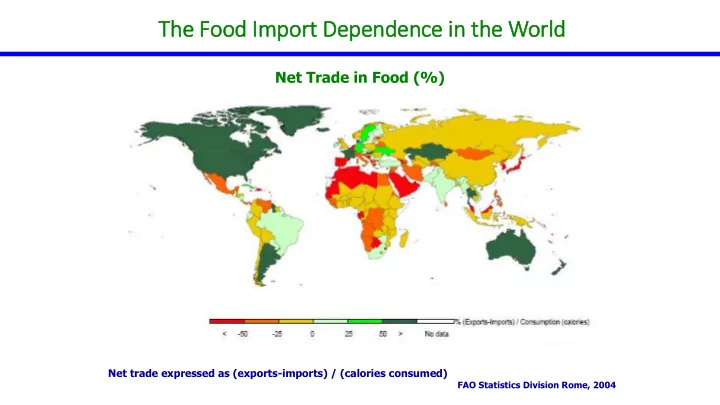
Th The Food Im Import t Dependence in in th the World Net Trade in Food (%) Net trade expressed as (exports-imports) / (calories consumed) FAO Statistics Division Rome, 2004 Food Surpluses and Deficit in Different Regions of the World Food

slide-1
SLIDE 1

Th The Food Im Import t Dependence in in th the World

Net Trade in Food (%)

Net trade expressed as (exports-imports) / (calories consumed)

FAO Statistics Division Rome, 2004

slide-2
SLIDE 2

From the Economist Online, 28 May 2012

Food Surpluses and Deficit in Different Regions of the World

Food Surplus and Deficit in Different Parts of the World

slide-3
SLIDE 3

Global Cereal Trade: Cereal imports and exports (in million MT) in different parts of the world in 2007, 2010 and 2013.

ARAB ENVIRONMENT IN 10 YEARS

slide-4
SLIDE 4
  • 10

40 90 140 190 240 1970 1980 1990 2000 2015 2030

million tonnes

East Asia South Asia Near East/North Africa (Arab countries) Latin America S.S.Africa

Historical Development Projections

Cereals imports of developing regions 1970-2030

Food insecurity in developing regions of the world

Source: FAO, 2002 World Agriculture: Towards 2015/30. http://www.fao.org/es/ESD/gstudies.htm

slide-5
SLIDE 5

Implications of the Food Crisis

Most developing countries are moving from self-reliance to self sufficiency

slide-6
SLIDE 6

Potential of Arab countries to enhance food security based on agricultural potential (renewal water resources, arable land area, soil fertility and irrigated area)

ARAB ENVIRONMENT IN 10 YEARS

slide-7
SLIDE 7

Total renewable water resources per capita (2007-2014) in Arab countries (FAO AQUASTAT, 2017)

ARAB ENVIRONMENT IN 10 YEARS

Water Poverty level

Average Per Capita Water Resources − World average: 7000 m3 − Arab world average: 813 m3 (2011) − Absolute water scarcity level: 500 m3

slide-8
SLIDE 8

Energy Water

Improving Livelihoods & National Economic Growth

Policies and Actions Finance, Governance and Innovation Drivers

  • Policies
  • Economic
  • Natural

Resources (renewal water resources)

  • Climate Change
  • Technological
  • Institutional
  • Expertise &

Labor force

  • Demographic

Impacts

  • Food &

Nutritional Security

  • Environmental

Sustainability

  • Poverty Reduction
  • Health
  • Labor Market
  • Gender Equity

Food Production

slide-9
SLIDE 9

Importance of Mountains Ecosystem to Global Environment, Food Security and Livelihoods

  • Mountains are important towers of water reservoirs that provide 70% of

world fresh water including irrigation water;

  • Mountain ecosystems are key source of different types of renewal energy

including hydropower, solar energy, wind power and biomass fuels such as wood.

  • Water streams and rivers along with the mountains altitude gradient

provide hydropower:

  • Wind flow and circulation and high solar radiation in the mountains

provide renewal sources of solar and wind energy.

slide-10
SLIDE 10

Moutains & River Basin Source: ICIMOD

Importance of Mountain Ecosystem to Water, Energy and Food Nexus