SLIDE 1
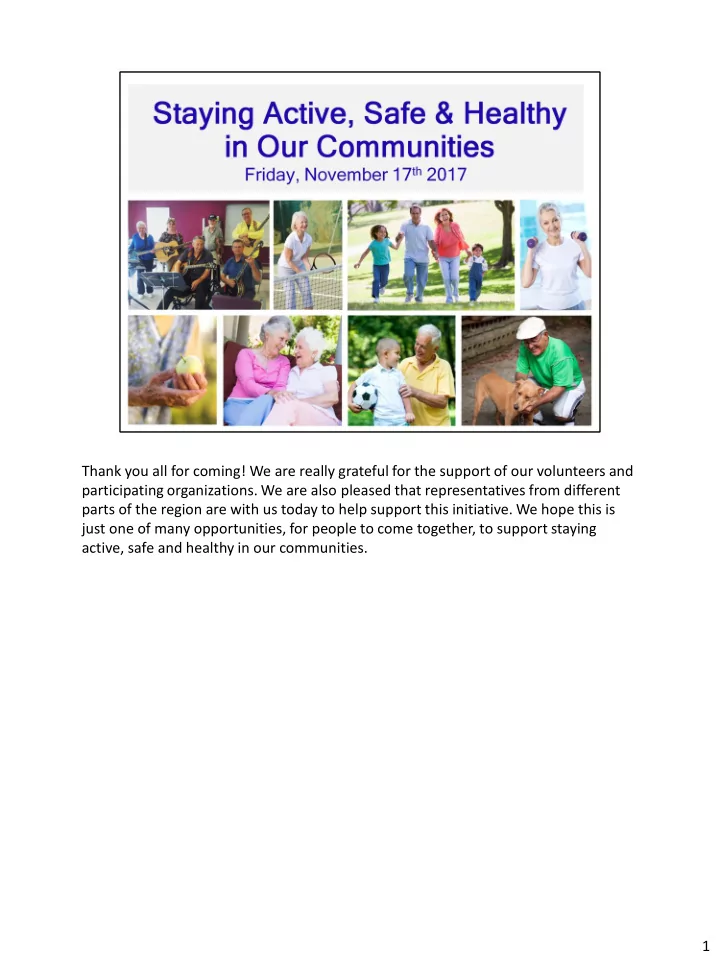
Thank you all for coming! We are really grateful for the support of our volunteers and participating organizations. We are also pleased that representatives from different parts of the region are with us today to help support this initiative. We hope this is just one of many opportunities, for people to come together, to support staying active, safe and healthy in our communities. 1
SLIDE 2 My name is Julia Miller, and I’m a Knowledge Broker here at the Centre for Studies in Aging and Health, at Providence Care Hospital. I’d like to give you a bit of background
- n who has been involved in developing, and launching this calendar and why it was
created. I am one of many members of the South East Regional Integrated Fall Prevention and Management Strategy. Together we are representatives from organizations across
- ur region, working together to reduce falls among older adults.
2
SLIDE 3
Currently our membership includes representatives from 16 different organizations who have a vested interest in preventing and managing falls in our region. The calendar is the result of efforts from our Public Awareness & Education, Engagement & Advocacy Working groups as well as representatives of the Ontario Age-Friendly Community Outreach Program. 3
SLIDE 4 The Age-Friendly Community Outreach Program is funded by the Ministry of Seniors
- Affairs. This project supports the development of partnerships, online resources, and
the creation of a network for knowledge exchange across Ontario.
- Dr. John Puxty, who is a co-chair of our Regional Falls Strategy is also a lead on this
Age-Friendly Communities project. In seeing the value of supporting fall prevention initiatives as ways to increase the age-friendliness of communities, we were able to work together to develop the calendar and share its launch with you today. For those not familiar with this concept; an age-friendly community is one where policies, services and physical spaces are designed to enable people of all ages to live in a secure and accessible physical and social environment. AFCs contribute to good health, and allow people to participate fully in society, throughout their lifetime. 4
SLIDE 5
An important component of Age-Friendly Communities, is the use of Universal Design principles, which create environments which are inclusive without accessibility appearing as an after-thought. For that reason I am so glad that we were able to host this event in this wonderful new hospital, which has incorporated so many elements which help illustrate what we hope to achieve in the development of Age-Friendly Communities. 5
SLIDE 6
Ways in which Providence Care Hospital models some of the aims of Age-Friendly Communities include its wide sidewalks with marked slopes and tactile paving to let users know that they are changing to a different surface, benches with arms for people to stop and rest when needed, large bilingual signage, ample bike parking, easily accessible outdoor fixtures which work well for people with wheelchairs, and barrier free access to the park and nature. 6
SLIDE 7
Inside Providence Care Hospital we have automatic doors, large windows and bright lights, easy to access elevators, a variety of sizes of armed chairs spaced comfortably to make getting around easier for everyone; as well as handrails and high contrast signs. 7
SLIDE 8 An important aspect of fall prevention has to do with our physical environment. By incorporating age-friendly elements such as good lighting, hand rails, doorways and spaces that accommodate mobility aids, furniture and fixtures that support a variety
- f people; We have environments that support inclusion and remove barriers to
participation, as well as reduce the risk of falls. 8
SLIDE 9
When we look at fall prevention from an Age-Friendly Communities lens, we look for partners from a variety of roles to understand the barriers that exist to preventing falls in our communities, and then work together to address them. We begin to understand ways to improve communication and awareness of risk factors, prevention strategies and related programs and services in our communities. We can begin to understand the individual, and the context of their lives, so we can better support their needs. I’d like to point out that there are no one size fits all solutions, be it for age-friendly communities or fall prevention. I find it interesting that we have learned that the best way to tackle fall prevention, is to take a multi-factorial approach, by addressing a variety, of individualized contributing factors we achieve the best outcomes. Similarly through the development of age-friendly communities, while there is a great framework for addressing the 8 domains…to be successful and sustainable, initiatives have to fit the context of each individual communities diverse needs. This means we need collaborative groups, with special skills and backgrounds, to tackle such complex work. 9
SLIDE 10 November is Fall Prevention Month and this is a big deal for our strategy members, because this is when we rally together, and try extra hard to raise awareness, and get people engaged in fall prevention activities. Our strategy co-chair, Patti Lennox of Community and Primary Health Care and strategy member, Brenda Adams of the Victorian Order of Nurses developed a fall prevention calendar a couple of years ago with the support of the South East LHIN. This was really popular and they found it to be a great way to keep fall prevention at the top of mind all year round. Our group wanted to build on that success and take it another step further by sharing even more information about resources available in our communities, to help keep
- ur older adults safe, active and healthy all year round.
There is a phrase that we like to use, and it’s that “It takes a community to prevent a fall and we all have a role to play.” 10
SLIDE 11
Often people think of a fall, as a problem of the individual. While the greatest impact is likely going to be at that individual level, the family, friends and communities of those older individuals are also impacted. By increasing awareness that falls are often a sign of a problem, fall risk factors and ways we can reduce risks of falling, we help support the quality of life of our older adults. The image on the screen is from a Heart & Stroke campaign called Make Health Last, and I thought this was a fitting way to illustrate the impact a fall can have. 11
SLIDE 12
This slides shows just some of the risk factors for falls…as you can see there are quite a few. Likely you know someone who has at least one of these risk factors. When we think about it this way, we begin to see how individual health problems, can create a public health issue. 12
SLIDE 13 In Ontario alone, falls are the leading cause of injury for those aged sixty five and
- ver. In 2010, they suffered over 100,000 emergency department visits, over 20,000
hospital admissions and more than 2000 deaths. The costs associated with these injuries were $1 billion dollars in direct costs alone. 13
SLIDE 14 Hip fractures are unfortunately a common consequence of a fall. Back in 2013, Osteoporosis Canada attempted to project the number of hip fractures, and their associated direct costs up until two thousand and thirty five. The costs shown in this table are using 2010 dollars, and put the cost of a single hip fracture at $21,439
- dollars. Many in the health care sector, would say this is significantly below the costs
for treatment today, and no one can truly estimate the cost of pain and suffering associated with these injuries. 14
SLIDE 15 These Canadian statistics reflect how significant a problems falls are. They are the leading cause of injury among older Canadians. 20 -30% of seniors experience 1 or more fall each year. Falls in older adults cause 85% of injury related hospitalizations, 95% of all hip fractures and $2 billion dollars in direct healthcare costs. Falls can result in chronic pain, reduced mobility, loss of independence and
- death. 50% of all falls that require hospitalization happen in the home.
The average older Canadian stays in hospital 10 days longer for falls than any
- ther cause and over one third of older adults ARE admitted to a long-term
care home following a hospitalization for a fall. 15
SLIDE 16
This chart looks at the number of injury deaths, hospitalizations, emergency room visits and related disability cases by cause in Canada in 2010. When we look at the numbers related to falls compared to other injuries, we see what a significant problem fall-related injuries and deaths are. 16
SLIDE 17 The Cost of Injury in Canada, 2015 report provided information regarding the economic burden of injury by cause. This chart shows the costs in millions for
- 2010. As you can see, the total costs of falls are the highest of all injuries for
that year, with a total of 8,680 million dollars. As the Canadian population ages these costs are expected to increase significantly. 17
SLIDE 18 This chart illustrates the increase in hospitalization rate by gender and age
- group. Across all ages, females are hospitalized more for fall related injuries
and as both genders age, the rates increase significantly. In the five year period between 2003 and 2008 injuries due to falls rose 43% and deaths due to falls rose 65%. As the population ages, addressing the problem of falls in Canada will become increasingly urgent. 18
SLIDE 19 When we look at the projected population pyramids, for the South East region, for the years 2016 and then 2036, we see that the in twenty years the segment of 70-80 year olds, will make up the largest age groups in our population. It is also important to consider that over the period of 2013/2014 self-reports from
- lder adults in our region, included the following conditions that can increase the risk
for falls. These self-reports found that:
- nearly half had arthritis
- just under half had high blood pressure
- roughly one in five had heart disease
- around 20% had diabetes
19
SLIDE 20
Most falls are preventable and our goal is to keep older adults on their feet, independent, aging in their own homes and communities all year round. There are many opportunities to support our goal by working with municipalities, policy makers as well as others within the health and community care sectors. The statistics just shared were not intended to promote the fear of falling but to promote the awareness of what a significant issue falls are for our society and one that we could be doing so much more again if we have more support. We hope that the calendars we are sharing will be valuable tools in helping us move forward to healthier and safer communities. If just one of these 5000 calendars, prevents 1 hip fracture, we have saved our health care system thousands of dollars and an individual, their family, friends and community a lot of unnecessary pain and struggle. 20
SLIDE 21 A 2012 survey, conducted for Revera suggested that ageism has become the most tolerated form of social discrimination in Canada. Key points from their findings include that: many older adults expressed that health care providers tended to dismiss their complaints as an inevitable part of aging. The three most common forms of ageism faced by Canadians included being ignored
- r treated like they are invisible, being treated like they have nothing to contribute
and treated as though they are incompetent. 21
SLIDE 22
As a culture, we need to revisit how we look at and talk about aging. Aging is not a disease. Betty Friedan said “ Aging is not lost youth, but a new stage of opportunity and strength.” and Cindy Joseph said “Aging is just another word for living”. 22
SLIDE 23 I do believe that aging is a privilege and a triumph, and as David Bowie put it, Aging is an extraordinary process where you become the person you always should have been.
- Dr. Samir Sinha has a great way of describing older adults; he refers to them as people
65 and better. He has been an advocate for Age-friendly Communities, and for changing the way we look at, and talk about aging in health care. 23
SLIDE 24
Older age affords an array of new opportunities, related to social freedom and power in numbers. Scilla Elworthy spoke about the gains of growing older in a culture that values speed and youth. She said “When we’re too old to be arrested, too frail to be arrested and we’re not employed so we can’t be fired, we’re the ones that can speak out.” 24
SLIDE 25 We ask you to speak out to help improve our communities, health care system and social policies. Tell us what you need, what you like and how we can do better to support your safety, health and well-being. When we help one another, everybody wins. We will be inviting people to participate in activities to inform our work. Please visit
- ur Strategies table display for more information.
I would like to now hand the floor over to our lovely co-chair Patti Lennox. 25
SLIDE 26 Thank you – the equally lovely Julia! We all know how important it is to get moving, to get active and stay active! VON and CPHC offer exercise classes of all kinds across the South East LHIN – classes designed to increase mobility, flexibility and balance. Whether it be regular fitness, gentle fit, chair exercises or specialty group classes for persons with Parkinson’s, arthritis and stroke recovery: there is something for everyone! We also provide 12 week Fall Prevention classes that combine education and
- exercise. We want to keep seniors on their feet!
And now, it’s time for you to get on yours. VON fitness instructor, Meighan is going to put you through your paces … take it away Meighan. It’s time to “bust a move”… 26
SLIDE 27
South East Regional Integrated Fall Prevention & Management Strategy email: fall.prevention@lhins.on.ca Patti Lennox 1-800-465-7646. extension 2303 http://sagelink.ca/integrated-falls-prevention-strategy-project www.fallprevention.southeasthealthline.ca 27