Thank you I - - PowerPoint PPT Presentation

thank you
SMART_READER_LITE
LIVE PREVIEW

Thank you I - - PowerPoint PPT Presentation

2015 2 2015.10.26 13 30 14 30 Thank you


slide-1
SLIDE 1

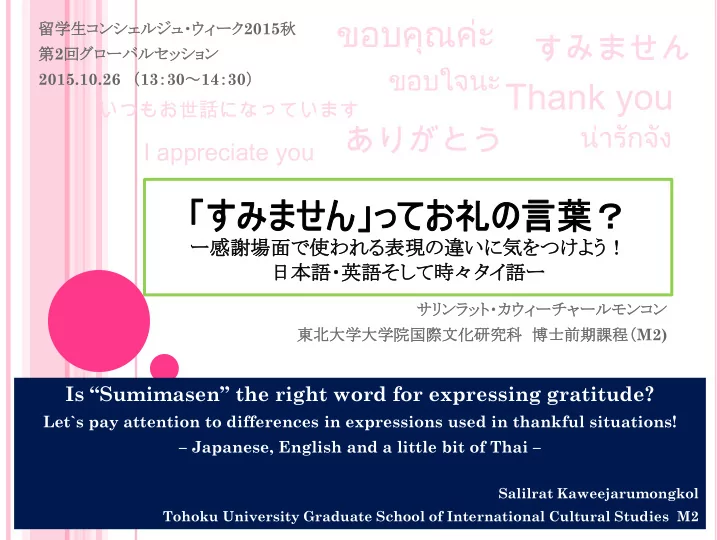
「すみません」ってお礼の言葉?

ー感謝場面で使われる表現の違いに気をつけよう! 日本語・英語そして時々タイ語ー

ขอบคุณค่ะ

น่ารักจัง

ありがとう すみません

Thank you

いつもお世話になっています

I appreciate you

ขอบใจนะ

サリンラット・カウィーチャールモンコン 東北大学大学院国際文化研究科 博士前期課程(M2) 留学生コンシェルジュ・ウィーク2015秋 第2回グローバルセッション 2015.10.26 (13:30~14:30)

Is “Sumimasen” the right word for expressing gratitude?

Let`s pay attention to differences in expressions used in thankful situations! – Japanese, English and a little bit of Thai –

Salilrat Kaweejarumongkol Tohoku University Graduate School of International Cultural Studies M2

slide-2
SLIDE 2

タイ語での自己紹介

http://www.oknation.net/blog/greenmonkey17/2015/09/21/entry-1

ฉันชื่อ......ค่ะ /ผมชื่อ......ครับ

チャン・チュー…カ /ポム・チュー…クラブ

(わたしは…です。)

ยินดีที่ได้รู้จัก ค่ะ / ครับ

インディー・ティー・ダイ・ルーチャック・カ/クラブ

(はじめまして。どうぞよろしく。)

สวัสดีค่ะ/ครับ

サワッディー・カ/クラブ

(おはよう/こんにちは/こんばんは)

How w to in introd roduc uce e your ur self lf in Thai

“Sawasdee kha / khrap. (Hello.) Chan / Phom chuu …(your name)… kha / khrap . (My name is …..) Yindee tii dai ruuchak khrap. (Nice to meet you.) “kha” and “khrap” are for being more polite. “kha” is for ladies, “khrap” is for men. “chan” and “phom” are the first personal pronoun. “chan” is for ladies, “phom” is for men.

slide-3
SLIDE 3

タイはどこ?

http://www.onleansheetmetal.com/xiaxin/alpwilvp.html

日本 タイ

Where re is Thailand nd?

Thailand is located on South East Asia. It is about 5 hours far from Japan. The local time is later than Japan for 2 hours.

slide-4
SLIDE 4

タイの国王

ラーマ9世 通称:プーミポンアドゥンラヤデート (Bhumibol Adulyadej)

https://ja.wikipedia.org/

The King of Thailand nd

The king of Thailand now is the king Bhumibol Adulyadej known as Rama IX since he is the 9th monarch of the Chakri Dynasty.

slide-5
SLIDE 5

宗教

http://www.m-culture.go.th/

仏教 Re Reli ligio ion

Most of Thai people are Buddhists but there are also Islamists or Christians.

slide-6
SLIDE 6

タイの首都は?

http://www2m.biglobe.ne.jp/ZenTech/world/map/thailand/Map- Thailand-Province.htm

BANGKOK バンコク

Ca Capital al Ci City

There are 77 provinces in Thailand and Bangkok is the capital city. Thailand has been divided into 4 major regions; North, North-east, Central, and South.

slide-7
SLIDE 7

食文化

http://kanchanapisek.or.th http://it.e- tech.ac.th/bcm3716/knowleag e7.html http://www.student.c hula.ac.th

トムヤムクン

Food

  • d Culture

ure

In the old days, Thai people ate rice by hand, but now became using spoons and forks like

  • ther countries.

The most well-known for being a representative food of Thailand is “Tom-Yam-Kung”. It is famous for its spicy taste and becomes a popular menu for both Thai people and foreigners.

slide-8
SLIDE 8

食文化

http://www.foodtravel.tv http://www.manager.co.th http://www.bloggang.co m/ http://bapada-1.blogspot.jp/2009/05/9- 800.html

Food

  • d Culture

ure

Besides using spoons and forks, when eating Thai noodles, which is called “Kuay-tiaw”, most of Thai people use spoons and chopsticks. However, some of them still using spoons and forks.

slide-9
SLIDE 9

タイ語

http://kiriusa.at.webry.info/200612/article_4.html

子音字 44字

http://thaigonavi.com

母音字 32字

http://kiriusa.at.webry.info/200612/article_4.html

声調 5つ

Thai ai langua nguage ge

The language mainly used in Thailand is Thai. There are 44 consonant letters, 32 vowels, and 5 tones. Thai words are composed of these 3 elements.

slide-10
SLIDE 10

「ワイ」 & 挨拶のことば

http://www.oknation.net/blog/greenmonkey17/2015/09/2 1/entry-1

สวัสดีค่ะ/ครับ

サワッディー・カ/クラブ

(おはよう/こんにちは/こんばんは)

ขอบคุณค่ะ/ครับ

コップ・クン・カ/クラブ

(ありがとうございます)

ขอโทษค่ะ/ครับ

コー・トーッ・カ/クラブ

(すみません)

ขอบคุณมากค่ะ/ครับ

コップ・クン・マーク・カ/クラブ

(どうもありがとうございます)

“Wai Wai” & O Other er Greeti eeting ng Expr press ession

  • ns

“Wai” is not only used for greetings, but also for expressing your gratitude and apology. The gratitude expression commonly used in Thai is “Khop-khun”, and the apology expression is “Khor-thot”. If you have a great feeling of gratitude, you can add the word “Maak” after the gratitude expression, e.g. “Khop-kun maak.”

slide-11
SLIDE 11

タイ語の挨拶のことば

ขอบคุณค่ะ/ครับ

コップ・クン・カ/クラブ

(ありがとうございます)

ไม่เป็นไรค่ะ/ ครับ

マイペンライ・カ/クラブ

(どういたしまして/大丈夫です/ 気にしないでください。)

ขอโทษค่ะ/ครับ

コー・トーッ・カ/クラブ

(すみません)

Other er Gree eeting ing Expr press essions ions

You can response to the expression “Khop-khun” and “Khor-thot” with the same expression; “Mai-pen-rai”. In contrast to Thai, in Japanese, you have to response to the expression “Arigatou” with “Douitashimashite” and to the expression “Sumimasen” with “Daijoubu desu” or “Kinishinaidekudasai”.

slide-12
SLIDE 12

感謝場面における言語行動

ありがとうございます。 すみません。

感謝 詫び

お世話になりました。 お疲れさま。

Speech ech Acts s on Grat atitu itude e Expr pressing ssing Situat ations ions

We have learned that “Arigatou” is used for expressing one’s gratitude, while “Sumimasen” has been used for apologizing. Moreover, we also learned the other gratitude expressions like “Osewaninarimashita”, “Otsukaresama”, etc. but we do not know how to use them appropriately. This is why we, as Japanese learners, always face up with the problem in inappropriate using gratitude expressions in Japanese during studying abroad in Japan.

slide-13
SLIDE 13

http://eigogakusyu-web.com/word/tango/step/

どう言います?

すみません

What at do you

  • u say?

y?

In this situation, Japanese, English, and Thai perceive it as a situation for apologizing and the expression used in this situation is, of course, an apology. Japanese “Sumimasen”, English “Sorry”, Thai “Khor-thot”.

slide-14
SLIDE 14

どう言います?

目上の人がお茶を出してくれた場面

http://www.hyoe.co.jp/blog/staff/2012/03/post- 264.html

すみません

What at do you

  • u say?

y?

(Received tea served by a superior) In this situation, although Japanese, like English and Thai, perceived as a situation for expressing gratitude, the appropriate expression for this situation is not “Arigatou” but “Sumimasen”.

slide-15
SLIDE 15

どう言います?

目上の人が奢ってくれた場面

http://www.irasutoya.com/2015/08/blog-post_390.html

すみません

What at do you

  • u say?

y?

(A superior paid a meal for you.) Like the former situation, the appropriate expression in Japanese for this situation is also “Sumimasen”, while in English and Thai are gratitude expressions, “Thank you” and “Khop-kun”, respectively.

slide-16
SLIDE 16

どう言います?

すみません。

上司が車で送ってくれた場面 『Sam Num Nua Tong』2011年放送

What at do you

  • u say?

y?

(A superior drove you to your house.) This situation is also the same as the former situations; “Sumimasen” is used for expressing thank in Japanese. Why ?

slide-17
SLIDE 17

ขอบคุณ

コップ・クン

(ありがとうございます)

ขอโทษ

コー・トーッ

(すみません)

感謝する時 謝る時 Th Thank k you. u. So Sorry. y.

ありがとうございます。 すみません。 すみません。

タイ語 英語 日本語

Summar mmary y from m thes ese e situat uations. ions.

As we have seen in the former situations, we can summarize that both English and Thai have a similar use of gratitude expressions and apology, while in Japanese “Sumimasen”, which expected to be used only for apologizing, can also be used both for thanking.

slide-18
SLIDE 18

なぜ「すみません」?

タイ語・英語 (話し手にとっての快適状況) 日本語 (相手にとっての不快状況)

「すみません」の方が丁寧

http://www.irasutoya.com/2015/08/blog- post_390.html

http://www.hyoe.co.jp/blog/staff/2012/03/post- 264.html

Why hy “Sumimasen umimasen”?

The similar point of these 3 situations is that the interlocutors are superiors. In Japanese, the language that is highly sensitive to vertical relationship (social status), it is more polite to express your uncomfortable feeling to accept something or a favor from superiors by using “Sumimasen”. On the other hand, in English and Thai, it is polite to express your delight for accepting something or a favor by using gratitude expressions though the interlocutor’s status is higher than the speaker.

相手が目上の場合

slide-19
SLIDE 19

こんな違いもあるよ!

友人からプレゼントをもらった場面

http://amanaimages.com/info/infoRM.aspx?SearchKey=02419000115

うれしい。 ありがとう。 かわいい。 ありがとう。

コップ・クン・ナ. ナーラック・チャン (ありがとう。 あなたってかわいい!!)

You read my mind!

Other er differenc erences es

Moreover, there are the other different use of expressions in gratitude expressing situations. Like this situation, receiving a gift from a close friend. In Japanese, the most frequently used expression besides “Arigatou” is “Ureshii”, expressing your delight, or “Kawaii”, complimenting the gift. On the other hand, English and Thai prefer using a compliment to the giver such as “Naa-rak chan” (lit. You’re so cute.) or “You read my mind!”, respectively.

slide-20
SLIDE 20

親しい目上の人からプレゼントをもらった場面

タイ語 (相手へのプラス評価) 日本語 (詫び表現と併用した方が丁寧)

ドラマからみると、…

コッブ・クン・カ. クンメー・ナーラック (ありがとう! お母さんって素敵!!) すみません。 ありがとう ございます。 『Panyachon-kon-krua』2012年放送

Let Let’s s have ve a lo look

  • k on TV d

dra rama. ma.

(Received a Branded gift from mother) This is the situation taken from Thai drama. In Thai, we prefer adding other functions after the ritual one,“Khop-khun”. The most frequently used one is complimenting to a giver like this example; “Khun Mae Naa-rak” (lit. Mum, you’re so cute!”) In this case, Japanese prefer using both “Arigatou” and “Sumimasen” since the use of “Sumimasen” is more polite to a superior.

slide-21
SLIDE 21

彼氏が朝ご飯を作ってくれた場面

『Sen Tai Slay Sod』2011年放送

タイ語 (相手へのプラス評価)

コッブ・クン・カ. タム・アーハーンチャーオ・ ハイ・ドゥアイ. ナーラック・ア (ありがとう! 朝食を作ってくれたの。 かわいい!!)

ドラマからみると、…

Let Let’s s have ve a lo look

  • k on TV d

dra rama. ma.

(A boyfriend prepared a breakfast and brought it to his girlfriend’s office) This situation is also taken from Thai drama. The use of compliment towards the giver like “Naa-rak chan” (lit. You’re so cute.) appeared again in this situation.

slide-22
SLIDE 22

親しい先輩からプレゼントをもらった場面 『Last Cinderella』2013年放送

日本語 (ものに対する言及)

すごい!! かわいい!!

ドラマからみると、…

Let Let’s s have ve a lo look

  • k on TV d

dra rama. ma.

(Received a sexy underwear from a close senior) This is a situation taken from Japanese drama. In this case, Japanese do not use a compliment to the giver, but prefer using “Sugoi” (lit. Wonderful), expressing one’s delight, and “Kawaii” (lit. it’s lovely.), complimenting the gift.

slide-23
SLIDE 23

主人から結婚指輪をもらった場面 『Last Cinderella』2013年放送

すごい綺麗。 ありがとう。

日本語 (ものに対する言及)

ドラマからみると、…

Let Let’s s have ve a lo look

  • k on TV d

dra rama. ma.

(Received a wedding ring from husband) This situation is also taken from Japanese drama. The expression used in this situation is also the same as the former; complimenting the gift like “Sugoi kirei” (lit. it’s really beautiful.)

slide-24
SLIDE 24

なぜ???

Why?? ???

Why there are the differences like this between Thai and Japanese

  • r even between English and Japanese?
slide-25
SLIDE 25

日本語VSタイ語・英語

コップ・クン

(ありがとうございます)

日本語 タイ語・英語

Thank ank you. u.

「ありがとうございます。 すみません。」 「すみません。」 相手へのプラス評価 (ナーラック)(lit. かわいい/素敵) ものに対する言及 (「かわいい。」/「きれい。」) 相手を喜ばせたい/ 相手との距離を縮めたい 相手に迷惑をかけたくない。/ 相手との距離をとりたい (You read my mind.) Japanese nese vs Thai and English sh

Considering the use of “Sumimasen”, “Arigatou. Sumimasen”, or an expression of complimenting a gift, the Japanese people tend to think that receiving a favor from superiors means to bother them so it is more polite to use “Sumimasen” lonely or together with “Arigatou”. All of these using acknowledge us that the Japanese view of thinking is based on a concept of taking a distance from others, which is the most influential concept in Japanese. On the other hand, English and Thai speakers tend to use compliment to please the giver. By this using, it can be supposed that they want to reduce the distance between the partner.

slide-26
SLIDE 26

日本語の決まった感謝表現をもっと見よう!

お世話になりました。 ごちそうさまでした。 お疲れさま。 清ルミ(2007)『優しい日本語:英語にできない「おかげさま」のこころ』 太陽出版 Other er formulaic rmulaic gra ratitude tude expres pressio sions ns in Japa panese nese

Besides “Arigatou” and “Sumimasen”, there are many formulaic gratitude expressions frequently used in daily life, e.g. “Osewaninarimashita”, “Gochisousamadeshita”, “Otsukaresama” etc. Most of these formulaic expressions has no direct translation in either English and Thai. In this book, there are many Japanese formulaic expressions including the above expressions. It is about how these expressions will be translated into English and also the situation used.

slide-27
SLIDE 27

日本語の決まった感謝表現をもっと見よう!

主人がいつもお世話に なっています。 Thank you for always looking after My husband. (いつも私の夫の めんどうをみてくれて ありがとうございます)

『優しい日本語』 p.73

Other er formu rmulaic aic grat atitu itude de expres pressio sions ns in Japa panese nese

In this case, the formulaic expression “Osewaninatteimasu” is used to express gratitude in Japanese, while the English translation is in the form of “Thank you for…..”. In English, it is necessary to mention about the reason of gratitude and also in Thai.

slide-28
SLIDE 28

ごちそうさまでした。 Thank you for the meal. (食事をありがとうございました。)

http://mangatop.info/sozai/jinbutuman/25 97/ http://xn-- pcksd1bza2ae0c0qse9132bkzub.jp/archives/ 6917

日本語の決まった感謝表現をもっと見よう!

Other er formu rmulaic aic grat atitu itude de expres pressio sions ns in Japa panese nese

In this case, the formulaic gratitude expression is also used; “Gochisousamadeshita”. The English translation is in the form of “Thank you for…..” again.

slide-29
SLIDE 29

おつかれさま。 Thank you for your help. / Thank you for your cooperation. (ご協力いただきまして ありがとうございます。)

http://www.ne.jp/asahi/chiba/miyanomori/info/i nfo_14.html http://www.jichiro-osaka.gr.jp/whatsnew/news_080714.html

日本語の決まった感謝表現をもっと見よう!

Other er formu rmulaic aic grat atitu itude de expres pressio sions ns in Japa panese nese

The use of a formulaic gratitude expression appeared again in this situation; “Otsukaresama”, while its English translation is in the form of “Thank you for…..” again.

slide-30
SLIDE 30

決まった表現 Thank you for …(相手の行為)..

英語(或いはタイ語)と日本語の違いは?

日本語 (省略(短い)表現が好まれる) 英語(或いはタイ語) (全て言うことが好まれる) What at are e the Differences erences? ?

In Japanese, there are many formulaic expressions used in various situations not only in the gratitude expressions. This is because Japanese prefer omitting some part of the sentence which can be expected that the hearer can understand. This can be seen from many opted sentences such as “…….. kedo (lit. but…),/ noni (lit. despite of…) / kara (lit. because….)” On the other hand, in English and Thai, you have to mention clearly about the reason for

  • thanking. If you do not so, the hearer cannot figure out why you have to thank them.
slide-31
SLIDE 31

先日はありがとうございました。 /先日はどうも。 Thank you for the

  • ther day. (????)

先日はどうも。

日本語 (相手の恩恵を覚えていることを 示すため) 英語(或いはタイ語) (その場でできるだけ自分の 感謝の気持ちを全て言う。) Se Senji jitsu tsu wa wa doumo

  • umo. (lit. Thank

ank you u for the other er day.

  • y. (*))

*))

Since Japanese prefer a short form of thanking expressions, they tend to use it more frequently than English and Thai. That is why there is the expression mentioned about the previous benefit like “Senjitsu wa doumo.” This is considered unnatural expression both in English and Thai. It is because in English and Thai, all of the feeling towards the giver or the benefit are completely mentioned at that time, so it is unnecessary to thank it again afterward.

slide-32
SLIDE 32

日本語 VS 英語 VS タイ語

http://create.t-koni.net/bn224.html

すみません。 You read my mind! うれしい! ナーラック・ チャン Thank you for you help. コップ・クン

Japa panese nese VS En Engl glish ish VS T Thai

As you saw in the slides before, different languages have different expressions for expressing gratitude though the situations are similar. This is why we have to learn what kind of expression appropriately used in that language to avoid a problem occurred when doing a cross-cultural communication.

slide-33
SLIDE 33

おまけ!

Tour urist ist Attrac actions ions in Thai ailand land

slide-34
SLIDE 34

https://sites.google.com/a/bumail.net/suwatsa- vipa/interest/thxng-theiyw-hna-rxn http://www.environnet.in.th/?p=7048 http://www.paiduaykan.com/travel/

季節

2月~5月 6月~9月 10月~1月 夏 乾季 雨季

Se Season asons in Thai ailand land

There are only 3 seasons in Thailand; hot season, rainy season, and cold season. The hot season is from February to May. The rainy season is from June to September. The cold season is from October to January.

slide-35
SLIDE 35

お寺に入る時の注意事項

http://www.dmc.tv

Do Do’s s and d Don’ts ts when en visiti ting ng temple ples

There are many things you have to pay attention to when travelling in Thailand, but the most important thing is that you ought to pay attention to the Do’s and Don’ts before entering temples because they are sacred places for Buddhists. The first one is that do not wear shorts. You should be covered down at least below your knees. Moreover, do not wear a T-shirt or shirt has no sleeves.

slide-36
SLIDE 36

注意事項

http://www.louangprabang.net

Do Do’s s and d Don’ts ts when en visiti ting ng temples ples

Besides, for women, do not touch or hand a monk something. When this is breached, a monk requires fasting to perform cleansing ritual.

slide-37
SLIDE 37

Bangkok gkok

The fist place I would like to introduce you is the capital city of Thailand, Bangkok. The transportation in Bangkok are buses, sky trains, subways, boats, taxis, motorbike-taxis, and tuktuk.

Bangkok バンコク

http://www.bangkokto urist.com/

Tuktuk (トゥクトゥク)

slide-38
SLIDE 38

バンコク

Grand Palace 王宮

http://7greens.tourismthailand.org/th/green_attraction/deta il/90

  • 先代のラーマ1世~8世までの

住まい。

  • 現在、儀式及び式典の場、

迎賓館として利用されている。

  • 王宮内には様々な建物があり、

ボロムピマン宮殿は年に一度 4月6日にだけ一般公開される。 Grand and Palac ace

The Grand Palace is a former royal residence (Rama I – Rama VIII) that is today only used on ceremonial occasions. The Borombhiman Hall inside the Grand Palace will be generally opened for visiting only on April 6th annually, the anniversary day of the Chakri Dynasty. The residence of the present King Rama IX has been moved to the Dusit Palace.

slide-39
SLIDE 39

バンコク

http://www.oknation.net http://www.manager.co.th

Wat Pho (Temple of Reclining Buddha) ワット・ポー

  • ラーマ1世によって建立 され、タイ

の最初の大学(タイ式マッサージ) として知られている。

  • 巨大な寝仏はこの寺院の見どころ。
  • タイ式のマッサージも受けられる。

Wat Pho (or r Wat Phra ra Chet etuph uphon

  • n)

It was built by Rama I and was the country’s earliest center for public education. Inside the temple, there is the 3rd largest Reclining Buddha in Thailand. Moreover, you can try on a traditional Thai message here for relaxing.

slide-40
SLIDE 40

Ayutthaya アユタヤ

Ayut utthaya haya Provi

  • vince

nce

The second place is “Phra Nakhon Si Aydhaya” province or generally called “Ayutthaya”. Since it used to be the capital city of Thailand in Ayudhaya Dynasty, there are many ruins of the old capital left in the Ayutthaya historical park.

slide-41
SLIDE 41

アユタヤ県

Wat Phra Si Sanphet ワット・プラ・シー・サンペット

https://th.wikipedia.org/

  • アユタヤの象徴である3基並

んだ仏塔。

  • アユタヤー王朝の王室守護

寺院。

  • 3基の仏塔だけ残っている。

それぞれに3人の王の遺骨 が納められる。 Wat Ph Phra ra Si Si Sa Sanphet nphet

There are the three magnificent stupas here which is considered to be the most iconic image in

  • Aytthaya. It was the city’s largest temple and was used by several kings.
slide-42
SLIDE 42

アユタヤ県

Wat Mahathat ワット・マハータート

http://travel.kapook.com/view25593.html http://travel.kapook.com/view25593.html

  • ワット・プラ・シー・サンペットと並び重要と

されている。

  • 残っているのは、木の根に取り 込まれて

しまった仏像の頭部、仏塔、頭部を落と された仏像だけ。 Unseen Thailand Wat Maha hathat hat

Wat Mahathat is one of the unseen Thailand places. It is as important as Wat Phra Si Sanphet and located on the Ayutthaya historical park. The high light of this temple and be the most photographed image in Ayutthaya is a Buddha head that lies tangled within a tree’s entwined roots.

slide-43
SLIDE 43

Samut Songkhram サムット・ソンクラーム

  • 首都のバンコクから車で1時

間ぐらい離れているところ。

Samut mut Songkhr gkhram am Prov

  • vince

ince

The last place I would like to introduce you is Samut Songkhram Province. It is the smallest province in Thailand and 1 hour far from Bangkok so it is the best place for Thai people and foreigners to visit here even on weekend.

slide-44
SLIDE 44

サムット・ソンクラーム県

Amphawa アンパワー

http://travel.sanook.com/938288/

  • 運河が道路のように使われていた古い時代のバンコクの

風景が伝える町。

  • 運河沿いにある昔のおもちゃやお菓子が売られている店

と、運河に浮かぶ多数の食堂船がこの町のみどころ。

  • 夕方ボートツアーで周辺の運河の木に集まった無数の蛍

を見ることができる。

Amphaw phawa Floati ating ng Market rket

The first tourist attraction is Amphawa floating market which usually opened on weekend and holiday. It depicts the scenery of Bangkok in the old time where canals were the main transportation route. There are many shops along both side of the riverbanks selling toys and snacks which had been selling in the old time. Besides, there are many boats selling grilled seafood, and many Thai food, etc. Moreover, There are boat tours travelling to the nearby temples in Amphawa district in the

  • evening. You may also see many fireflies along the trip.
slide-45
SLIDE 45

サムット・ソンクラーム県

http://travel.sanook.com/1261321/

Talat Maeklong (Talat Rom Hup) メークローン市場 (タラート・ロム・フップ)

https://sheshesmile.wordpress.com/

  • 鉄道線路の上で生鮮食料品や果物が

売られている市場。

  • 列車が来ると、日よけが畳み込まれる。

列車が通過すると、再び日よけが 延べられ、路線上に商品が並び、何も なかったように市場。

  • 1日3往復、6回列車が通過するたび

に折り畳まれる。

Unseen Thailand

Maeklong eklong Railway lway Market rket (Tal alat at Rom m Hup)

It is also one of the unseen Thailand tourist attractions. This market is located on the Maeklong railway in Maeklong district, a central town of Samut

  • Songkhram. There are many fresh seafood, fruits, vegetables, etc. selling in this market.

The most wonderful scene of this market is when a train comes, the merchants will enfold their sunshades, unfold again after the train has passed and continue selling like nothing happened. The train passes 6 times per day and they have to enfold and unfold the sunshades every time it passes.

slide-46
SLIDE 46

タイの観光スポット

Other er Touri urist st Attractions actions in Thail ilan and

If you are interesting in Thailand and would like to know more about Thailand’s Tourist Attractions, please go to the 『地球の歩き方コーナー』for Japanese, and the “Lonely Planet Corner” for English.

『地球の歩き方コーナー』 『Lonely Planet コーナー』

slide-47
SLIDE 47

ありがとうございました。 Thank you very much. ขอบคุณค่ะ