that a l o c a l r e p r e - s e n t a t i v e - - PDF document

that
SMART_READER_LITE
LIVE PREVIEW

that a l o c a l r e p r e - s e n t a t i v e - - PDF document

FE Review-Ethics 1. What must be proven for damages to be collected from a strict liability in tort? (A) that willful negligence caused an injury (B) that willful or unwillful negligence caused an lllJUry (C) that the manufacturer knew about a


slide-1
SLIDE 1

FE Review-Ethics 1

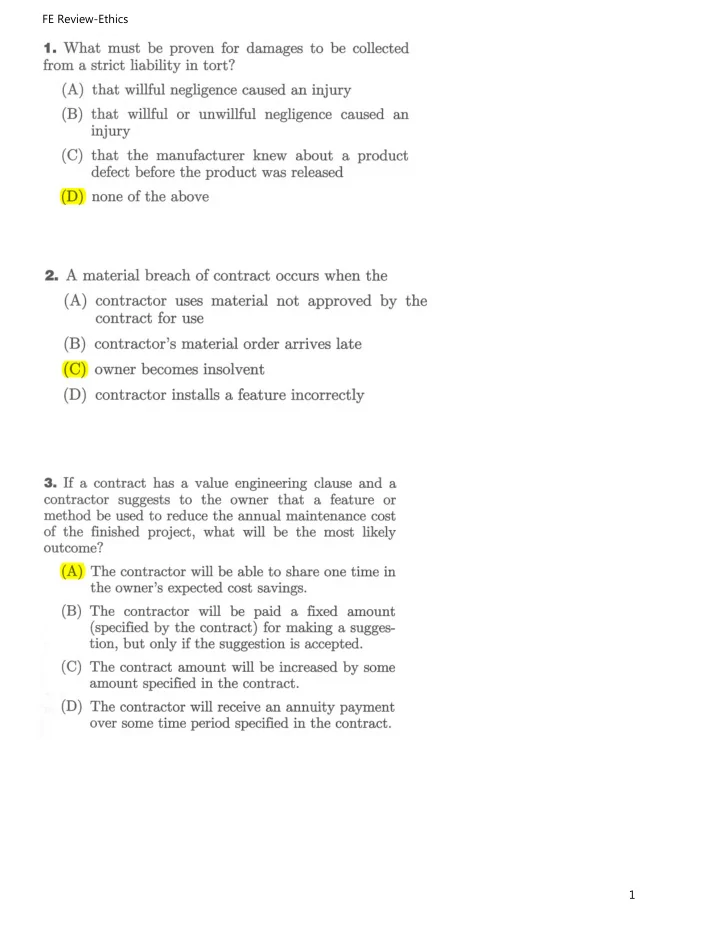
  • 1. What must be proven for damages to be collected

from a strict liability in tort? (A) that willful negligence caused an injury (B) that willful or unwillful negligence caused an lllJUry (C) that the manufacturer knew about a product defect before the product was released (D) none of the above

  • 2. A material breach of contract occurs when the

(A) contractor uses material not approved by the contract for use (B) contractor's material order arrives late ( C) owner becomes insolvent (D) contractor installs a feature incorrectly

  • 3. If a contract has a value engineering clause and a

contractor suggests to the owner that a feature or method be used to reduce the annual maintenance cost

  • f the finished project, what will be the most likely
  • utcome?

(A) The contractor will be able to share one time in the owner's expected cost savings. (B) The contractor will be paid a fixed amount (specified by the contract) for making a sugges- tion, but only if the suggestion is accepted. ( C) The contract amount will be increased by some amount specified in the contract. (D) The contractor will receive an annuity payment

  • ver some time period specified in the contract.
slide-2
SLIDE 2

FE Review-Ethics 2

  • 4. A tort is

(A) a civil wrong committed against another person (B) a section of a legal contract ( C) a legal procedure in which complaints are heard in front of an arbitrator rather than a judge or jury (D) the breach of a contract

  • 5. If a contract does not include the boilerplate clause,

"Time is of the essence," which of the following is true? (A) It is difficult to recover losses for extra hours billed. (B) Standard industry time guidelines apply. (C) Damages for delay cannot be claimed. (D) Workers need not be paid for downtime in the project.

  • 6. Which statement is true regarding the legality and

enforceability of contracts? (A) For a contract to be enforceable, it must be in writing. (B) A contract to perform illegal activity will still be enforced by a court. ( C) A contract must include a purchase order. (D) Mutual agreement of all parties must be evident.

slide-3
SLIDE 3

FE Review-Ethics 3

  • 7. Which option best describes the contractual lines of

privity between parties in a general construction contract? (A) The consulting engineer will have a contractual

  • bligation to the owner, but will not have a

contractual obligation with the general contrac- tor or the subcontractors. (B) The consulting engineer will have a contrac- tual obligation to the owner and the general contractor. ( C) The consulting engineer will have a contractual

  • bligation to the owner, general contractor, and

subcontractors. (D) The consulting engineer will have a contractual

  • bligation to the general contractor, but will not

have a contractual obligation to the owner or subcontractors.

  • 8. A contract has a value engineering clause that allows

the parties to share in improvements that reduce cost. The contractor had originally planned to transport con- crete on-site for a small pour with motorized wheelbar-

  • rows. On the day of the pour, however, a concrete pump

is available and is used, substantially reducing the con- tractor's labor cost for the day. This is an example of (A) value engineering whose benefit will be shared by both contractor and owner (B) efficient methodology whose benefit is to the. contractor only ( C) value engineering whose benefit is to the owner

  • nly

(D) cost reduction whose benefit will be shared by both contractor and laborers

slide-4
SLIDE 4

FE Review-Ethics 4

  • 9. In which of the following fee structures is a specific

sum paid to the engineer for each day spent on the project? (A) salary plus (B) per-diem fee ( C) lump-sum fee (D) cost plus fixed fee 1

  • O. What type of damages is paid when responsibility is

proven but the injury is slight or insignificant? (A) nominal (B) liquidated

(C) compensatory

(D) exemplary

  • 1. An environmental engineer with five years of experi-

ence reads a story in the daily paper about a proposal being presented to the city council to construct a new sewage treatment plant near protected wetlands. Based

  • n professional experience and the facts presented in the

newspaper, the engineer suspects the plant would be extremely harmful to the local ecosystem. Which of the following would be an acceptable course of action? (A) The engineer should contact appropriate agen- cies to get more data on the project before mak- ing a judgment. (B) The engineer should write an article for the paper's editorial page urging the council not to pass the project. ( C) The engineer should circulate a petition through the community condemning the project, and present the petition to the council. (D) The engineer should do nothing because he doesn't have enough experience in the industry to express a public opinion on the matter.

slide-5
SLIDE 5

FE Review-Ethics 5

  • 2. An engineer is consulting for a construction company

t h a t

h a s b e e n r e c e i v i n g b a d p u b l i c i t y i n t h e l

  • c

a l p a p e r s a b

  • u

t i t s w a s t e

  • h

a n d l i n g p r a c t i c e s . K n

  • w

i n g that t h i s c r i t i c i s m i s b a s e d

  • n

p u b l i c m i s p e r c e p t i

  • n

s a n d t h e p a p e r ' s thirst f

  • r

c

  • n

t r

  • v

e r s i a l s t

  • r

i e s , t h e e n g i n e e r w

  • u

l d l i k e t

  • w

r i t e a n a r t i c l e to b e printed i n t h e p a p e r ' s e d i t

  • r

i a l p a g e . What statement b e s t d e s c r i b e s t h e e n g i

  • n

e e r ' s e t h i c a l

  • b

l i g a t i

  • n

s ? ( A ) T h e e n g i n e e r ' s r e l a t i

  • n

s h i p with the c

  • m

p a n y m a k e s i t u n e t h i c a l f

  • r

him to take a n y p u b l i c a c t i

  • n
  • n

i t s b e h a l f . ( B ) The e n g i n e e r s h

  • u

l d r e q u e s t that a l

  • c

a l r e p r e

  • s

e n t a t i v e

  • f

t h e e n g i n e e r i n g r e g i s t r a t i

  • n

board r e v i e w t h e data a n d w r i t e the a r t i c l e i n

  • r

d e r that an impartial point of view be presented. ( C ) A s l

  • n

g a s the a r t i c l e i s

  • b

j e c t i v e and t r u t h f u l , a n d p r e s e n t s a l l r e l e v a n t i n f

  • r

m a t i

  • n

i n c l u d i n g the engineer's professional credentials, ethical

  • b

l i g a t i

  • n

s h a v e b e e n s a t i s f i e d . ( D ) T h e a r t i c l e must be

  • b

j e c t i v e and t r u t h f u l , p r e s e n t a l l r e l e v a n t i n f

  • r

m a t i

  • n

i n c l u d i n g

t h e

e n g i

  • n

e e r ' s p r

  • f

e s s i

  • n

a l c r e d e n t i a l s , a n d d i s c l

  • s

e a l l d e t a i l s

  • f

the e n g i n e e r ' s a f f i l i a t i

  • n

with t h e company.

slide-6
SLIDE 6

FE Review-Ethics 6

  • 3. After making a presentation for an international

project, an engineer is told by a foreign official that his company will be awarded the contract, but only if it hires the official's brother as an advisor to the project. The engineer sees this as a form of extortion and informs his boss. His boss tells him that, while it might be illegal in the United States, it is a customary and legal business practice in the foreign country. The boss impresses upon the engineer the importance of getting the project, but leaves the details up to the engineer. What should the engineer do? (A) He should hire the official's brother, but insist

that he perform some useful function for his salary.

(B) He should check with other companies doing business in the country in question, and if they routinely hire relatives of government officials to secure work, then he should do so too. ( C) He should withdraw his company from consid- eration for the project. (D) He should inform the government official that his company will not hire the official's brother as a precondition for being awarded the contract, but invite the brother to submit an application for employment with the company.

  • 4. If one is aware that a registered engineer willfully

violates a state's rule of professional conduct, one should (A) do nothing (B) report the violation to the state's engmeermg registration board ( C) report the violation to the employer (D) report the violation to the parties it affects

  • 5. Which of the following is an ethics violation specifi-

cally included in the NCEES Model Rules? (A) an engineering professor "moonlighting" as a pri- vate contractor (B) an engineer investing money in the stock of the company for which he/she works ( C) a civil engineer with little electrical experience signing the plans for an electric generator (D) none of the above

slide-7
SLIDE 7

FE Review-Ethics 7

  • 6. A senior licensed professional engineer with 30 years
  • f

experience in geotechnical engineering is placed i n charge of a multidisciplinary design team consisting of a structural group, a geotechnical group, and an envi- ronmental group. In this role, the engineer is responsible for supervising and coordinating the efforts of the groups w h e n working on large interconnected projects. I n

  • rder

t

  • facilitate coordination, designs are prepared

by the groups under the direct supervision of the group leader, and then they are s u b m i t t e d to her for review and approval. This arrangement is ethical as long as (A) the engineer signs and seals each design segment

  • nly after being fully briefed by the appropriate

group leader (B) the engineer signs and seals only t h

  • s

e design segments pertaining t

  • geotechnical engineering

( C) each design segment is signed and sealed by the licensed group leader responsible for its preparation (D) the engineer signs and seals each design segment

  • nly after it has been reviewed by an indepen-

dent consulting engineer who specializes in the field in which it pertains

  • 7. The National Society of Professional Engineers'

(NSPE) Code of Ethics addresses competitive bidding. Which of t h e following is N O T stipulated? (A) Engineers a n d their firms may refuse to bid competitively on engineering services. (B) Clients are required to seek competitive bids for design services. ( C) Federal laws governing procedures for procuring engineering services (e.g., competitive bidding) remain in full force. (D) Engineers a n d their societies may actively lobby for legislation that would prohibit competitive bidding for design services.

slide-8
SLIDE 8

FE Review-Ethics 8

  • 8. You are a city engineer in charge
  • f

receiving bids on behalf of the city council. A contractor's bid arrives w i t h t w

  • tickets to a professional foot

ball game. The bid is the lowest received. What should you do? (A) R e t u r n the tickets and accept the bid. (B) Return the tickets and reject the bid. ( C) Discard the tickets and accept the bid. (D) Discard the tickets and reject the bid.

  • 9. A relatively new engineering firm is considering run-

ning an advertisement for their services in the local

  • newspaper. An ad agency has supplied them with four
  • concepts. Of the four ad concepts, which one(

s) would be acceptable from the s t a n d p

  • i

n t

  • f professional ethics?

I. an advertisement contrasting their successes over t h e past year with their nearest competitors' failures II. an advertisement offering a free television to any-

  • ne who hires them for work valued at over

$10,000 III. an advertisement offering to beat the price of any

  • ther engineering firm for the same services

IV. an advertisement that tastefully depicts their logo against the backdrop of the Golden Gate Bridge (A) I and III (B) I, III, and IV ( C) II, III, and IV (D) neither I, II, III, nor IV

slide-9
SLIDE 9

FE Review-Ethics 9

10.

C

  • m

p l e t e the s e n t e n c e : " A p r

  • f

e s s i

  • n

a l e n g i n e e r who took the l i c e n s i n g examination in m e c h a n i c a l e n g m e e r m g ( A ) may n

  • t

d e s i g n in e l e c t r i c a l e n g i n e e r i n g . " ( B ) may d e s i g n in e l e c t r i c a l e n g i n e e r i n g if s h e f e e l s c

  • m

p e t e n t . " ( C ) may d e s i g n in e l e c t r i c a l e n g i n e e r i n g if s h e f e e l s competent and the e l e c t r i c a l portion of the d e s i g n i s i n s i g n i f i c a n t and i n c i d e n t a l

t

  • the
  • v

e r

  • a

l l j

  • b

. " ( D ) may d e s i g n i n e l e c t r i c a l e n g i n e e r i n g if another e n g i n e e r c h e c k s the e l e c t r i c a l e n g i n e e r i n g w

  • r

k . "