
SLIDE 1
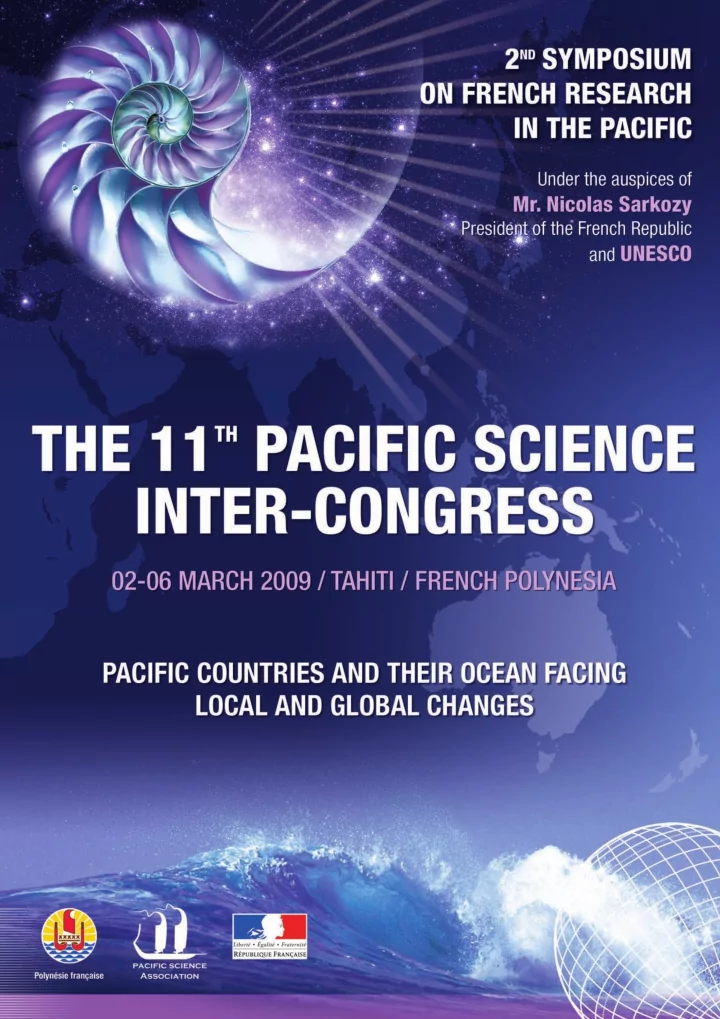
The 11 th Pacific Science Inter-Congress The Inter-Congress Theme - - PDF document
The 11 th Pacific Science Inter-Congress The Inter-Congress Theme Background Pacific Countries and Their Ocean Facing Local The 1st Symposium on French Research in the Pacific was and Global Changes held in August 2004 in Noumea, in New
“Pacific Countries and Their Ocean Facing Local and Global Changes”
The PSI2009 theme centered on current regional and international concerns, in which science can help inform policy makers and the public. The program was divided into five sub-sessions to address this theme in a way that facilitates multidisciplinary approaches that encompass scientific, human, socio-economic and cultural aspects. > Ecosystems, Biodiversity and Sustainable Development > Climate Change and Ocean Acidification > Health Challenges in the Pacific: Infectious diseases, non-communicable diseases and health workforce > Culture and Politics: The stakes of modernity > Governance and the Economy: Future challenges for the Pacific.
> Assess problems and issues related to local and global changes in countries and territories in the Pacific, and how these changes are both geographically based and inter-linked. > Gather together scientists from across the Asia-Pacific region, based on recognition that all countries and territories in the Pacific Rim and Basin face similar or linked problems. > Provide an opportunity for young scientists in the Pacific to garner important experience and take part in stimulating intellectual exchanges. > Develop productive exchanges between participants from the countries and territories in the Asia-Pacific region and the communities in French Polynesia, Wallis and Futuna and New Caledonia.
The 1st Symposium on French Research in the Pacific was held in August 2004 in Noumea, in New Caledonia. In 2007, the State of France and French Polynesia agreed to organize the 2nd Symposium on French Research in the Pacific which makes it possible to provide an international aspect to the event.
> Ministry of Foreign Affairs (through the Pacific Fund) > Ministry of Higher Education and Research > French Polynesia > Overseas Secretariat of State > Research Institute for Development
A Local Organizing Committee was established under the joint auspices of the High Commissioner of the Republic in French Polynesia and the President of French Polynesia. Special Assistants in Charge of Research and Technology in French Polynesia and in New Caledonia and the Director of the Research Delegation of French Polynesia were assigned to the Committee Secretariat.
Polynesia or her representative
representative
representative
representative
representative
representative
representatives if needed
representative
if needed
her representative
Observatoire de l’Environnement or his representative
Director or his representative
les Recifs Corralliens in French Polynesia or her representative
pour l’Exploitation de la Mer or his representative
representative
le Développement or his representative
de l’Environnement or his representative
representative
Polynesia
Technology in French Polynesia
NEXT >>
representative
representative
Minières or his representative
Scientifique or his representative
pour l’Exploitation de la Mer or his representative
Calédonie or her representative
Développement or his representative
Research and Technology in New Caledonia
Association, Chinese Academy of Science, China
Développement, Nouméa, Nouvelle-Calénie
Nouvelle-Calédonie
Recherche pour l’Exploitation de la Mer, Polynésie française
Cachan, France
la Recherche Scientifique – Université Paris 6, Villefranche-sur-mer, France
Développement, Nouméa, Nouvelle-Calédonie
Polynésie française
Développement, Nouméa, Nouvelle-Calédonie
Scientifique, Centre de Recherches Insulaires et Observatoire de l’Environnement, Polynésie française
Thailand
USA
Université de Perpignan, France
Recherche Scientifique – Ecole des Hautes Etudes en Sciences Sociales - Université de Provence, Centre de Recherche et de Documentation sur l’Océanie, France
française
Australia
Okinawa, Japan
Knowledge of centres of species richness and endemism are fundamental to strategies for conserving biodiversity and the sustainable management of natural resources; indeed, it is within this context that modern biodiversity science takes place. The already-noticeable erosion of biodiversity has altered
the economic value of biological capital and ecosystem services more salient to the public and policymakers. Bio-taxonomic knowledge of an ecosystem is an important component of both effective environmental management and to the development of biotechnology. Pacific island environments are unique because their populations are particularly subject to intense speciation mechanisms that integrate the major drivers of evolution: migration, extinction, genetic drift, and natural selection. Oceanic islands are natural laboratories of the biodiversity dynamic, and of the interaction between humans and the environment. Because of the unique importance of biodiversity in the Pacific Islands and its role in serving human needs, its protection must be integrated into the sustainable development context in the region. Biodiversity plays a critical role in the economies and societies of the Pacific islands, such as forest products, fisheries, and aquaculture (ex. pearl oysters in French Polynesia). The session has been organised around five sub-themes:
The Pacific Region is a critical one from the standpoint of climate change and variability, and stands to face some of the most severe impacts of anthropogenic climate change as atmospheric CO2 increases, sea level rises, ocean acidification intensifies, and climate warms. Climate modelling and paleoclimate reconstruction offer important and complementary tools for understanding past and future changes. Ecosystems face unprecedented challenges as the oceans become more acidic, human land-use intensifies, and extreme temperature and rainfall events become more frequent. The aim of this session was twofold:
future, in the context of the present greenhouse effect. We encourage both global and Pacific-based studies. Presentations dealing with the interaction between natural and human activities, and models of global warming and its impacts over the next century, are particularly welcome;
socio-economic implications. Studies dealing with monitoring, experimental perturbations and modelling are particularly welcome.
Moving into the 21st Century, the Asia-Pacific region faces several major public health challenges. For the region as a whole, infectious diseases still represent a major threat. The risk of emerging epidemics is high, especially for arboviruses (ex. dengue, Chikungunya, encephalitis) and
NEXT >>
pandemic influenza; non-communicable diseases also pose serious health challenges. While several efficient networks already exist to characterize epidemiological trends and detect new epidemic waves, preparedness is still an issue in the region. The Pacific Islands face specific additional concerns, including an emerging HIV/AIDS epidemic, as evidenced by a report released by the World Health Organization and the Secretariat of the Pacific Community. The current situation presents an urgent call for increased education and prevention campaigns on sexually transmitted infections, as well as better surveillance, screening and treatment. Another key challenge for “Healthy Islands” - a model proposed for the Pacific - is the increasing burden of non-communicable diseases. Lifestyle diseases such as
increasing in both adults and children. The incidence of these diseases has grown dramatically because of changes in diet and a dramatic reduction in individuals’ level of
both manage the existing problem as well as to discourage lifestyle factors that negatively impact health. Finally, the ability to protect public health depends on the presence of educated and well-trained public health professionals from the laboratory to the field. It is imperative that the Pacific region be committed to raining and educating health workers, developing networks within the international scientific community and building applied research programs designed to meet the needs of the region’s countries and territories.
Since their first face to face encounter with the West in the 16th Century, the peoples of the Pacific have been ceaselessly and actively engaged in adapting and re-shaping their societies and cultures in response to new cultural, technical and socio-political influences. The peoples of the Pacific are an integral part of global historical processes and they have succeeded, to a greater
the same time undergoing change. But at the beginning of the 21st Century, globalization introduces a new level and intensity of economic change and cultural exchanges – not just in the Pacific, but
change, many island identities and cultures are experiencing a sense of being overwhelmed. The question of cultural identity has become more acute: local languages are threatened with oblivion; development encourages the absorption of smaller ethnic groups into global or national societies; and many living traditions such as techniques and aesthetic values of material culture are neglected. In the context of policy-making in the Pacific, the critical question lies in developing new paradigms for governance which bring together a respect for certain fundamental values upon which Pacific cultures are based, while also recognizing the inevitability (and to some degree, the desirability) of social change and development. In other words, the challenge is how to manage globalization more effectively so that ethnic groups can actively participate in the development paths that are open to them. In this regard, social science brings an array of knowledge and tools that can help illuminate how to better facilitate the successful and equitable adaptation of traditional and contemporary Pacific societies to the challenges of the future.
Globalization greatly impacts the economic systems, trade agreements and relations between countries and territories
The social economic workshop considered questions related to global, regional and local interaction, under the following themes:
NEXT >>
and the resulting financial transfers between countries and territories of the region
in the Pacific
Pacific Islands
self-reliance
the Pacific area.
The Pacific Science Association (PSA) is a regional non- governmental, scholarly organization that seeks to advance science, technology, and sustainable development in and of the Asia-Pacific region, by actively promoting inter- disciplinary and international research and collaboration. PSA is composed of both national member organizations (typically National Academies of Science) and individual member scientists. The PSA Secretariat has been based at the Bishop Museum in Honolulu, Hawai’i since the
PSA facilitates interdisciplinary and international research and collaboration in the Asia-Pacific region, with a focus
engage science in the service of human needs and im- proving both the environment and quality of life of the region’s peoples. PSA serves as a catalyst for scientific and scholarly collaboration; develops scientific capacity within the region; fosters effective communication between scientists, policy makers and the public; actively involves the Pacific Island states in regional and international scientific activities; and promotes the “Science of the Pacific”. Through quadrennial Congress and Inter-Congress mee- tings and ongoing scientific Working Groups, PSA provides an interdisciplinary international platform for scientists to discuss and review common concerns and priorities in the
from developed countries with those from developing countries, including the archipelagic and more remote states of the Pacific. PSA facilitates research initiatives on critical emerging issues for the region, such as biodiversity loss, climate change and ocean acidification, emerging infectious diseases, and the social implications of globalization – issues in which science can provide crucial information required by both society and policymakers to make sound and informed decisions. PSA’s ongoing activities include:
different location every four years. Somewhat smaller and more topically focused Inter-Congress meetings are also held in between each Congress.
Science is a quarterly journal devoted to the biological, physical, and social sciences of the Pacific Region.
The National Academies Forum is the peak organisation for the four Australian learned academies: Academy of the Social Sciences in Australia, Australian Academy of Science, Australian Academy of Technological Sciences and Engineering, and Australian Academy of the
basis for cooperative activities by the four Academies and a common point of access to the Academies for outside
national vision, helping to overcome the difficulties that have often separated science, technology and engineering from the social sciences and the humanities.
http://www.cast.org.cn/ (Chinese language) The China Association for Science and Technology (CAST) is a non-profit, non-governmental organization of Chinese scientific and technological workers. As a bridge between the nation’s scientific and technological workers and the government, it is an important driving force in developing the country’s science and technology. The major tasks of CAST are: 1) to promote the advancement of science and technology by means of scientific exchanges; 2) to popu- larize scientific knowledge among the general public; 3) to safeguard the legitimate rights of scientific and tech- nological workers and organize them to participate in the political life of the state; 4) to award scientific and tech- nological workers with outstanding contributions; 5) to provide policy advice and other services to the government and the society on science- and technology-related issues so as to contribute to the nation’s economic and social development; 6) to develop cooperative relations with the international science and technology community; and 7) to conduct continued education through various training programs.
The University of Hong Kong (or HKU, as it is familiarly known to students, staff and alumni) is the oldest tertiary education institution in Hong Kong. On March 16, 1910, Sir Frederick Lugard, the then Governor of Hong Kong, laid the foundation stone for the University, signifying the birth
http://www.sinica.edu.tw/ (Chinese language) Academia Sinica was founded in Nanking on June 9, 1928. As the highest academic institution in Taiwan , Academia Sinica has two basic missions: conducting scientific re- search in its own institutes, as well as providing guidance, channels of communication, and encouragement to raising academic standards in the country. Academia Sinica has adopted various measures to promote internal integra- tion of research activities in the three research disciplines (mathematics and physical sciences; life sciences; and humanities and social sciences); to help with the planning, implementation, and evaluation of long-term projects in
harness basic research results for applications and tech- nology transfer; to engage the academic and research community within China-Taipei (Taiwan) toward a modern and forward-looking collective academic vision; to cultivate an intellectual environment that is conducive to the nurtu- ring of young scholars and the recognition of outstanding scholarship in China-Taipei; and to promote international cooperation and scholarly exchanges that will accelerate the overall development of academic research in Academia Sinica and China-Taipei.
NEXT >>
http://www.academie-sciences.fr/ (Français) The Academy of Sciences of the Institute of France brings together French scholars and forms associations with foreign scholars, where both the former and the latter are selected from among the most eminent. By their involve- ment, they contribute to the accomplishing of the missions
and durable, it encourages scientific life, and contributes to progress in the sciences and in their applications: it studies social questions associated with the development
with the involvement of other Academies, it is involved in the development of international scientific relations, nota- bly within the European Union, and in the representation abroad of research carried out in France, it monitors the quality of the teaching of the sciences and works to ensure that the products of scientific development are integrated into the culture of people of our time, it encourages the diffusion of science among the public, it diligently upholds the role and the quality of French scientific language. The Academy represents New Caledonia and French Polynesia in the PSA.
http://www.uog.edu/ The University of Guam, accredited by the Western As- sociation of Schools and Colleges, is a 4-year Land-Grant U.S. institution which offers baccalaureate and master de-
Pacific island research through its diverse research centers, e.g., Cancer Research Center, Institute for Micronesian Health and Aging Studies, Marine Laboratory, Micronesian Language Institute, Richard F. Taitano Micronesian Area Research Center, Water and Environmental Research Ins- titute of the Western Pacific, and Western Pacific Tropical Research Center. The university exists to service its learners and the communities of Guam, Micronesia and the neigh- boring regions of the Pacific and Asia.
http://www.lipi.go.id/ (Bahasa Indonesia) LIPI’s mandate is To assist the President of the Republic of Indonesia in organizing research and development, to pro- vide guidance and service in science and technology, and advise the government on national science and technology
and technology; provides guidance on the development of science and technology; encourages and develops science consciousness among the Indonesian people; encourages and develops the scientific community; develops coopera- tion with national as well as international scientific bodies; provides services relating to science and technology; and advises the government on the formulation of national policy on science and technology in the following fields: Social Science and Humanities, Natural Sciences, Enginee- ring Sciences, Scientific Infrastructure.
The Science Council of Japan, born of the firm conviction that science constitutes the foundation of culture, was established, in January 1949, for promotion and permea- tion of science in all government agencies, industries and people’s lives, as the organization to represent Japanese scientists, both in Japan and abroad and as a «special agency» under jurisdiction of the Prime Minister’s Office. In the subsequent reorganization of central government agencies in January 2001, the Council was affiliated with the Ministry of Public Management, Home Affairs, Posts and Telecommnunications. The Council, consisting of 210 representative members (term: 3 years) elected from among some 730,000 scien- tists in the country, and functioning independently, is mandated (1) to deliberate on important matters related to science and implement decisions reached and (2) to promote effective exchanges among researchers to achieve greater productivity in conducting scientific research. The Council provides counsel and recommendations when requested by the government and also has authority to
NEXT >>
government. Some of the Council’s international activities include: affiliating with various international academic institutions, sending delegations to academically important conferences
ge programs, and cosponsoring and supporting important international academic conferences in Japan.
http://www.nas.go.kr/main.php (Korean language) The National Academy of Sciences, Republic of Korea , is the Senior national organization of distinguished Korean scientists and scholars. Its primary objective is to promote learning and research in all areas of sciences by confer- ring membership and preferential treatment to those who have made outstanding contributions to the advancement
Fellows who are selected by their peers for outstanding contributions to the sciences and education. The Academy is dedicated to: fostering the highest levels of learning and research in all areas of scholarship by conferring the National Academy of Sciences Award; making available its members’ broad and varied knowledge to evaluate and advise on social, cultural, economic and scientific issues for the benefit of Korea; promoting Korean scholarship and accomplishments internationally through active exchan- ges with other national academies; and suggesting policy recommendations of the promotion of science to the national government.
MOSTI was first established in 1973 as the Ministry of Technology, Research and Local Government. As it assu- med additional responsibility as the lead agency pertaining to environmental matters, the ministry then assumed its name Ministry of Science, Technology and Environment (MOSTE) in 1976. MOSTI reached its current form after the restructuring of MOSTE following the Cabinet decision on March 27, 2004. With the new entity of MOSTI came seve- ral agencies, including the Introduction of cluster approach in February 2007 (Biotechnology, ICT, Industry, Sea to Space and S&T Services). Introduction of National Innova- tion Model 2007. Its Strategic Focus Areas have two main
chain, by increasing productivity and competitiveness in agriculture, manufacturing and services sectors; and to ge- nerate new sources of wealth in technology and knowled- ge-intensive sectors. Thrust Two is to raise the country’s capacity for knowledge, creativity and innovation and nur- ture first class mentality. Knowledge and innovation will be key determinants of Malaysia’s success as a KBE. Enhance innovation system that encourages top quality R&D and its commercialization.
The mission of the Academy of Sciences, Malaysia is the pursuit, encouragement and enhancement of excellence in the fields of science, engineering and technology, for the development of the nation and the benefit of mankind. ASM is not an adhering member of PSA, but rather this position is fulfilled by the Malaysian Ministry of Science, Technology & The Environment.
http://www.u-ryukyu.ac.jp/ ( ) The University of the Ryukyus was founded in 1950 under U.S. military control and became a Japanese national university in 1972, when Okinawa reverted to Japan. This historical background gives UR university unique characte- ristics that cannot be found in other national universities in Japan . Japanese universities are now undergoing a barrage of reforms, learning a great deal from U.S. univer-
a number of systems that other Japanese universities are now considering adopting.
NEXT >>
The Far Eastern Branch of the Russian Academy of Scien- ces (RAS-FEB). RAS-FEB contains 35 research institutions under 6 regional scientific centers (Amur Scietific Center, Kamchatka Scientific Center, Primorsky Scientific Center, Sakhalin Scientific Center, North-East Scientific Center, and Khabarovsk Scientific Center). The staff of the FEB RAS is 7,435 members, including 1,461 research staff mem- bers (13 Academicians, 20 Corresponding Members, 271 Doctors of Sciences and 1,157 Candidates of Sciences). Scientific activities are focused on studies of geology and geophysical consistent patterns of evolution and structure
velopment of scientific basis for technologies for complex processes of automation and making of expert systems, development of communication systems, evaluation of seismic and volcanic danger, fundamental research of biodiversity, evolution and ecology of the plant and animal kingdom of the Far East, study of molecular basis of struc- ture of marine biological systems, investigation of princi- ples of molecular structure of marine biological systems, investigation in molecular immunology, biotechnology,
The Singapore National Academy of Science is an umbrella
is the promotion of science and technology in Singapore. The nine scientific societies under the aegis of the Acade- my are: Institute of Physics Singapore; Singapore Associa- tion for the Advancement of Science; Singapore Institute
National Institute of Chemistry; Singapore Institute of Statistics; Singapore Society for Microbiology & Biotech- nology; Singapore Society for Biochemistry & Molecular Biology; and Science Teachers Association of Singapore. The various constituent societies play a very active role in the promotion of their respective mission objectives. Some
following: presentation of SNAS Young Scientist Awards, which was instituted in 1997 to give recognition to outs- tanding young researchers; publication of the international science journal, COSMOS, with the Editorial Board com- prising Nobel Laureates, Fellows of the Royal Society, and
nal conferences Presentation of SNAS Awards to outstan- ding university students in the various scientific disciplines; publishing of papers in international refereed journals and chapters in books of international publishers on issues
Academy is headed by Professor Leo Tan Wee Hin, Direc- tor of the National Institute of Education and Professor of Biological Sciences, Nanyang Technological University.
Based in Suva , Fiji , The University of the South Pacific (USP) is the premier provider of tertiary education in the Pacific Region, and an international centre of excellence for teaching and research on all aspects of Pacific culture and environment. Established in 1968, USP’s academic pro- grammes are recognised worldwide, attracting high calibre students and staff from throughout the Pacific Region and
Countries: Cook Islands, Fiji Islands, Kiribati, Marshall Islands, Nauru, Niue, Samoa, Solomon Islands, Tokelau, Tonga, Tuvalu, and Vanuatu.
http://www.nrct.net/ (Thai language) The National Research Council of Thailand (NRCT) was inaugurated by the National Research Council Act B.E.2502 (1959) and was designated by the Cabinet as the national body responsible for implementing research – rela- ted matters and considering proposals of the Office of the National Research Council of Thailand before forwarding them with comments to the Cabinet. The council is also assigned to give the Prime Minister comments on research issues upon requested. The NRCT is chaired by the Prime Minister, with Deputy Prime Ministers as Vice Chairmen, and Ministers and Deputy Ministers as Advisors.
NEXT >>
As the UK national academy of science founded in 1660, the Royal Society plays a crucial role as the champion of top quality science and technology. It does this by: funding top science researchers; stimulating international interac- tion through grants; producing authoritative statements and reports which provide advise government and the public on key issues in science and technology; publishing scientific journals and maintaining a richly resourced his- tory of science library and archive; devising a science com- munications programme comprising meetings, lectures, exhibitions aimed at specialists and non-specialists; pro- moting science education and awareness; and rewarding scientific excellence by electing to its Fellowship the most distinguished scientists in the UK and the Commonwealth and by awarding medals and prizes to scientists throu- ghout the world for work of distinction.
The National Academy of Sciences (NAS) is a private, non- profit, self-perpetuating society of distinguished scholars engaged in scientific and engineering research, dedicated to the furtherance of science and technology and to their use for the general welfare. Upon the authority of the charter granted to it by the Congress in 1863, the Aca- demy has a mandate that requires it to advise the federal government on scientific and technical matters. Dr. Ralph
U.S. National Committee for PSA.
With a view to improve the science and technology of Vietnam and to contribute to national development, Viet- nam Academy of Science & Technology was established as a national center for scientific research. It is the biggest scientific research institute in the country and has been in
been on research in various scientific and technological fields. The institutes of VAST include Institute of Mathematics, Institute of information Technology, Institute of Mechanics, Institute of Physics, institute of Chemistry, Institute of Bio- technology, Institute of Geography, Institute of Geophysics, Institute of Tropical Technology, Institute of Oceanography
instruments, qualified and skilled professors etc. The courses and programs of VAST are available in diffe- rent fields of science and technology. Various divisions of the institute are state owned companies, development units, Institute for Scientific Information etc. Working in collaboration with various national and international uni- versities, VAST is involved in a number of projects for the development and growth of scientific and technological research in the country.
Based at the Bishop Museum in Honolulu, Hawaii, USA, the PSA Secretariat facilitates various research initiatives relevant to the organization’s mission, liaises with national and international organizations, and carries out PSA admi- nistration tasks.
John Burke Burnett (2004 - present) In March 2004, John Burke Burnett took over the running
called, has a focus on the interface between conservation policy, biological science, and traditional communities. He has an academic background in policy, economics and an- thropology, and has worked closely with scientists, NGOs, corporate and governmental organizations, and local com- munities in the Asia-Pacific for the last 15 years. His field experience is primarily in East Asia and the Pacific with par- ticular emphasis in eastern Indonesia and New Guinea. He co-founded the Indo-Pacific Conservation Alliance (IPCA), and will remain its Executive Director. From 1995-98 he was Special Projects Coordinator [and] Japan Coordinator at Conservation International’s Asia-Pacific Program. He lived in both Japan and Indonesia for two years each, and in Washington DC for 15 years. He has strong conversatio- nal and reading knowledge of Indonesian/Malaysian and Japanese languages. Degrees: M.A., (International Eco- nomics), Johns Hopkins University - School for Advanced International Studies (SAIS); 1991. B.S., Southern Metho- dist University, 1987.
Lu Eldredge (1989 – 2004) The former Executive Secretary, L.G. Eldredge, is pursuing his interests in marine introduced species and Pacific regio- nal information at the Bishop Museum. Brenda Bishop (1948 – 1988)
Co-Chairs:
Director and Professor Seto Marine Biological Laboratory, Graduate School of Science Kyoto University Japan email: yshira@seto.kyoto-u.ac.jp
Senior Scientist Monterey Bay Aquarium Research Institute (MBARI) 7700 Sandholdt Road Moss Landing, CA 95039 USA email: brpe@mbari.org
Co-Chairs:
Department of Geography National Taiwan University Taipei , Taiwan 106 FAX 886-2-2362-2911 nora@ccms.ntu.edu.tw
Department of Anthropology University of Guam UOG Station Mangilao, Guam 96923, USA FAX 671-734-7930 stephera@uog9.uog.edu
Chair:
Laboratory of Climatic Research Institute of Atmospheric Physics Chinese Academy of Sciences P .O. Box 2718 Beijing 100080 China FAX 86-1-256-3458 fcb@tea.ac.cn
Chair:
Chair:
Director, Research Program The East-West Center 1601 East-West Road Honolulu, Hawaii 96848, U.S.A. Tel: 1-808-944-7245 Fax: 1-808-944-7399 lewisn@eastwestcenter.org
Chair:
Vice President for Sciences The Bishop Museum 1525 Bernice Street Honolulu , Hawaii 96817 USA FAX (808) 847-8252 allison@hawaii.edu
National Pintung University of Science and Technology Pintung 91207 , Taiwan choumasa@mail.npust.edu.tw
c/o Department of Botany University of Hawaii 3190 Maile Way Honolulu, Hawaii 96822, USA amdhawaii@aol.com
Forum
Pacific Basin Information Node (PBIN) 310 Ka`ahumanu Ave. Kahului, Maui, HI 96732 USA mark_fornwall@usgs.gov
NEXT >>
Chair:
Institute of Applied Sciences University of the South Pacific PO Box 1168 Suva FIJI skelton_p@usp.ac.fj Executive Secretary:
Terry J. Donaldson, Ph.D Ichthyologist University of Guam Marine Laboratory UOG Station Mangilao, Guam 96923 USA donaldsn@uguam.uog.edu
Chair:
Director National Institute of Education 1 Nanyang Walk Singapore 637616 whltan@nie.edu.sg
Chair:
Vice Chairman National Science Council, 19/F 106 Ho-Ping East Rd., Sec. 2 Taipei, Taiwan 10636 cytsay@nsc.gov.tw
Chair:
Department of Virus Morphology Institute of Virology Chinese Academy of Preventative Medical Sciences 100 Ying Xin Jie Xuan Wu Qo, Beijing 100052 China hongt@cae.cn FAX (86) 1-301- 9945
Chair:
National Natural Sciences Founda- tion of China 35 Huayuan Beilu East Gate, Haidian District Beijing 100083 China sunshu@rose.nsfc.gov.cn
Institute of Atmospheric Physics Chinese Academy of Sciences Beijing 100029, People’s Republic of China Fax: 86-10-620-45230; Email: fcb@tea.ac.cn
Director, Research Program The East-West Center 1601 East-West Road Honolulu, Hawaii 96848 USA Tel: 1-808-944-7245 Fax: 1-808-944-7399 Email: lewisn@eastwestcenter.org
Dean of the Faculty of Science University of the Ryukyus Okinawa, Japan Email: tsuchiya@sci.u-ryukyu.ac.jp
Department of Geography Faculty of Arts & Social Sciences [and] National Antarctic Research Centre University of Malaya Kuala Lumpur 50603, Malaysia Email: azizans@um.edu.my
Science Advisor to the Prime Mi- nister Central Government Building No.4(7F) 3-1-1 Kasumigaseki Chiyoda-ku Tokyo, 100-8970 Japan Tel: 81-3-3404-4981 Fax: 81-3-3404-6224 [and] Adjunct Professor The Research Center for Advanced Science and Technology (RCAST) The University of Tokyo #102, Bldg. 14 4-6-1, Komaba, Meguro-ku Tokyo,153-8904 Japan Email: kurokawa@is.icc.u-tokai. ac.jp or Kurokawa@grips.ac.jp
Director Research Center for Biodiversity China Medical University No.91 Hsueh-Shih Road Taichung 40402 China-Taipei
Fax 886-8 7740338 Email: choumasa@mail.cmu.edu.tw
man FASc Director General National Space Agency Malaysia Email: mazlan@angkasa.gov.my Email: Mazlan.OTHMAN@unvienna.
Chairman Russian Academy of Sciences - Far Eastern Branch Vladivostok, Russia Email: sergienko@hq.febras.ru
Division of Biological Sciences University of the South Pacific Suva, Fiji Email: sobey_m@usp.ac.fj
Congress in 2011 (TBA) Chair of 11th Pacific Science Inter- Congress (TBA) Contact: Dr. Pierre Mery, Dêlêga- tion rêgionale à la recherche et à la technologie en Polynesie Française Email : pierre.mery@polynesie-fran- caise.pref.gouv.fr
The Pacific Science Council was convened on the occasion
were held at the Tahiti Hilton Hotel in Papeete, Tahiti, French Polynesia on Tuesday, 3 March from 14:00 – 18:00, and on Thursday, 5 March from 12:00 – 13:30. The PSA Executive Board meetings were folded into the Council meetings. All Officers and a majority of the Ordi- nary Board Members were present. Board Members unable to attend were: Academician Valentin Sergienko (Ordinary Board Member, Russia); Dr. Mazlan Othman (Ordinary Board Member; Malaysia). Some Board Members and Officers also served as Council representatives on behalf of their national member organizations. The following persons attended the Pacific Science Council meetings as representatives of their respective Adhering
present, and thus constituted a quorum. A number of Observers (non-voting) were also present; some of them represented organizations that are already, or are conside- ring becoming, Adhering Organizations to PSA.
Board Members: Congbin Fu, President (China-Beijing) Nancy Lewis, Vice-President (USA) Makoto Tsuchiya, PSA Secretary-General (Okinawa) Azizan Abu Samah, Treasurer (Malaysia) Kiyoshi Kurokawa, PSA Past-President (Japan) Chang-Hung Chou, Ordinary Board Member (China-Taipei) Milika Sobey, Ordinary Board Member (Pacific Islands) Pierre Mery, Chair of 11th Pacific Science Inter-Congress Council Members: Congbin Fu (China-Beijing) Yingnan LIANG (China-Beijing) John Malpas (China-Hong Kong) Nora Chiang (China-Taipei) Tsu-Chang HUNG (China-Taipei) Gerard Siclet (France) Marie-Lise Chanin (France) Ann Ames (Guam) Deddy Setiapermana (Indonesia) Masaaki Morisawa (Japan) Akira Taniguchi (Japan) Tschol Su KIM (Korea) Yung Nok LEE (Korea) Ho Koon Seng (Malaysia) Makoto Tsuchiya (Okinawa) Kiyoshi Nakachi (Okinawa) Randy Thaman (Pacific Islands) Montri Chulavatnatol (Thailand) Kathie Bailey-Mathae (USA) David Schindel (USA) Peter Brewer (USA) Nguyen Gia Lap (Vietnam) Tran Duc Thanh (Vietnam) Observers/Non-Voting: Li XIE, Observer (China-Beijing) Qing TIAN, Observer (China-Beijing) Priscille (Tea) Frogier, Observer (French Polynesia) Terry Donaldson (Guam) Nasaruddin (Malaysia) Abu Bakar Salleh (Malaysia) Ahmad Zaidee Laidin (Malaysia) Judy Grindell (New Zealand) PSA Secretariat: Burke Burnett, PSA Executive Secretary Not present: Valentin Sergienko, Board Member (Russia) Mazlan Othman, Board Member (Malaysia) Australia delegation (2 slots) Peru delegation (1 slot) Russia delegation (2 slots) Singapore delegation (1 slot)
Twenty-one Pacific Science Congresses have been held since the first meeting in Honolulu in 1920. They are the principal meetings of the Pacific Science Association and are held every four years in rotating venues throughout the Asia-Pacific Rim and Basin. Though each Congress is centered on a central theme, they are broad and multi- disciplinary in scope. Pacific Science Inter-Congresses are held at four year intervals in-between Congresses. They are typically somewhat smaller in scale, and more thematically
Congresses. Congress and Inter-Congress symposia sessions are organi- zed by the host organization in close cooperation with the PSA Executive Board, Organizing Committee, and PSA Se-
tions with common goals are also key facilitating partners. The most recent Congress was held 12-19 June 2007 in Okinawa, Japan, and the most recent Inter-Congress was held 3-6 March 2009 in Tahiti, French Polynesia. The next Congress will be held in Kuala Lumpur, Malaysia in June 2011. Two awards are given during every Congress, the Herbert
gory Medal is awarded by the Board of Directors of Bishop Museum, based on distinguished research contributions in the Pacific region in one or more of the scientific discipli- nes in which the Museum is active, and on distinguished contributions to the development of institutions and
The Hatai Medal is awarded by the National Committee for PSA at the Science Council of Japan, based on distin- guished contributions to marine biology research in the Pacific.
First Pan-Pacific Scientific Conference 2 — 20 August 1920 Honolulu, Hawaii Chairman: Dr. Herbert E. Gregory, Director, Bernice P . Bis- hop Museum, Honolulu Vice-President and Secretary: Dr. Arthur L. Dean, President, University of Hawaii Second Pan-Pacific Science Congress 13 — 22 August 1923 Melbourne, Australia and 23 August — 3 September 1923 Sydney, Australia President: Sir David Orme Masson, President, Australian National Research Council and Emeritus Professor, Univer- sity of Melbourne General Secretaries: R.H. Cambage, Royal Society; Dr. A.C.D. Rivett, University of Melbourne; E.C. Andrews, Mines Department; G. Lightfoot, Commonwealth Institute
Third Pan-Pacific Science Congress 30 October — 11 November 1926 Tokyo, Japan President: Dr. Joji Sakurai, President, National Research Council of Japan and Emeritus Professor Tokyo Imperial University General Secretaries: Professors N. Yamasaki and K. Matsu- bara, Tokyo Imperial University Fourth Pacific Science Congress 16 — 25 May 1929 Batavia and Bandoeng, Java, Netherlands Indies President: Dr. O. de Vries, Director, Rubber Experiment Station of Buitenzorg and Professor of Chemistry, Medical Faculty of Batavia
NEXT >>
First General Secretary: Dr. H.J. Lam, Buitenzorg Botanical Gardens Second General Secretary: Dr. H.J.T. Bijlmer, Military Sur- geon and Anthropologist, Batavia Fifth Pacific Science Congress 1 — 4 June 1933 Victoria, British Columbia, Canada and 5 — 15 June 1933 Vancouver, British Columbia, Canada President: Dr. H.M. Tory, President National Research Council of Canada General Secretary: S.J. Cook, National Research Council of Canada Sixth Pacific Science Congress 24 July — 12 August 1939 Berkeley, Stanford, and San Francisco, California, USA President: Dr. Ross B. Harrison, Chairman, National Re- search Council Secretary-General: Dr. Roy E. Clausen, Professor of Gene- tics, University of California Seventh Pacific Science Congress 2 — 22 February 1949 Auckland and Christchurch, New Zealand President: Dr. R.A. Falla, President, Royal Society of New Zealand Secretary-General: Dr. Gilbert Archey, Director, Auckland Institute and Museum Eighth Pacific Science Congress 16 — 28 November 1953 University of the Philippines Quezon City, Philippines President: Dr. Vidal A. Tan, Chairman, National Research Council of the Philippines and President, University of the Philippines Secretary-General: Dr. Patrocinio Valenzuela, Executive Secretary, National Research Council of the Philippines Assistant Secretary-General: Dr. Alfredo C. Santos, Assis- tant Executive Secretary, National Research Council of the Philippines Ninth Pacific Science Congress 18 November — 9 December 1957 Sanitham Hall and Chulalongkorn University Bangkok, Thailand President: Air Marshall Muni M. Vejyant-Rangsrisht, Rector, Chulalongkorn University Secretary-General: Dr. Charng Ratanarat, Director General, Department of Science Tenth Pacific Science Congress 21 August — 6 September 1961 University of Hawaii Honolulu, Hawaii, USA President: Dr. Laurence H. Snyder, President, University of Hawaii Secretary-General: Harold J. Coolidge, Executive Director, Pacific Science Board Eleventh Pacific Science Congress 22 August — 10 September 1966 University of Tokyo Tokyo, Japan President: Dr. Shinichiro Tomonaga, President, Science Council of Japan Secretary-General: Dr. Yoshio Hiyama, Professor, University
Twelfth Pacific Science Congress 18 August — 3 September 1971 Australian National University Canberra, Australia President: Sir Macfarlane Burnet, Emeritus Professor of Experimental Medicine, University of Melbourne Secretary-General: Sir Otto Frankel, Senior Research Fellow, CSIRO
NEXT >>
Thirteenth Pacific Science Congress 18 — 30 August 1975 University of British Columbia Vancouver, Canada President: Dr. Ian McTaggart Cowan, University of British Columbia Secretary-General: Dr. W.S. Hoar, University of British Columbia Fourteenth Pacific Science Congress 20 August — 1 September 1979 Academy of Sciences of the USSR Khabarovsk, USSR President: Academician A.V. Sidorenko, Academy of Scien- ces of the USSR, Moscow Secretary-General: Dr. M.A. Drobyshev, Institute of Oriental Studies, Moscow Fifteenth Pacific Science Congress 1 — 11 February 1983 University of Otago Dunedin, New Zealand President: Emeritus Professor J.A.R. Miles, University of Otago Secretary-General: Professor C.F.W. Higham, Dept. of An- thropology, University of Otago Sixteenth Pacific Science Congress 20 — 30 August 1987 Hotel Lotte Seoul, Korea President: Professor Tai Whan Shin, National Academy of Science of Korea Secretary-General: Professor Choon Ho Park, Dept. of Law, University of Korea, Seoul Seventeenth Pacific Science Congress “Towards the Pacific Century: The Challenge of Change” 27 May — 2 June 1991 Sheraton Waikiki Hotel Honolulu, Hawaii, USA President: Dr. W. Donald Duckworth, Director, Bishop Museum Secretary-General: Dr. Nancy Davis Lewis, University of Hawaii Eighteenth Pacific Science Congress “Population, Resources and Environment: Prospects and Initiatives” 5 — 12 June 1995 Beijing, China Chairman: Dr. Congbin Fu, Chinese Academy of Sciences Vice-Chairman: Dr. Jingyi Liu, Chinese Academy of Scien- ces and Dr. Dianmo Li, Chinese Academy of Sciences Nineteenth Pacific Science Congress “Science for Pacific Posterity: Environments, Resources and Welfare of the Pacific Peoples” 4 — 9 July 1999 University of New South Wales Sydney, Australia President: National Academies Forum Secretary-General: Dr. Bill O’Sullivan Twentieth Pacific Science Congress “Science & Technology for Healthy Environments” 17 — 21 March 2003 Sofitel Central Plaza Bangkok Hotel Bangkok, Thailand President: Dr. Wanasri Samanasena, Deputy Secretary-Ge- neral, The National Research Council of Thailand Secretary-General: Prof. Dr. Montri Chulavatnatol Twenty-First Pacific Science Congress “Diversity and Change: Challenges and Opportunities for Managing Natural and Social Systems in the Asia-Pacific” 12 — 16 June 2007 University of the Ryukyus Okinawa, Japan
NEXT >>
Twenty-Second Pacific Science Congress «Asia-Pacific Science in the 21st Century: Meeting the Challenges of Climate Change and Globalization» 13 — 17 June 2011 Organizers: Malaysian Academy of Science; Ministry of Science, Technology, and Innovation; International Science, Technology and Innovation Centre for South-South Coo- peration (under the auspices of UNESCO); International Council for Science - Regional Office for Asia and the Pacific; Pacific Science Association Supported by: Universiti Malaya, Universiti Sains Malaysia, Universiti Kebangsaan Malaysia, Universiti Putra Malaysia Kuala Lumpur, Malaysia.
First Pacific Science Inter-Congress 5 — 9 May 1969 University of Malaya Kuala Lumpur, Malaysia President: Professor Chin Fung Kee, University of Malaya Chairman, Liaison Committee: Professor A.J. Berry, Univer- sity of Malaya Second Pacific Science Inter-Congress 20 — 26 May 1973 University of Guam Mangilao, Guam Chairman: Dr. L.G. Eldredge, University of Guam Third Pacific Science Inter-Congress 18 — 22 July 1977 Bali Beach Hotel Bali, Indonesia Chairman: Professor H. Tb. Bachtiar Rifai, Indonesian Insti- tute of Sciences Fourth Pacific Science Inter-Congress 1 — 5 September 1981 Hyatt Regency Hotel Singapore Chairman: Professor Huang Hsing Hua, National University
Fifth Pacific Science Inter-Congress 3 — 7 February 1985 The Manila Hotel Manila, Philippines Honorary Chairman: Dr. Paulo C. Campos, National Re- search Council of Philippines Chairman: Dr. Leland S. Valladolid, President, National Research Council of Philippines Sixth Pacific Science Inter-Congress 7 — 10 August 1989 Federico Santa Maria University Valparaiso, Chile Chairman: Professor Francisco Orrego Vicuña, Institute of International Studies, University of Chile, Santiago Seventh Pacific Science Inter-Congress “The Pacific: Crossroads for Culture and Nature” 27 June — 3 July 1993 Okinawa, Japan Chairperson: Dr. Keishin Sunagawa, University of the Ryukyus Secretary-General: Dr. Eiki Senaha, University of the Ryukyus Eighth Pacific Science Inter-Congress “ Islands in the Pacific Century” 13 — 19 July 1997 University of the South Pacific Suva, Fiji Secretary-General: Dr. Mahendra Kumar, University of the South Pacific
NEXT >>
Ninth Pacific Science Inter-Congress “Sustainable Development in the Pacific” 15 — 19 November 1998 Academia Sinica Taipei, China Honorary Chairman: Dr. Yuan-Tseh Lee, President, Acade- mia Sinica Co-Chairmen: Dr. Shang-Fa Yang, Dr. Kuo-Shu Yang, & Dr. Chang-Hung Chou, Academia Sinica Tenth Pacific Science Inter-Congress “The Integration of Natural and Social Sciences in the New Pacific Millennium” 1 — 6 June 2001 Hilton Guam Resort and the University of Guam Mangilao, Guam, USA Secretary-General: Joyce Camacho, University of Guam Eleventh Pacific Science Inter-Congress 3 — 6 March 2009 Hilton Tahiti Hotel Tahiti, French Polynesia Co-Chairpersons: Dr. Pierre Mery, Special Assistant in Charge of Research and Technology in French Polynesia,
Assistant in Charge of Research and Technology in New Caledonia
In the two years since the 21st Pacific Science Congress endorsed a PSA emphasis on ocean acidification as a ra- pidly emerging scientific field of critical importance to the Pacific Island nations, the topic has grown in prominence and importance. New information has emerged regarding critical new ecosystem effects for critical habitats such as coral reefs, as well as the prediction of a marked increase in oceanic dead zones. The presentation of a large number
is testimony to the strong growth of this field. The PSA therefore encourages the revitalization of the PSA Working Group on Ocean Acidification, with the goal of presenting a comprehensive account of progress in this field to policy- makers at the 2011 Congress.
PSA recognizes the rapid increase in effective cooperation in science and education between regional and internatio- nal scientific and educational institutions, international and local NGOs, regional organizations, government agencies, the private sector and local communities, and the applica- tion of this cooperation to sustainable development in the Pacific Islands. PSA also recognizes the important contribu- tion that funding entities, including international founda- tions, industry, and national aid sources, have played in these developments. PSA endorses the increasing emphasis on the application and packaging of science and education as a basis for improved education and sustainable development and conservation initiatives and for bridging the gap between the most up-to-date science and Pacific Island nations and local communities. PSA also endorses the increasing emphasis on documen- ting, conserving, and applying indigenous and traditional knowledge to local development initiatives, and on collec- ting, protecting, and promoting the conservation of threa- tened cultural plants and other biodiversity and genetic resources, which can help provide a basis for sustainable island development. PSA recognizes the importance of increased involvement
representatives in cooperative scientific and educational initiatives, with particular recognition of the increase in the representation of youth in scientific initiatives and the increased emphasis on the postgraduate training of Pacific as integral components of cooperative initiatives. The PSA recognizes the following gaps or opportunities for further increasing the effectiveness of cooperation in science and education as a basis for sustainable develop- ment in the Pacific Islands:
countries on the eastern Pacific Rim such as Chile and Ecuador that have active interests in Pacific Island scienti- fic research and education.
local researchers in scientific research and educational materials development, and on the recording of traditio- nal knowledge and its incorporation into scientific and educational initiatives and outputs.
Pacific Islands though the expansion and enhancement
increasing formal postgraduate education of Pacific Islanders, and forging strong links between Pacific Rim research organizations and their Pacific Island counter- parts.
education at the community-level and the packaging and delivery of science and educational materials and re- search outputs in ways more appropriate for use by local communities.
Invasive alien species (IAS) represent a well-known threat to native Pacific biodiversity and several sectors of the region’s civil society. Several regional organizations are
NEXT >>
already in place to facilitate regional coordination and cooperation in the taxonomy and natural history of IAS (e.g., PACINET, BioNET-INTERNATIONAL, and the University
region’s national environmental agencies (e.g., SPREP , Paci- fic Invasives Partnership); and applied scientific approaches to the monitoring and identification of IAS such as DNA barcoding (e.g., Consortium for the Barcode of Life). PSA endorses increased collaborative efforts to identify and address invasive species issues, which constitute one of the main threat to sustainable island development. PSA is well-positioned to take an active leadership role in creating synergies among these potential partners. PSA resolves to promote the creation, by the 22nd PSA Congress in 2011,
capabilities needed to implement science-based, cost-ef- fective programs for monitoring and controlling IAS in the Pacific.
PSA recognizes that taxonomy is a basic tool in addressing many practical socioeconomic challenges, such as food security, environmental protection, and public health. The Association also recognizes the significant “taxonomic impediment” to biodiversity conservation, which is the lack of trained taxonomists and research infrastructure for taxonomy. PSA recognizes the need to strengthen taxonomic and bio-informatic capacity in the region as a way of addres- sing the “taxonomic impediment” to the sustainable use
strengthen the long-term collaborations between the taxonomic research institutions and activities on Pacific islands and taxonomic initiatives around the Pacific Rim and elsewhere.
The Pacific Science Association wishes to extend its congratulations and gratitude to the Governments of France, the Government of French Polynesia for the outs- tanding success of the 11th Pacific Science Inter-Congress. In particular, the PSA Council and Executive Board wish to acknowledge the exceptional efforts of Dr. Pierre Mery, Special Assistant in Charge of Research and Technology in French Polynesia, Dr. Priscille Frogier, Director of the Research Department of French Polynesia, and Dr. Jean- Claude Angue, Special Assistant in Charge of Research and Technology in New Caledonia. The PSA Council and Executive Board also wish to thank the Session Organizers and the members of the Internatio- nal Organizing Committee, including Co-Chairs Dr. Cong- bin Fu and Dr. Fabrice Colin, as well as Bill Aalbersberg, Hamid Amir, Marie-Lise Chanin, Jean-Claude Cochard, Julie Cole, Juan Correa, Jacques Commaille, David Fielding, Jean-Pierre Gattuso, Hervé Jourdan, Nancy Lewis, Christian Montet, Claude Payri, Serge Planes, Sumonta Promboon, George Roderick, Bernard Salvat, Gérard Siclet, Serge Tche- rkezoff, Rémy Teyssou, Randy Thaman, Darrell Tryon, and Makoto Tsuchiya. PSA also extends its thanks to the Local Organizing Com- mittee, including Mr. Adolphe Colrat, the High Commis- sioner of the Republic of French Polynesia and Mr. Oscar Temaru, the President of French Polynesia. PSA recognizes and thanks the Vice-President of French Polynesia, the Minister-in-Charge of Research and Cultural Affairs, the Minister-in-Charge of Environment, the Minister-in-Charge
Minister-in-Charge of the Economy, and the Heads of the Departments of French Polynesia. Representing the Office
General Secretary, the Attaché to the General Secretary, the Windward Islands Administrator, the Chief of Staff of the High Commissioner, and the Heads of French Depart-
the University of French Polynesia and the various research institutions in French Polynesia and New Caledonia. The PSA thanks the various keynote speakers, including
Jonathan Overpeck, Dr. John Connell, Dr. Mark McGillivray,
NEXT >>
Dominique Wolton, and Dr. Pierre Jacquet. The PSA wishes to emphasize its sincere and deep thanks to the Government of France and French Polynesia, who provided the generous financial support for the Inter-Con-
young scientists, students, and Pacific Island guests at this meeting would not have been possible. We also wish to acknowledge and thank our partners at the Académie des Sciences for its critical cooperation and support, and for the success in integrating 2nd Symposium on French Research in the Pacific with the 11th Inter-Congress and thereby enhancing the success of both meetings. The PSA Council and Board recognize the hard work of a number of individuals working in the Inter-Congress Secretariat and logistics team and we thank them for their
tion of such a complex meeting such as this Inter-Congress was fundamental, and the PSA Council and Executive Board extend their thanks. The PSA thanks and congratulates the Delegation from Malaysia for its presentation on the 22nd Pacific Science
Malaysia in ensuring the success of the next Congress in Kuala Lumpur in June 2011. And finally, PSA thanks all the scientists and students who shared the fruits of their research in their presentation and poster sessions.
This event was organized by France, New Caledonia (Go- vernment and Congress), French Polynesia and Wallis and Futuna, under the aegis of the national Ministries for Re- search, for Overseas Territories and with support from the Ministry of Foreign Affairs, particularly through the Perma- nent Secretariat for the Pacific. This event was conducted
fic community of the Pacific area for he was conscious of the need for research in the Pacific to gain “the perspica- city unavoidable to reconcile the respect of the unmemora- ble inheritances and the search for modernity”. This symposium had three objectives : First of all to present a progress report on research conducted in the Pacific, it richness and diversity. In addition, to identify and formalize common research issues with the region’s countries with strengthened co-operation in mind. Lastly, to plan the development of french research in terms of the Pacific’s future needs. This first symposium was a big success, with the participa- tion of more than 400 scientists, including one large majo- rity of French. During the closing ceremony, a proposal for the organization of the second edition in French Polynesia was adopted. In direct connection with this symposium and the goals set for French research activities in the Pacific a conference was organized in October 2006, in Tahiti - French Polyne-
two issues related to the major current problems met by the countries and territories of the Pacific region. The two themes addressed were : “Natural Hazards and climate variability” and “Societies, Resources, Environment”. This event registered the participation of approximately 200 researchers and scientists and highlighted the weak inte- gration of French research in the Pacific area or at the very least a strong “Franco-French collaboration”. To ensure regional participation and give an international character to this event, France and French Polynesia pro- posed to the Pacific Science Association, which accepted it, to jointly organize the 11th Pacific Sciences Inter-congress with the 2nd Symposium of French Research in the Pacific. A topic of shared interest for PSA, French Polynesia but also the Pacific countries and territories was defined : “Pacific countries and their ocean facing local and global changes”. This topic is of first importance for any oceanic insular system of the area but also for the border countries
rect consequences of these changes. The two conferences “2nd Symposium of French Research in the Pacific” and “11th Pacific Science Inter-congress” were completely merge to lead to a single conference. French research was expressed and was presented in the different thematic sessions of the congress with all other research activities undertaken in the area. This organization allowed profitable exchanges between the French resear- chers and their colleagues of the Pacific, thus breaking the isolation of French research in the Pacific.