
SLIDE 1
The 16th World Conference of historical cities
Daisaku Kadokawa, Mayor of Kyoto City
Kyoto - a free city for international cultural exchange
~Contributing to world peace through Culture ~
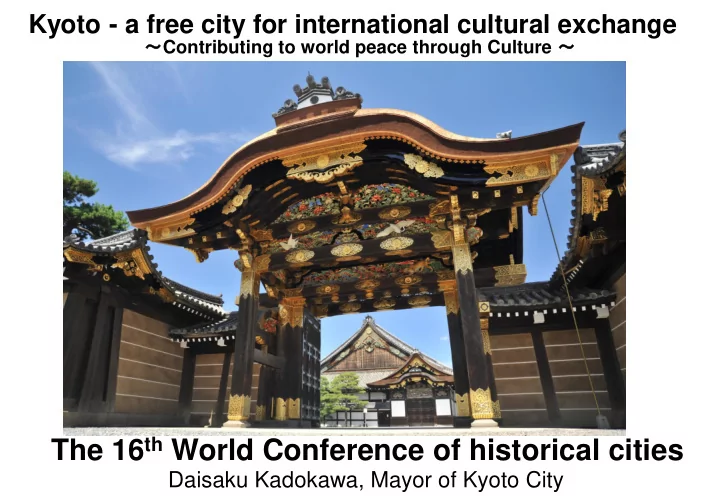
The 16 th World Conference of historical cities Daisaku Kadokawa, - - PowerPoint PPT Presentation
Kyoto - a free city for international cultural exchange Contributing to world peace through Culture The 16 th World Conference of historical cities Daisaku Kadokawa, Mayor of Kyoto City 1 The Concept of Heian-kyo Capital Creation in 794
The 16th World Conference of historical cities
Daisaku Kadokawa, Mayor of Kyoto City
Kyoto - a free city for international cultural exchange
~Contributing to world peace through Culture ~
1
Any city is in need of some ideal.
A grand vision to indicate how Kyoto must be in the 21st Century
Kyoto City Master Plan (2001~2025)
Declaration of Kyoto as a City Open to the Free Exchange of World Cultures in 1978
2
2
World Conference of Historical Cities has been held since 1987
International Research Center for Japan Studies was set up in 1987. The League of HistoricalCities was established in 1994.
Consulate General of France was moved in Kyoto in 2009.
This year marks 40th Anniversary
The 1st Chapter indicates “The Way of Life as Kyoto Citizens” Kyoto is an ancient city which has preserved old cultural heritages and scenic natural beauty for over one thousand years. We cannot, however, merely take pride in past glories, nor live isolated. We must communicate widely with the world, and through international exchanges Kyoto must be always renewed culturally and continue to create her own unique culture. It is our hope, therefore, to make Kyoto a center of international cultural exchange. A free city for international cultural exchange is one where peoples of any country may assemble freely and in peace, regardless of race, creed or social system, for the purpose of cultural exchange. We, the citizens of Kyoto, would like calmly to make this resolution and pledge our efforts towards what we can do for the realization of this ideal.
The Concept of Heian-kyo Capital Creation in 794
the capital
Religion Arts & Culture Autonomy Education Nature & Landscape
Human Rights, Multicultural Coexistence
Universities
Students are 10%
Then through the combination of unity, depth, innovation, universities, industry, culture and arts, etc. Building Communities
Environment
Kyoto Protocol
International
Declaration of Kyoto as a City Open to the Free Exchange of World Cultures
Manufacturing Spiritual Culture
Both aspects mutually stimulate and raise the succession and creation of artistic sensitivity, skill of craftspeople, and knowledge Building Human Resources
「Hitozukuri」
Food Culture Social Welfare
3
Characteristics of Kyoto City
Tourism
「Machizukuri」
Living together with nature, developing and creating for over 1,000 years Learn from History, Look at the Present and Design our Future
Innovation
74 designated traditional industries in Kyoto City
Ceramic Precision machines, Medical equipments Capacitor, etc. Semiconductor manufacturing equipment Drug development Biomedicine iPS
Content industries Advanced industries
Movies, Manga, Anime, Games, Performing Arts, etc.
Tea ceremony Incense ceremony Kyoto Cuisine Festivals Noh, Kyogen Kabuki, Japanese traditional dance Life aesthetics Lifestyle philosophy Dyed textiles Sake Textiles
Machiya townhouses Kyo- vegetables Traditional architecture Printing Food Culture
4
Altar fittings for Buddhist and Shinto Forestry Kyo-yaki and Kiyomizu-yaki Ceramics
Ikebana – Flower Arrangement
5
International City, Kyoto that draws attention from the world International Sports Events, Cultural Events, International Meetings will be held in Japan! <Sports Events/Cultural Events>
・Rugby World Cup in 2019 ・Japan Expo2020 (TBD) in 2020 ・Tokyo Olympic and Paralympic Games in 2020 ・Kansai World Masters Games in 2021 *As first attempt in Asia
<International Meetings to be held in Kyoto>
・International Panel on Climate Change (IPCC) General Meeting in May, 2019. ・International Council of Museum(ICOM) Kyoto Conference in Sep., 2019. ・UNWTO/UNESCO World Conference on Tourism and Culture in Dec., 2019. ・UN Congress on Crime Prevention and Criminal Justice in April, 2020.
A university consortium of 48 universities in and around Kyoto City City of Universities and Students In Kyoto,150,000 students study at 38 universities. There are 10,991 international students* from the world.
6
*including the number of students at Japanese language schools and vocational schools
A credit exchange system is operated with more than 400 courses available at 48 universities so that students can attend lectures at any of those universities.
Welcome package project for International Students
・Offering support for international students on their arrival in Japan (ex. Providing information on local rules for living and administration procedures)
・Local residents including Japanese student volunteers
support students from abroad!
City for Tourism - Kyoto
40.51 47.27 49.55 51.62 53.62
Wanderlust Travel Awards 2017/2018 Reader’s Choice #1 Best City
UK based travel magazine
As one of 20 cities selected in the category of World’s Most Romantic Cities 2017
#2 in 2016
US based travel magazine
Ranked in the Top 10 for 7 consecutive years
US based travel magazine
#5 in 2018
Most Attractive Cities in the World World’s Best City
Number of tourists to Kyoto
35 40 45 50 55 60
People (millions)
(Year)
50 million Annual Visitors !
30
7
City for Tourism - Kyoto
Rapid increase in number of foreign tourists staying in Kyoto
The number of foreign tourists staying in Kyoto in 2017 was tripled in 5 years 2014 3.16 1.83 1.13
8
3.18
People (millions)
3 2 1 4
2013 2015 2016 2017 3.53million
City for Tourism - Kyoto Improvement of the Acceptance Environment
Prayers spaces
https://kyoto.travel/en/muslim
9
・Visitors Host as Certified Guides by Kyoto City ・KYOTO Wi-Fi as free Wi-Fi service ・Foreigner-Friendly Taxi ・Multilingual Interpreter Service for Emergency Calls ・Expansion in number of Prayer Spaces and Certified Halal Food Restaurants ・Transmitting Information via Website for Muslim Tourists
Aiming at Secure and Comfortable City for Tourism
City for Tourism - Kyoto, where anyone will be impressed
・Clean streets. Beautiful landscape/scenery ・All temples and shrines are fantastic ・Local residents are very kind and helpful
We have given questionnaires to foreign tourists 4 times a year in total of 1700 people to measure their satisfaction level and to listen to what impressed and disappointed
・Opinions about things disappointed
・Opinions about things impressed ・Too Many Tourists ・Bus was so crowded that I could not get on it ・Need more multi-lingual guide signs <Things satisfied rated most highly in survey> “City Cleanliness”: 96.7%(*) “Temples, Shrines, Historical sites”: 96.6% “Nature/Landscape” :96.1% “Traditional Cultures”: 94.8% “Public Security”: 94.5%
* These figures indicates % of “Very Satisfied”, “Satisfied” and
“Somewhat satisfied” in the survey among tourists from abroad.
10
Subjective opinions of the tourists from abroad makes Kyoto enhance services as an international city for tourism
City Cleanliness: One of the things international tourists are most impressed with Kyoto.
cleaning activities, etc. Beauty and cleanliness is one of the things that rated most highly in the surveys among international tourists.
Item Very good Very bad Avg.
Not Experienced
7 6 5 4 3 2 1 Beauty and cleanliness of the town 63.1% 26.0% 7.8% 2.7% 0.3% 0.1% 0.0% 6.5 4.4%
96.9%
City for Tourism - Kyoto Impress tourists with cleanliness
11
Source: Kyoto Tourism Comprehensive Survey (2016)
Cleaning actions taken by all citizens towards making Kyoto one of the world’s most beautiful cities.
Giving a little consideration Kadohaki
Improving oneself through cleaning, Souji ni manabu kai
Volume of waste halved since its peak! (50% reduction)
Target at 390,000 t!
❖ Significant reduction in waste disposal costs: Reduced by 15.4 billion JPY
FY 2002 (peak): 36.7 billion JPY ➡ FY 2016: FY 21.3 billion JPY The number of incineration plants 5 plants(peak) ➡ 3 plants(current) Peak
Target
(10,000 t)
Reduce Waste by Half, Together with Residents!
82 65 50
41.3
39 20 40 60 80
2000 2006 2010 2017 2020 12
・Promoting Eco-school Districts to become involved in community-wide ecological activities ・Implementing Biodiesel Fuel Project by collecting used tempura
13
70,000 80,000 100,000
1990 1991 1992 1993 1994 1995 1996 1997 1998 1999 2000 2001 2002 2003 2004 2005 2006 2007 2008 2009 2010 2011 2012 2013 2014 2015 2016
≈
(TJ)
90,000
Energy consumption in FY 2016 (Kyoto City area) decreased by 27% from its peak
(FY 1997)
Energy Conservation with Residents &
Businesses United
Compared to 1990 By FY 2010: 15% reduction Target achieved! By FY 2016: 3.9% reduction (2.8% increase for all of Japan in FY 2016)
Greenhouse gas emissions (in Kyoto City) 27% reduction
Peak
Switch from Car-Centric Society to a Society Prioritizing People and Public Transport
14
28,3% 21,8%
22,6% 29,1%
15% 20% 25% 30%
自動車 鉄道・バス
2000 2017
Pedestrian Friendly City, Kyoto: giving priority to pedestrians and public transportation
Percentage of people visiting Kyoto by private car Share ratio of transportation Automobiles Railway,bus 0% 10% 20% 30% 40%
1994 2017
41. 7%
8. 7%
Establishment of “Pedestrian Friendly City, Kyoto" Charter in Jan., 2010. Development of comprehensive “Pedestrian Friendly City, Kyoto" transportation strategy with 94 policies! ・Developing attractive city for people in leading roles ・Improving convenience of public transport
Kyoto Declaration for Cultivating a Culture of Sustainable Cities
At the Kyoto Conference on the Global Environment 2017(KYOTO+20) in December 2017,.
Kyoto Declaration
aiming for the Formulation of Sustainable Urban
Cultures in balance with environment was announced
Increased importance of cities role
to implement measures against climate change
・Coexistence with nature is realized ・Resource-efficient and circular economy is realized ・Change in people’s value and lifestyle ・Energy autonomy of cities is realized ・Raising Leaders for building a sustainable society ・Urban mobility with low environmental impact is realized ・Strategies for adapting to the impacts of climate change are in place with Technology Innovation ・Peaceful resolution of social problems is well advanced through efforts to shift to a sustainable society
Vision for cities of the world in 2050 outlined in the Kyoto Declaration
Triggered by IPCC 49th General Assembly (Kyoto City, May 2019),Kyoto City publicize
about the environment to citizens etc.
15
Over-population in Urban Cities
(half of the world’s population live on 2% of land area)
A large source of Greenhouse gas emission
(accounting for 75% of global carbon emission)
45m→31m, 31m→15m, etc.
Creation of standards for building design in each area, including roof color,
Establishing vistas in order to preserve the symbolic views
All rooftop and flashing signboards are prohibited, and there are restrictions on color and size for outdoor advertisements
Designation system for the historical landscape and traditional buildings, Subsidy system for the repairs of the appearance of traditional buildings and for the restores of the historical landscape 16 30,213 spots removed and corrected
Polishing the beauty of Kyoto, imparting it to posterity, and transmitting it to the world
New Landscape Policy - Enact and Enforce Six Ordinances
17
Preserving the beautiful scenery of Kyoto 100 years into the future
18
・ Selected by the Rockefeller Foundation as one of 100 Resilient Cities in May 2016 ・ Advancing the world’s highest level of city planning for a safe, secure and resilient city Advancing the development of the Kyoto City Resilience Strategy
Building a Disaster-resistant, Sustainable, Safe and Secure City
18
Initiatives to be Resilient City Initiatives for SDGs*
*Adopted at UN General Assembly in Sep., 2015.
Common goals to achieve in cooperation with the whole international society by 2030 to develop a balanced society in economy and environment which is sustainable and mutually equal. By the encouragement in raising awareness, cooperation among various subjects will be reinforced and SDGs as goals for everyone will be achieved. (Integrated with initiatives of Resilient City)
What is “Resilient City”? It is the city that aims to be a stronger, more flexible to recover as quickly as possible, preparing for following events; Shock - Events that occur suddenly, such as natural disasters and cyber attacks, and cause major damages Stress - Events that affect the cities by continuing for a long period of time, such as a declining population and a dilution of the local community
(Kyoto City Official Travel Guide) https://kyoto.travel/en