The 3-pound universe we live in Cerebrum/Cerebral Cortex Thalamus - - PDF document

the 3 pound universe we live in
SMART_READER_LITE
LIVE PREVIEW

The 3-pound universe we live in Cerebrum/Cerebral Cortex Thalamus - - PDF document

CSE 473 Guest Lecture (Raj Rao): Neural Networks Outline: The 3-pound universe Those gray cells Input-Output transformation in neurons Modeling neurons Neural Networks Learning Networks Applications Corresponds


slide-1
SLIDE 1

1

  • R. Rao: Neural Networks

CSE 473 Guest Lecture (Raj Rao): Neural Networks

✦ Outline:

➭ The 3-pound universe ➭ Those gray cells… ➭ Input-Output transformation in neurons ➭ Modeling neurons ➭ Neural Networks ➭ Learning Networks ➭ Applications

✦ Corresponds to Chapter 19 in Russell and Norvig

2

  • R. Rao: Neural Networks

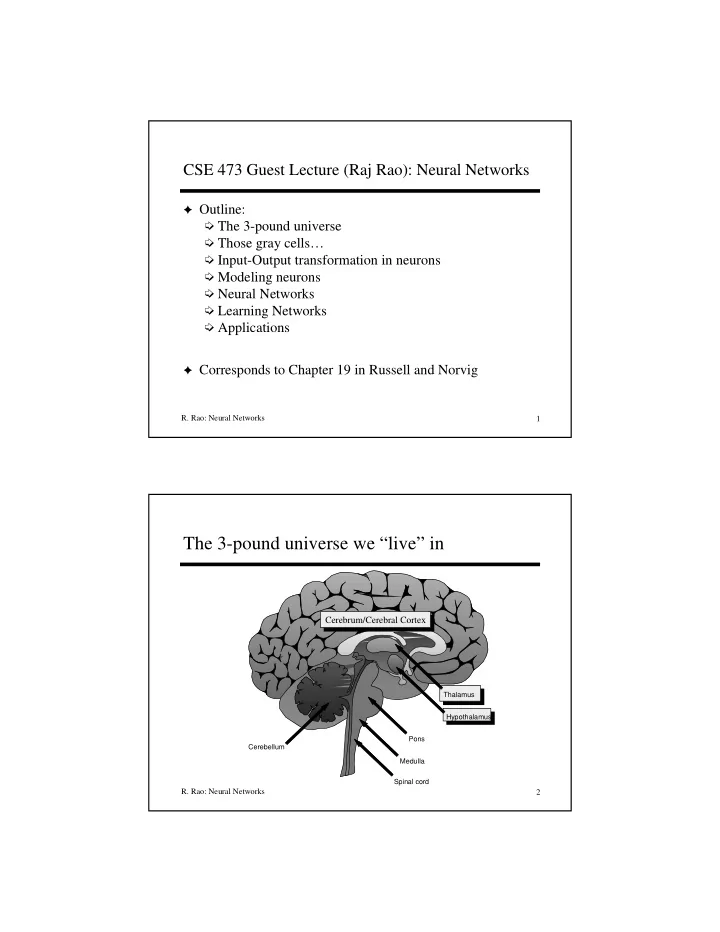
The 3-pound universe we “live” in

Thalamus Hypothalamus Pons Medulla Spinal cord Cerebellum

Cerebrum/Cerebral Cortex

slide-2
SLIDE 2

3

  • R. Rao: Neural Networks

Those gray cells…Neurons

From Kandel, Schwartz, Jessel, Principles of Neural Science, 3rd edn., 1991, pg. 21

4

  • R. Rao: Neural Networks

Basic Input-Output Transformation in a Neuron

Input Spikes Output Spike (Excitatory Post-Synaptic Potential)

Spike (= a brief pulse)

slide-3
SLIDE 3

5

  • R. Rao: Neural Networks

Communication between neurons: Synapses

✦ Synapses: Connections between

neurons

➭ Electrical synapses (gap junctions) ➭ Chemical synapses (use neurotransmitters) ✦ Synapses can be excitatory or

inhibitory

✦ Synapses are integral to memory

and learning

6

  • R. Rao: Neural Networks

Distribution of synapses on a real neuron…

slide-4
SLIDE 4

7

  • R. Rao: Neural Networks

McCulloch–Pitts artificial “neuron” (1943)

✦ Attributes of artificial neuron:

➭ m binary inputs and 1 output (0 or 1) ➭ Synaptic weights wij ➭ Threshold µi Inputs Output Weighted Sum Threshold Θ(x) = 1 if x ≥ 0 and 0 if x < 0

n t w n t

i ij j j i

+ ( ) = ( ) −

L N M O Q P

1 Θ µ

8

  • R. Rao: Neural Networks

Properties of Artificial Neural Networks

High level abstraction of neural input-output transformation:

Inputs ! weighted sum of inputs ! nonlinear function ! output

Often used where data or functions are uncertain

➭ Goal is to learn from a set of training data ➭ And generalize from learned instances to new unseen data

Key attributes:

  • 1. Massively parallel computation
  • 2. Distributed representation and storage of data (in the synaptic

weights and activities of neurons)

  • 3. Learning (networks adapt themselves to solve a problem)
  • 4. Fault tolerance (insensitive to component failures)
slide-5
SLIDE 5

9

  • R. Rao: Neural Networks

Topologies of Neural Networks

completely connected feedforward (directed, acyclic) recurrent (feedback connections)

10

  • R. Rao: Neural Networks

Networks Types

✦ Feedforward versus recurrent networks

➭ Feedforward: No loops, input ! hidden layers ! output ➭ Recurrent: Use feedback (positive or negative)

✦ Continuous versus spiking

➭ Continuous networks model mean spike rate (firing rate)

✦ Supervised versus unsupervised learning

➭ Supervised networks use a “teacher”

➧ Desired output for each input is provided by user

➭ Unsupervised networks find hidden statistical patterns in input data

➧ Clustering, principal component analysis, etc.

slide-6
SLIDE 6

11

  • R. Rao: Neural Networks

Perceptrons

✦ Fancy name for a type of layered feedforward networks ✦ Uses McCulloch-Pitts type neuron: ✦ Output of neuron is 1 if and only if weighted

sum of inputs is greater than 0: Θ(x) = 1 if x ≥ 0 and 0 if x < 0 (a “step” function) Output w

i ij j j

= L

N M M O Q P P

Θ ξ

Multilayer Single-layer

12

  • R. Rao: Neural Networks

Computational Power of Perceptrons

✦ Consider a single-layer perceptron ➭ Assume threshold units ➭ Assume binary inputs and outputs ➭ Weighted sum forms a linear hyperplane ✦ Consider a single output network with two inputs ➭ Only functions that are linearly separable can be computed ➭ Example: AND is linearly separable: a AND b = 1 iff a = 1 and b = 1

wij

j j

ξ

= 0

ξ o = −1

Linear hyperplane

slide-7
SLIDE 7

13

  • R. Rao: Neural Networks

Linear inseparability

✦ Single-layer perceptron with threshold units fails if problem

is not linearly separable

➭ Example: XOR ➭ a XOR b = 1 iff (a=0,b=1) or (a=1,b=0) ➭ No single line can separate the “yes”

  • utputs from the “no” outputs!

✦ Minsky and Papert’s book

showing such negative results was very influential – essentially killed neural networks research for over a decade!

14

  • R. Rao: Neural Networks

Solution in 1980s: Multilayer perceptrons

✦ Removes many limitations of single-layer networks ➭ Can solve XOR ✦ Two examples of two-layer perceptrons that compute XOR ✦ E.g. Right side network ➭ Output is 1 if and only if x + y – 2(x + y – 1.5 > 0) – 0.5 > 0

x y

slide-8
SLIDE 8

15

  • R. Rao: Neural Networks

Multilayer Perceptron

Input nodes Output neurons

}

One or more layers of hidden units (hidden layers)

a

e a g

β −

+ = 1 1 ) (

a

Ψ(a) 1

The most common activation functions: Step function Θ or Sigmoid function: (non-linear “squashing” function)

g(a) g(a)

16

  • R. Rao: Neural Networks

x y

  • ut

x y 1 1 2 1 2

2 1

1 1 − 1 − 2 1 − 1 − 1

2 1 −

?

Example: Perceptrons as Constraint Satisfaction Networks

slide-9
SLIDE 9

17

  • R. Rao: Neural Networks

x y

  • ut

x y 1 1 2 1 2

2 1 1 > − + y x 2 1 1 < − + y x

=0 =1

2 1

1 1 −

Example: Perceptrons as Constraint Satisfaction Networks

18

  • R. Rao: Neural Networks

x y

  • ut

x y 1 1 2 1 2

2 > − − y x 2 < − − y x

=0 =0 =1 =1

1 − 2 1 −

Example: Perceptrons as Constraint Satisfaction Networks

slide-10
SLIDE 10

19

  • R. Rao: Neural Networks

x y

  • ut

x y 1 1 2 1 2 =0 =0 =1 =1

1 − 1

2 1 −

  • 2

1 −

>0

Example: Perceptrons as Constraint Satisfaction Networks

20

  • R. Rao: Neural Networks

x y

  • ut

x y 1 1 2 1 2

2 < − − y x 2 1 1 > − + y x

=0 =0 =1 =1

2 1

1 1 − 1 − 2 1 − 1 − 1

2 1 −

Perceptrons as Constraint Satisfaction Networks

slide-11
SLIDE 11

21

  • R. Rao: Neural Networks

Learning networks

✦ We want networks that can adapt themselves ➭ Given input data, minimize errors between network’s

  • utput and actual output by changing weights (supervised

learning) ➭ Can generalize from learned data to predict new outputs

Can this network adapt its weights to solve a problem? How do we train it?

22

  • R. Rao: Neural Networks

Gradient-descent learning (a la Hill-climbing)

✦ Use a differentiable activation function

➭ Try a continuous function f ( ) instead of step function Θ( )

➧ First guess: Use a linear unit

➭ Define an error function (cost function or “energy” function)

✦ Changes weights in the direction of smaller errors

➭ Minimizes the mean-squared error over input patterns µ ➭ Called Delta rule = Widrow-Hoff rule = LMS rule

E Y w

i u ij j j u i

= −

L N M M O Q P P

∑ ∑ ∑

1 2

2

ξ Then ∆w E w Y w

ij ij i u ij j j u j

=− = −

L N M M O Q P P

∂ ∂

∑ ∑

η η ξ ξ

Cost function measures the network’s squared errors as a differentiable function

  • f the weights
slide-12
SLIDE 12

23

  • R. Rao: Neural Networks

Learning via Backpropagation of Errors

✦ Backpropagation is just gradient-descent learning for

multilayer feedforward networks

✦ Use a nonlinear, differentiable activation function

➭ Such as a sigmoid:

✦ Result: Can propagate credit/blame back to internal nodes

➭ Change in weights for output layer is similar to Delta rule ➭ Chain rule (calculus) gives ∆wij for internal “hidden” nodes

f h h wij

j j

≡ + − ≡∑ 1 1 2 exp η ξ

a f

where

24

  • R. Rao: Neural Networks

Backpropagation

Vj

slide-13
SLIDE 13

25

  • R. Rao: Neural Networks

Backpropagation (for Math lovers’ eyes only!)

✦ Let Ai be the activation (weighted sum of inputs) of neuron i ✦ Let Vj = g(Aj) be output of hidden unit j ✦ Learning rule for hidden-output connection weights: ➭ ∆Wij = -η∂Ε/∂Wij = η Σµ [di – ai] g’(Ai) Vj = η Σµ δi Vj ✦ Learning rule for input-hidden connection weights: ➭ ∆wjk = -η ∂Ε/∂wjk = -η (∂Ε/∂Vj ) (∂Vj/∂wjk ) {chain rule} =η Σµ,ι ([di – ai] g’(Ai) Wij) (g’ (Aj) ξk) = η Σµ δj ξk

26

  • R. Rao: Neural Networks

Hopfield networks (example of recurrent nets)

✦ Act as “autoassociative” memories to store patterns

➭ McCulloch-Pitts neurons with outputs -1 or 1, and threshold Θ ➭ All neurons connected to each other

➧ Symmetric weights (wij = wji) and wii = 0

➭ Asynchronous updating of outputs

➧ Let si be the state of unit i ➧ At each time step, pick a random unit ➧ Set si to 1 if Σj wij sj ≥ µi; otherwise, set si to -1

completely connected

slide-14
SLIDE 14

27

  • R. Rao: Neural Networks

Hopfield networks

✦ Network converges to cost function’s local minima which

store different patterns

✦ Store p N-dimensional pattern vectors x1, …, xp using a

“Hebbian” learning rule:

➭ wji = 1/N Σm=1,..,p x m,j x m,i for all j ≠ i; 0 for j = i ➭ W = 1/N Σm=1,..,p x m x mT (outer product of vectors; diagonal zero)

➧ T denotes vector transpose

x4 x1

28

  • R. Rao: Neural Networks

Pattern Completion in a Hopfield Network

! Local minimum (“attractor”) of cost (or “energy”) function stores pattern Network converges from here to here

slide-15
SLIDE 15

29

  • R. Rao: Neural Networks

Recent Trends and Applications of Neural Networks

✦ Recent Trends ➭ Probabilistic approach: NNs as Bayesian networks (allows principled derivation of dynamics, learning rules, and even network structure) ➭ Not-so-artificial networks: Make network more biologically realistic ➭ NNs in Hardware: Ultra-fast implementation of large learning networks in silicon ✦ Applications ➭ Text to speech generation (NETtalk by Sejnowski & Rosenberg) ➭ Handwritten character recognition (zip codes on envelopes) ➭ Autonomous driving (ALVINN at CMU – uses backprop network) ➭ Control of other physical systems

➧ Demos! (by Keith Grochow, as part of CSE 599, 2001)

30

  • R. Rao: Neural Networks

Demos

✦ Neural Network learns to balance a pole on a cart

➭ System:

➭ 4 state variables: xcart, vcart, θpole, vpole ➭ 1 input: Force on cart

➭ Backprop Network:

➭ Input: State variables ➭ Output: New force on cart ✦ NN learns to back a truck into a loading dock

➭ System (Nyugen and Widrow, 1989):

➭ State variables: xcab, ycab, θcab ➭ 1 input: new θsteering

➭ Backprop Network:

➭ Input: State variables ➭ Output: Force on cart xcart vcart vpole θpole