The Age of Healthcare Consumerisation : Wearables, Health Apps, - - PowerPoint PPT Presentation

the age of healthcare
SMART_READER_LITE
LIVE PREVIEW

The Age of Healthcare Consumerisation : Wearables, Health Apps, - - PowerPoint PPT Presentation

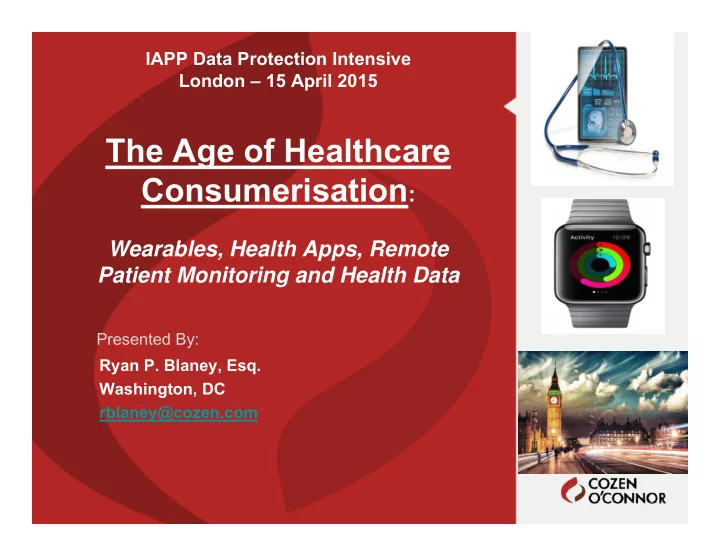
IAPP Data Protection Intensive London 15 April 2015 The Age of Healthcare Consumerisation : Wearables, Health Apps, Remote Patient Monitoring and Health Data Presented By: Ryan P. Blaney, Esq. Washington, DC rblaney@cozen.com Agenda


slide-1
SLIDE 1

Presented By:

IAPP Data Protection Intensive London – 15 April 2015

The Age of Healthcare Consumerisation:

Wearables, Health Apps, Remote Patient Monitoring and Health Data

Ryan P. Blaney, Esq. Washington, DC rblaney@cozen.com
slide-2
SLIDE 2
slide-3
SLIDE 3

Agenda

  • “Uberification” of Healthcare

– The Healthcare Internet of Things (IoT)

  • Regulatory Guidance and Trends
  • Unique Privacy & Security Concerns in the Age of

Healthcare Consumerisation

  • Privacy Considerations for International

Companies Investing and Doing Business with U.S. Healthcare Companies

3

slide-4
SLIDE 4

Uberification of Healthcare

4

  • Uber’s Goal – “to make transportation of

people easier and more efficient.”

  • On Demand Mobile Services (ODMS)
  • “Making getting care easier”
  • 1. Big Data and Personalized Medicine
  • 2. Telemedicine
  • 3. Remote Patient Monitoring
  • 4. Healthcare Apps
slide-5
SLIDE 5

Big Data and Personalized Medicine

“[Genome Science] will revolutionize the diagnosis, prevention and treatment of most, if not all, human diseases.” Do you know when and who???

5

slide-6
SLIDE 6

June 26, 2000 – First Survey of Human Genome

6

slide-7
SLIDE 7

Predictive Analytics

“Figuring out how to get the right drug, to the right person, at the right dose, at the right time.”

  • Dr. Francis Collins

National Institute of Health

7

slide-8
SLIDE 8

What is Predictive Analytics?

  • Predictive analytics is the process of

learning from historical data in order to make predictions about the future (or any unknown)

  • For healthcare, predictive analytics will

enable the best decisions to be made, allowing for care to be personalized to each individual

8

slide-9
SLIDE 9

Big Data in Healthcare – Why Now?

500 25000 5000 10000 15000 20000 25000 30000 2012 2020

Source: American Informatics Association

Petabytes

9

slide-10
SLIDE 10

Big Money

  • $1.9 Billion into

companies that purported to use predictive analytics.

Source: Rock Health Funding Database

10

slide-11
SLIDE 11

New Data Streams

“Current data sets generally revolve around claims but that’s going to be changing with lots of clinical data and transactional information with lifestyle becoming more readily accessible.”

  • Dr. Same Ho – Chief Medical Officer,

United Healthcare

11

slide-12
SLIDE 12

Uberification: Telemedicine

12

slide-13
SLIDE 13

Uberification: Remote Patient Monitoring

  • RPM - is a technology to enable

monitoring of patients outside of conventional clinical settings (e.g. in the home), which may increase access to care and decrease healthcare delivery costs.

13

slide-14
SLIDE 14

Uberification: Healthcare APPs

  • Pharmaceutical apps
  • Provider Apps
  • Payor Apps

“As mobile apps continue to grow in popularity, a question arises of how patients can be confident they’re downloading safe, effective apps.”

14

slide-15
SLIDE 15

FDA Mobile Health Guidance

FDA’s Mission: “Protecting the public health by assuring the safety, effectiveness and security of …. Medical devices.” Why the FDA is looking at digital health?

15

slide-16
SLIDE 16

Scope of FDA Oversight

16

slide-17
SLIDE 17

Definition of Medical Device

  • An instrument, apparatus, implement,

machine, contrivance, implant, or in vitro reagent that is intended for use in the diagnosis of disease or other conditions,

  • r in the cure, mitigation, treatment, or

prevention of disease in man, or intended to affect the structure or any function of the body.

17

slide-18
SLIDE 18

Is this a Mobile Medical App?

  • Key question: Is your app’s intended use

(alone or in concert with a device – regulated or otherwise) to diagnose, treat, mitigate, cure, or prevent a specific disease or condition?

18

slide-19
SLIDE 19

Uberification: Wearables

  • Market is expected to grow
  • ver the next 10 years from $14

billion to $70 billion.

  • “We are taking a very light

touch, an almost hands-off approach,” FDA’s associate director for digital health.

  • The Apple Effect????

– Partnerships with major health care providers – Mayo Clinic – Epic’s Electronic Medical Records

19

slide-20
SLIDE 20

20

slide-21
SLIDE 21

Wearables: Healthcare Payors

  • Company health plans: 94% of

consumers currently enrolled in wellness programs familiar with Apple Watch

  • Health Insurance company Oscar

teamed up with wearable device maker, Misfit to offer free activity trackers for all uses and offer rewards for being active.

21

slide-22
SLIDE 22

Wearables: Life Insurance

  • Discovery - International life and

disability policies

  • Vitality – based in South Africa
  • According to a New York Times article

published on April 8, 2015 – “John Hancock will become the first life insurance company to introduce a similar program for American consumers.”

22

slide-23
SLIDE 23

The Future of Wearables

23

slide-24
SLIDE 24

US, EU and International Regulations

24

slide-25
SLIDE 25

Who is the Enforcer in the US?

25

slide-26
SLIDE 26

Mobile Health; Consumers

26

slide-27
SLIDE 27

The Feds Training the AGs

27

slide-28
SLIDE 28

State Attorney General Enforcement

  • State Attorney Generals have started to

exercise the authority granted by HITECH to bring civil actions on behalf of state residents for violations of HIPAA

  • Connecticut, Vermont, Massachusetts,

Minnesota AGs have brought actions under HIPAA – Minnesota went against a BA

28

slide-29
SLIDE 29

Andrew Paterson’s Blog Entry

  • https://iconewsblog.wordpress.com/201

4/06/26/wearable-technology-the-future-

  • f-privacy/
  • Wearable technology must comply with

UK data privacy laws

29

slide-30
SLIDE 30

ICO – Requirements

  • Organizations collecting information

through wearables must:

  • 1. Inform people how their data is being

collected and used

  • 2. Only collect information that is relevant,

adequate and not excessive

  • 3. Comply with CCTV Code of Practice
  • 4. Keep the Information Secure
  • 5. Delete it once it is no longer required

30

slide-31
SLIDE 31

Australian Privacy Commissioner

  • Encouraged organizations

to develop policies for the use of wearable technologies at work.

31

slide-32
SLIDE 32

Office of the Privacy Commissioner of Canada (OPC)

  • Published research report,

“Wearable Computing: challenges and

  • pportunities”
  • Personal Information

Protection and Electronic Documents Act (PIPEDA)

32

“wearable devices can amplify privacy risks …”

slide-33
SLIDE 33

Unique Privacy & Security Concerns in the Age of Healthcare Consumerisation

33

slide-34
SLIDE 34

Privacy Concerns for Wearables

  • 1. Can your data be shared with or sold to third

parties?

  • 2. What measures will the company or third

party vendors take to ensure that PHI and non covered PHI is safe and secure?

  • 3. What are the default privacy settings? Are

they set to public or private?

  • 4. Health Data is not necessarily protected by

HIPAA

  • 5. Who Owns the Data?

34

slide-35
SLIDE 35

Privacy Issues for Wearables

  • Company bring your own device

(BYOD) issues

  • Voice recordings and labor and

employment issues

  • Need to update company privacy

policies for wearable technologies

  • Technology is coming very fast … the

law needs to keep up

35

slide-36
SLIDE 36

Non-Healthcare International Companies

  • Privacy Considerations for

Companies Investing and Doing Business with U.S. Healthcare Companies

36

slide-37
SLIDE 37

What is HIPAA?

  • The Health Insurance Portability And

Accountability Act of 1996 (HIPAA)

– Administrative Simplification

  • Standards for health care electronic

transactions and code sets

  • Security of electronically stored and transmitted

health information.

  • Privacy of individually identifiable health

information

37

slide-38
SLIDE 38

What is HIPAA?

  • Privacy Rule – sets the standards for who

may have access to PHI

– applies to all forms of PHI whether electronic, written or oral

  • Security Rule – sets the standards for

ensuring that only those who should have access to electronic PHI (EPHI) will actually have access

– Only applies to PHI that is in electronic form

38

slide-39
SLIDE 39

HIPAA Applicability

  • Covered Entities

– Health plans - including, for example:

  • Group Health Plans (medical, dental and LTC

plans)

  • Health insurance issuers
  • Issuers of Flexible spending accounts

– Health care providers that transmit electronic information in connection with health claims transactions – Health care clearinghouses

39

slide-40
SLIDE 40

HIPAA Applicability

  • Business Associates

– a person or organization, other than a member of a covered entity's workforce, that performs certain functions or activities

  • n behalf of, or provides certain services to,

a covered entity that involve the use or disclosure of individually identifiable health information – Examples include billing companies, attorneys, accountants, consultants, etc.

40

slide-41
SLIDE 41

HIPAA General Rule

  • PHI may not be disclosed without patient

authorization unless the disclosure is

  • therwise permitted by HIPAA or required by

law.

  • Failure to comply = breach

– Breach notification if unsecured PHI

41

slide-42
SLIDE 42

Top HIPAA Issues - Breach

  • Revised Definition of “Breach:”

– Breach presumed unless:

  • “LoProCo:” The CE or BA can demonstrate that

there is a low probability that the PHI has been compromised based on:

– Nature and extent of the PHI involved (including the types

  • f identifiers and the likelihood of re-identification;

– The unauthorized person who used the PHI or to whom the disclosure was made; – Whether the PHI was actually acquired or viewed; and – The extent to which the risk to the PHI has been mitigated.

– Focus on the risk to the data, instead of risk of harm to the individual

42

slide-43
SLIDE 43

43

slide-44
SLIDE 44

500+ Breaches by Type (%)

Breaches 10 20 30 40 50 60 51 9 18 8 4 9 1

Breaches

Breaches

44

slide-45
SLIDE 45

500+ Breach by Location of PHI (%)

22 13 21 11 4 6 12 11 Laptop Desktop Paper Other EMR Email Network Server Portable Device

45

slide-46
SLIDE 46

Lessons Learned

  • Appropriate Safeguards can prevent

breaches:

– Evaluate the risk to e-PHI when at rest on removable media, mobile devices and computer hard drives – Take reasonable and appropriate measures to safeguard e-PHI – Encrypt data stored on portable/moveable devices & media – Consider appropriate data backup – Train workforce members on how to effectively safeguard data and report security incidents.

46

slide-47
SLIDE 47

Lessons Learned from Enforcement

  • HIPAA CEs and BAs are required to

undertake a careful risk analysis – understand the threats and vulnerabilities to individuals’ data – have appropriate safeguards in place to protect this information.

  • Take caution when implementing changes to

information systems.

  • Create a “Culture of Compliance”
  • CMPs

47

slide-48
SLIDE 48

48

slide-49
SLIDE 49

Employ Strong, Unique Passwords

  • Passwords are like underwear:

– You shouldn’t leave them out where people can see them – You should change them regularly – You shouldn’t loan them out to others

  • Strong passwords: 8+ characters long with

upper/lower characters, numbers, and symbols that don’t contain your user name, real name, or company name

  • Unique passwords: No two passwords are

exactly the same – use a password convention

slide-50
SLIDE 50

Use Two-factor Authentication

  • Two Factors:

– Something you know – Something you possess

  • Use with:

– Personal email accounts – Device accounts (e.g, Apple and Microsoft) – Financial intermediaries (where available)

  • Banks
  • Investment accounts
  • Credit cards
slide-51
SLIDE 51

Hacking Defenses

slide-52
SLIDE 52

Learn to Spot Phishing Messages

1. Is the email coming from the address you would expect? 2. Is there anything unusual about the message itself? 3. Is the message missing something you would normally expect to see? 4. Do the links point to what seem to be legitimate web pages?

PS - Did the message come to you as a surprise? PPS - Do the message headers and IP addresses check out? (Ask IS.)

Use your smartphone to click a link if you absolutely must

slide-53
SLIDE 53

Protect Your Home Computer

  • Anti-virus/anti-

malware

– Current, real-time protection

  • Firewall: Turn it on!
  • Home router

– WPA2 – Change default passwords

  • Clean-up

(CCleaner)

  • Backup/Restore

capabilities

– Online (Carbonite, CrashPlan) – External drive ($65 for 1TB) – Recovery USB flash drive

slide-54
SLIDE 54

Recognize Signs of Common Scams

  • A cold-call representative of a (non-US)

company wants your help settling a litigation debt with a US business, needs local counsel, etc. BUT:

– The caller doesn’t want to talk on the phone – The caller’s email address doesn’t match the companies domain (e.g, www.rbs.com v. mharris@rbsbank.com) – The email domain was registered recently (IS can make that determination) – Messages seem odd or unprofessional (capitalization, spelling, usage, signature lines) – The caller doesn’t show up in LinkedIn or public records searches

slide-55
SLIDE 55

Watch Over Your Financial Accounts

  • Set up email or text alerts for:

– Credit card purchases – Debit card transactions – Bank account withdrawals or transfers – Investment account trades or transfers

  • Check your credit report several times

per year: Equifax, Experian, TransUnion

  • Consider credit monitoring (despite

mixed reviews?)

  • Set up fraud alerts:

– http://www.consumer.ftc.gov/articles/0275-place-fraud-alert

  • Set up credit freezes if you’re high risk,

divorcing, or need little to no credit

  • http://www.consumer.ftc.gov/articles/0279-extended-fraud-alerts-and-credit-

freezes

slide-56
SLIDE 56

Thank You

Presented By: Ryan P. Blaney, Esq. Washington, DC rblaney@cozen.com Blog Co-Editor: Healthlaw Informer at: http://www.healthlawinformer.com/

56