THE AHRQ AND LANCET REPORTS ON DEMENTIA INTERVENTIONS: - - PowerPoint PPT Presentation

the ahrq and lancet reports on dementia interventions
SMART_READER_LITE
LIVE PREVIEW

THE AHRQ AND LANCET REPORTS ON DEMENTIA INTERVENTIONS: - - PowerPoint PPT Presentation

National Institute on Aging (NIA) IMbedded Pragmatic Alzheimers Disease (AD) and AD-Related Dementias (AD/ADRD) Clinical Trials (IMPACT) Collaboratory (NIA U54AG063546) THE AHRQ AND LANCET REPORTS ON DEMENTIA INTERVENTIONS: INTERPRETATION AND


slide-1
SLIDE 1

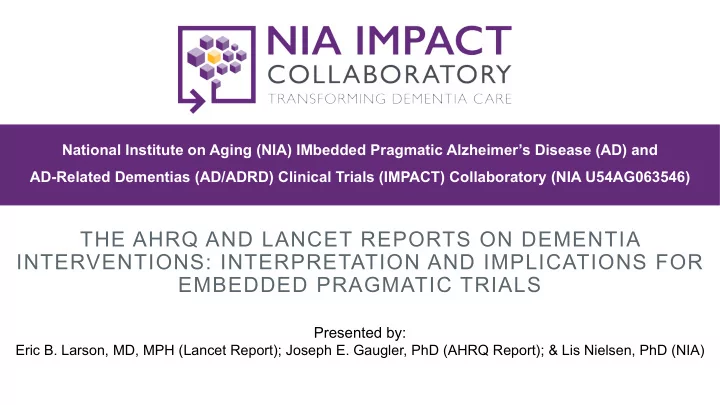
National Institute on Aging (NIA) IMbedded Pragmatic Alzheimer’s Disease (AD) and AD-Related Dementias (AD/ADRD) Clinical Trials (IMPACT) Collaboratory (NIA U54AG063546)

THE AHRQ AND LANCET REPORTS ON DEMENTIA INTERVENTIONS: INTERPRETATION AND IMPLICATIONS FOR EMBEDDED PRAGMATIC TRIALS

Presented by:

Eric B. Larson, MD, MPH (Lancet Report); Joseph E. Gaugler, PhD (AHRQ Report); & Lis Nielsen, PhD (NIA)

slide-2
SLIDE 2

Housekeeping

  • All participants will be muted
  • Enter all questions in the Zoom Q&A or chat box and send to All Panelists and

Attendees

  • Moderator will curate questions and ask them at the end
  • Want to continue the discussion? Look for the associated podcast released about 2

weeks after Grand Rounds.

  • Visit impactcollaboratory.org
  • Follow us on Twitter: @IMPACTcollab1
  • LinkedIn: https://www.linkedin.com/company/65346172 @IMPACT Collaboratory
slide-3
SLIDE 3

Eric B. Larson, MD, MPH

Kaiser Permanente Washington Health Research Institute Senior Investigator Former executive director of Kaiser Permanente Washington Health Research Institute and former vice president for research and health care innovation of Kaiser Permanente Washington Core Leader, IMPACT Health Care Systems Core Member, IMPACT Steering Committee

slide-4
SLIDE 4

The Lancet Commission Dementia Report 2020: Perspectives and opportunities to improve care and evidence-base

slide-5
SLIDE 5

Overall Lancet Summary

  • Well-being is the goal for much of dementia care.
  • Interventions should be individualized to whole person and

carers.

  • Evidence supports psychosocial interventions “tailored” to

neuropsychiatric symptoms.

  • Interventions for carers reduce depression and anxiety & may be

cost-effective.

  • Keeping people with dementia physically healthy affects

cognition.

  • Hospitalizations are distressing with poor outcomes and high

costs.

slide-6
SLIDE 6

Lancet 2020 Approach

  • Identify evidence for advances with likely greatest impact since 2017 report
  • “Triangulation framework”—consistency of evidence from different research lines
  • Summarize best evidence using quality systematic reviews, meta-analyses, or individual studies
  • Perform systematic literature reviews and meta-analyses where needed
  • “Present a synthesis of evidence …balance, strengths, and limitations”
slide-7
SLIDE 7

Principles of Intervention in People with Dementia

  • “People with dementia have complex problems with symptoms in

many domains.”

  • “Must consider person as a whole,” their context and their close

carers.

  • “Dementia as an illness which affects cognition by definition affects

the ability to organize activities and people with dementia often need help to do what they enjoy.”

  • “Wellbeing is one of the goals of dementia care.”
slide-8
SLIDE 8

Medications

  • Less endorsement of cholinesterase

inhibitors than 2017 report

  • “No longer remunerated in France

…only offer a small benefit while shifting clinician’s attention from other interventions”

  • Abeta therapeutics, anti-tau, anti-

amyloid and anti-inflammatory drugs while a current focus, “no evidence of efficacy and some evidence of worsening”

  • For symptoms: no new evidence for

antipsychotics

slide-9
SLIDE 9

Training, Exercise, and Physical Activity

  • Cognitive Training
  • Meta-analysis found small statistically significant benefit on overall cognition

driven by 2 trials of virtual reality or video games with high risk of bias.

  • Cochrane review of 33 trials (2000 participants – high or uncertain risk of bias):

Small to moderate effects on overall cognition lasting a few months to 1 year; “no evidence…that cognitive training was better than cognitive stimulation therapy.”

  • Exercise and Physical Activity
  • Dementia and physical activity RCT: Improved fitness but didn’t slow decline.
  • Reducing Disability in Dementia Study (RDAD): Increased physical activity

days.

slide-10
SLIDE 10

Interventions for Neuropsychiatric Symptoms of Dementia

  • “First line assessment and management of neuropsychiatric

symptoms should focus on basic health: Describe and diagnose symptoms, look for causes such as pain…illness, discomfort, hunger, loneliness, boredom, lack of intimacy and worry that could cause the behaviours and alleviate these while considering risks of harm.”

  • “Evidence is slowly accumulating for the effectiveness, at least

in the short term, of person centered, evidence based psychosocial interventions”

slide-11
SLIDE 11

Examples: Interventions for Neuropsychiatric Symptoms of Dementia

  • German cluster 6-month RCT of nurse-delivered care

management using a computer assisted assessment to personalize intervention modules:

  • Better outcomes vs. usual care on NPI scores**; greater than expected,

but effects on quality of life apparent only in persons living with carer.

  • An 8-session home-based tailored activity program RCT (to

PLWD and family member)

  • Reduction in overall neuropsychiatric symptoms, functional

independence and pain; not sustained at 4 months.

slide-12
SLIDE 12

Agitation – Evidence Growing

  • Distressing symptom for PLWD (contributes to costs)
  • Two new cluster RCTs multi-component interdisciplinary interventions in “care

homes” showed reduced agitation

  • WHELD study: To improve communication with PLWD w/social sensory experiences or other

activities; antipsychotic review and addressed physical problems; lower CMAI scores

  • TIME study: Manual based assessment and structured case conferences for tailored plan.

Reduced agitation at 8 weeks and 12 weeks

  • Another 6-session RCT didn’t reduce agitation but was cost-effective, improving QOL
  • Conclusion: Evidence favors multicomponent interventions in care homes.

Major knowledge gap: People living at home. Effect sizes as good or better than antipsychotics and no side effects.

slide-13
SLIDE 13

Apathy

  • A new area for me – the opposite of engagement; reduced initiative

and activity.

  • Conclusions: People engage more in preferred activities – but

require additional support to do so (e.g., pleasant events).

  • A study in care homes: Engagement does occur in people during

activities in those who attended.

  • Cochrane review of methylphenidate: Small improvement, low quality

evidence but not on NPI apathy scale.

slide-14
SLIDE 14

Carers and Carer Distress

  • Carer distress associated with increased use and costs of health

services.

  • 6-year follow-up of 8 session STrAtegies for RelaTives intervention

(START): A manual-based coping intervention delivered by supervised psychology graduates found continuing effectiveness for depression, risk of “case-level depression”, and 3 times lower costs c/w those not receiving intervention.

  • Caregiver depression rather than symptoms of PLWD associated

with ED use for PLWD.

slide-15
SLIDE 15

Functioning

  • U.K. RCT of 14 sessions of cognitive rehab focused on individual goal

attainment (home-based with OT/nurse) reported increased goal attainment at 3 & 9 months, but no improvement in QOL, mood, self efficacy, cognition, carer stress, health status; and was not cost-effective.

  • Meta-analysis: “All interventions which had improved functioning in

PLWD in the community have been individual rather than group interventions.”

  • Physiotherapists for exercise (2 studies)
  • Individualized cognitive rehab (2 studies)
  • In home activities focused OT (3 studies): “Reduced functional decline compared

to controls

slide-16
SLIDE 16

Depression and Sleep

  • Depression: Two new systematic reviews of antidepressants

reported moderate-quality evidence that antidepressant treatment for PLWD does not lead to better control of symptomatology.

  • Sleep: No evidence that medication for sleep in dementia is

effective and considerable evidence for harm (earlier death, increased hospitalization and falls)

  • “Testing of non-pharmacological interventions is ongoing”
slide-17
SLIDE 17

People with Dementia Have Other Illnesses

  • 70-80% of those diagnosed in primary care have at least 2 other chronic

illnesses; Multimorbidity is associated with faster functional decline, worse QOL for PLWD and their family carers

  • Hospitalization is 1.4-4 times more common c/w similar illnesses;

systematic review and meta-analysis (included 34 studies, 277432 people) showed “admissions often for conditions that might be manageable in the community”

  • Early detection of physical illness (pain, falls, diabetes incontinence and

sensory impairment) is important

  • No intervention has successfully reduced number of hospital admissions of

community dwelling PLWD (c/w interventions like education, exercise, rehab and telemedicine which have reduced admissions for PLW/OD)

slide-18
SLIDE 18

Delirium and Dementia/Physical Illness and Frailty

  • Co-occurrence common, especially in those over 80 years
  • Delirium associated with dramatic increase in risk.
  • Most research on delirium prevention has been in people w/o dementia.
  • But Hospital Elder Life Program (HELP), a delirium-prevention program, reduced

incidence and includes those cognitively impaired.

  • No definitive evidence that any medication improves delirium. Cholinesterase

inhibitors, antipsychotics and sedating benzodiazepines are ineffective and the latter are associated with mortality and morbidity.

  • MIGHT prevention and advances in delirium management “offer a means of dementia

prevention”?

  • Likewise, given the link of very old age, frailty, dementia, MIGHT therapy focusing on age-

related process that underpin many diseases of late life reduce the incidence and severity of dementia?

slide-19
SLIDE 19

“End of Life Care” (or Late-in-Life care) in Dementia

  • Trajectory is unpredictable; only a quarter of those dying with dementia have severe dementia.
  • One RCT testing decision aids re: care goals led to increased palliative care content in care plans.
  • Another prospective study (U.K.) showed high levels of agitation (54%) and pain (61% on

movement) in PLWD (advanced) in care homes.

  • Capacity to make abstract decisions, including about the future, might be lost early in dementia.
  • “Advance care planning designed to empower people with dementia and improve quality of dying

might theoretically be something everyone should do before developing dementia.”

  • Agreement of proxies with stated end-of-life treatment preferences of people with dementia is only

low to moderate. Advanced care plan might reduce uncertainty and “perceptions of quality of care.”

slide-20
SLIDE 20

Some Key Takeaways from 2020 Lancet Report

  • Well-being is the goal of much dementia care:
  • How well do we measure this or set this as our goal – in caring and in research?
  • People with dementia have complex problems and symptoms in many domains.
  • Interventions should be individualized, whole persons and include family carers.
  • Evidence supports psychosocial interventions tailored to individual needs to manage neuropsychiatric

symptoms.

  • Evidence-based interventions for carers can reduce depressive and anxiety symptoms over years and are

cost effective.

  • Keeping people with dementia physically healthy is important for their cognition and well being.
  • Avoiding hospitalizations is worthwhile as is prevention of delirium – a big opportunity for IMPACT and other

pragmatic research programs. There is much opportunity for improvement, especially post-COVID

  • Advance care planning including possibly establishing preferences before dementia impairs judgement and

decision making should be promoted.

slide-21
SLIDE 21

The AHRQ and Lancet Reports on Dementia Interventions: Interpretation and Implications for Embedded Pragmatic Trials

Joseph E. Gaugler, PhD Robert L. Kane Endowed Chair in Long-Term Care & Aging Director, Center for Healthy Aging & Innovation University of Minnesota Co-Lead, Implementation Core, NIA IMPACT Collaboratory

slide-22
SLIDE 22

Aims

  • Brief Overview: Butler M, Gaugler JE, Talley KMC, et al. Care

Interventions for People Living With Dementia and Their Caregivers. Comparative Effectiveness Review No. 231. (Prepared by the Minnesota Evidence-based Practice Center under Contract No. 290- 2015-00008-I.) AHRQ Publication No. 20-EHC023. Rockville, MD: Agency for Healthcare Research and Quality; August 2020. Posted final reports are located on the Effective Health Care Program search

  • page. DOI: https://doi.org/10.23970/AHRQEPCCER231.
  • Disclaimer: My role
  • How do we advance dementia care science?
slide-23
SLIDE 23

Disclaimer: This presentation is based on a report of research conducted by the Minnesota Evidence-based Practice Center (EPC). The findings and conclusions in this document are those of the authors who are responsible for its

  • contents. Statements in the presentation should

not be construed as an official position of AHRQ or

  • f the U.S. Department of Health and Human
  • Services. No author has any affiliation or financial

conflict of interest. Contract Support: By the Agency for Healthcare Research and Quality (AHRQ Contract Number HHSA290201500008I)

slide-24
SLIDE 24

Investigators

  • Mary Butler, PhD, MBA
  • Joseph E. Gaugler, PhD
  • Kristine Talley, PhD, RN, GNP-BC
  • Priyanka Desai, PhD, MHP
  • Sue Duval, PhD
  • Mary Forte, DC, PhD
  • Weiwen Ng, PhD Candidate
  • Edward Ratner, MD
  • Jayati Saha, PhD, MPH
  • Tetyana Shippee, PhD
  • Brittin Wagner, PhD
  • Lobsang Yeshi, MS
slide-25
SLIDE 25

OVERVIEW OF AHRQ REPORT’S METHODS AND FINDINGS

slide-26
SLIDE 26

Objective

“To understand the evidence base for care interventions for people living with dementia (PLWD) and their caregivers, and to assess the potential for broad dissemination and implementation of that evidence” (Butler et al., 2020, p. vii)

slide-27
SLIDE 27

Data Sources

“Ovid Medline, Ovid Embase, Ovid PsycINFO, CINAHL, and the Cochrane Central Register of Controlled Trials (CENTRAL) to identify randomized controlled trials, nonrandomized controlled trials, and quasi-experimental designs published and indexed in bibliographic databases through March 2020” (Butler et al., 2020,

  • p. vii)
slide-28
SLIDE 28

Methods (Butler et al., 2020, p. vii)

  • Non-pharmacological interventions targeting PLWD, their informal or

formal caregivers, or health systems were searched.

  • Rigorous AHRQ Evidence Practice Center standards were applied to

screen abstracts and extract study data

  • Eligible studies included randomized controlled trials and quasi-

experimental observational studies enrolling people with Alzheimer’s disease or related dementias or their informal or formal caregivers.

  • Narrative summary of results for studies not judged to be NIH Stage

Model 0 to 2 (pilot or small sample size studies) or to have high risk

  • f bias.
slide-29
SLIDE 29

Categorization

  • To support readiness for broad dissemination decisions, used NIH

Stage Model (Onken et al,. 2014) as a framework for categorizing studies to focus on those best designed to look for real-world effects.

  • Modified PRECIS-2 (Loudon et al., 2015) tool to assist with

assessment

  • Stage 0-2 categorized as pilot
  • Stage 3 categorized as “explanatory”
  • Stage 4 categorized as “pragmatic”
slide-30
SLIDE 30

Results: Eligible Studies

Title and abstract review excluded 7425 references Eligible Studies 894 references Unique studies = 627 Companions = 267 Full Text Review 1795 references Excludes 901 references

Duplicate of study already screened = 240 Not included population= 97 Not included intervention = 62 Not included outcomes = 77 Not included study design = 194 Not included publication type = 295

Handsearch 3 references Bibliographic database searches 9217 references

slide-31
SLIDE 31

Results: Eligible Studies

  • 100 studies in the analytic set: the set of studies not judged to be

pilots or have a high potential for bias that might have interfered with the ability of the study to answer its research question.

  • 527 studies in the evidence map: the set of studies that did not

undergo synthesis. Summarizes what has been studied and facilitates identifying future research needs.

slide-32
SLIDE 32

Results

  • Current available Stage III or IV evidence cannot yet provide clear

answers about which interventions (or interventions components)

  • ffer consistent benefits.
  • Low-strength evidence for collaborative care models
  • Low-strength evidence for REACH II
  • On-going research funded post-2015 with stronger

rigor/reporting requirements may help resolve some questions

slide-33
SLIDE 33

IMPLICATIONS FOR DEMENTIA CARE SCIENCE

slide-34
SLIDE 34

Compare and Contrast

  • Contrast: Question/Scope
  • AHRQ question: “What is the evidence for interventions ready for broad

dissemination?”

  • Lancet Commission 2020 report: “identify the evidence for advances likely

to have the greatest impact” since its 2017 report

  • “What is ready” versus “what to do”
  • Contrast: Method
  • AHRQ: Use of rigorous AHRQ review methods, NIH Stage Model, and

qualitative synthesis due to study heterogeneity

  • Lancet: Narrative review supplemented by some systematic search

activities, used a “triangulation framework evaluating the consistency of evidence from different lines of research and used that as the basis to evaluate evidence”

slide-35
SLIDE 35

Implications: Moving Forward (Gaugler, Jutkowitz, & Gitlin, 2020)

  • What is our philosophy?
  • Advancing implementation science
  • NIH Stage Model as concept, process, and nomenclature
  • NIA IMPACT Collaboratory
  • a priori planning
  • Engagement of persons living with dementia and their family caregivers
  • Aligning measures with treatment and personal goals
  • INTERDEM
  • LINC-AD
  • Goal Attainment Scaling (e.g., Reuben & Jennings, 2019)
  • Achieving greater understanding of intervention benefits and mechanisms
  • Reporting
  • Categorization challenges
  • Taxonomy approaches
slide-36
SLIDE 36

Implications for NIA-funded Research

Lis Nielsen, PhD

Director, Division of Behavioral and Social Research, National Institute on Aging

slide-37
SLIDE 37

Behavioral and Social Research on Alzheimer’s Disease

slide-38
SLIDE 38

Dementia Care Summits 2017 & 2020

  • Identified opportunities for strengthening our fields
  • 2017 Summit informed AD/ADRD research milestones
  • 2020 Summit gaps and opportunities currently being finalized
  • https://www.nia.nih.gov/2020-dementia-care-summit
slide-39
SLIDE 39

Impetus for the AHRQ/NASEM project

  • Research on care/caregiving in the Alzheimer’s and related

dementias field is expanding.

  • Some programs to improve care and caregiving have already been

disseminated.

  • A rigorous, independent review of which care/caregiving-related

interventions are effective and ready for widespread dissemination was needed.

slide-40
SLIDE 40

Overall goals of the AHRQ/NASEM project

  • Take stock of the current state of knowledge
  • Inform decision making about which care interventions for

individuals with dementia and their caregivers are ready for dissemination and implementation on a broad scale.

slide-41
SLIDE 41

A Collaborative Effort AHRQ-EPC: Systematic Evidence Review National Academies Committee: Development of Recommendations NIA: Next steps

slide-42
SLIDE 42

Why engage two independent organizations?

  • AHRQ offers a highly-refined systematic evidence review process

that has been trusted by governmental organizations for its comprehensiveness and independence

slide-43
SLIDE 43

Why engage two independent organizations?

  • AHRQ offers a highly-refined systematic evidence review process

that has been trusted by governmental organizations for its comprehensiveness and independence

  • NASEM offers an external, independent committee that can

consider:

  • The EPC’s findings on our current state of knowledge;
  • The EPC’s findings in a larger context (of ongoing research, etc.); and
  • Whether dissemination & implementation is justifiable.
  • How the existing evidence and other evidence considered in the review

may inform specific research priorities.

slide-44
SLIDE 44

NASEM Committee’s Ongoing Work

  • Use the EPC findings as a guide to determine the balance for the

NASEM recommendations (“what to tell the public” and “research gaps” identified)

  • Prioritize implementable guidance to the NIA re: actions needed

in future award solicitations, peer review changes, etc.

slide-45
SLIDE 45

Issues Identified by AHRQ Evidence Review

  • Why an intervention works
  • Intervention fidelity
  • Real-world implementation
  • Fitting complex interventions

into complex systems

  • Meaningful classification of

interventions

  • Quality of life
  • Progressive nature of

dementia

  • Focus on dyadic populations
  • Interventions for diverse

populations

  • Consideration of broader

research context

slide-46
SLIDE 46

What’s so hard about delivering interventions with fidelity? What can be done?

CHALLENGES

  • Specialized background may

be required

  • Training cannot be assumed

to work SOLUTIONS

  • Determine essential

ingredients

  • Consider ease of

implementability at the

  • utset
  • Develop and test scalable

training procedures

NIH Stage Model guides our planning and points to solutions.

slide-47
SLIDE 47

2016 & 2017

  • Quality of care for in LTSS settings PLWD

at end of life (R03, R01)

  • Pragmatic trials for dementia care (R01,

R21/R33)

  • Socially assistive robots for PLWD and

caregivers (R41/R42, R43/R44)

  • Informal and formal caregiving reissue

(R21, R01)

2018

  • Pragmatic trials for

dementia care in LTSS settings (R61/R33)

  • Assistive technology for

PLWD and caregivers (R41/R42, R43/R44)

  • Dementia care and

caregiver support interventions (R01)

2015

  • Informal and formal

caregiving (R01, R21)

2019 & 2020

  • High-priority research topics: Dementia

care and caregiving

  • Special interest: Dementia care workforce
  • Interpersonal processes in AD clinical

interactions and care partnerships (R01)

  • Dementia care HCBS (R01, R21)
  • Preliminary testing of interventions
  • Dementia care Roybal

Centers (P30)

  • AD/ADRD Collaboratory

(U54)

  • AD Demography and Aging

Centers (P30)

  • High-priority AD care

network (R24)

2018 Centers & Networks

slide-48
SLIDE 48

R21 or R61 Phase

  • Operationalize intervention, including

interventions addressing disparities

  • Evidence identifying mechanism of action
  • Determine feasibility
  • Validating training interventions for care

providers

  • Partner with healthcare providers and pilot test
  • Develop and test inexpensive methods and

deliver intervention R33 Phase

  • Adequately powered to test effectiveness

NIA initiatives to promote intervention development

  • Adapt, modify, or refine the intervention to

increase potency and scalability of the intervention

  • Adequately powered to test efficacy
  • Mechanism of action
  • Fidelity of delivery in the community
  • Create and test training interventions for care

providers

  • Produce preliminary data for Stage IV

pragmatic trials

Dementia Care and Caregiver Support Interventions (R01)

RFA-AG-18-030 (Stage I-III)

Pragmatic Trials for Dementia Care in LTSS Settings

RFA-AG-17-065/064 and PAR-18-585 (Stage I/IV)

slide-49
SLIDE 49

“Launchpad” for development and implementation of Stage IV Pragmatic Clinical Trials embedded within healthcare systems “Incubator” to conduct Stage 0 Through IV Clinical Trials to lay the groundwork for larger dementia care provider behavioral interventions.

NIA investments in dementia care and caregiving intervention development infrastructure

slide-50
SLIDE 50
slide-51
SLIDE 51

Multiple entry points

Training Research Resources Early Stage Pilots Later Stage Pilots FOAs & NOSIs

slide-52
SLIDE 52

Training opportunities

  • RCMAR scientists and pilot proposals
  • AD/ADRD institutional training programs
  • Diversity and re-entry supplements
  • Other NIA career or fellowship opportunities
slide-53
SLIDE 53

Use research resources

  • AD/ADRD Demography and Economics of Aging Centers
  • Center for Advancing Sociodemographic and Economic Study of Alzheimer’s Disease

and Related Dementias (USC)

  • Hopkins' Economics of Alzheimer's Disease and Services Center
  • Center to Accelerate Population Research in Alzheimer’s (Michigan)
  • BSR-supported data infrastructure
slide-54
SLIDE 54

Early stage intervention development pilots

  • Roybal Centers pilot opportunities
  • Example research ideas appropriate for this stage:
  • Stage I and Stage III research on the development and testing of training

materials to teach individuals in the community to deliver an efficacious intervention with fidelity

  • Stage II or Stage III research to determine the governing

principles/mechanisms of behavior change of an efficacious intervention

  • Stage II or Stage III research to determine the essential ingredients/critical

components of an efficacious intervention

slide-55
SLIDE 55

Later stage pragmatic trials

  • IMPACT pilot opportunities
  • Example research ideas appropriate for this stage
  • Stage IV research to test the effectiveness of interventions to improve patient,

physician, or healthcare system performance that can be easily delivered with fidelity that have been shown to have some degree of evidence of efficacy, such as simple default interventions, simple nudge interventions, 100% technology-based interventions, de-prescribing interventions

slide-56
SLIDE 56

Dementia care/caregiving-specific FOAs & NOSIs

  • Dementia care workforce (R01/R21) (NOT-AG-20-026)
  • Preliminary testing of interventions (Stage I, II, III) (NOT-OD-20-106)
  • Dementia care and caregiver high priority topics (NOT-AG-18-

056/057)

  • Late-stage clinical trials of non-pharmacological interventions (PAR-

18-878)

  • Interventions to mitigate cognitive decline in PLWD (PA-18-347)
slide-57
SLIDE 57

Future Opportunities

  • NIA approved concepts provide hints of future
  • Active NIA/BSR opportunities updated as new initiatives are

published

  • Subscribe to the NIA blog for real-time announcements
slide-58
SLIDE 58

NIA supports research to generate evidence

The NIA mission is to support and conduct research on aging, foster the development of scientists, and provide research resources. Including intervention research to elucidate what works, why, for whom, and under what circumstances

  • Use-inspired basic research on the principles that account for an intervention’s effects
  • Implementation research tackling whether principle-based interventions can be

delivered with fidelity in real world contexts

It is the mission of other agencies and organizations to deliver services.

slide-59
SLIDE 59

Summary

  • NIA regularly solicits input from the research community and public to

inform our programs in AD/ADRD science

  • The Care Interventions for People With Dementia and their Caregivers

AHRQ Evidence Review draft and final reports raised serious concerns

  • Numerous NIA funding opportunities – many predating the AHRQ report –

address similar issues confronting the field

  • Existing infrastructure and opportunities offer multiple entry points for

researchers at all levels, and new opportunities are always on the horizon

slide-60
SLIDE 60

AHRQ and NASEM Key Dates & Links

  • Link to final AHRQ report (Summer 2020):

https://effectivehealthcare.ahrq.gov/products/care-interventions-pwd/report

  • The NASEM committee is still deliberating its recommendations, and the

Committee’s final public session was held in September

  • Final NASEM report expected in early 2021
  • Link to NASEM ACTIVITY:

https://www.nationalacademies.org/our-work/care-interventions-for-individuals- with-dementia-and-their-caregivers---phase-two#sectionProjectScope

slide-61
SLIDE 61

Q&A

  • Enter all questions in the Zoom Q&A or chat box and send to All Panelists and

Attendees

  • Moderator will curate questions
  • Want to continue the discussion? Look for the associated podcast released about 2

weeks after Grand Rounds.

  • Visit impactcollaboratory.org
  • Follow us on Twitter: @IMPACTcollab1
  • LinkedIn: https://www.linkedin.com/company/65346172 @IMPACT Collaboratory