
SLIDE 1
The ¡Analysis ¡of ¡Faces ¡ ¡ in ¡Brains ¡and ¡Machines ¡
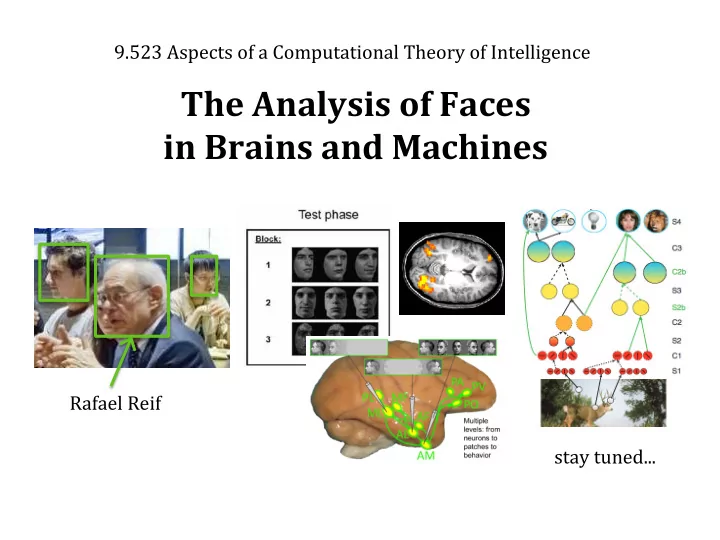
9.523 ¡Aspects ¡of ¡a ¡Computational ¡Theory ¡of ¡Intelligence ¡ Rafael ¡Reif ¡ stay ¡tuned... ¡
The Analysis of Faces in Brains and Machines Rafael - - PowerPoint PPT Presentation
9.523 Aspects of a Computational Theory of Intelligence The Analysis of Faces in Brains and Machines Rafael Reif stay tuned... Why is face
9.523 ¡Aspects ¡of ¡a ¡Computational ¡Theory ¡of ¡Intelligence ¡ Rafael ¡Reif ¡ stay ¡tuned... ¡
Remember/recognize ¡people ¡we’ve ¡seen ¡before ¡
¡
Categorization ¡– ¡e.g. ¡gender, ¡race, ¡age, ¡kinship ¡
¡
Social ¡communication ¡– ¡emotions/mood, ¡intentions, ¡trustworthiness, ¡ ¡ ¡ ¡competence ¡or ¡intelligence, ¡attractiveness ¡
¡
Scene ¡understanding, ¡e.g. ¡direction ¡of ¡gaze ¡suggests ¡focus ¡of ¡attention ¡
¡
Jenkins, ¡White, ¡Van ¡Montfort ¡& ¡Burton, ¡Cognition, ¡2011 ¡
chance ¡ performance ¡ testmybrain.org ¡ Wilmer ¡et ¡al., ¡2012 ¡ Duchaine ¡& ¡Nakayama, ¡2006 ¡
Bruce ¡et ¡al., ¡1999 ¡
Which ¡of ¡the ¡10 ¡photos ¡on ¡the ¡ bottom ¡depicts ¡the ¡target ¡face? ¡
¡
Viewers ¡are ¡~ ¡70% ¡correct ¡ ¡ Performance ¡degrades ¡with ¡ changes ¡in ¡pose, ¡expression ¡
¡
Only ¡slight ¡improvement ¡with ¡ short ¡video ¡clip ¡of ¡target ¡
Public ¡databases ¡of ¡face ¡images ¡serve ¡as ¡benchmarks: ¡
¡
Labeled ¡Faces ¡in ¡the ¡Wild ¡(LFW, ¡http://vis-‑www.cs.umass.edu/lfw) ¡ ¡> ¡13,000 ¡images ¡of ¡celebrities, ¡5,749 ¡different ¡identities ¡
¡
YouTube ¡Faces ¡Database ¡(YTF, ¡http://www.cs.tau.ac.il/~wolf/ytfaces) ¡ ¡3,425 ¡videos, ¡1,595 ¡different ¡identities ¡ ¡ Private ¡face ¡image ¡datasets: ¡
¡
(Facebook) ¡Social ¡Face ¡Classieication ¡dataset ¡ ¡ ¡4.4 ¡million ¡face ¡photos, ¡4,030 ¡different ¡identities ¡ (Google) ¡100-‑200 ¡million ¡face ¡images, ¡~ ¡8 ¡million ¡different ¡identities ¡ ¡ LFW ¡ YTF ¡ Facebook ¡DeepFace ¡ 97.4% ¡ 91.4% ¡ Google ¡FaceNet ¡ 99.6% ¡ 95.1% ¡ Human ¡performance ¡ 97.5% ¡ 89.7% ¡
¡ ¡
PhD ¡thesis, ¡Picture ¡Processing ¡System ¡by ¡Computer ¡Complex ¡and ¡ ¡ ¡ ¡ ¡ ¡Recognition ¡of ¡Human ¡Faces ¡
nose, ¡mouth, ¡boundaries ¡of ¡face ¡
distances ¡and ¡angles ¡between ¡features ¡
Goal: ¡reduce ¡the ¡dimensionality ¡of ¡the ¡data ¡while ¡retaining ¡as ¡much ¡ ¡ ¡ ¡information ¡as ¡possible ¡in ¡the ¡original ¡dataset ¡
¡
PCA ¡allows ¡us ¡to ¡compute ¡a ¡linear ¡transformation ¡that ¡maps ¡data ¡from ¡ ¡ ¡ ¡a ¡high ¡dimensional ¡space ¡to ¡a ¡lower ¡dimensional ¡subspace ¡
¡
¡
Sample ¡images ¡from ¡the ¡Yale ¡face ¡database, ¡results ¡from ¡C. ¡deCoro ¡ ¡http://www.cs.princeton.edu/~cdecoro/eigenfaces/ ¡
1-14
Perform ¡PCA ¡on ¡a ¡large ¡set ¡of ¡training ¡ images, ¡to ¡create ¡a ¡set ¡of ¡eigenfaces, ¡ Ei(x,y), ¡that ¡span ¡the ¡data ¡set ¡ First ¡components ¡capture ¡most ¡of ¡the ¡ variation ¡across ¡the ¡data ¡set, ¡later ¡ components ¡capture ¡subtle ¡variations ¡ Each ¡face ¡image ¡F(x,y) ¡can ¡be ¡expressed ¡as ¡a ¡weighted ¡combination ¡of ¡the ¡ eigenfaces ¡Ei(x,y): ¡ ¡ ¡ Ψ(x,y): ¡average ¡face ¡(across ¡all ¡faces) ¡ Ψ(x,y) ¡
http://vismod.media.mit.edu/vismod/demos/facerec/basic.html ¡
¡
Each ¡face ¡image ¡F(x,y) ¡can ¡be ¡expressed ¡as ¡a ¡weighted ¡combination ¡of ¡the ¡ eigenfaces ¡Ei(x,y): ¡ ¡ ¡ ¡ ¡ ¡ ¡ ¡ ¡
(1) Compute ¡weights ¡wi ¡ ¡ for ¡novel ¡face ¡image ¡ (2) Find ¡image ¡m ¡in ¡face ¡ database ¡with ¡most ¡ similar ¡weights, ¡e.g. ¡
m i=1 k
¡
1-16
(results ¡from ¡C. ¡deCoro) ¡
1-17
1-18
Use ¡simple ¡rectangle ¡features: ¡ ¡ ¡ ¡ ¡ ¡ ¡Σ ¡I(x,y) ¡in ¡gray ¡area ¡– ¡Σ ¡I(x,y) ¡in ¡white ¡area ¡ within ¡24 ¡x ¡24 ¡image ¡sub-‑windows ¡
¡features ¡per ¡sub-‑window! ¡
Learn ¡most ¡discriminating ¡features ¡from ¡ thousands ¡of ¡samples ¡of ¡face ¡and ¡non-‑ face ¡image ¡windows ¡
1-19
x ¡= ¡image ¡window ¡ f ¡= ¡feature ¡ ¡ p ¡= ¡+1 ¡or ¡-‑1 ¡ θ ¡= ¡threshold ¡ ¡ weak ¡classiBier ¡using ¡one ¡feature: ¡ (x1,w1,1) ¡ ¡ ¡ ¡ ¡ ¡ ¡ ¡ ¡(xn,wn,0) ¡
normalize ¡ weights ¡ find next best weak classifier use ¡classieication ¡errors ¡ ¡ ¡ ¡ to ¡update ¡weights ¡
n ¡training ¡samples, ¡ equal ¡weights, ¡ known ¡classes ¡
~ ¡200 ¡features ¡yields ¡good ¡results ¡ ¡for ¡“monolithic” ¡classieier ¡
AdaBoost ¡
1-20
Early ¡classieiers ¡use ¡a ¡few ¡highly ¡ discriminating ¡features, ¡low ¡threshold ¡
removes ¡50% ¡non-‑face ¡windows ¡ ¡
examples ¡
5000 ¡faces ¡ many ¡more ¡non-‑face ¡patches ¡ ¡ faces ¡are ¡normalized ¡ for ¡scale, ¡rotation ¡ ¡ small ¡variation ¡in ¡pose ¡
1-22
With ¡additional ¡diagonal ¡features, ¡classieiers ¡were ¡created ¡ to ¡handle ¡image ¡rotations ¡and ¡proeile ¡views ¡
faces ¡more ¡than ¡other ¡objects ¡
¡
inversion ¡effect ¡
different ¡when ¡aligned ¡with ¡ different ¡bottom ¡halves ¡
¡
perceived ¡as ¡identical ¡
Identieication ¡of ¡the ¡“studied” ¡face ¡is ¡ signieicantly ¡better ¡in ¡the ¡whole ¡vs. ¡ part ¡condition ¡ Test ¡conditions ¡ Eyebrows ¡are ¡important! ¡
12 ¡female ¡faces ¡scanned ¡for ¡ 3D ¡shape ¡and ¡visual ¡texture ¡ image ¡sequences ¡were ¡created ¡that ¡ morph ¡between ¡two ¡different ¡faces ¡
morph ¡sequences, ¡ back ¡and ¡forth ¡ same ¡or ¡different ¡person? ¡ (shown ¡separated ¡in ¡time) ¡ performance ¡within ¡morph ¡ groups ¡was ¡compromised ¡ by ¡temporal ¡association ¡
Wallis ¡& ¡Bulthoff, ¡PNAS, ¡2001 ¡
Improves ¡accuracy ¡in ¡the ¡ recognition ¡of ¡famous ¡faces ¡
¡
PCA ¡
commercial ¡system ¡
human ¡experiments ¡
average ¡“texture” ¡ average ¡ “shape” ¡