The Arithmetic of Coxeter Permutahedra Federico Ardila San - - PowerPoint PPT Presentation
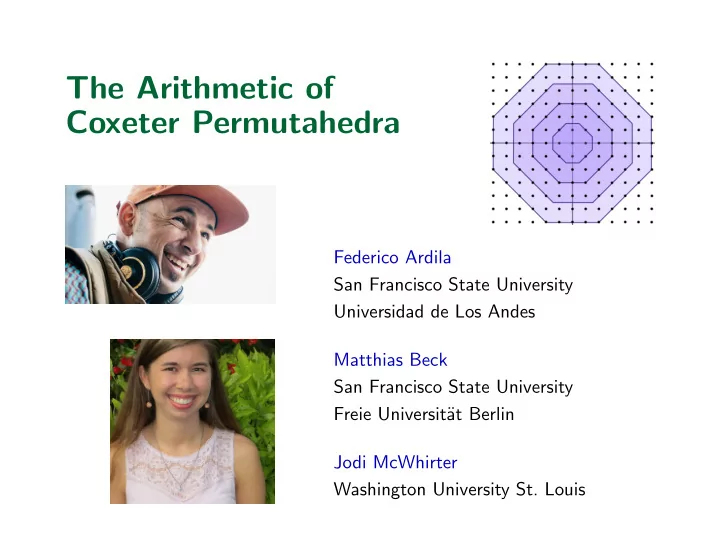
The Arithmetic of Coxeter Permutahedra Federico Ardila San Francisco State University Universidad de Los Andes Matthias Beck San Francisco State University Freie Universit at Berlin Jodi McWhirter Washington University St. Louis The
The Menu
◮ Ehrhart (quasi-)polynomials ◮ Zonotopes ◮ Coxeter permutahedra ◮ Signed graphs ◮ Tree generating functions
3/22/2020 https://upload.wikimedia.org/wikipedia/commons/3/3e/Permutohedron.svg https://upload.wikimedia.org/wikipedia/commons/3/3e/Permutohedron.svg 1/1
(4,1,2,3) (4,2,1,3) (3,2,1,4) (3,1,2,4) (2,1,3,4) (1,2,3,4) (1,2,4,3) (1,3,2,4) (2,1,4,3) (2,3,1,4) (3,1,4,2) (4,1,3,2) (4,2,3,1) (3,2,4,1) (2,4,1,3) (1,4,2,3) (1,3,4,2) (2,3,4,1) (1,4,3,2) (2,4,3,1) (3,4,2,1) (4,3,2,1) (4,3,1,2) (3,4,1,2)
The Arithmetic of Coxeter Permutahedra Federico Ardila, Matthias Beck & Jodi McWhirter
Measuring Polytopes
Rational polytope — convex hull of finitely many points in Qd — solution set of a system of linear (in-)equalities with integer coefficients Goal: measuring... ◮ volume vol(P) = lim
t→∞
1 td
- P ∩ 1
tZd
- ◮
discrete volume
- P ∩ Zd
- Ehrhart function ehrP(t) :=
- P ∩ 1
tZd
- =
- tP ∩ Zd
for t ∈ Z>0
The Arithmetic of Coxeter Permutahedra Federico Ardila, Matthias Beck & Jodi McWhirter
Discrete Volumes & Ehrhart Quasipolynomials
Rational polytope — convex hull of finitely many points in Qd q(t) = cd(t) td + · · · + c0(t) is a quasipolynomial if c0(t), . . . , cd(t) are periodic functions; the lcm of their periods is the period of q(t). Theorem (Ehrhart 1962) For any rational polytope P ⊂ Rd, ehrP(t) :=
- tP ∩ Zd
is a quasipolynomial in t whose period divides the lcm of the denominators of the vertex coordinates
- f P.
Example P = [−1
2, 1 2]2
The Arithmetic of Coxeter Permutahedra Federico Ardila, Matthias Beck & Jodi McWhirter
Why care about... Ehrhart (Quasi-)Polynomials
◮ Linear systems are everywhere, and so polyhedra are everywhere. ◮ In applications, the volume of the polytope represented by a linear system measures some fundamental data of this system (“average”). ◮ Polytopes are basic geometric objects, yet even for these basic objects volume computation is hard and there remain many open problems. ◮ Many discrete problems in various mathematical areas are linear problems, thus they ask for the discrete volume of a polytope in disguise. ◮ Much discrete geometry can be modeled using polynomials and, conversely, many combinatorial polynomials can be modeled geometrically.
The Arithmetic of Coxeter Permutahedra Federico Ardila, Matthias Beck & Jodi McWhirter
Zonotopes
Zonotope — Minkowski sum of line segments Z = n
j=1[aj, bj]
Shephard (1974) Decomposition of Z into translates of half-open parallele- pipeds spanned by the linearly indepen- dent subsets of {bj − aj : 1 ≤ j ≤ n}. Stanley (1991) For a finite set of vectors U ⊂ Zd, let Z(U) :=
u∈U[0, u]
Then ehrZ(U)(t) =
- W⊆U
- lin. indep.
vol(W) t|W| where |W| denotes the number of vectors in W and vol(W) is the relative volume of the parallelepiped generated by W.
The Arithmetic of Coxeter Permutahedra Federico Ardila, Matthias Beck & Jodi McWhirter
Lie Combinatorics
Finite crystallographic root systems An−1 := {±(ei − ej) : 1 ≤ i < j ≤ n} Bn := {±(ei − ej), ±(ei + ej) : 1 ≤ i < j ≤ n} ∪ {±ei : 1 ≤ i ≤ n} Cn := {±(ei − ej), ±(ei + ej) : 1 ≤ i < j ≤ n} ∪ {±2 ei : 1 ≤ i ≤ n} Dn := {±(ei − ej), ±(ei + ej) : 1 ≤ i < j ≤ n} . . . and E6, E7, E8, F4, G2 . Positive roots are obtained by choosing the plus sign in each ± above. Standard Coxeter permutahedron of the finite root system Φ Π(Φ) :=
- α∈Φ+
- −α
2, α 2
- = conv{w · ρ : w ∈ W}
where ρ := 1
2
- α∈Φ+ α and W is the Weyl group of Φ
The Arithmetic of Coxeter Permutahedra Federico Ardila, Matthias Beck & Jodi McWhirter
Lie Combinatorics
Finite crystallographic root systems An−1 := {±(ei − ej) : 1 ≤ i < j ≤ n} Bn := {±(ei − ej), ±(ei + ej) : 1 ≤ i < j ≤ n} ∪ {±ei : 1 ≤ i ≤ n} Cn := {±(ei − ej), ±(ei + ej) : 1 ≤ i < j ≤ n} ∪ {±2 ei : 1 ≤ i ≤ n} Dn := {±(ei − ej), ±(ei + ej) : 1 ≤ i < j ≤ n} . . . and E6, E7, E8, F4, G2 . Positive roots are obtained by choosing the plus sign in each ± above. Standard Coxeter permutahedron of the finite root system Φ Π(Φ) :=
- α∈Φ+
- −α
2, α 2
- Integral Coxeter permutahedron ΠZ(Φ) :=
- α∈Φ+
[0, α]
The Arithmetic of Coxeter Permutahedra Federico Ardila, Matthias Beck & Jodi McWhirter
Standard Coxeter Permutahedra
An−1 = {±(ei − ej) : 1 ≤ i < j ≤ n} Bn = {±(ei − ej), ±(ei + ej) : 1 ≤ i < j ≤ n} ∪ {±ei : 1 ≤ i ≤ n} Cn = {±(ei − ej), ±(ei + ej) : 1 ≤ i < j ≤ n} ∪ {±2 ei : 1 ≤ i ≤ n} Dn = {±(ei − ej), ±(ei + ej) : 1 ≤ i < j ≤ n} Π(An−1) = conv{permutations of 1
2(−n + 1, −n + 3, . . . , n − 3, n − 1)}
Π(Bn) = conv{signed permutations of 1
2(1, 3, . . . , 2n − 1)}
Π(Cn) = conv{signed permutations of (1, 2, . . . , n)} Π(Dn) = conv{evenly signed permutations of (0, 1, . . . , n − 1)}
The Arithmetic of Coxeter Permutahedra Federico Ardila, Matthias Beck & Jodi McWhirter
Why care about... Coxeter Permutahedra
◮ Many questions about permutations can be answered looking at the geometry of the permutahedron ◮ Fundamental objects in the representation theory of semisimple Lie algebras ◮ Connections to optimization (Ardila–Castillo–Eur–Postnikov 2020) ◮ Zonotopes with natural connections to tree enumeration
The Arithmetic of Coxeter Permutahedra Federico Ardila, Matthias Beck & Jodi McWhirter
Signed Graphs
A signed graph G = (V, E, σ) comes with a signature σ : E∗ → {±} A simple cycle is balanced if its product of signs is +. A signed graph is balanced if it contains no half edges and all of its simple cycles are balanced. An all-negative signed graph is balanced if and only if it is bipartite. A signed graph is balanced if and only if it has no half edges and can be switched to an all-positive signed graph.
The Arithmetic of Coxeter Permutahedra Federico Ardila, Matthias Beck & Jodi McWhirter
Signed Graphs and Root Systems
Zaslavsky Encoding (1981) of a subset S ⊆ Φ+ into the signed graph GS with ◮ a positive edge ij for each ei − ej ∈ S ◮ a negative edge ij for each ei + ej ∈ S ◮ a halfedge at j for each ej ∈ S ◮ a negative loop at j for each 2ej ∈ S Linear independent subsets of Φ+ correspond precisely to signed pseudo- forests which consist of signed trees plus possibly ◮ a single halfedge (halfedge-tree) ◮ a single loop (loop-tree) ◮ a single unbalanced cycle (pseudotree) |ΦG| = n − tc(G) vol(ΦG) = 2pc(G)+lc(G)
The Arithmetic of Coxeter Permutahedra Federico Ardila, Matthias Beck & Jodi McWhirter
Why care about... Signed Graphs
◮ Earliest appearance in social psychology (Heider 1946, Cartwright– Harary 1956) “The enemy of my enemy is my friend” ◮ Type-B analogues of graphs, natural from the viewpoint of incidence matrices ◮ Applications to ◮ Knot theory (positive/negative crossings) ◮ Biology (perturbed large-scale biological networks ◮ Chemistry (M¨
- bius systems)
◮ Physics (spin glasses—mixed Ising model) ◮ Computer science (correlation clustering)
The Arithmetic of Coxeter Permutahedra Federico Ardila, Matthias Beck & Jodi McWhirter
Integral Coxeter Permutahedra
Fix Φ ∈ {An, Bn, Cn, Dn : n ≥ 2} and consider ΠZ(Φ) =
- α∈Φ+
[0, α] Linear independent subsets of Φ+ correspond precisely to signed pseudo- forests which consist of signed trees plus possibly ◮ a single halfedge (halfedge-tree) ◮ a single loop (loop-tree) ◮ a single unbalanced cycle (pseudotree) |ΦG| = n − tc(G) vol(ΦG) = 2pc(G)+lc(G) Ardila–Castillo–Henley (2015) Let F(Φ) be the set of Φ-forests. Then ehrΠZ(Φ)(t) =
- G∈F(Φ)
2pc(G)+lc(G) tn−tc(G).
The Arithmetic of Coxeter Permutahedra Federico Ardila, Matthias Beck & Jodi McWhirter
Almost Integral Zonotopes
Lemma Let U ⊂ Zd be a finite set and v ∈ Qd. Then ehrv+Z(U)(t) =
- W⊆U
- lin. indep.
χW(t) vol(W) t|W| where χW(t) :=
- 1
if (tv + span(W)) ∩ Zd = ∅,
- therwise.
Ardlia–M B–McWhirter Fix Φ ∈ {An : n ≥ 2 even} ∪ {Bn : n ≥ 1}. Let F(Φ) be the set of Φ-forests and E(Φ) ⊆ F(Φ) be the set of Φ-forests such that every tree component has an even number of vertices. Then ehrΠ(Φ)(t) =
- G∈F(Φ)
2pc(G)tn−tc(G) if t is even,
- G∈E(Φ)
2pc(G)tn−tc(G) if t is odd.
The Arithmetic of Coxeter Permutahedra Federico Ardila, Matthias Beck & Jodi McWhirter
Exponential Generating Functions
Lambert W-function W(x) =
- n≥1
(−n)n−1 xn n! W(x) eW (x) = x There are tn := nn−2 trees on [n], with exponential generation function
- n≥1
tn xn n! = −W(−x) − 1 2 W(−x)2 Sample tree generating function magic
- n≥0
ehrΠZ(An−1)(t) xn n! =
- n≥0
- forests
G on [n]
tn−tc(G) xn n!
The Arithmetic of Coxeter Permutahedra Federico Ardila, Matthias Beck & Jodi McWhirter
Exponential Generating Functions
Ardlia–M B–McWhirter Exponential generating functions for integral and standard Coxeter permutahedra, e.g., for t odd,
- n≥0
ehrΠ(A2n−1)(t) x2n (2n)! = exp
- −W(−tx) + W(tx)
2t − W(−tx)2 + W(tx)2 4t
- n≥0
ehrΠ(Bn)(t) xn n! = exp
- −W (−2tx)+W (2tx)
4t
− W (−2tx)2+W (2tx)2
8t
- 1 + W(−2tx)
The Arithmetic of Coxeter Permutahedra Federico Ardila, Matthias Beck & Jodi McWhirter