The Arts Council and Englands rural communities Laura Dyer, - - PowerPoint PPT Presentation

the arts council and england s rural communities
SMART_READER_LITE
LIVE PREVIEW

The Arts Council and Englands rural communities Laura Dyer, - - PowerPoint PPT Presentation

The Arts Council and Englands rural communities Laura Dyer, Executive Director, North, Midlands and South West Paul Bristow, Director Strategic Partnerships Rural Services Network, Monday 14 July 2014 Part of FLOW outdoor visual arts


slide-1
SLIDE 1

The Arts Council and England’s rural communities

Laura Dyer, Executive Director, North, Midlands and South West Paul Bristow, Director Strategic Partnerships

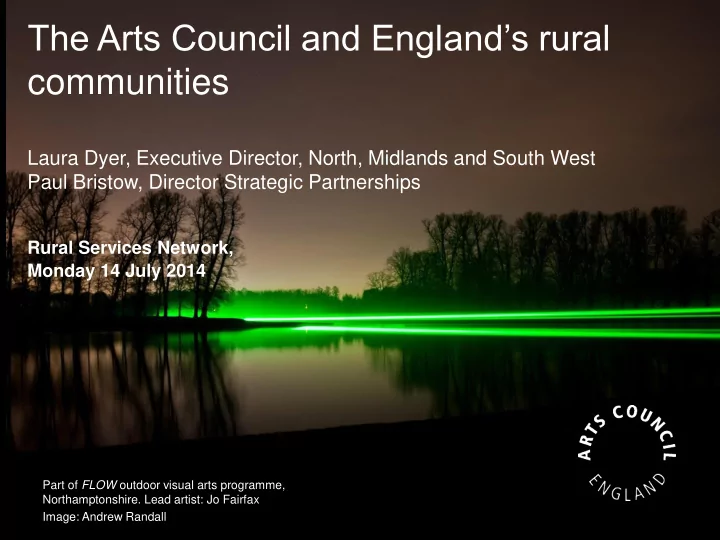
Part of FLOW outdoor visual arts programme,

  • Northamptonshire. Lead artist: Jo Fairfax

Image: Andrew Randall

Rural Services Network, Monday 14 July 2014

slide-2
SLIDE 2

The Arts Council and communities in rural England

  • 1. The Arts Council’s engagement with rural communities and policy
  • Our strategy
  • The state of arts and culture in rural areas
  • Arts Council England and communities living in rural England – a position statement
  • 2. How the Arts Council will engage with rural stakeholders
  • Who we engage with/who we should engage with
  • Our policy making
  • 3. Our work 2014-18
  • Review of data and evidence relating to arts and culture and rural communities
  • Helping cultural organisations make a difference in rural communities
  • How can the Arts Council support cultural in rural areas
  • 4. Your feedback, ideas and comments
slide-3
SLIDE 3

Arts Council England – our vision and strategy

  • We have a ten year vision for arts and culture, delivered

through our strategy for 2010-20 Achieving great art and culture for everyone

  • Five goals define our work:
  • Excellence
  • For everyone
  • Resilience and sustainability
  • Diversity and skills
  • Children and young people
slide-4
SLIDE 4

“We must take account of the differing needs of differing places. We will do this in partnership with local government, the largest investor in arts and culture in England. We will also take account of the respective needs of rural and urban communities, so that people are not disadvantaged by where they live”

Great art and culture for everyone, Arts Council England (2014)

slide-5
SLIDE 5

Arts Council England and communities living in rural England a position statement

  • We refreshed our strategy in 2013 and then revisited our

approach to rural communities

  • Working with Defra, we held a rural proofing workshop in

summer 2013

  • We considered the outcomes of this and then issued a

position statement on our approach

  • This is a living document, setting out an approach which

can be amended as circumstances change or on the advice of stakeholders

slide-6
SLIDE 6

Arts and culture in rural areas

  • Engagement with arts and culture is higher in rural than

urban areas – rather than saying this is not a problem, we see this as a strength that rural communities can build on

  • Local government support for culture is under severe

pressure

  • There are concerns about the informal networks that

sustain the cultural sector in rural areas

  • Issues of broadband and transport access pose barriers

to engagement and sector growth

  • The economic value of culture is not always appreciated

by some decision makers in rural areas

slide-7
SLIDE 7

Our position statement

  • We set out how we will work to take account of the

needs of rural communities to realise our goals

  • We will work to understand the particular needs and

aspirations of rural communities

  • We will work in partnership with local government, the

arts and cultural sector and others who work in and represent rural communities

  • We will ensure that our investment and support is

appropriate for all areas of the country – including rural – and change our approach as appropriate

  • We will refresh our approach to rural proofing once Lord

Cameron has reported

slide-8
SLIDE 8

How we engage with rural stakeholders

  • We meet twice a year with a rural stakeholders group,

including rural arts organisations, NRTF, RSN, the LGA, SCL, ACRE, WiRE, Defra, and others

  • We have joined the RSN
  • We see our engagement with local government as key –

there are a number of places on our Area Councils reserved for local government members

  • We are talking to LEPs about the priorities for growth in

rural areas and how culture can contribute

  • Professional bodies – AD:uk, National Rural Touring

Forum, SCL, Museums Association, Associatin of Independent Museums

slide-9
SLIDE 9

Action 2014 - 18

  • Review, with Defra, data and evidence on culture and

rural communities to better inform policy development

  • Help the cultural sector in rural areas to support

economic growth and stronger community through better working with LAGs

  • Consider how best to support the cultural sector in rural

areas through an era of declining public investment

slide-10
SLIDE 10

Background to the data and evidence review

Dates in 2014 Activity

April - May Formulate review group, agree draft terms of reference, consult with advisers on terms of reference, carry out mapping exercise of existing data and research about the sector in rural areas 5th June Initial presentation to Arts Council’s rural stakeholder group, inclusive of recommendations on priorities for additional analysis of the sector in rural areas June - Sept Undertake additional analysis and research September Final consultation with advisers October Final presentation to Arts Council’s rural stakeholder group October Final amendments to review report, agreement by Arts Council and Defra and start of implementation of recommendations.

slide-11
SLIDE 11

Stage 1 of the review: Mapping currently available and ongoing data and research about the sector in rural areas 1. Organisational infrastructure and resilience 2. The arts and cultural workforce 3. Income and funding flows 4. Artistic and cultural participation (active participation in making or doing artistic activity) 5. Artistic and cultural audiences (attending artistic performances and events as an audience member) 6. The social and economic benefits of arts and culture 7. Socio-economic and demographic data and evidence relating to rural areas in England that are of relevance to the arts and cultural sector.

Data and research available from:

  • ACE
  • DCMS
  • NCVO
  • DfE
  • HESA
  • DCLG
  • CIPFA
  • CC Skills
  • ONS
  • DEFRA
  • Audience

Agency

slide-12
SLIDE 12

ACE conclusions about key evidence gaps and priorities for rural analysis ACE cannot analyse every topic and every dataset available about the sector in rural areas: we’d encourage other researchers and organisations to conduct their own localised research. Three key gaps in the knowledge and evidence-base we think could be prioritised for further analysis by ACE over 2014: 1. Area of benefit of ACE investment on rural areas 2. Rural audience behaviour and cultural participation in rural communities 3. The contribution of arts and culture to rural economies.

slide-13
SLIDE 13

Proposed priority 1: Area of benefit calculations for rural areas in relation to ACE investment

Arts Council England National Portfolio Organisation Investment in major population centres and surrounding areas

slide-14
SLIDE 14

Proposed priority 2: Rural audiences and cultural participation in rural areas Additional analysis of the Taking Part Survey could analyse data across the rolling dataset of c.139,000 respondents, which could be analysed by the small-area ONS/DEFRA classification:

  • Rural V urban arts audience attendance
  • Rural V urban arts and cultural participation (actively making or

doing artistic activity)

  • Rural V urban key drivers of engagement with arts and culture
  • Rural V urban attitudes towards arts and culture
  • Rural V urban digital engagement with arts and culture

All of these topics could be explored by art form, geography (e.g. rural Yorkskhire V rural South West), and demographics/socio-economic within rural areas (e.g. people living in deprived rural neighbourhoods compared to people living in affluent rural neighbourhoods)

slide-15
SLIDE 15

Proposed priority 3: The contribution of arts and culture to rural economies

  • Much of the evidence-base about the role of arts and

culture in local economies, local regeneration and place- shaping is based on urban locations and urban investments

  • Though there are data and toolkits available for
  • rganisations based in rural areas (e.g. BOP Consulting

guidance available on ACEs website about measuring the economic benefits of arts and culture

  • The Local Culture and Heritage Profile Tool available on

the DCMS website contains detailed data about the sector and the broader creative and cultural industries in each LA and LEP area

  • However, a research study that explored the role of arts and

culture or a specific investment on a local rural economy would be a useful addition to the evidence-base.

slide-16
SLIDE 16

Supporting culture’s social and economic contribution to rural communities

  • Making the case for culture's value – advocating to LEPs

and LAGs

  • Making our investment eligible as match for EU

Structural and Investment Funds

  • Explaining to LEPs and LAGs how our investment can

help deliver local economic and community priorities

  • Disseminating best practice

We can’t do this alone – how can we work with the RSN and other partners?