The ASCI Target (or ASCI Curves) Computing Speed (FLOPS) 10 14 - - PDF document

the asci target or asci curves
SMART_READER_LITE
LIVE PREVIEW

The ASCI Target (or ASCI Curves) Computing Speed (FLOPS) 10 14 - - PDF document

MINI-Processors: Network Interface Cards (NICs) as First-Class Citizens Wu-chun Feng * feng@lanl.gov http://home.lanl.gov/feng Purdue University * Los Alamos National Laboratory Los Alamos, NM 87545 W. Lafayette, IN 47907 Funded in


slide-1
SLIDE 1

1

MINI-Processors: Network Interface Cards (NICs) as First-Class Citizens Wu-chun Feng*†

feng@lanl.gov http://home.lanl.gov/feng

* Los Alamos National Laboratory

Los Alamos, NM 87545 Purdue University†

  • W. Lafayette, IN 47907

Funded in part by DOE Next-Generation Internet (NGI)

Presented at The Ohio State University, 11/18/99

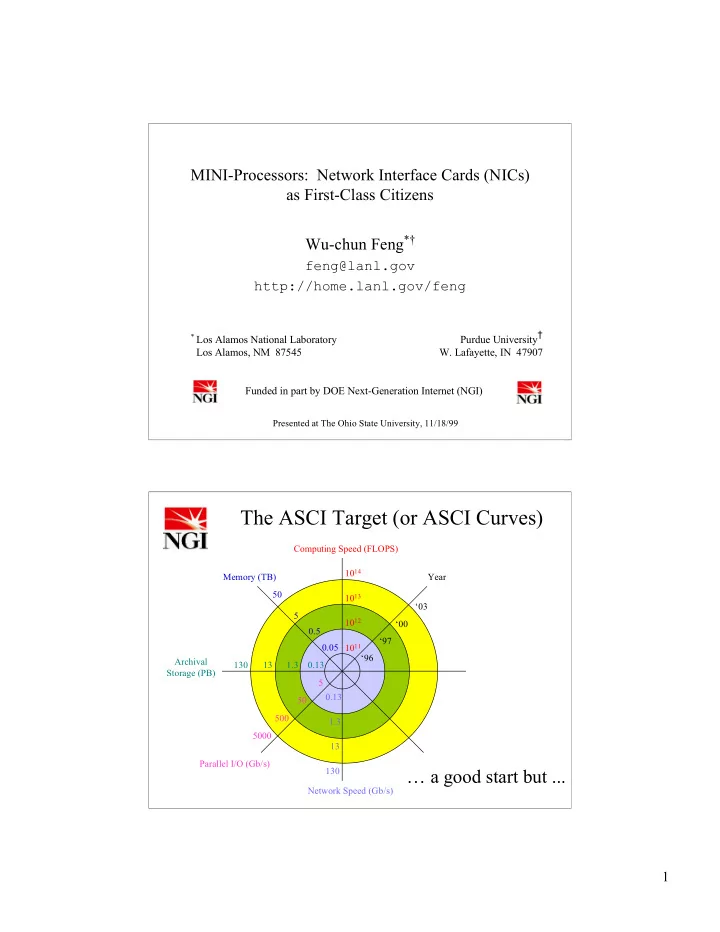
The ASCI Target (or ASCI Curves)

1011 1012 ‘96 ‘97 ‘00 ‘03 Year 1013 1014 Computing Speed (FLOPS) 0.05 0.5 5 50 Memory (TB) 0.13 1.3 13 130 Archival Storage (PB) Parallel I/O (Gb/s) 5 50 500 5000 0.13 1.3 13 130 Network Speed (Gb/s) … a good start but ...

slide-2
SLIDE 2

2

11/22/99 Wu-chun Feng, CIC-5 3

Recent Solutions Between Processor & Network

  • HiPPI-6400 NIC (beta prototype)

– NIC processor to free CPU from network operations. – Hardware capabilities

  • IP checksum
  • Error detection and re-transmission
  • Flow control
  • Low-level messaging operations for OS-bypass protocols.
  • OS-Bypass Protocol

– Orders-of-magnitude reduction in app-to-network latency.

  • Problem

– Application-to-network (vice versa) still a bottleneck!

6400 Mb/s (6.4 Gb/s)

11/22/99 Wu-chun Feng, CIC-5 4

Current PC Technology

Component "Latency" "Bandwidth" CPU 1-2 ns 3.6 Gi/s DRAM access time 60-100 ns 6.4 Gb/s Network link 1 µ s 6.4 Gb/s Memory bus 10 ns 6.4 Gb/s I/O bus 15 ns 1.1 Gb/s Appl-to-network (TCP/IP) 100-150 µ s 0.25-0.50 Gb/s Appl-to-network (OS byp) 3 µ s 0.60-0.90 Gb/s

Goal: Alleviate application/network bottleneck. (Example) Benefits

  • Enable QoS in middleware.
  • WWW ≠ World Wide Wait
  • Remote Viz (FY01): 80 GB/s = 640 Gb/s.
  • High-speed bulk data transfer.

CPU $ Main Memory Memory Bus I/O Bus

I/O Bridge

NIC

6.4 Gb/s 1.1 Gb/s

slide-3
SLIDE 3

3

11/22/99 Wu-chun Feng, CIC-5 5

Trends

  • CPU Speed: Doubling every 1.5 years.
  • Memory Access Speed: 7% - 9% increase / year.
  • Memory Capacity: Quadrupling every 3 years.
  • Network Link BW: Doubling every year.

– 10 Mb/s Ethernet (1988) to 6400 Mb/s HiPPI (1998) The future for I/O Bus and Memory Bus ...

  • PCI-X: 4.3 Gb/s (1Q00)
  • RAMBUS: 9.6 Gb/s, 28.8 Gb/s, 86.4 Gb/s (“now”).

PC technology Supercomputer technology

SGI O2K (now): XIO BW = 6.4 Gb/s max, 0.8 Gb/s actual Problems: Directory-based ccNUMA & 10:1 CPU:NIC ratio.

NICs as First-Class Citizens

CPU $ Main Memory Memory Bus I/O Bus

I/O Bridge

NIC CPU $ Main Memory

I/O Bridge

NIC

I/O Bus Memory Bus

Network

Note: Each node could contain multiple CPUs.

  • Move NIC to memory bus.
  • What’s new?
  • Integrate NIC into memory

subsystem.

  • Treat NIC as a peer CPU.

$

Goals

  • Alleviate application/network

bottleneck.

That is, memory-integrated, network-interface processors (MINI-Processors)

slide-4
SLIDE 4

4

11/22/99 Wu-chun Feng, CIC-5 7

NIC Access ≡ Memory Access

I/O Access Memory Access

Device on I/O bus Memory on memory bus Indirect via operating system (OS) Direct via protected user access Uncached NIC registers Cached NIC registers Ad hoc data movement Cache block transfers Explicit data movement via API Memory-based queue Notification via interrupts Notification via cache invalidation Limited device memory Plentiful memory No out-of-order access & spec. Out-of-order access & spec.

11/22/99 Wu-chun Feng, CIC-5 8

Move NIC from I/O Bus to Memory Bus

  • I/O Bus

+ Standard interface (e.g., PCI) – High latency (e.g., PCI = 10-14 cycles = 300-425 ns) – Low bandwidth (e.g., PCI = 1.1 Gb/s peak bandwidth)

  • Memory Bus

– Non-standard interface but bridges possible (e.g., Intel AGP) + Low latency (e.g., Intel DRAM = 60-100 ns) + High bandwidth (e.g., Intel AGP = 4.2 Gb/s peak bandwidth) + Cache coherency

slide-5
SLIDE 5

5

11/22/99 Wu-chun Feng, CIC-5 9

NIC Access ≡ Memory Access

I/O Access Memory Access

Device on I/O bus Memory on memory bus Indirect via operating system (OS) Direct via protected user access Uncached NIC registers Cached NIC registers Ad hoc data movement Cache block transfers Explicit data movement via API Memory-based queue Notification via interrupts Notification via cache invalidation Limited device memory Plentiful memory No out-of-order access & spec. Out-of-order access & spec.

11/22/99 Wu-chun Feng, CIC-5 10

Virtualize NIC & Bypass OS

  • OS-Based Network Protocols

– High latency to access NIC

  • Packets go through OS via Unix sockets.
  • High DMA initiation overhead.

+ Easy protection of address spaces + Easy address translation for mbufs

  • OS-Bypass Network Protocols (e.g., ST, PM, FM, etc.)

+ Lower-latency and higher-bandwidth access to NIC

  • Use virtual memory HW to virtualize NIC, i.e., memory-map NIC.
  • Bypass OS.
slide-6
SLIDE 6

6

11/22/99 Wu-chun Feng, CIC-5 11

NIC Access ≡ Memory Access

I/O Access Memory Access

Device on I/O bus Memory on memory bus Indirect via operating system (OS) Direct via protected user access Uncached NIC registers Cached NIC registers Ad hoc data movement Cache block transfers Explicit data movement via API Memory-based queue Notification via interrupts Notification via cache invalidation Limited device memory Plentiful memory No out-of-order access & spec. Out-of-order access & spec.

11/22/99 Wu-chun Feng, CIC-5 12

Cache NIC Registers

  • NIC Registers Currently Uncached

– High latency – Low bandwidth – CPU accesses to NIC may have side effects (unlike normal cache memory)

  • Cache NIC Registers in CPU Cache(s)

+ Complementary advantages of the above + Exploit temporal locality – False sharing

slide-7
SLIDE 7

7

NICs as First-Class Citizens

CPU $ Main Memory Memory Bus I/O Bus

I/O Bridge

NIC CPU $ Main Memory

I/O Bridge

NIC

I/O Bus Memory Bus

Network

Note: Each node could contain multiple CPUs.

  • Move NIC to memory bus.
  • What’s new?
  • Integrate NIC into memory

subsystem.

  • Treat NIC as a peer CPU.

$

Goals

  • Alleviate application/network

bottleneck.

That is, memory-integrated, network-interface processors (MINI-Processors)

11/22/99 Wu-chun Feng, CIC-5 14

NIC Access ≡ Memory Access

I/O Access Memory Access

Device on I/O bus Memory on memory bus Indirect via operating system (OS) Direct via protected user access Uncached NIC registers Cached NIC registers Ad hoc data movement Cache block transfers Explicit data movement via API Memory-based queue Notification via interrupts Notification via cache invalidation Limited device memory Plentiful memory No out-of-order access & spec. Out-of-order access & spec.

slide-8
SLIDE 8

8

11/22/99 Wu-chun Feng, CIC-5 15

Transfer Packets via Cache Block Transfers

  • I/O Transfer

– Uncached load/stores to memory-mapped device registers transfer very few bytes – High DMA initiation overhead – User-level DMA has side effects

  • Cache Block Transfer

+ High bandwidth + Memory buses are optimized for cache block transfer + Cache coherency

11/22/99 Wu-chun Feng, CIC-5 16

NIC Access ≡ Memory Access

I/O Access Memory Access

Device on I/O bus Memory on memory bus Indirect via operating system (OS) Direct via protected user access Uncached NIC registers Cached NIC registers Ad hoc data movement Cache block transfers Explicit data movement via API Memory-based queue Notification via interrupts Notification via cache invalidation Limited device memory Plentiful memory No out-of-order access & spec. Out-of-order access & spec.

slide-9
SLIDE 9

9

11/22/99 Wu-chun Feng, CIC-5 17

Memory-Based Queue API

  • Memory-Based Queue API vs. User-Level NIC API

+ Decouples NIC from CPU

  • Sending/receiving packets = reading/writing queue memory
  • Both CPU and NIC can send/receive multiple packets to/from

queues without blocking

+ Avoids side effects by treating NIC queue accesses as side-effect-free memory accesses.

11/22/99 Wu-chun Feng, CIC-5 18

NIC Access ≡ Memory Access

I/O Access Memory Access

Device on I/O bus Memory on memory bus Indirect via operating system (OS) Direct via protected user access Uncached NIC registers Cached NIC registers Ad hoc data movement Cache block transfers Explicit data movement via API Memory-based queue Notification via interrupts Notification via cache invalidation Limited device memory Plentiful memory No out-of-order access & spec. Out-of-order access & spec.

slide-10
SLIDE 10

10

11/22/99 Wu-chun Feng, CIC-5 19

Proper Notification

  • Interrupt

– Heavyweight – Corrupts the cache(s). Adversely affects cache hit rate.

  • Results in added memory-bus traffic.
  • Cache Invalidation

+ “Non-intrusive”

  • NIC invalidates cached NIC register in CPU’s cache.
  • CPU misses on cached but invalidated NIC register & gets

valid NIC register from NIC.

11/22/99 Wu-chun Feng, CIC-5 20

NIC Access ≡ Memory Access

I/O Access Memory Access

Device on I/O bus Memory on memory bus Indirect via operating system (OS) Direct via protected user access Uncached NIC registers Cached NIC registers Ad hoc data movement Cache block transfers Explicit data movement via API Memory-based queue Notification via interrupts Notification via cache invalidation Limited device memory Plentiful memory No out-of-order access & spec. Out-of-order access & spec.

slide-11
SLIDE 11

11

11/22/99 Wu-chun Feng, CIC-5 21

Buffering Packets

  • Use device memory of NIC

– Limited buffer space

  • Use virtual memory

+ Plentiful buffer space Issues

  • Address translation for users’ virtual addresses in NIC.
  • Protected NIC access to main memory.

11/22/99 Wu-chun Feng, CIC-5 22

NIC Access ≡ Memory Access

I/O Access Memory Access

Device on I/O bus Memory on memory bus Indirect via operating system (OS) Direct via protected user access Uncached NIC registers Cached NIC registers Ad hoc data movement Cache block transfers Explicit data movement via API Memory-based queue Notification via interrupts Notification via cache invalidation Limited device memory Plentiful memory No out-of-order access & spec. Out-of-order access & speculation

slide-12
SLIDE 12

12

11/22/99 Wu-chun Feng, CIC-5 23

[NIC Access ≡ Memory Access] Out-of-Order Access Possible

+ Additional scheduling flexibility in a dynamic pipeline.

  • Certain loads/stores

– May be scheduled earlier than other loads/stores – May be completely bypassed

  • CPU may not need to stall ...

11/22/99 Wu-chun Feng, CIC-5 24

NIC Access ≡ Memory Access

I/O Access Memory Access

Device on I/O bus Memory on memory bus Indirect via operating system (OS) Direct via protected user access Uncached NIC registers Cached NIC registers Ad hoc data movement Cache block transfers Explicit data movement via API Memory-based queue Notification via interrupts Notification via cache invalidation Limited device memory Plentiful memory No out-of-order access & spec. Out-of-order access & speculation

slide-13
SLIDE 13

13

11/22/99 Wu-chun Feng, CIC-5 25

Predictions for Next-Generation Supercomputer

  • Bottlenecks

– Application-to-memory interface – Application-to-network interface – Application-to-storage interface

  • Fault Tolerance

– Machine with 10K nodes (each similar to a desktop computer) should have a MTBF that is 10K times worse than a desktop computer! – The question is not whether anything is broken at any given time, but rather how many components are broken (and how the machine works in the presence of broken network links or nodes).

11/22/99 Wu-chun Feng, CIC-5 26

Status

  • Internal interface: Memory access.
  • External interface: Myrinet.

– Problems: Myrinet performance degrades under heavy load. Nearly all other technologies are PCI I/O-based. – Solution: HiPPI-6400 when commercially available. Use Myrinet to prototype for now.

  • Implementation of Intel x86-based simulator underway.
  • DARPA SLAAC1 FPGA card for hardware prototype.

– Linux device driver is done. – Porting of user-mode code is underway.

slide-14
SLIDE 14

14

11/22/99 Wu-chun Feng, CIC-5 27

Future Work

  • Finalization of internal/external interface design. (12/99)
  • Simulator

– Issues to address in presence of a cache-coherent NIC.

  • Optimized bus-based cache-coherency protocol. (4/00)
  • Scalability of system bus. (7/00)

– NIC integration within CPU?

  • Hardware Prototype

– Initial design of hardware prototype. (2/00) – Completion of initial prototype. (7/00) – Simulation results guide evolution of prototype. (Ongoing …)

  • Continuing discussions with Intel.