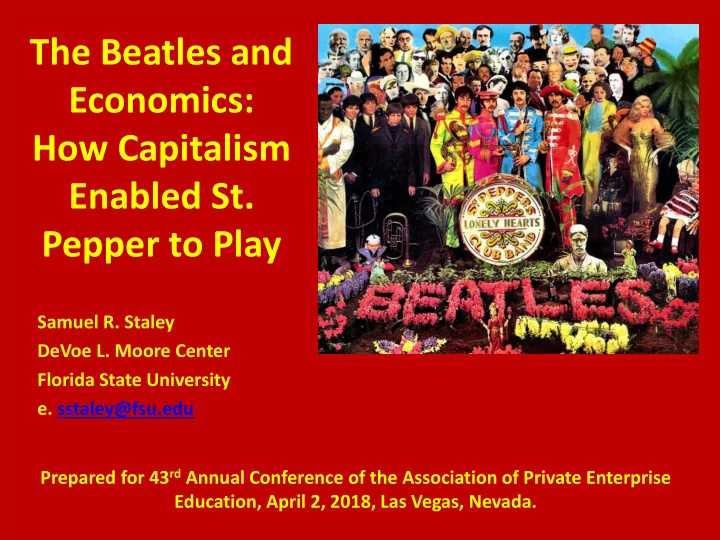
The Beatles and Economics: How Capitalism Enabled St. Pepper to - - PowerPoint PPT Presentation

the beatles and economics how capitalism enabled st
SMART_READER_LITE
LIVE PREVIEW

The Beatles and Economics: How Capitalism Enabled St. Pepper to - - PowerPoint PPT Presentation

The Beatles and Economics: How Capitalism Enabled St. Pepper to Play Samuel R. Staley DeVoe L. Moore Center Florida State University e. sstaley@fsu.edu Prepared for 43 rd Annual Conference of the Association of Private Enterprise Education,


slide-1
SLIDE 1

The Beatles and Economics: How Capitalism Enabled St. Pepper to Play

Samuel R. Staley DeVoe L. Moore Center Florida State University

  • e. sstaley@fsu.edu

Prepared for 43rd Annual Conference of the Association of Private Enterprise Education, April 2, 2018, Las Vegas, Nevada.

slide-2
SLIDE 2

Beatles were the most influential popular music act in the 20th century

  • Best selling band in

history (800 million albums sold)

  • Most number 1 hits on

Billboard’s Hot 100 (20)

  • Rock & Roll Hall of Fame

– Group (1988) – John (1994) – Paul (1999) – George (2004) – Ringo (2015)

APEE, April 2, 2018 Staley, Capitalism and Sgt. Pepper 2

  • Founded in Liverpool, England
  • Active 1960-1970

– Effectively disbanded in 1968

  • Members were not formally

trained on their instruments

slide-3
SLIDE 3

The Beatles

1964 1967

APEE, April 2, 2018 Staley, Capitalism and Sgt. Pepper 3

slide-4
SLIDE 4

The Beatles: A Black Swan event?

  • A Black Swan event is

– Disruptive – Fundamentally reshapes an industry/economy – Cannot be forecast

  • Can economics explain the rise of the

Beatles? Could their rise and influence have been predicted?

  • Sgt. Pepper’s Lonely Hearts Club Band

APEE, April 2, 2018 Staley, Capitalism and Sgt. Pepper 4

slide-5
SLIDE 5
  • Sgt. Pepper’s Lonely Hearts

Club Band

  • Released in 1967
  • 32 million copies sold
  • Watershed album for

music

– Rolling Stone magazine: “most important rock & roll album ever made”

  • Threshold album for the

Beatles

– Largely experimental music but includes a diverse range of music

APEE, April 2, 2018 Staley, Capitalism and Sgt. Pepper 5

slide-6
SLIDE 6

Economics of Sgt. Pepper

  • Inputs (11/66 to 4/67)
  • Compared to previous

albums:

– 30 x hours in recording and editing – 60 x the cost to the studio

  • Five months in the

studio (400 hours)

100 200 300 400 500 600 700 800 Hours

Hours spent recording and editing Beatles albums

Please, Please Me

  • Sgt. Pepper

APEE, April 2, 2018 Staley, Capitalism and Sgt. Pepper 6

slide-7
SLIDE 7

What enabled this effort?

  • Beatles were the top selling/grossing act in

the world

  • Stopped touring in 1966 at the end of their

tour of Japan & Philipines

  • Individual Beatles were independently

wealthy

  • Studio had bank and a bankable act

APEE, April 2, 2018 Staley, Capitalism and Sgt. Pepper 7

slide-8
SLIDE 8

Per Capita GDP (current US$)

APEE, April 2, 2018 Staley, Capitalism and Sgt. Pepper 8

$3,007 $1,380 $479 $3,828 $1,851 $920 $5,247 $2,348 $2,027 $0 $1,000 $2,000 $3,000 $4,000 $5,000 $6,000 USA UK Japan 1960 1965 1970

slide-9
SLIDE 9

Growth in Youth Population

APEE, April 2, 2018 Staley, Capitalism and Sgt. Pepper 9

5,000,000 10,000,000 15,000,000 20,000,000 25,000,000 1930 1940 1950 1960 1970 1980

U.S. Teenage Population Growth

10-14 years old 15-19 years old 20-24 years old Beatles Era

slide-10
SLIDE 10

Teenage workforce was growing

  • Teenage male labor

force participation:

  • 1955: 58.9%
  • 1965: 50.4%
  • 1973: 59.8%
  • Teenage female labor

force participation:

  • 1955: 39.7%
  • 1965: 38.0%
  • 1973: 47.8%
  • Discretionary income

was increasing as the Beatles peaked creatively

APEE, April 2, 2018 Staley, Capitalism and Sgt. Pepper 10 1000 2000 3000 4000 5000 6000 7000 8000 9000 1950 1955 1965 1973

U.S. Teenage Employment (16-19 yrs old)

Employed Men Women

slide-11
SLIDE 11

Conclusions

  • Wealth creation was central to the growth of popular

music

– Funnel resources into growing and emergent niches (e.g., rock music)

  • Monetizing this wealth was crucial to creating the

space for the Beatles to exercise their creativity

– Growth mindset – Not all bands had similar mindsets

  • Conclusion: Free-market capitalism was a necessary

but not sufficient condition for the production and success of Sgt. Pepper’s Lonely Hearts Club Band

APEE, April 2, 2018 Staley, Capitalism and Sgt. Pepper 11