The Best Medicine: Playing with Shelter Dogs October 2, 2014 - - PDF document

the best medicine playing with shelter dogs october 2 2014
SMART_READER_LITE
LIVE PREVIEW

The Best Medicine: Playing with Shelter Dogs October 2, 2014 - - PDF document

The Best Medicine: Playing with Shelter Dogs October 2, 2014 ___________________________________ ___________________________________ ___________________________________ ___________________________________ ___________________________________


slide-1
SLIDE 1

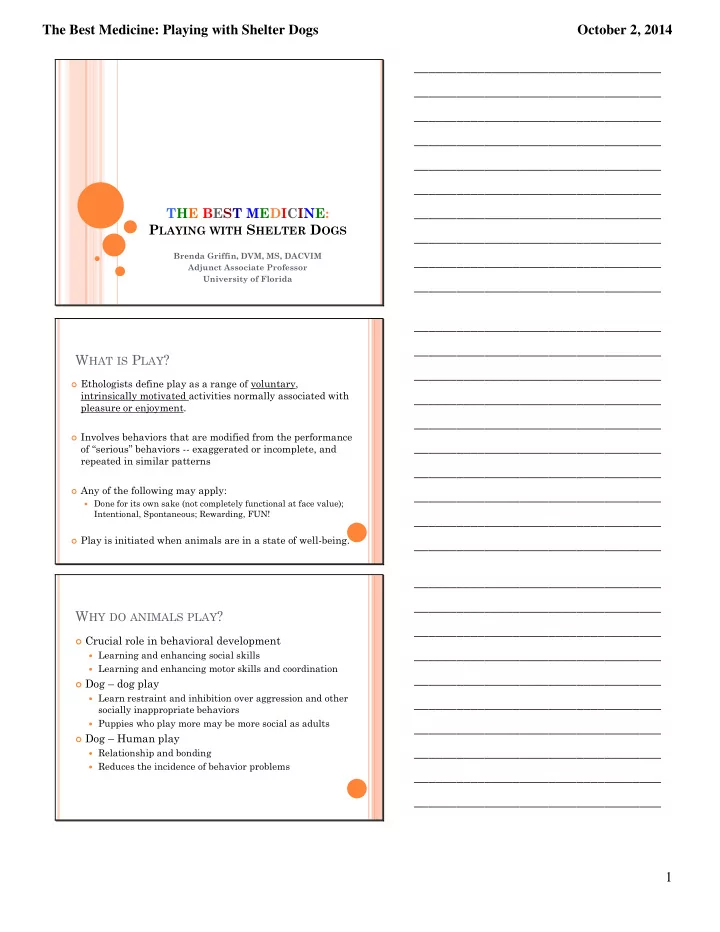
The Best Medicine: Playing with Shelter Dogs October 2, 2014 1 THE BEST MEDICINE: PLAYING WITH SHELTER DOGS

Brenda Griffin, DVM, MS, DACVIM Adjunct Associate Professor University of Florida

___________________________________ ___________________________________ ___________________________________ ___________________________________ ___________________________________ ___________________________________ ___________________________________ ___________________________________ ___________________________________ ___________________________________ WHAT IS PLAY?

 Ethologists define play as a range of voluntary,

intrinsically motivated activities normally associated with pleasure or enjoyment.

 Involves behaviors that are modified from the performance

  • f “serious” behaviors -- exaggerated or incomplete, and

repeated in similar patterns

 Any of the following may apply:  Done for its own sake (not completely functional at face value);

Intentional, Spontaneous; Rewarding, FUN!

 Play is initiated when animals are in a state of well-being.

___________________________________ ___________________________________ ___________________________________ ___________________________________ ___________________________________ ___________________________________ ___________________________________ ___________________________________ ___________________________________ ___________________________________ WHY DO ANIMALS PLAY?

 Crucial role in behavioral development  Learning and enhancing social skills  Learning and enhancing motor skills and coordination  Dog – dog play  Learn restraint and inhibition over aggression and other

socially inappropriate behaviors

 Puppies who play more may be more social as adults  Dog – Human play  Relationship and bonding  Reduces the incidence of behavior problems

___________________________________ ___________________________________ ___________________________________ ___________________________________ ___________________________________ ___________________________________ ___________________________________ ___________________________________ ___________________________________ ___________________________________

slide-2
SLIDE 2

The Best Medicine: Playing with Shelter Dogs October 2, 2014 2 WHAT CONSTITUTES DOG PLAY BEHAVIOR?

 Dog play behavior is comprised of components of

the predatory sequence

 Search (nose)  Stalk  Rush  Chase  Bite/Grab/Hold  Tug/Shake/Kill  Rip/Shred/Chew  Guard your share  Exaggerated, incomplete, repeated in similar sequences

Dog are predators – Play behavior is predatory behavior!

___________________________________ ___________________________________ ___________________________________ ___________________________________ ___________________________________ ___________________________________ ___________________________________ ___________________________________ ___________________________________ ___________________________________ THE LANGUAGE OF PLAY

 “Normal” play is often ROUGH and INTENSE  Owners/caregivers often want to curb it “in case the dog

becomes aggressive”

 Owners/caregivers are not good at ascertaining the

difference between play and aggression

 Studying body language and signaling is key  Play involves ‘give and take’  Pauses or breaks are needed to allow emotions to settle (so

that over-arousal does not occur)

 Play styles and preferences vary  Dogs are individuals

___________________________________ ___________________________________ ___________________________________ ___________________________________ ___________________________________ ___________________________________ ___________________________________ ___________________________________ ___________________________________ ___________________________________ THE LANGUAGE OF PLAY

 Play bow  Open mouthed play face  Low tail wag  Lateral movement

 Side stance/twist/spin

 Exaggerated, repetitive movements

 Bouncing, lunging, face pawing  Approach, retreat

 Chasing

 Chase me posture – jump and tag, jumps backward and looks,

nipping

 Body slamming  Belly up (self-handicapping)  Wrestling/neck biting  Zoomies  Barking – excitement bark, higher tone – or the fun police  Growling  Arousal – piloerection, dilated eyes, wild eyes, high tail – loose/wiggly

___________________________________ ___________________________________ ___________________________________ ___________________________________ ___________________________________ ___________________________________ ___________________________________ ___________________________________ ___________________________________ ___________________________________

slide-3
SLIDE 3

The Best Medicine: Playing with Shelter Dogs October 2, 2014 3 DO DOGS RESPOND TO SIGNALS TO PLAY

FROM HUMANS?

Videotaped 21 owners and their dogs Specific actions used by humans do

communicate a playful context to dogs

Lunging and bowing, especially

combined with vocalizing were the most frequent signals to instigate play

Rooney, Bradshaw, Robinson. Do dogs respond to play signals given by humans? Animal

  • Behaviour. 61(4) 715-722, 2001.

___________________________________ ___________________________________ ___________________________________ ___________________________________ ___________________________________ ___________________________________ ___________________________________ ___________________________________ ___________________________________ ___________________________________ PLAY AND WELFARE

“Animal welfare is usually considered primarily in terms of the animal’s negative experiences. Four of the ‘Five Freedoms’ are freedoms from unpleasant experiences (hunger/thirst; discomfort; pain/injury/disease; fear/distress), and only one potentially addresses positive aspects of welfare (freedom to perform normal behavior). ”

  • Phillips. Animal welfare: A construct of positive and negative

affect? The Veterinary Journal. 175; 291–292, 2008.

___________________________________ ___________________________________ ___________________________________ ___________________________________ ___________________________________ ___________________________________ ___________________________________ ___________________________________ ___________________________________ ___________________________________

Welfare is not merely the absence of negative experiences, but also the presence of positive ones.

___________________________________ ___________________________________ ___________________________________ ___________________________________ ___________________________________ ___________________________________ ___________________________________ ___________________________________ ___________________________________ ___________________________________

slide-4
SLIDE 4

The Best Medicine: Playing with Shelter Dogs October 2, 2014 4 WELFARE MONITORING

 Normal, species typical behaviors  Dogs need to be able to be dogs.  Happy dogs PLAY!

___________________________________ ___________________________________ ___________________________________ ___________________________________ ___________________________________ ___________________________________ ___________________________________ ___________________________________ ___________________________________ ___________________________________ PLAY AS A BEHAVIORAL MARKER OF WELFARE

Animals in positive affective states

may play more frequently

Positive affect enhances cognitive

states, affecting how animal process and learn

Yeates and Main. Vet J. Assessment of positive welfare: a review. 175(3): 293-300. 2007.

___________________________________ ___________________________________ ___________________________________ ___________________________________ ___________________________________ ___________________________________ ___________________________________ ___________________________________ ___________________________________ ___________________________________ THE IMPACT OF POSITIVE VERSUS

NEGATIVE EMOTIONAL STATES

 Human psychology research suggests that

changes in cognitive function (i.e., how we process information) is impacted by our emotional state.

 For example, people in negative states attend to

threats, retrieve negative memories, and make negative judgment about ambiguous stimuli more than happier people.

 Emerging area of animal welfare research:

investigating the possibility that such affect- induced ‘cognitive biases’ also occur in animals.

___________________________________ ___________________________________ ___________________________________ ___________________________________ ___________________________________ ___________________________________ ___________________________________ ___________________________________ ___________________________________ ___________________________________

slide-5
SLIDE 5

The Best Medicine: Playing with Shelter Dogs October 2, 2014 5 ANIMAL EMOTIONS AND WELFARE

 Boissy, Manteuffel, Jensen, et al. Assessment of positive

emotions in animals to improve their welfare. Physiology &

  • Behavior. 92; 375–397. 2007.

 Paul, Harding, Mendl. Measuring emotional processes in

animals: the utility of a cognitive approach. Neuroscience and Biobehavioral Reviews 29; 469–49, 2005.

 Mendl, Burman, Parker, et al. Cognitive bias as an

indicator of animal emotion and welfare: Emerging evidence and underlying mechanisms. Applied Animal Behaviour Science 118, 161–181; 2009.

 Mellor. NZ Vet J. Animal emotions, behaviour and the

promotion of positive welfare states. 60(1):1-8, 2012.  Potential implications for shelter dogs: dogs that experience more positive emotional states are potentially more likely to cope effectively

___________________________________ ___________________________________ ___________________________________ ___________________________________ ___________________________________ ___________________________________ ___________________________________ ___________________________________ ___________________________________ ___________________________________ IT’S CONTAGIOUS:

SOCIAL DIMENSION OF ANIMAL EMOTIONS

 One simple and widespread form of emotional

transfer among animals is the process called emotional contagion that causes animals to shift, upon perceiving animals in an emotional state, their own affective state in the same direction.

 Because this process can multiply both negative

and positive emotions in animal groups, it can be

  • f importance for welfare in domestic and captive

animals.

  • Spinka. Social dimension of emotions and its

implication for animal welfare. Applied Animal Behaviour Science. 138; 170–181, 2012.

___________________________________ ___________________________________ ___________________________________ ___________________________________ ___________________________________ ___________________________________ ___________________________________ ___________________________________ ___________________________________ ___________________________________ BENEFITS OF PLAY

 Provides positive social interaction, aerobic exercise,

mental stimulation

 Positive affect – enhances emotional state, cognition  Decreases stress in shelter dogs  Both play and quiet time with people reduced cortisol

concentrations in shelter dogs.

 Shiverdecker, Schiml, Hennessy. Human interaction moderates

plasma cortisol and behavioral responses of dogs to shelter housing. Physiology & Behavior 109, 75–79, 2013.  Play group dogs - No differences in cortisol, but playgroup

dogs had less stress behaviors

 Belpedio, Buffington, Sarah Clusman, et al. Effect of Multidog Play

Groups on Cortisol Levels and Behavior of Dogs (Canis lupus familiaris) Housed in a Humane Society. Journal of Applied Companion Animal Behavior. 4(1), 2010.

___________________________________ ___________________________________ ___________________________________ ___________________________________ ___________________________________ ___________________________________ ___________________________________ ___________________________________ ___________________________________ ___________________________________

slide-6
SLIDE 6

The Best Medicine: Playing with Shelter Dogs October 2, 2014 6

LAUGHTER IS THE BEST MEDICINE

 Endorphin release  Muscle relaxation / soothes tension  Stress buster  Mood booster  Makes coping with difficult things easier  Facilitates connecting with others  Pain relief  Immune system booster  Play is increasingly used therapeutically by some physicians.

  • -Mayo Clinic

___________________________________ ___________________________________ ___________________________________ ___________________________________ ___________________________________ ___________________________________ ___________________________________ ___________________________________ ___________________________________ ___________________________________

THE NATIONAL INSTITUTE FOR PLAY

 “We envision a near term future where all

existing scientific research related to human play is integrated… and the field of Human Play is a credentialed discipline in the scientific community.”

___________________________________ ___________________________________ ___________________________________ ___________________________________ ___________________________________ ___________________________________ ___________________________________ ___________________________________ ___________________________________ ___________________________________

HOWARD, MCINNES. THE IMPACT OF CHILDREN'S

PERCEPTION OF AN ACTIVITY AS PLAY RATHER THAN NOT PLAY ON EMOTIONAL WELL-BEING. CHILD CARE HEALTH

  • DEV. 2013 SEP;39(5):737-42.

 129 children – age 3 to 5 years  The cues children use to differentiate play and not play were used to

create an activity session that was ‘like play’ and an activity session that was ‘not like play’. The activity itself remained constant.

 Children were allocated to either of the activity session types

alternately and emotional well-being was measured using the Leuvens Involvement Scale.

 Results: Children who undertook the ‘like play’ activity scored

significantly higher on emotional well-being than children who undertook the same activity but ‘not like play’.

 Detailed observational analysis also showed increased behavioural

indicators relating to emotional well-being among children participating in the ‘like play’ rather than ‘not like play’ activity session.

 Conclusion: Children demonstrate increased emotional well-being

when they perceive an activity as play rather than not play. Findings support the proposition that play can be seen as an observable behaviour but also as a mental state, and creating playful learning situations may maximize the developmental potential of play.

___________________________________ ___________________________________ ___________________________________ ___________________________________ ___________________________________ ___________________________________ ___________________________________ ___________________________________ ___________________________________ ___________________________________

slide-7
SLIDE 7

The Best Medicine: Playing with Shelter Dogs October 2, 2014 7 PLAY AND DOG TRAINING

 Play has been used for decades to

enhance dog training

 Motivator, reward  Condition positive emotional responses (make

training fun)

 Reduce stress  Enhance the dog-handler relationship

___________________________________ ___________________________________ ___________________________________ ___________________________________ ___________________________________ ___________________________________ ___________________________________ ___________________________________ ___________________________________ ___________________________________ RESILIENCE

 In psychiatry, resilience describes an individual’s

capacity to recover from extremes of emotional trauma and stress.

 Resilience is influenced by many factors

including genetics, early life experiences, personality, neurobiology, and many others.

 The influence of play on emotional resilience will

likely be a hot topic in the future.

___________________________________ ___________________________________ ___________________________________ ___________________________________ ___________________________________ ___________________________________ ___________________________________ ___________________________________ ___________________________________ ___________________________________ WHY PLAY WITH SHELTER DOGS

 Enhance social and cognitive skills; enrichment,

social interaction, exercise, mental stimulation, stress reduction, enhances welfare, promotes positive emotional states, enhances training

 Why else?  THE POWER OF CONNECTION  Engage the dog and connect!

___________________________________ ___________________________________ ___________________________________ ___________________________________ ___________________________________ ___________________________________ ___________________________________ ___________________________________ ___________________________________ ___________________________________

slide-8
SLIDE 8

The Best Medicine: Playing with Shelter Dogs October 2, 2014 8

PROTOPOPOVA, WYNNE. ADOPTER-DOG

INTERACTIONS AT THE SHELTER: BEHAVIORAL AND CONTEXTUAL PREDICTORS OF ADOPTION. APPL. ANIM.

  • BEHAV. SCI. (2014).

 Only two behaviors predicted the likelihood of

adoption during an interaction with a potential adopter:

 Ignoring play initiation by the potential adopter – very

low likelihood of adoption

 Lying down in the proximity of the potential adopter –

14 times more likely to be adopted

___________________________________ ___________________________________ ___________________________________ ___________________________________ ___________________________________ ___________________________________ ___________________________________ ___________________________________ ___________________________________ ___________________________________

WEISS, MILLER, ET AL. WHY DID YOU CHOOSE THIS PET?: ADOPTERS AND PET SELECTION PREFERENCES

IN FIVE ANIMAL SHELTERS IN THE UNITED STATES.

ANIMALS 2012, 2(2), 144-159.

 Dogs – physical appearance #1 for adults and

puppies (age also very important)

 Behavior with people and playfulness were the

next most important reasons

 Interacting with the animal out of his/her

enclosure was highly important to adopters

___________________________________ ___________________________________ ___________________________________ ___________________________________ ___________________________________ ___________________________________ ___________________________________ ___________________________________ ___________________________________ ___________________________________ INCREASING ADOPTER APPEAL

“You can discover more about a person in an hour

  • f play than in a year of conversation.”
  • -Plato

“You can discover more about a person dog in an hour of play than in a year of conversation looking at him in a kennel.”

  • -Joe Adopter

PLAY IS A POWERFUL WAY TO CONNECT ___________________________________ ___________________________________ ___________________________________ ___________________________________ ___________________________________ ___________________________________ ___________________________________ ___________________________________ ___________________________________ ___________________________________

slide-9
SLIDE 9

The Best Medicine: Playing with Shelter Dogs October 2, 2014 9 WHY PLAY WITH SHELTER DOGS?

 Because it is a FUN!  Good for the dogs  Good for the people (staff, volunteers, adopters)  Play promotes social connection  The best medicine for all!

___________________________________ ___________________________________ ___________________________________ ___________________________________ ___________________________________ ___________________________________ ___________________________________ ___________________________________ ___________________________________ ___________________________________ TYPES OF PLAY

 Playing with conspecifics (dog-dog play)  Benefits of healthy playgroups  Dogs are experts at teaching dogs  Aimee Sadler – Playing for Life  Population medicine!  Also great for foster dogs  Playing with people  Toy (object) play  Food (play) games  Physical play  For dogs in the shelter and in foster care!

___________________________________ ___________________________________ ___________________________________ ___________________________________ ___________________________________ ___________________________________ ___________________________________ ___________________________________ ___________________________________ ___________________________________ THINK LIKE A PREDATOR—WHAT’S FUN?

 Running games  Chasing games  Hunting games (sniffing games)  Seek and destroy games  Jumping games  Mind games  Anything “fun” has game potential!

___________________________________ ___________________________________ ___________________________________ ___________________________________ ___________________________________ ___________________________________ ___________________________________ ___________________________________ ___________________________________ ___________________________________

slide-10
SLIDE 10

The Best Medicine: Playing with Shelter Dogs October 2, 2014 10 MY TOP 3 FAVORITE GAMES TO PLAY WITH DOGS

1.

Fetch

2.

Tug

3.

Chase

___________________________________ ___________________________________ ___________________________________ ___________________________________ ___________________________________ ___________________________________ ___________________________________ ___________________________________ ___________________________________ ___________________________________ TOY PLAY

 Case example: Cody  Toy selection  Fetch  Chase IT  Tug  Toy play is a foundation for off lead control:

Leash comes off – toy comes out!

___________________________________ ___________________________________ ___________________________________ ___________________________________ ___________________________________ ___________________________________ ___________________________________ ___________________________________ ___________________________________ ___________________________________ ___________________________________ ___________________________________ ___________________________________ ___________________________________ ___________________________________ ___________________________________ ___________________________________ ___________________________________ ___________________________________ ___________________________________

slide-11
SLIDE 11

The Best Medicine: Playing with Shelter Dogs October 2, 2014 11 ___________________________________ ___________________________________ ___________________________________ ___________________________________ ___________________________________ ___________________________________ ___________________________________ ___________________________________ ___________________________________ ___________________________________ ___________________________________ ___________________________________ ___________________________________ ___________________________________ ___________________________________ ___________________________________ ___________________________________ ___________________________________ ___________________________________ ___________________________________ ___________________________________ ___________________________________ ___________________________________ ___________________________________ ___________________________________ ___________________________________ ___________________________________ ___________________________________ ___________________________________ ___________________________________

slide-12
SLIDE 12

The Best Medicine: Playing with Shelter Dogs October 2, 2014 12 ___________________________________ ___________________________________ ___________________________________ ___________________________________ ___________________________________ ___________________________________ ___________________________________ ___________________________________ ___________________________________ ___________________________________ ___________________________________ ___________________________________ ___________________________________ ___________________________________ ___________________________________ ___________________________________ ___________________________________ ___________________________________ ___________________________________ ___________________________________ ___________________________________ ___________________________________ ___________________________________ ___________________________________ ___________________________________ ___________________________________ ___________________________________ ___________________________________ ___________________________________ ___________________________________

slide-13
SLIDE 13

The Best Medicine: Playing with Shelter Dogs October 2, 2014 13 TOY PLAY AND MARKETING

 Suspending a toy at the front of the pen exerted

no effect on dog behavior, although its presence in the pen promoted interest, possibly more positive perceptions of dog desirability.

Wells, D.L., Hepper, P.G., 2000. The influence of environmental change on the behaviour of sheltered dogs.

  • Appl. Anim. Behav. Sci. 68, 151–162.

___________________________________ ___________________________________ ___________________________________ ___________________________________ ___________________________________ ___________________________________ ___________________________________ ___________________________________ ___________________________________ ___________________________________ KEEP IT FRESH!

 Dogs habituate quickly  Developing toy drive – absence makes the heart

grow fonder

TOY SELECTION ___________________________________ ___________________________________ ___________________________________ ___________________________________ ___________________________________ ___________________________________ ___________________________________ ___________________________________ ___________________________________ ___________________________________ ___________________________________ ___________________________________ ___________________________________ ___________________________________ ___________________________________ ___________________________________ ___________________________________ ___________________________________ ___________________________________ ___________________________________

slide-14
SLIDE 14

The Best Medicine: Playing with Shelter Dogs October 2, 2014 14 ___________________________________ ___________________________________ ___________________________________ ___________________________________ ___________________________________ ___________________________________ ___________________________________ ___________________________________ ___________________________________ ___________________________________ ___________________________________ ___________________________________ ___________________________________ ___________________________________ ___________________________________ ___________________________________ ___________________________________ ___________________________________ ___________________________________ ___________________________________

J O L L Y B A L L

___________________________________ ___________________________________ ___________________________________ ___________________________________ ___________________________________ ___________________________________ ___________________________________ ___________________________________ ___________________________________ ___________________________________ ___________________________________ ___________________________________ ___________________________________ ___________________________________ ___________________________________ ___________________________________ ___________________________________ ___________________________________ ___________________________________ ___________________________________ ___________________________________ ___________________________________ ___________________________________ ___________________________________ ___________________________________ ___________________________________ ___________________________________ ___________________________________ ___________________________________ ___________________________________ ___________________________________ ___________________________________ ___________________________________ ___________________________________ ___________________________________ ___________________________________ ___________________________________ ___________________________________ ___________________________________ ___________________________________ ___________________________________ ___________________________________ ___________________________________

slide-15
SLIDE 15

The Best Medicine: Playing with Shelter Dogs October 2, 2014 15 MEET BOOGIE WOOGIE PIT BULL: ___________________________________ ___________________________________ ___________________________________ ___________________________________ ___________________________________ ___________________________________ ___________________________________ ___________________________________ ___________________________________ ___________________________________ FETCH!

 An easy & fun way to teach a dog to play fetch is to use the 2-toy method.  Get 2 identical dog toys -- plush dog toys or a ball or whatever the dog likes.  Offer the toy and let the dog play with it – Don’t take it away from him!  Then, wave the other toy – he will likely drop the first one and grab the

second one. Alternate the toys, playfully teasing the dog to entice him.

 Next, begin tossing one of the toys – only a couple of feet at first. As soon as

the dog goes to get the toy, call and encourage him to come back – run backwards to encourage him to follow if necessary. When he reaches you, show the other toy. He will probably want to get the other toy. He may drop the other one he has – or you can trade him for a treat. Then, throw the second toy. He will then run after it and you can start the process over

  • again. Start slowly and build up over time.

 Always stop for the day before your dog tires of the game.  NOTE: Special toys designated for FETCH should be put away unless you

are actually playing the game– this will help to keep them fresh and enticing, leaving the dog wanting more.

___________________________________ ___________________________________ ___________________________________ ___________________________________ ___________________________________ ___________________________________ ___________________________________ ___________________________________ ___________________________________ ___________________________________ CHASE IT!

 BE THE SQUIRREL!

___________________________________ ___________________________________ ___________________________________ ___________________________________ ___________________________________ ___________________________________ ___________________________________ ___________________________________ ___________________________________ ___________________________________

slide-16
SLIDE 16

The Best Medicine: Playing with Shelter Dogs October 2, 2014 16 CHASE IT STICKS LUNGE WHIP + BRAIDED FLEECE ___________________________________ ___________________________________ ___________________________________ ___________________________________ ___________________________________ ___________________________________ ___________________________________ ___________________________________ ___________________________________ ___________________________________ ___________________________________ ___________________________________ ___________________________________ ___________________________________ ___________________________________ ___________________________________ ___________________________________ ___________________________________ ___________________________________ ___________________________________ ___________________________________ ___________________________________ ___________________________________ ___________________________________ ___________________________________ ___________________________________ ___________________________________ ___________________________________ ___________________________________ ___________________________________

slide-17
SLIDE 17

The Best Medicine: Playing with Shelter Dogs October 2, 2014 17

CHASE IT!

 1. "Be the squirrel!" -- Use the pole to move the

toy on the ground--> erratic motion --> quick hop in the air!!!

 2. Let dog capture it occasionally.  3. Release for treat (toss treat to free the

squirrel!)

 4. Take breaks (squirrel stops moving)  5. Finally, the squirrel dies and the game ends.  6. Always leave 'em wanting more!

___________________________________ ___________________________________ ___________________________________ ___________________________________ ___________________________________ ___________________________________ ___________________________________ ___________________________________ ___________________________________ ___________________________________

CHASE IT!

 Commercially available  Kong Chase It squirrel; Vee Chase and Pull (Clean Run)  Or, make your own very easily using a horse lunge whip

and a dog toy!

___________________________________ ___________________________________ ___________________________________ ___________________________________ ___________________________________ ___________________________________ ___________________________________ ___________________________________ ___________________________________ ___________________________________

“TUG”

Dog owners have been admonished for

decades not to play “tug of war” because of the risk of increasing aggression and/or dominance

This behavior is not an agonistic behavior

(it has nothing to do with conflict resolution between dogs or defensive aggression)

This is a predatory behavior (chase, grab,

shake) Jean Donaldson

___________________________________ ___________________________________ ___________________________________ ___________________________________ ___________________________________ ___________________________________ ___________________________________ ___________________________________ ___________________________________ ___________________________________

slide-18
SLIDE 18

The Best Medicine: Playing with Shelter Dogs October 2, 2014 18 DOES PLAYING TUG-OF-WAR AFFECT THE

DOG-HUMAN RELATIONSHIP?

 If the dog “wins”, is the dog establishing dominance?  14 Golden Retrievers – 24 sessions of tug

 ‘Allowed to win’ group  ‘Always lost’ group

 Relationship with the experimenter was assessed, via a composite

behavioral test, once at the outset and once after each treatment

 “Dominance” not affected  All dogs scored higher for obedient attentiveness after play

treatments, irrespective of whether they won or lost.

 Dogs were more likely to playfully seek attention and were more into

the game if allowed to win. Rooney and Bradshaw. An experimental study of the effects of play upon the dog human relationship. Applied Animal Behaviour Science. 75; 161-176, 2002.

___________________________________ ___________________________________ ___________________________________ ___________________________________ ___________________________________ ___________________________________ ___________________________________ ___________________________________ ___________________________________ ___________________________________ “TUG”

 Dogs do not ascertain rank by grabbing hold of

an object and tugging to see “who wins”

 It is a cooperative behavior and very often when

  • ne “wins”, the game begins again as they re-

engage in tug

___________________________________ ___________________________________ ___________________________________ ___________________________________ ___________________________________ ___________________________________ ___________________________________ ___________________________________ ___________________________________ ___________________________________ “TUG”

Played with rules, tug of war is a

tremendous predatory energy burner and good exercise for dog and owner

The game does not make the dog a predator:

he already is one.

___________________________________ ___________________________________ ___________________________________ ___________________________________ ___________________________________ ___________________________________ ___________________________________ ___________________________________ ___________________________________ ___________________________________

slide-19
SLIDE 19

The Best Medicine: Playing with Shelter Dogs October 2, 2014 19

BENEFITS OF “TUG”

Outstanding outlet for predatory behavior Efficient in terms of space and time

requirements

A solution to cabin fever! Especially important for high drive dogs to

have such an outlet: reduces the risk of behavior problems from under-stimulation/ arousal problems

Helps teach impulse control – ON/OFF! Great training reward

TUG TOYS ___________________________________ ___________________________________ ___________________________________ ___________________________________ ___________________________________ ___________________________________ ___________________________________ ___________________________________ ___________________________________ ___________________________________ ___________________________________ ___________________________________ ___________________________________ ___________________________________ ___________________________________ ___________________________________ ___________________________________ ___________________________________ ___________________________________ ___________________________________ ___________________________________ ___________________________________ ___________________________________ ___________________________________ ___________________________________ ___________________________________ ___________________________________ ___________________________________ ___________________________________ ___________________________________

slide-20
SLIDE 20

The Best Medicine: Playing with Shelter Dogs October 2, 2014 20 ___________________________________ ___________________________________ ___________________________________ ___________________________________ ___________________________________ ___________________________________ ___________________________________ ___________________________________ ___________________________________ ___________________________________ ___________________________________ ___________________________________ ___________________________________ ___________________________________ ___________________________________ ___________________________________ ___________________________________ ___________________________________ ___________________________________ ___________________________________ ___________________________________ ___________________________________ ___________________________________ ___________________________________ ___________________________________ ___________________________________ ___________________________________ ___________________________________ ___________________________________ ___________________________________

slide-21
SLIDE 21

The Best Medicine: Playing with Shelter Dogs October 2, 2014 21 ___________________________________ ___________________________________ ___________________________________ ___________________________________ ___________________________________ ___________________________________ ___________________________________ ___________________________________ ___________________________________ ___________________________________

“TUG”

An intense game When you are playing it, you are playing

together

It is you and your dog against the toy:

together you are making the kill!

This is very pleasurable for the dog and is

a bonding experience!

It is not about rank, but cooperation But, there are rules to be learned…

___________________________________ ___________________________________ ___________________________________ ___________________________________ ___________________________________ ___________________________________ ___________________________________ ___________________________________ ___________________________________ ___________________________________

TUG

 Encourage the dog to grab a toy – find one he likes and wave it in front of him.

Reward him for getting it by allowing him to have it. Get it back from him after a minute by “trading” him the toy for a tasty treat. Then, wave the toy again. Gradually work up to tugging – some dogs are naturals, others will need more encouragement.

 Once the dog is “into” the game, it is time to begin teaching him some rules to play by:  Teach him to leave the toy on command

Have a release command such as “out”, “leave it” or “mine”

The dog releases, gets a food reward, then command to re-take it (“tug”, “get it”, “yours”

The dog gets used to having it, releasing it, receiving a reward, being presented with it again

 Dog may not take or re-take the object until invited to do so

The penalty for doing so is a time out (game ends)

 Zero tolerance for accidental nips

The game ends

 As long as the dog plays by these rules, he can get as excited as he wants!

Shake, growl, tug, tug, TUG! FUN!!

 Always stop for the day before your dog tires of the game!

___________________________________ ___________________________________ ___________________________________ ___________________________________ ___________________________________ ___________________________________ ___________________________________ ___________________________________ ___________________________________ ___________________________________

slide-22
SLIDE 22

The Best Medicine: Playing with Shelter Dogs October 2, 2014 22 ___________________________________ ___________________________________ ___________________________________ ___________________________________ ___________________________________ ___________________________________ ___________________________________ ___________________________________ ___________________________________ ___________________________________ BENEFITS OF TOY PLAY

 68 family dogs, 2 games (ball and tug), 2 handlers  Examined factors that influenced play  Play motivated more by motivation to play and

fear (or lack thereof) than by familiarity of play partner

 Dogs that received more playful interaction with

their owner were less likely to show fear during play in an unfamiliar place.

 These dogs showed either stronger motivation to

play tugging or decreased inhibition.

Toth, Gacsi, Jozsef et al. Playing styles and possible causative factors in dogs’ behaviour when playing with

  • humans. Applied Animal Behaviour Science 114; 473–484,

2008.

___________________________________ ___________________________________ ___________________________________ ___________________________________ ___________________________________ ___________________________________ ___________________________________ ___________________________________ ___________________________________ ___________________________________ FOOD PLAY = PLAYING GAMES WITH FOOD!

 Get It – Get it (food toss) Game  Chase ME Game  Catch  See It – Drop It  Incorporating targets  Get It – Get it Game – Target Version  Place  Find It Games (nose work, food puzzles)

___________________________________ ___________________________________ ___________________________________ ___________________________________ ___________________________________ ___________________________________ ___________________________________ ___________________________________ ___________________________________ ___________________________________

slide-23
SLIDE 23

The Best Medicine: Playing with Shelter Dogs October 2, 2014 23

FOOD SELECTION

___________________________________ ___________________________________ ___________________________________ ___________________________________ ___________________________________ ___________________________________ ___________________________________ ___________________________________ ___________________________________ ___________________________________ GET IT GET IT (FOOD TOSS) GAME

 Toss food left – GET IT GET IT – toss food right –

GET IT GET IT -- Toss food left – GET IT GET IT – toss food right – GET IT GET IT – repeat sequence a couple of times…

 Start with a short toss at first – get your dog’s

attention and be sure he sees you toss the treat.

 Using a treat that is a contrasting color compared to

floor will help him see it and easily succeed. When he gets the first treat, wait until he turns back to look at you and then toss the next treat in the opposite direction…. And so forth…

___________________________________ ___________________________________ ___________________________________ ___________________________________ ___________________________________ ___________________________________ ___________________________________ ___________________________________ ___________________________________ ___________________________________ CHASE ME

 One absolute rule: It’s one-way only:  The dog should chase you and not the other way around (don’t

encourage the dog running from you)

 To play the game, run away from the dog—make some noise, clapping

& giggling are good

 This will encourage him to run towards you  When he is only a few feet away, toss treats or a toy behind you (even

through your legs) so he keeps running in your direction

 Then turn and run the other way  You only have to run 5 or 10 feet to play!  Know when to stop:  If chase leads to ‘nip my owner’s leg’, then the game stops (try a toy or

food toss to divert him)

 Not for young kids to play for this reason  This teaches your dog: running to you is fun! This is a great

foundation for a fun and reliable recall.

 Intersperse chase games and obedience commands for a fun session!  Note: This game is often very good for shy/anxious dogs – can be

confidence building. It is not always good for mouthy/jumpy dogs – it can encourage unruly behavior!

___________________________________ ___________________________________ ___________________________________ ___________________________________ ___________________________________ ___________________________________ ___________________________________ ___________________________________ ___________________________________ ___________________________________

slide-24
SLIDE 24

The Best Medicine: Playing with Shelter Dogs October 2, 2014 24 CATCH

 If your dog likes popcorn, it is a great tool to use

to teach them this trick – light, big, fluffy, easy to see—and relatively easy to catch.

 Buy a bag and toss them one kernel at the time.  Some dogs don’t try to catch at first – but as the

kernels fly gently in their face, they will try!

 Watch those motor skills improve!  Coordination may take time, but they will

develop skill in time!

 Catching is fun and often quite amusing for all

involved.

___________________________________ ___________________________________ ___________________________________ ___________________________________ ___________________________________ ___________________________________ ___________________________________ ___________________________________ ___________________________________ ___________________________________

SEE IT – DROP IT

 This game uses food to teach impulse control –

the dog learns to wait and look at the food before being cued to GET IT GET IT!

 The game progresses from gently restraining the

dog so that he waits and sees it, to the dog doing this on his own, to the dog doing it even if the treat is dropped or tossed.

 The handler patiently helps the dog succeed with

a playful attitude.

 Short sessions will prevent frustration and keep

the dog (and handler) in the game.

 This is a handy way to teach stay – all the while

the dog just thinks it is a fun game!

___________________________________ ___________________________________ ___________________________________ ___________________________________ ___________________________________ ___________________________________ ___________________________________ ___________________________________ ___________________________________ ___________________________________

TARGETS ARE FUN!

 In dog training, a "target" is anything that the dog

must focus on and perform some action towards.

 Trainers use targets to help get dogs into the position

they want – or to perform the behaviors that want them to perform.

 Dogs tend to develop strong positive associations with

targets – they provide a positive focal point, which is especially helpful for dogs that tend to “worry” or for those that are very “busy”… Focusing on the target is a great thing!

 Targets are very useful for building many skills –

(playing many games!) and can be faded as necessary

  • ver time.

___________________________________ ___________________________________ ___________________________________ ___________________________________ ___________________________________ ___________________________________ ___________________________________ ___________________________________ ___________________________________ ___________________________________

slide-25
SLIDE 25

The Best Medicine: Playing with Shelter Dogs October 2, 2014 25

TARGETS!

___________________________________ ___________________________________ ___________________________________ ___________________________________ ___________________________________ ___________________________________ ___________________________________ ___________________________________ ___________________________________ ___________________________________ PLACE

 “Place” is a type of “target game” – In this case, the

dog’s target is his “place” (a bed, a mat, a platform – whatever you have chosen it to be). As you play this game, the dog will become very confident that it is a good place for him to be.

 The game is to make him choose to go there – and

when he does, he earns a reward.

 An excellent way to train this exercise is through

“shaping” – this means you will reward successive approximations of the behavior (eg. reward when dog has one foot on the place, 2 feet on it and so forth), gradually raising the criteria for a reward until the dog is completely on his place.

___________________________________ ___________________________________ ___________________________________ ___________________________________ ___________________________________ ___________________________________ ___________________________________ ___________________________________ ___________________________________ ___________________________________ PLACE

 Begin no more than a foot away from the “place”. Try to

refrain from luring the dog to the place. The plan is to “get him to do it himself” and then reward him for it.

 The dog needs to know you have treats (and needs to be

motivated by that) – his problem is to figure out how to earn the treats.

 Stare at the place – use your body language if you need

to help him (lean towards the place) but try to refrain from luring him with your hand or leash. Begin to click (or use your reward word) and reward him with treats for each contact with his place.

 If your dog is not comfortable with the mat or platform

that you have chosen for his place, allow him to become familiar with it – encourage him to sniff it, walk over it…

___________________________________ ___________________________________ ___________________________________ ___________________________________ ___________________________________ ___________________________________ ___________________________________ ___________________________________ ___________________________________ ___________________________________

slide-26
SLIDE 26

The Best Medicine: Playing with Shelter Dogs October 2, 2014 26 PLACE

 Wonderful for shy dogs – confidence building – great for

them to go to their place and then meet someone – because after all, only GREAT things happen when they are on their place!

 Also helpful for dogs that need to learn impulse control!  After the dog readily goes to his place when you stand

next to it, then it is time to add the command “Place”.

 The next step is to work from a little farther distance

away – stand back from the place a couple of feet and stare at it – stay at this distance until the dog goes to his “place” all by himself. Gradually increase the distance you are from the place in small increments.

___________________________________ ___________________________________ ___________________________________ ___________________________________ ___________________________________ ___________________________________ ___________________________________ ___________________________________ ___________________________________ ___________________________________ PHYSICAL PLAY

 Tag  Hide and seek  Go wild and freeze  Touch, spin and other “fun” behaviors

___________________________________ ___________________________________ ___________________________________ ___________________________________ ___________________________________ ___________________________________ ___________________________________ ___________________________________ ___________________________________ ___________________________________

“PRESCRIBING” PLAY

 For behavioral wellness  Practical shelter protocols  Play to learn good behavioral skills – Playing “Skames”  For behavior modification  Dogs with poor impulse control (jumpy/mouthy/easily

aroused)

 Shy/fearful/anxious dogs  Dogs with kennel stress

___________________________________ ___________________________________ ___________________________________ ___________________________________ ___________________________________ ___________________________________ ___________________________________ ___________________________________ ___________________________________ ___________________________________

slide-27
SLIDE 27

The Best Medicine: Playing with Shelter Dogs October 2, 2014 27

“PRESCRIBING” PLAY

 For behavioral wellness  Practical shelter protocols  Play to learn good behavioral skills – Playing “Skames”  Use it to improve welfare and to market dogs for adoption.

___________________________________ ___________________________________ ___________________________________ ___________________________________ ___________________________________ ___________________________________ ___________________________________ ___________________________________ ___________________________________ ___________________________________

NO EXACT RULES

 Pick games that work for your population  Of dogs and people  Great timing not required  It takes some knowledge of canine body

language/signaling – plus common sense, compassion and a light heart.

 Start simple – set up for fun and success  Target dogs who need play the most

___________________________________ ___________________________________ ___________________________________ ___________________________________ ___________________________________ ___________________________________ ___________________________________ ___________________________________ ___________________________________ ___________________________________ “PRESCRIBING” PLAY

 For behavior modification  Dogs with poor impulse control (jumpy/mouthy/easily aroused)  Shy/fearful/anxious dogs  Dogs with kennel stress  Play has tremendous potential as a healing therapy to improve

behavioral health

___________________________________ ___________________________________ ___________________________________ ___________________________________ ___________________________________ ___________________________________ ___________________________________ ___________________________________ ___________________________________ ___________________________________

slide-28
SLIDE 28

The Best Medicine: Playing with Shelter Dogs October 2, 2014 28 KEEP IT SIMPLE: TWO THINGS TO REMEMBER

 No motivation, no training. (No motivation, no

change in behavior.)

 Food must be “delicious” to the subject

 May have to discover it in privacy  Create food drive!

 Toys must be engaging

 Let the subject choose and let him have it for a little while  Create toy drive

 Practicing “bad” behavior is not allowed!  If play is triggering/increasing negative emotions or

inappropriate behaviors, find a new game.

___________________________________ ___________________________________ ___________________________________ ___________________________________ ___________________________________ ___________________________________ ___________________________________ ___________________________________ ___________________________________ ___________________________________ PLAY IS THE BEST MEDICINE FOR SHELTER DOGS

 Play is enriching – physically, emotionally & socially  Play reduces stress  Play enhances social skills  Play enhances training/learning  Play enhances emotional state  Play likely enhances emotional resilience  Play is contagious  Play helps us get to “know” shelter dogs  Play helps dogs make connections with people

Play is healthy for them—& us. Plus, it’s

FUN! ___________________________________ ___________________________________ ___________________________________ ___________________________________ ___________________________________ ___________________________________ ___________________________________ ___________________________________ ___________________________________ ___________________________________ Because the ability to play is

  • ne of the most beneficial

activities for emotional health and wellbeing, shelter veterinarians should strive to identify and recommend specific types of play for dogs as means of improving their behavioral health, while enhancing their social skills with people and/or other dogs and their adoptability. ___________________________________ ___________________________________ ___________________________________ ___________________________________ ___________________________________ ___________________________________ ___________________________________ ___________________________________ ___________________________________ ___________________________________

slide-29
SLIDE 29

The Best Medicine: Playing with Shelter Dogs October 2, 2014 29

“It is a happy talent to know how to play.” ― Ralph Waldo Emerson

___________________________________ ___________________________________ ___________________________________ ___________________________________ ___________________________________ ___________________________________ ___________________________________ ___________________________________ ___________________________________ ___________________________________ ___________________________________ ___________________________________ ___________________________________ ___________________________________ ___________________________________ ___________________________________ ___________________________________ ___________________________________ ___________________________________ ___________________________________