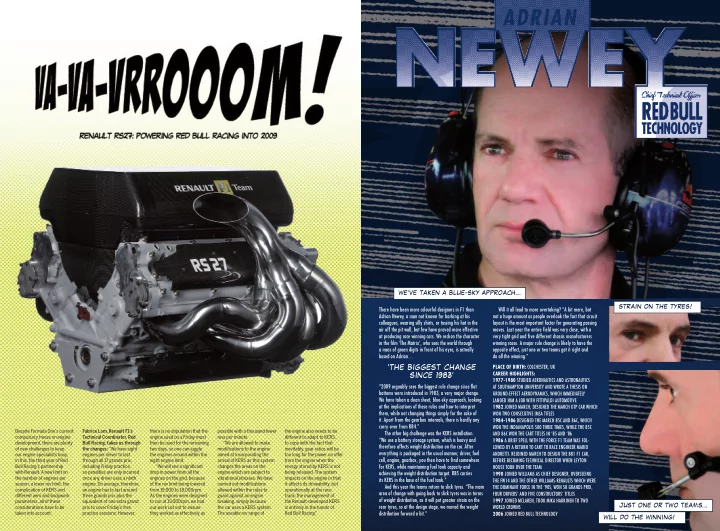

just one or two teams... will do the winning! strain on the tyres! we’ve taken a blue-sky approach... There have been more colourful designers in F1 than Adrian Newey, a man not known for barking at his colleagues, wearing silly shirts, or tossing his hat in the air off the pit wall, but few have proved more effective at producing race winning cars. We reckon the character in the film ‘The Matrix’, who sees the world through a mass of green digits in front of his eyes, is actually based on Adrian…
‘the biggest change since 1983’
“2009 arguably sees the biggest rule change since flat bottoms were introduced in 1983, a very major change. We have taken a clean sheet, blue-sky approach, looking at the implications of these rules and how to interpret them, while not changing things simply for the sake of
- it. Apart from the gearbox internals, there is hardly any
carry-over from RB4.” The other big challenge was the KERS installation. “We use a battery storage system, which is heavy and therefore affects weight distribution on the car. After everything is packaged in the usual manner, driver, fuel cell, engine, gearbox, you then have to find somewhere for KERS, while maintaining fuel tank capacity and achieving the weight distribution target. RB5 carries its KERS in the base of the fuel tank.” And this year the teams return to slick tyres. “The main area of change with going back to slick tyres was in terms
- f weight distribution, as it will put greater strain on the
rear tyres, so at the design stage, we moved the weight distribution forward a bit.” Will it all lead to more overtaking? “A bit more, but not a huge amount as people overlook the fact that circuit layout is the most important factor for generating passing
- moves. Last year the entire field was very close, with a
very tight grid and five different chassis manufacturers winning races. A major rule change is likely to have the
- pposite effect, just one or two teams get it right and
do all the winning.”
PLACE OF BIRTH: COLCHESTER, UK CAREER HIGHLIGHTS: 1977-1980 STUDIED AERONAUTICS AND ASTRONAUTICS AT SOUTHAMPTON UNIVERSITY AND WROTE A THESIS ON GROUND-EFFECT AERODYNAMICS, WHICH IMMEDIATELY LANDED HIM A JOB WITH FITTIPALDI AUTOMOTIVE 1982 JOINED MARCH, DESIGNED THE MARCH GTP CAR WHICH WON TWO CONSECUTIVE IMSA TITLES 1984-1986 DESIGNED THE MARCH 85C AND 86C, WHICH WON THE INDIANAPOLIS 500 THREE TIMES, WHILE THE 85C AND 86C WON THE CART TITLES IN ’85 AND ‘86 1986 A BRIEF SPELL WITH THE FORCE F1 TEAM WAS FOL- LOWED BY A RETURN TO CART TO RACE ENGINEER MARIO
- ANDRETTI. REJOINED MARCH TO DESIGN THE 881 F1 CAR,
BEFORE BECOMING TECHNICAL DIRECTOR WHEN LEYTON HOUSE TOOK OVER THE TEAM 1990 JOINED WILLIAMS AS CHIEF DESIGNER, OVERSEEING THE FW14 AND THE OTHER WILLIAMS-RENAULTS WHICH WERE THE DOMINANT FORCE IN THE ‘90S, WON 58 GRANDS PRIX, FOUR DRIVERS’ AND FIVE CONSTRUCTORS’ TITLES 1997 JOINED MCLAREN, TOOK MIKA HAKKINEN TO TWO WORLD CROWNS 2006 JOINED RED BULL TECHNOLOGY
Despite Formula One’s current compulsory freeze on engine development, there are plenty- f new challenges to keep
- ur engine specialists busy,
- nce any driver uses a ninth
- engine. On average, therefore,
- f the rev limit being lowered
- ur work cut out to ensure
- perationally at the race