The Bimetallic Standard and Arbitrage J. Parman (College of William - - PowerPoint PPT Presentation

the bimetallic standard and arbitrage
SMART_READER_LITE
LIVE PREVIEW

The Bimetallic Standard and Arbitrage J. Parman (College of William - - PowerPoint PPT Presentation

The Bimetallic Standard and Arbitrage J. Parman (College of William & Mary) American Economic History, Spring 2012 February 16, 2012 1 / 29 Bank Money Not all money was in the form of US currency While the constitution explicitly said the

slide-1
SLIDE 1

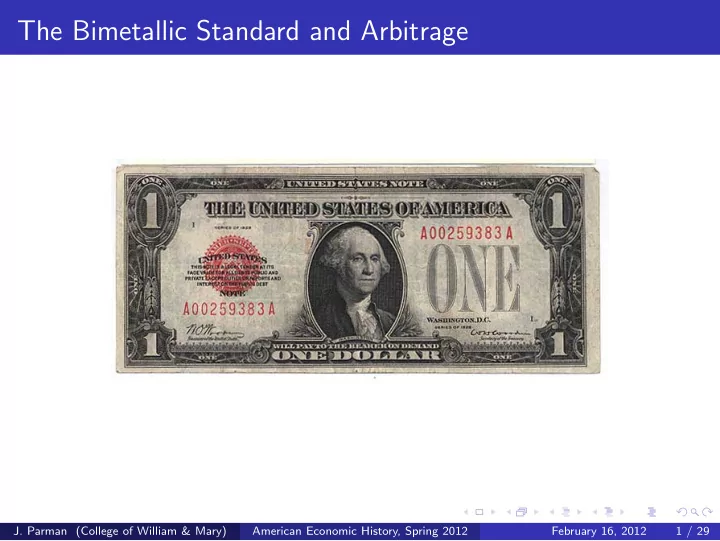
The Bimetallic Standard and Arbitrage

  • J. Parman (College of William & Mary)

American Economic History, Spring 2012 February 16, 2012 1 / 29

slide-2
SLIDE 2

Bank Money

Not all money was in the form of US currency While the constitution explicitly said the federal government could mint currency and individuals states could not, it did not prevent states from indirectly creating currency in the form of bank notes States could charter banks which could issue their own notes These bank notes could be redeemed in full for legal tender upon presentation to the bank of issue Banks and bank notes became a huge portion of the country’s financial system (by the Civil War there were

  • ver 9,000 kinds of bank notes in circulation)
  • J. Parman (College of William & Mary)

American Economic History, Spring 2012 February 16, 2012 2 / 29

slide-3
SLIDE 3

The Role of Banks as a Financial Intermediary

Banks serve as an important link between savers and borrowers They take in deposits from savers that are looking for interest, security and a certain level of liquidity They make loans to borrowers who are willing pay interest in exchange for access to money that can be repaid in the future Banks greatly reduce the transaction costs involved in matching savers and borrowers, mobilizing greater amounts of capital and facilitating economic growth

  • J. Parman (College of William & Mary)

American Economic History, Spring 2012 February 16, 2012 3 / 29

slide-4
SLIDE 4

The Role of Banks in the Creation of Money

Event Total Deposits Total Reserves Person A deposits $1,000 $1,000 $1,000 Bank lends out $900 $1,000 $100 Person B deposits $900 $1,900 $1,000 Bank lends out $810 $1,900 $190 Person C deposits $810 $2,710 $1,000 Bank lends out $729 $2,710 $271 … … … … … … Final $10,000 $1,000 Money Creation with a 10% Reserve Ratio

  • J. Parman (College of William & Mary)

American Economic History, Spring 2012 February 16, 2012 4 / 29

slide-5
SLIDE 5

State Chartered Banks

A group of investors pools together a reserve of specie The bank solicits deposits from individuals The bank then makes loans by issuing bank notes Bank notes are used by the borrower as payment to another party The bank note can be brought back to the bank and redeemed for specie Or, the bank note is passed on to someone else as payment

  • J. Parman (College of William & Mary)

American Economic History, Spring 2012 February 16, 2012 5 / 29

slide-6
SLIDE 6

What Happened When Bank Notes Circulated as Currency?

If notes started passing from one person to another without being taken back to the bank, they served as paper currency The market value of a note wasn’t necessarily the face value Face value did mean something, it was the amount of specie you could collect from the bank Market value takes this into account but gets lowered by several factors:

transaction costs (traveling to the bank) the risk that a bank will not be able to cover the note the willingness of others to accept the note as currency

  • J. Parman (College of William & Mary)

American Economic History, Spring 2012 February 16, 2012 6 / 29

slide-7
SLIDE 7

The Market Value of Bank Notes

The Michigan Farmer and Western Agriculturalist, 1843

  • J. Parman (College of William & Mary)

American Economic History, Spring 2012 February 16, 2012 7 / 29

slide-8
SLIDE 8

The Growth of State Chartered Banking

00 800 1600 1800 300 400 500 600 700 600 800 1000 1200 1400 1600

  • ans ($ millions)

Banks Banks Loans ($ millions) 100 200 200 400 600 1820 1822 1824 1826 1828 1830 1832 1834 1836 1838 1840 1842 1844 1846 1848 1850 1852 1854 1856 1858 1860 Lo

  • J. Parman (College of William & Mary)

American Economic History, Spring 2012 February 16, 2012 8 / 29

slide-9
SLIDE 9

Loans as a Fraction of GDP

0 35 0.4 0.15 0.2 0.25 0.3 0.35 0.05 0.1

  • J. Parman (College of William & Mary)

American Economic History, Spring 2012 February 16, 2012 9 / 29

slide-10
SLIDE 10

The Good That Came From Banks

Bank loans were clearly a significant part of the economy and benefited consumers and producers in a variety of important ways Banks monetized the economy in a way that specie alone could not

Transaction costs were reduced Consumption could be smoothed over time Production could be smoothed over time

Through providing credit, banks encouraged entrepreneurship Banks provided an efficient way for people to liquidate assets in difficult times

  • J. Parman (College of William & Mary)

American Economic History, Spring 2012 February 16, 2012 10 / 29

slide-11
SLIDE 11

When Banks Aren’t That Good

Banks have a lot of benefits, but antebellum banking wasn’t a strictly positive experience One problem with state chartered banks was that many didn’t lend money in a socially efficient way Many banks tended to make big loans to their own presidents or to family and friends This creates problems: loans aren’t going to the most efficient ventures, the public loses confidence in the bank, big loans to a few insiders can carry extra risk

  • J. Parman (College of William & Mary)

American Economic History, Spring 2012 February 16, 2012 11 / 29

slide-12
SLIDE 12

Shady Banking Practices

  • J. Parman (College of William & Mary)

American Economic History, Spring 2012 February 16, 2012 12 / 29

slide-13
SLIDE 13

Banks and Default

The problems with antebellum banking weren’t restricted to inefficient loans Another problem was banks not being able to pay their depositors Remember that banks only keep a fraction of total deposits as reserves If too many people try to claim their deposits at once, the bank runs into trouble If too many of the bank’s loans go into default, they won’t be able to pay depositors There are a few consequences to all of this: devaluation

  • f circulating banknotes that can ultimately lead to

bank runs and direct loss of deposits if banks go bankrupt

  • J. Parman (College of William & Mary)

American Economic History, Spring 2012 February 16, 2012 13 / 29

slide-14
SLIDE 14

Banks and Default

  • J. Parman (College of William & Mary)

American Economic History, Spring 2012 February 16, 2012 14 / 29

slide-15
SLIDE 15

Banks and Default

  • J. Parman (College of William & Mary)

American Economic History, Spring 2012 February 16, 2012 15 / 29

slide-16
SLIDE 16

Banks and Default

  • J. Parman (College of William & Mary)

American Economic History, Spring 2012 February 16, 2012 16 / 29

slide-17
SLIDE 17

The Panic of 1837

Banks were at the mercy of public confidence This is demonstrated by the Panic of 1837 Through the 1820s there was increasing confidence in bank money (meaning more deposits, loans, and notes) The traditional view holds that unregulated banks behaved irresponsibly They increased note issues without sufficient reserves to back them up Eventually, people panic and make a run on the banks

  • J. Parman (College of William & Mary)

American Economic History, Spring 2012 February 16, 2012 17 / 29

slide-18
SLIDE 18

The Panic of 1837

The problem is that the facts don’t quite match Banks weren’t dropping their reserve ratio in the years leading up to the panic People weren’t getting irrationally confident in the banks (currency ratio was rising) What was primarily driving changes in the money supply was an increase in the stock of specie When the inflow of specie stopped, trouble ensued

  • J. Parman (College of William & Mary)

American Economic History, Spring 2012 February 16, 2012 18 / 29

slide-19
SLIDE 19

Jacksonian Inflation and the Panic of 1837

  • J. Parman (College of William & Mary)

American Economic History, Spring 2012 February 16, 2012 19 / 29

slide-20
SLIDE 20

Jacksonian Inflation and the Panic of 1837

  • J. Parman (College of William & Mary)

American Economic History, Spring 2012 February 16, 2012 20 / 29

slide-21
SLIDE 21

Jacksonian Inflation and the Panic of 1837

  • J. Parman (College of William & Mary)

American Economic History, Spring 2012 February 16, 2012 21 / 29

slide-22
SLIDE 22

Jacksonian Inflation

Annual rate of change Fraction of change in money stock Money 16.5% Determinants of money: Specie 19.2 116% Reserve ratio 2.0 16 Currency ratio ‐5.1 ‐31 Interaction of currency and reserve ratios ‐0.5 ‐3 Annual rate of inflaction, 1833‐1836 8.3 Determinants of the Change in Money Supply during the Jacksonian Inflation, 1833‐1836

  • J. Parman (College of William & Mary)

American Economic History, Spring 2012 February 16, 2012 22 / 29

slide-23
SLIDE 23

The Panic of 1837

When specie stopped flowing into the country (partly because of British policies) people changed their mind about the security of deposits People rushed to cash in bank notes Banks had to suspend payments temporarily, another panic a couple years later led to many bank failures The money supply contracted and a period of deflation began

  • J. Parman (College of William & Mary)

American Economic History, Spring 2012 February 16, 2012 23 / 29

slide-24
SLIDE 24

The Effects of Bank Runs

So how badly did the bank panics and the resulting contraction of the money supply hurt the American economy? Not as badly as similar bank runs hurt the economy during the Great Depression. To see why, we can use some simple economic theory: MV = PT M: money in circulation V : velocity (how quickly money circulates) P: price level T: real output

  • J. Parman (College of William & Mary)

American Economic History, Spring 2012 February 16, 2012 24 / 29

slide-25
SLIDE 25

The Effects of Bank Runs

MV = PT So the initial problem is a drop in M In the 20th century, prices are fairly sticky so a fall in M is balanced by a fall in T In the 19th century, prices adjusted quickly so the fall in M was balanced by a fall in P, output actually grew during the slump What was different about the 19th century? Agriculture was big and manufacturers trimmed costs rather than

  • utput
  • J. Parman (College of William & Mary)

American Economic History, Spring 2012 February 16, 2012 25 / 29

slide-26
SLIDE 26

Other Ways to Bankrupt a Bank

The bank runs we’ve talked about weren’t necessarily the fault of the banks There were instances where bankruptcies were very much the bank’s fault This is usually discussed in the context of the free banking era The basic idea is that states allowed anybody who met certain requirements to set up a bank anywhere they wanted Some of these banks were good, some were bad The bad ones put up worthless collateral to set up the bank, paid themselves dividends as people starting making deposits and taking out loans, then declared bankruptcy when people came to take their money out

  • J. Parman (College of William & Mary)

American Economic History, Spring 2012 February 16, 2012 26 / 29

slide-27
SLIDE 27

Wildcat Banks

  • J. Parman (College of William & Mary)

American Economic History, Spring 2012 February 16, 2012 27 / 29

slide-28
SLIDE 28

Losses From Free Banking

  • J. Parman (College of William & Mary)

American Economic History, Spring 2012 February 16, 2012 28 / 29

slide-29
SLIDE 29

Losses From Free Banking in Context

Noteholder Losses under Free Banking $1,851,600 Nominal GDP (1860) $4,350,000,000 Noteholder Losses as a % of GDP 0.04% Outstanding Subprime Loans $1,344,000,000,000 Nominal GDP (2007) $13,807,500,000,000 Subprime Loans as a % of GDP 9.73% The Impact of Free Banking Losses

  • J. Parman (College of William & Mary)

American Economic History, Spring 2012 February 16, 2012 29 / 29