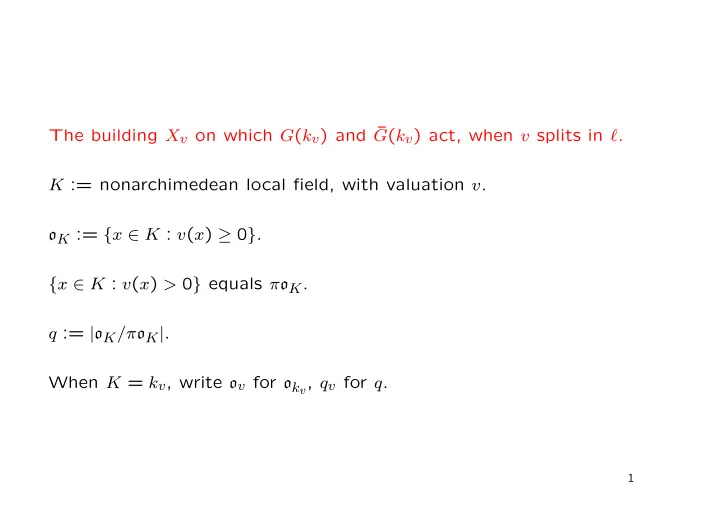
SLIDE 1 The building Xv on which G(kv) and ¯ G(kv) act, when v splits in ℓ. K := nonarchimedean local field, with valuation v.
{x ∈ K : v(x) > 0} equals πoK. q := |oK/πoK|. When K = kv, write ov for okv, qv for q.
1
SLIDE 2
Any basis {v1, v2, v3} of K gives a lattice in K3: L = {a1v1 + a2v2 + a3v3 : a1, a2, a3 ∈ oK}. (1) E.g. {v1, v2, v3} = {e1, e2, e3} gives L0 := o3
K.
LatK := set of lattices in K3. g ∈ GL(3, K) & L ∈ LatK ⇒ g(L) ∈ LatK. GL(3, K) acts transitively on LatK. GL(3, oK) := {g ∈ GL(3, K) : g & g−1 have entries in oK}. GL(3, oK) equals {g ∈ GL(3, K) : g(L0) = L0}. GL(3, oK) = {g ∈ M3×3(oK) : v(det(g)) = 0}.
2
SLIDE 3
L1, L2 ∈ LatK equivalent if L2 = tL1, some t ∈ K×. [L] := equivalence class of L. XK := set of equivalence classes. For g ∈ GL(3, K), g.[L] := [g(L)]. GL(3, K) acts transitively on XK. g = tI ⇒ g.[L] = [L] for all L ∈ LatK. PGL(3, K) acts transitively on XK. For i ∈ {0, 1, 2}, [g(L0)] ∈ XK has type i if v(det(g)) ≡ i (mod 3). SL(3, K) acts transitively on {[L] ∈ XK : type([L]) = i}.
3
SLIDE 4 [L1] is adjacent to [L2] if there are representatives Lj of [Lj] for j = 1, 2 so that πL1 L2 L1. This implies πL2 πL1 L2, so adjacency is a symmetric relation. Adjacent lattice classes have dif- ferent types. Fact: Given [L] with type([L]) = i, and j = i, ♯{[M] ∈ XK : [M] adjacent to [L] & type([M]) = j} = q2 + q + 1. Proof: L/πL is a vector space of dimension 3 over the residual field
- K/πoK. For ν = 1, 2, πL ⊂ M ⊂ L and type([M]) = i + ν (mod 3) iff
M/πL is a ν-dimensional subspace.
4
SLIDE 5
[L1], [L2], [L3] form a chamber if there are representatives Lj of [Lj] for j = 1, 2, 3 so that πL1 L3 L2 L1. Each chamber contains one lattice class of each type. Any pair of adjacent lattice classes lies in q + 1 distinct chambers. Any lattice class belongs to (q2 + q + 1)(q + 1) distinct chambers. XK is a simplicial complex.
5
SLIDE 6
For g ∈ SL(3, K) and L ∈ LatK, g.[L] = [L] iff g(L) = L. For L ∈ LatK, {g ∈ SL(3, K) : g(L) = L} is a maximal compact subgroup of SL(3, K). Any maximal compact subgroup of SL(3, K) has this form. There are three conjugacy classes of maximal compact subgroups of SL(3, K), corresponding to the three types. Any two maximal compact subgroups of SL(3, K) are conjugate by an element of GL(3, K).
6
SLIDE 7
For i = 1, 2, SL(3, oK) acts transitively on {[L] ∈ XK : [L] adjacent to [L0] & type([L]) = i}. For any edge containing [L0], the stabilizer in SL(3, K) of that edge has index q2 + q + 1 in SL(3, oK). SL(3, oK) acts transitively on the set of chambers containing [L0]. For any chamber containing [L0], the stabilizer in SL(3, K) of that chamber has index (q2 + q + 1)(q + 1) in SL(3, oK).
7
SLIDE 8
We have seen that when v ∈ Vf \ T0 splits in ℓ, then G(kv) ∼ = SL(3, kv). The parahoric subgroups of G(kv) are its subgroups corresponding to the stabilizers of vertices, edges and chambers of Xv := Xkv. In particular, Pv = {g ∈ SL(3, kv) : g(o3
v) = o3 v} = SL(3, ov).
is a maximal parahoric subgroup of G(kv). Given ξ ∈ D satisfying ι(ξ)ξ = 1, we need to understand when the image ξv of ξ in GL(3, kv) under the map D → D ⊗ℓ kv ∼ = M3×3(kv) fixes the lattice class [o3
v]. In particular, if ξ ∈ G(k) when does ξv fix o3 v?
8
SLIDE 9 b1, . . . , b6 := basis of m over k. ξ ∈ D ⇒ ξ =
aijbiσj. Form matrix B = (ψi(bj)), where Gal(m/k) = {ψ1, . . . , ψ6}. Fact: det(B)2 ∈ ℓ.
- Lemma. b1, . . . , b6 can be chosen so that v(det(B)2) = 0 for all v ∈ Vf \T0
which split in ℓ. Example. In (a = 7, p = 2) case, m = Q[ζ], where ζ = ζ7. Choose b1, . . . , b6 = 1, ζ, . . . , ζ5. Then det(B) = 72s for s = 1 + 2ζ + 2ζ2 + 2ζ4, so det(B)2 = −75. So v(det(B)2) = 0 unless v = u7.
9
SLIDE 10
- Proposition. If ι(ξ)ξ = 1, and v ∈ Vf \ T0 splits in ℓ, then
ξv(o3
v) = o3 v
⇔ aij ∈ k ∩ ov for all i, j. When m ֒ → kv, the calculations only involve the matrix B. When m ֒ → kv, we also need the following:
- Lemma. If v ∈ Vf \ T0 splits in ℓ, but m ֒
→ kv, there is an ηv ∈ kv(Z) such that Nkv(Z)/kv(ηv) = D. Moreover, ˜ v(ηv) = 0. Reasons: Embed ℓ in kv, then extend to m = ℓ(Z) ֒ → kv(Z). This gives valuation ˜ v on kv(Z) extending v. The image of D ∈ ℓ in kv satisfies v(D) = 0. Case by case we see kv(Z) is an unramified extension of kv. Now apply norm theorem from local class field theory.
10
SLIDE 11 When v ∈ Vf \ T0 splits in ℓ but m ֒ → kv, the isomorphism D ⊗ℓ kv ∼ = M3×3(kv) involves conjugation by Jv = ΘCv. Here Cv is diagonal matrix with diagonal entries ηv, 1 and 1/ϕ(ηv), and Θ = (ϕi(θj)) for some basis θ0, θ1, θ2 of m over ℓ.
- Lemma. θ0, θ1, θ2 can be chosen in om and so that ˜
v(det(Θ)) = 0 for all v ∈ Vf \ T0 which split in ℓ. Example. In (a = 7, p = 2) case, m = Q[ζ], where ζ = ζ7. Choose θ0, θ1, θ2 = 1, ζ, ζ2. Then det(Θ) = −s. So ˜ v(Θ) = 0 unless v = u7.
11
SLIDE 12 The building Xv when v does not split in ℓ. K := non-archimedean local field, with valuation v, as before. L := K(s), a separable quadratic extension of K. The automorphism a + bs → a − bs of L is denoted x → ¯ x. ˜ v := unique extension to L of v.
v(x) ≥ 0}, and {x ∈ L : ˜ v(x) > 0} equals πLoL. When K = kv, where v ∈ Vf does not split in ℓ, L = kv(s) is the com- pletion ℓ˜
v of ℓ with respect to the unique extension ˜
v of v to ℓ, and we write o˜
v for oL.
12
SLIDE 13
f : L3 × L3 → L: a nondegenerate sesquilinear form on L3. Then f ↔ a nonsingular Hermitian matrix F: f(x, y) = y∗Fx, where x = x1e1 + x2e2 + x3e3 and y = y1e1 + y2e2 + y3e3. The unitary group of F is UF = {g : L3 → L3 : f(gx, gy) = f(x, y) for all x, y ∈ L3}. UF ∼ = {g ∈ M3×3(L) : g∗Fg = F}. SUF ∼ = {g ∈ M3×3(L) : g∗Fg = F and det(g) = 1}.
13
SLIDE 14
For L ∈ LatL, L′ = {x ∈ L3 : f(x, y) ∈ oL for all y ∈ L} (2) is again a lattice, called the dual lattice of L with respect to f. Then (L′)′ = L and L1 ⊂ L2 ⇐ ⇒ L′
2 ⊂ L′ 1.
For L0 = o3
L and g ∈ GL(3, L),
(g(L0))′ = (g∗F)−1(L0). (3)
14
SLIDE 15
Let Lat1 = {L ∈ LatL : L′ = L}, and Lat2 = {(M, M′) : M ∈ LatL and πM′ M M′}. (M, M′) ∈ Lat2 iff the lattice classes [M] and [M′] are adjacent in the building XL of SL(3, L). L ∈ Lat1 and (M, M′) ∈ Lat2 are called adjacent if πL M L. This means that πL πM′ M L, so that [L], [M] and [M′] form a chamber in XL.
15
SLIDE 16 Using (3), we see that L0 ∈ Lat1 ⇔ F ∈ GL(3, oL). If g ∈ UF and L ∈ LatL, then
- (g(L))′ = g(L′),
- g fixes L iff g fixes L′,
- if L ∈ Lat1, then g(L) ∈ Lat1, and
- if (M, M′) ∈ Lat2, then (g(M), g(M′)) ∈ Lat2.
So UF acts on each of the sets Lat1 and Lat2.
16
SLIDE 17
Lemma. Suppose that F ∈ GL(3, oL) so that L0 = o3
L is in Lat1.
Let g ∈ GL(3, K), and M = g(L0). Then (M, M′) is in Lat2, and is adjacent to L0 if and only if (a) If g has entries in oL, (b) If πg−1 has entries in oL, (c) If g∗Fg has entries in oL, (d) If π(g∗Fg)−1 has entries in oL, (e) If ˜ v(det(g)) = ˜ v(π).
17
SLIDE 18
(a) If L ∈ Lat1, then g(L) = L if and only if g(L) ⊂ L. (b) If (M, M′) ∈ Lat2, then g(M) = M if and only if g(M) ⊂ M. (c) If (M, M′) ∈ Lat2, then g(M′) = M′ if and only if g(M′) ⊂ M′.
18
SLIDE 19 There is a building B associated with SUF. This is a very special case of results of Bruhat and Tits (see §10.1 in Bruhat-Tits “Groupes R´ eductifs sur un corps local I: Donn´ ees radicielles valu´ ees”, Publ. Math. I.H.E.S. 41 (1972), 5–251, and §1.15 in Tits, “Reductive groups over local fields”, Proc. Amer. Math. Soc. Symp. Pure Math. 33 (1979), 29–69. In this case, the building B is a tree.
- Theorem. With the above notation, the set Lat1 ∪ Lat2, together with
the above adjacency relation, forms a tree T. This tree is homogeneous
- f degree q+1 when L is a ramified extension of K, and is bihomogeneous
when L is an unramified extension of K, each v ∈ Lat1 having q3 + 1 neighbors, and each v ∈ Lat2 having q + 1 neighbors. It is isomorphic to the Bruhat Tits building B associated with SUF. Elements of Lati are called vertices of type i of this tree.
19
SLIDE 20 Assume now K = kv and L = kv(s), where v ∈ Vf does not split in ℓ. We have seen that G(kv) ∼ = {g ∈ SL(3, kv(s)) : g∗F ′
vg = F ′ v}
for some invertible Hermitian F ′
v.
- Lemma. In each case, we can arrange that F ′
v ∈ GL(3, o˜ v), so that o3 ˜ v is
a type 1 vertex of Xv. Recall: Ψ(ι(ξ)) = F −1Ψ(ξ)∗F for either F =
p 1 1
OR F =
T ϕ(T) ϕ2(T)
for D defined using m so that Gal(m/Q) is non-abelian and σ satisfying σ3 = p OR for D defined using m so that Gal(m/Q) is abelian and σ satisfying σ3 = D, respectively.
20
SLIDE 21 Recall: ˜ v := unique extension of v to ℓ.
v := {x ∈ ℓ˜ v = kv(s) : ˜
v(x) ≥ 0}. F has entries in m. When v ∈ Vf does not split in ℓ, and m ֒ → kv(s) = ℓ˜
v, F ′ v is just the image
- f F under the embedding M3×3(m) ֒
→ M3×3(kv(s)). Example: (a = 7, p = 2). F has diagonal entries T, ϕ(T), ϕ2(T), where T = ζ + ζ−1 ∈ om ⊂ o˜
v, and det(F) = Nm/ℓ(T) = 1.
21
SLIDE 22 When v ∈ Vf does not split in ℓ, and m ֒ → kv(s) = ℓ˜
v, F ′ v is cvJ∗ v −1FvJ−1 v
, where Fv is the image of F in M3×3(kv(s, Z)), and Jv = ΘCv, as before.
- Lemma. We can choose ηv ∈ kv(s, Z) so that Nkv(s,Z)/kv(s)(ηv) = D so
that ¯ ηv = ηv when ¯ D = D, and so that ¯ ηvηv = 1 when ¯ DD = 1. When the extension ˜ v of v to v ramifies in m, we need to make case by case calculations. Example: (a = 7, p = 2). The 7-adic valuation on k = Q does not split in ℓ = Q(s) (where s2 = −7) — it ramifies there. Its unique extension to ℓ (↔ soℓ) ramifies in m = Q(ζ), where ζ = ζ7, because Nm/ℓ(ζ −1) = s.
22
SLIDE 23
We cannot use the norm theorem to show that D = (3 + s)/4 is a norm Nkv(s,Z)/kv(s)(ηv) when v is the 7-adic valuation. However: Hensel’s Lemma shows that 16c3 −12c−3 = 0 holds for a unique c ∈ Q7. Then η = c + (8c2 − 3c − 4)s/7 is in Q7(s) ⊂ Q7(s, Z) = kv(s, Z) and satisfies ¯ ηη = 1 and Nℓ˜
v(Z)/ℓ˜ v(η) = η3 = D.
In cases like this when ¯ DD = 1 and ¯ ηvηv = 1, the matrix Cv has inverse C∗
v and so
J∗
v −1FvJ−1 v
= Θ∗−1C∗
v −1FvC−1 v
Θ−1 equals Θ∗−1FvΘ−1 The choice of the basis θ0, θ1, θ2 of m over ℓ used to define Θ can be made independent of v. If cv is constant, the matrix F ′
v = cvJ∗ v −1FvJ−1 v
has entries in ℓ and is independent of v.
23
SLIDE 24 Example: (a = 7, p = 2). If we choose θ0, θ1, θ2 = 1, ζ, ζ2 as before, the Θ∗−1FvΘ−1 is not in GL(3, o˜
v) for the 7-adic valuation v.
We choose instead θ0 = s, θ1 = s(ζ − 1) and θ2 = (ζ − 1)2, and find that 7J∗
v −1FvJ−1 v
= 7Θ∗−1FvΘ−1 =
3 3 s 3 2 (1 + s)/2 −s (1 − s)/2
,
which has entries in oℓ ⊂ o˜
v and determinant 1.
So for the case (a = 7, p = 2), whenever v ∈ Vf does not split in ℓ, and m does not embed in kv(s), G(kv) ∼ = {g ∈ SL(3, kv(s)) : g∗F ′g = F ′} for the above F ′ ∈ SL(3, oℓ), and the lattice o3
˜ v ⊂ kv(s)3 is a type 1 vertex
24
SLIDE 25 Let ξ ∈ D satisfy ι(ξ)ξ = 1. As before, let b1, . . . , b6 be a basis of m
ξ =
aijbiσj. Suppose that v ∈ Vf does not split in ℓ, and let ξv ∈ UF ′
v be the image
D ֒ → D ⊗ℓ kv(s) ∼ = M3×3(kv(s)).
v(det(B)) = 0 and if ˜ v(det(Θ)) = 0, then ξv(o3
˜ v) = o3 ˜ v
iff aij ∈ k ∩ ov for all i, j.
25
SLIDE 26 Let us define the principal arithmetic subgroup Λ so that
- Pv = SL(3, ov) whenever v ∈ T \ T0 splits in ℓ,
- Pv = {g ∈ SL(3, o˜
v) : g∗F ′ vg = F ′ v} whenever v does not split in ℓ,
- Pv0 = G(kv0) if T0 = {v0}.
Let ξ ∈ G(k) ⊂ D. So ξ ∈ Λ iff
v) = o3 v whenever v ∈ T \ T0 splits in ℓ,
˜ v) = o3 ˜ v whenever v does not split in ℓ,
26
SLIDE 27 Example. (a = 7, p = 2) case. We choose b1, . . . , b6 = 1, ζ, . . . , ζ5 and θ0, θ1, θ2 = s, s(ζ − 1), (ζ − 1)2 as before. Then ˜ v(det(B)) = 0 and ˜ v(det(Θ)) = 0 for all v ∈ Vf \ T0 except v = u7. Writing ξ =
aijbiσj, ξv ∈ Pv for all v = u2, u7 ⇔ aij ∈ Q ∩ Zp for all primes p = 2, 7 ⇔ aij ∈ Z[1/2, 1/7] for each i, j. When v = u2, the condition ξv ∈ Pv always holds. In the case v = u7, when is ξv ∈ Pv?
27
SLIDE 28
Taking v = u7, ξv equals JvΨ(ξ)J−1
v
, where Jv = ΘCv. This is a matrix with entries in kv(s) = Q7(s), and we can write ξv =
x11 + y11s x12 + y12s x13 + y13s x21 + y21s x22 + y22s x23 + y23s x31 + y31s x32 + y32s x33 + y33s
where xij, yij ∈ Q7 for each i, j. Each of these is a linear combination of the coefficients aij’s of ξ. So we can write
x = Ma,
where a and x are column vectors of length 18, made from the coeffi- cients aij and from the numbers xij and yij, and where M is an 18 × 18 matrix with entries in Q7. In this case, the entries of M are explicit polynomials in the c ∈ Q7 used in solving NQ7(s,Z)/Q7(s)(η) = D.
28
SLIDE 29
ξv(o3
˜ v) = o3 ˜ v
⇔ ξv(o3
˜ v) ⊂ o3 ˜ v
⇔ ξv has entries in o˜
v.
In this case, o˜
v = {x + ys : x, y ∈ Z7} ⊂ Q7(s), and so
ξv(o3
˜ v) = o3 ˜ v
⇔ xij, yij ∈ Z7 for all i, j ⇔
x = Ma has entries in Z7.
If L ∈ GL(18, Z7), then Ma has entries in Z7 ⇔ LMa has entries in Z7. We can choose L ∈ GL(18, Z7) so that LM = E is in “reduced row echelon form”. Then ξv(o3
˜ v) = o3 ˜ v
⇔ Ea has entries in Z7.
29
SLIDE 30
We only need a 7-adic approximation M7 (mod 49 is enough) to M to get E. The following Magma commands give us E. M7:=Matrix(IntegerRing(49),18,18,[...]); E:=EchelonForm(M7); We used the order a10, . . . , a60, a11, . . . , a61, a12, . . . , a62 for the coefficients of ξ.
30
SLIDE 31
We get: E =
1 4 3 6 1 1 2 6 1 5 4 1 2 2 2 1 6 3 5 1 3 2 1 1 2 3 1 2 6 2 1 3 5 4 1 4 6 2 1 5 2 3 7 1 6 3 1 4 1 1 1 1 1 4 3 7 7
.
31
SLIDE 32 To summarize: For each v ∈ Vf \ T0 which splits in ℓ, let xv be the vertex [o3
v] of Xv.
For each v ∈ Vf which does not split in ℓ, let xv be the type 1 vertex o3
˜ v
Let Λ = {ξ ∈ G(k) : ξv.xv = xv for all v ∈ Vf \ T0}. This is a principal arithmetic subgroup in which each Pv is maximal, and no xv’s are of type 2. So the set we call T1 is ∅ here. The elements ξ of Λ are the ξ =
6
2
ai,jζi−1σj ∈ D such that ι(ξ)ξ = 1, Nrd(ξ) = 1, ai,j ∈ Z[1/2, 1/7] for all i, j, and such that Ea has entries in Z7.
32
SLIDE 33 We want to find elements not only of Λ but of its normalizer Γ in SU(2, 1). Recall equation (∗): 3α−1dk,ℓ = [¯ Γ : Π]
e′(Pv) In the case (a = 7, p = 2), with T1 = ∅, T equals T0 = {2}, and the term e′(Pv) for the 2-adic v is (2 − 1)2(2 + 1) = 3. Also, dk,ℓ = 21 and α = 2. We get [¯ Γ : Π] = 21. We can identify ¯ Γ with {ξ =
- ai,jζi−1σj ∈ D : ι(ξ)ξ = 1,
ai,j ∈ Z[1/2, 1/7] for all i, j, Ea has entries in Z7}/Z, where Z = {t1 : t ∈ ℓ & ¯ tt = 1}.
33