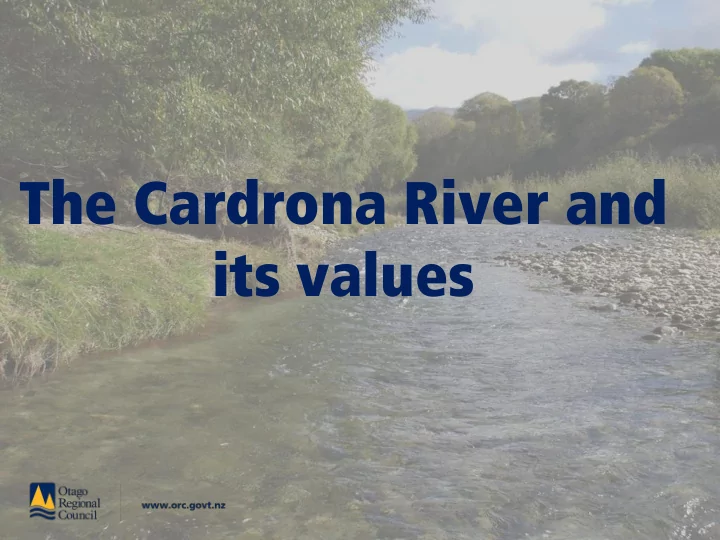
The Cardrona River and its values Ecological values in the Cardrona - PowerPoint PPT Presentation
The Cardrona River and its values Ecological values in the Cardrona Native fish Koaro Upland bully Longfin eel Clutha flathead galaxias Sports fish Rainbow trout Brown trout Socio-economic values in the Cardrona
The Cardrona River and its values
Ecological values in the Cardrona Native fish • Koaro • Upland bully • Longfin eel • Clutha flathead galaxias Sports fish • Rainbow trout • Brown trout
Socio-economic values in the Cardrona • Irrigation • Aesthetics • Tourism • Recreation • 4WDing
Clutha tha flathe head ad galaxias laxias • One of the most endangered fish in NZ • Are only able to exist where trout are absent or in very low numbers • Are mainly found in small creeks and will not be affected by any minimum flow
Rainb nbow ow trout • The Cardrona and it tribs provide important spawning areas for the upper Clutha • Juvenile trout will stay in tribs for as long as possible and then be pushed downstream by floods, so minimum flows will have very little effect on them • Most adult trout leave the Cardrona by the end of November/early December
Irriga gation ion • 2,440 l/s of “paper water” allocated • Actual peak use 1,160 l/s • 620l/s above The Larches • 540 below The Larches • Total use may drop down as low as 600 l/s in dry year
Does s the Cardron ona a natur urall ally y run dry?
Hydrol ology ogy of the Cardr drona ona • Neutral reach – no net loss or gain from groundwater • Losing reach – up to 600 l/s lost to groundwater • Gaining reach – 300 l/s gained from groundwater
Points nts to keep p in mind • 400-600 l/s is lost to groundwater below The Larches • 300 l/s is gained from aquifer downstream of SH6 • If no water is taken, flows at The Larches will be approx 300 l/s more than at the Clutha confluence
Primary mary and suppleme lementary ntary alloca cation ion limits
Primary allocation limit • The default allocation “target” is 500 l/s • The current estimated actual take is 1,160 l/s • We suggest that an allocation limit of between 500 l/s and 1,000 00 l/s is established. • This will allow current water users to operate while maintaining or increasing surety of supply, but will also encourage efficient water use
Supplementary allocation • Current supplementary minimum flow is 2,860 l/s (mean flow) at the Clutha confluence • We suggest the following supplementary allocation regime Supplementary minimum flow @ Allocation block size (l/s) Clutha confluence (l/s) 1,500 500 2,000 500 2,500 500 3,000 500
Sugge ggested sted minimum mum flow option ons • 3 different minimum flow options will be suggested • Each option is designed to maintain the variety of values put forward by the community in the previous workshops
Option A “Year round flow continuity” 700 l/s all year at the Clutha confluence
Opti tion A • Provides year round flow continuity • Provides flows of approx 1,000 l/s at The Larches (optimum flow for adult and juvenile rainbow trout) • Provides year round habitat for juvenile trout in the lower reaches of the Cardrona • Run of the river irrigation will difficult in an average or dry year
Option B “Peak holiday season flow” 700 l/s May-Jan at Clutha confluence 400 l/s Feb-Apr at The Larches
Option B • May to January (700 l/s at Clutha confluence ) • Flow continuity from May to January, which includes the peak tourist season • Flows of approx 1,000 l/s at The Larches (optimum flow for rainbow trout adult, juvenile & spawning) • Allows adult trout to return to the Clutha • Moderate irrigation restriction in January
Option B • Feb to April (400 l/s at The Larches) • Allows for irrigation to occur during the driest part of the year • Does not provide flow continuity during this period • Distributes water resources between “upper” and “lower” water takes
Option C “Extended low flow” 700 l/s May-Dec at Clutha confluence 400 l/s Jan-Apr at The Larches
Option C • May to Dec (700 l/s at Clutha confluence ) • Flow continuity from May to December, which is similar to current flow regime • Flows of approx 1,000 l/s at The Larches (optimum flow for rainbow trout adult, juvenile & spawning) • Allows adult trout to return to the Clutha in Nov/Dec • Very little irrigation restriction
Option C • Jan to April (400 l/s at The Larches) • Provides status quo for current irrigation practice • Does not provide flow continuity during this period • Distributes water resources between “upper” and “lower” water takes
Effects of minimum flow options on irrigation
Recommend
More recommend
Explore More Topics
Stay informed with curated content and fresh updates.