The COBRE grant-Mammalian Hibernation: A Path Towards a Center for - - PowerPoint PPT Presentation

the cobre grant mammalian hibernation
SMART_READER_LITE
LIVE PREVIEW

The COBRE grant-Mammalian Hibernation: A Path Towards a Center for - - PowerPoint PPT Presentation

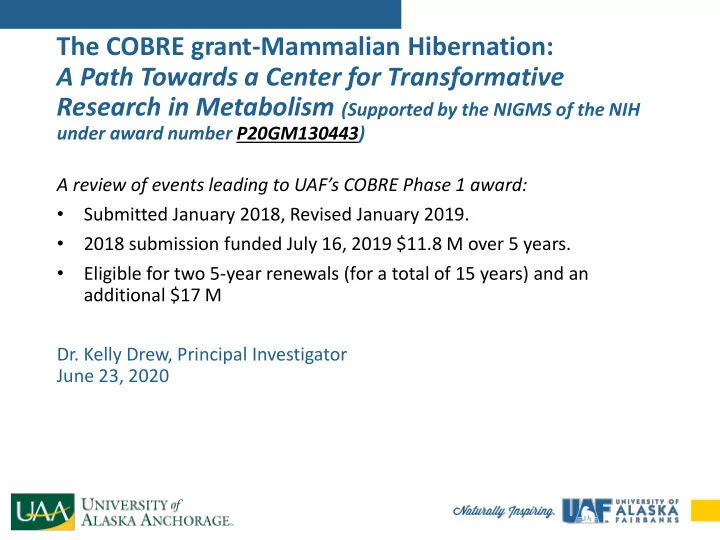
The COBRE grant-Mammalian Hibernation: A Path Towards a Center for Transformative Research in Metabolism (Supported by the NIGMS of the NIH under award number P20GM130443) A review of events leading to UAFs COBRE Phase 1 award: Submitted


slide-1
SLIDE 1

The COBRE grant-Mammalian Hibernation: A Path Towards a Center for Transformative Research in Metabolism (Supported by the NIGMS of the NIH

under award number P20GM130443) A review of events leading to UAF’s COBRE Phase 1 award:

  • Submitted January 2018, Revised January 2019.
  • 2018 submission funded July 16, 2019 $11.8 M over 5 years.
  • Eligible for two 5-year renewals (for a total of 15 years) and an

additional $17 M

  • Dr. Kelly Drew, Principal Investigator

June 23, 2020

slide-2
SLIDE 2

Introducing Members of our External Advisory Committee

  • Dr. Margaret E. Rice,

Professor and Vice Chair for Research in the Dept. of Neuroscience and Physiology at the NYU Grossman School

  • f Medicine.
  • Dr. Detlev Boison, Professor

and Vice Chair of Research and Training at the Dept of Neurosurgery, RWJMS and New Jersey Medical School, at Rutgers, The State University of New Jersey.

  • Dr. Thomas Kilduff,

Director of the Center for Neuroscience at SRI International.

  • Dr. Sven O. Ebbesson,

Professor Emeritus who formerly served as a Professor at UAF in the areas of medical science, neuroscience, and marine science.

  • Dr. David A. Lathrop,

Consulting Scientist and former Chief of the Heart Failure and Arrhythmias Branch in the Division of Cardiovascular Sciences at NHLBI of the NIH.

slide-3
SLIDE 3

Overall Project Summary

Establish a self-sustaining, multi-disciplinary biomedical research center that builds on our proven history of hibernation research, infrastructure, and long-term commitment and applies what has been learned about the underlying physiological mechanisms in hibernation into treatments that advance human metabolic health. Support the research and career development of both experienced as well as new investigators in all stages of translational studies related to hibernation, metabolism, and microbiome in biomedical research.

TRiM is the first biomedical research program in the U.S. to adopt hibernation as a model of natural adaptations in metabolism as an approach to treat metabolic disease.

slide-4
SLIDE 4

Overall Specific Aims-Build infrastructure and support research until it is competitive

 SA1: Establish an organizational structure and research infrastructure

comprised of an Administrative Core, a Microbiome Core (AIMS), and a Health and Metabolism Research Core that will support and promote a multidisciplinary framework that defines mechanisms of metabolic adaptations in hibernating mammals.

 SA2: Enhance the careers of experienced project leaders and new

investigators leading pilot projects by using effective mentoring and collaboration plans involving established NIH-funded investigators that will allow new investigators to submit high quality, competitive proposals to NIH for their individual research grants.

 SA3: Support research and pilot projects to develop an understanding

  • f hibernation mechanisms - physiological, genetic, and gut microbial -

and define how these mechanisms may play a role in treating metabolic disease and muscle atrophy or sarcopenia.

 SA4: Support clinical research projects related to the theme of this

Center.

slide-5
SLIDE 5

Michelle Rizk (Acting)

slide-6
SLIDE 6

Introductions

slide-7
SLIDE 7

“Center” of Transformative Research in Metabolism (TRiM)

slide-8
SLIDE 8
slide-9
SLIDE 9

Pubmed search-Hibernation and Alaska

slide-10
SLIDE 10

We invite you to take a journey in Translational Hibernation Research at UA as we describe:

  • What UAF/UAA has done…
  • Who we are now
  • What we are doing…
  • Where we are going…
slide-11
SLIDE 11

Exploring hibernation as a unique adaptation of northern mammals to survive Alaska’s long winters and working to translate this fundamental knowledge to enhance human health.

What we have done

slide-12
SLIDE 12

What have we learned?

12

Hibernation is a highly regulated adaptive, and reversible state of metabolic flexibility and anabolic sensitivity from which to discover novel therapeutic targets (Carey et al. 2003)

slide-13
SLIDE 13

What have we learned?

Hibernation allows northern mammals to comfortably survive Alaska’s long

  • winters. Through research, we are

learning that hibernating mammals:

  • Drop their body temperature below

freezing,

  • Preserve muscle mass despite not

eating or moving for 8 months, and

  • Switch from carbohydrate to fat

metabolism during hibernation. We have also discovered:

  • Which genes turn on and off during

hibernation, and

  • How body chemicals change during

hibernation.

slide-14
SLIDE 14

Why is the study of hibernation important to human health and Alaskan health?

Hibernation science has novel cues to treat metabolic disease and promote healthy aging Sarcopenia Disuse muscle atrophy Cachexia Anorexia Obesity Cardiac arrest and stroke Type 2 diabetes Osteoporosis Cardiac disease Fatty liver

slide-15
SLIDE 15

Who we are

slide-16
SLIDE 16

Introducing TRiM's Research Investigators and their Projects

  • Dr. Kelly Drew,

TRiM Principal Investigator UAF

P.I. Vadim Fedorov, PhD, Genomics, UAF

Project 1: Post transcriptional mechanisms of muscle atrophy prevention in hibernating mammals.

P.I. Khrys Duddleston, PhD, Microbiology, UAA

Project 2: Microbial provision of essential amino acids, protein conservation in hibernation Project 3: Nutritional strategies for metabolic health in aging

P.I. Robert “Trey” Coker, PhD, Clinical Nutrition and Exercise Physiology, UAF

slide-17
SLIDE 17

TRiM's Vision, Mission, and Values

Our Vision: Translating hibernation research to improve human health. Our Mission: To seek fundamental knowledge about the nature and

behavior of hibernating mammals and the translation of that knowledge to enhance human health, lengthen life, and reduce illness and disability.

Our Values: “TRiM”

➢ T for Team Science: Multiple, diverse perspectives, and expertise empowers great and innovative science. ➢ R for Respect: Respecting each person for their unique perspective, expertise, and contribution to the overall effort. ➢ I for Integrity: Helping people to be the best at what they do best and keeping a high ethical standard. ➢ M for Motivation: Motivating oneself and others to do the job better than it has been done before in order to create a cycle of empowerment and accomplishment for both the scientific community and the Institute.

slide-18
SLIDE 18

Translating hibernation research to improve human health.

What we are doing

slide-19
SLIDE 19

Alaska Senior Population, 2010 to 2019

Population 60+ Average Growth Rate 2010 – 2019: 5.8% per year and 52%, 2010-2019

Source: Alaska Department of Labor and Workforce Development, Research and Analysis Population Estimates, 2010-2019 20,000 40,000 60,000 80,000 100,000 120,000 140,000 160,000 2010 2011 2012 2013 2014 2015 2016 2017 2018 2019 60-64 65-69 70-74 75-79 80-84 85+

Alaska is the state with the fastest growing senior population per capita. Alaskans age 60+ are the fastest growing age demographic in the state. Within the senior population, people age 70-74 are growing rapidly, increasing at an annual rate of 10% as baby boomers come of age.

slide-20
SLIDE 20

Projected Alaska Senior Population by Age Cohort, 2020-2045

Population 60+ Average Annual Growth Rate: 5.25% (or 21% total older adult population increase, 2020 to 2045)

Source: Alaska Department of Labor and Workforce Development, Research and Analysis, Population Projections, Middle Scenario

  • 20,000

40,000 60,000 80,000 100,000 120,000 140,000 160,000 180,000 200,000 2020 2025 2030 2035 2040 2045 60-64 65-69 70-74 75-79 80-84 85+

From 2020 to 2045, Alaska’s older adults will increase by 30,708 people and comprise 21% of the state’s total population in 2045. During that time, the fastest growing age segment will be persons age 85+.

slide-21
SLIDE 21

Hibernation Science Offers Clues to Understand Frailty and Age-Related Health Conditions

 Sarcopenia  Disuse muscle atrophy  Cachexia  Anorexia  Obesity  Cerebral Ischemia and stroke  Type 2 diabetes  Osteoporosis  Cardiac disease  Fatty liver  Fall Risk

slide-22
SLIDE 22

22

  • Approach – Hibernation Science → Understanding frailty In

disease and understanding degeneration/regeneration of neurons and myocytes in aging. Frailty exacerbates morbidity and mortality associated with disease (acute – such as after a cardiac arrest, or chronic such as metabolic syndrome Type 2 Diabetes) as well as aging.

  • Our Goal – Translate hibernation science platforms into therapies

and diagnostics providing numerous partnering opportunities

slide-23
SLIDE 23

Health and Metabolism Research Core (HaMR) & Key Personnel

  • Dr. Cory Williams, Core Leader, UAF
  • Dr. Carl Murphy, Molecular Imaging Facility Manager, UAF
  • Dr. Øivind Tøien, Manager of Animal Instrumentation, UAF
slide-24
SLIDE 24

Advanced Investigations in Microbiome Sciences Core & Key Personnel

  • Dr. Brandon Briggs, Core Leader, UAA

Eric Henderson, B.S., Lab Manager Tyler Fox, B.S., Laboratory Technician

slide-25
SLIDE 25

Administrative Core & Key Personnel

  • Dr. Kelly Drew, Principal Investigator, UAF
  • Dr. Anya Goropashnaya, Research Professional, UAF
  • Dr. Bahareh Barati, Biostatician, UAF

Denise Daniello, MA, Program Coordinator, UAF Brittney Wilhite, MS, Fiscal Technician and Admin Assistant, UAF

slide-26
SLIDE 26

Alteration and Renovation: UAF LARS Arctic Ground Squirrel (AGS) Breeding Facility

  • Located at UAF Large Animal Research

Station (LARS), will optimize 5,000 sq. ft of space to breed Hep B free AGS in an open-air facility.

  • 100 live-trapped AGS from the Brooks Range

will start the breeding facility. UAF Animal Resources Center (ARC) will provide animal care.

  • Facility will include six 500-sq ft pens used to

house 30 pathogen-free wild AGS as founder

  • animals. Expected completion date is

8.15.2020.

  • Long-term Goal: Provide pathogen-free AGS

for UA researchers & their collaborators in a safe, sustainable manner.

slide-27
SLIDE 27

Business Model

27

Expenses

 Retain and nurture competitive investigators and Core resources

 HaMR

◼ Clinical research capacity – Human ◼ Clinical research capacity – companion and working animals

 AIMS

◼ Comprehensive service including organismal analysis, molecular analysis and

bioinformatics

Revenue

 Current COBRE award  Competitive COBRE renewal in 2024  Increase R-series and equivalent funding  Run cores as recharge centers. Expand core user base to offset UA support  Develop discovery platforms for corporate partnering opportunities

slide-28
SLIDE 28

Revenues and Expenses

Overall TRiM Program FY20 FY21 FY22 FY23 FY24

Revenue COBRE Grant $ 754,775.77 $ 1,439,148.00 $ 1,440,306.00 $ 1,440,306.00 $ 1,440,306.00 Other Grants $ - $ - $ - $ - $ - Other Support $ 266,139.00 $ 189,000.00 $ 194,000.00 $ 194,000.00 $ 194,000.00 COVID-19 Carry Forward *requested $ - $ 224,000.00 $ - $ - $ - Research User Fees $ 107,345.00 $ 35,000.00 $ 36,000.00 $ 37,000.00 $ 37,000.00 TOTAL REVENUE $ 1,128,259.77 $ 1,887,148.00 $ 1,670,306.00 $ 1,671,306.00 $ 1,671,306.00 Expenses Includes MIF Salaries & Benefits $ 574,687.91 $ 1,026,890.24 $ 915,808.19 $ 917,473.62 $ 919,155.70 Travel $ 14,394.65 $ 72,916.00 $ 53,259.00 $ 51,859.00 $ 51,859.00 Contractual Services $ 202,452.14 $ 340,832.00 $ 310,520.00 $ 314,020.00 $ 312,570.00 Commodities $ 176,136.85 $ 200,195.00 $ 384,044.00 $ 381,944.00 $ 383,394.00 Equipment $ 45,055.99 $ 51,000.00 $ - $ - $ - TOTAL EXPENSES $ 1,012,727.54 $ 1,691,833.24 $ 1,663,631.19 $ 1,665,296.62 $ 1,666,978.70 NET GAIN (LOSS) $ 115,532.23 195,314.76 $ 6,674.81 $ 6,009.38 $ 4,327.30

slide-29
SLIDE 29

Institutional Commitment Enhances Success and Sustainability of the “Center”

$- $50,000 $100,000 $150,000 $200,000 $250,000 $300,000 $350,000 IAB VCR Chancellor Director DBS Dean Provost

Amount ($) Source

FY20 Institutional Commitments

FY20 FY21 UAF IAB 318,100 321,281 VCR 107,460 111,270 Chancellor 170,000 140,000 UAA Director

  • Dept. Bio

Sciences 12,000 12,000 Dean 15,000 (requested) Provost 75,000

slide-30
SLIDE 30

Projected Indirect (F&A) Dollar Amounts for UAA and UAF, FY20-FY24

$0 $100,000 $200,000 $300,000 $400,000 $500,000 $600,000 $700,000 $800,000 $900,000 FY20 FY21 FY22 FY23 FY24 UAF UAA

slide-31
SLIDE 31

First Year Accomplishments - Scientific

Grant Proposal Submissions by TRiM investigators:

  • Two RO1’s submitted PI Duddleston (Project 2) and PI Coker (Project 3)
  • Positive reviews – Resubmissions on track for July 6.
  • Administrative Supplement (PI Coker - Project 3) to add sex as a variable to

clinical trial - Pending

  • M.J. Murdock Charitable Trust Commercialization grant (May 2020) (PI Coker -

Project 3) - Pending

  • Dr. Cory Williams, HaMR Core Leader, submitted a proposal to NSF (pending).

Publications by TRiM investigators and core leads (7.16.2019-5.1.2020):

  • 2 publications cited COBRE grant: V. Fedorov
  • 8 other publications by TRiM investigators: V. Fedorov, K. Duddleston, R. Coker,
  • B. Briggs, C. Williams, C. Murphy and K. Drew
  • 4 pending publications: V. Fedorov, A. Goropashnaya, R. Coker, B. Briggs,
  • C. Murphy, and K. Drew

Presentations:

  • 10 poster presentations
  • 9 presentations/invited Speaker/Stakeholder presentations
slide-32
SLIDE 32

First Year Accomplishments - Infrastructure

  • Established Core Resources: Admin Core, HaMR Core, and AIMS
  • Completed renovations plans for AGS Breeding Colony. Contractor is hired and

work is underway.

  • Completed renovation of the Microbiome AIMS facility (funded by INBRE).
  • All new hires are now completed.
  • Prepared outreach materials for legislative tour and other stakeholders.
  • Conducted videoconference meetings of the ISC, ESC, and a planning meeting

for the TAC.

  • Submitted NIH RPPR and SIRS reports on time.
slide-33
SLIDE 33

Challenges, First Year

UA Budget Cuts and Fiscal Exigency: Resulted in faculty departures and imposed

hiring freezes, which impacted Project 2 and the AIMS Core. Altered work-loads, will threaten research productivity and retention of successful faculty.

COVID-19 Setbacks:

  • Delayed submission of samples for ribosomal profile analysis needed by Project 1 which

will affect the project’s data analysis, project-related publications, and submission of a new collaborative R01 application by the PI and his advisor.

  • Renovation work of the AIMS facility was temporarily put on hold due to partial closure
  • f campus.
  • Sample shipments from PI Duddleston’s lab to UC Denver metabolomics were delayed

due to transportation barriers related to COVID-19.

  • Postponed start of Project 3 clinical trials. Trials will proceed when it is safe to do so as

determined by NIH, CDC, and the project’s advisors. PI Coker anticipates a new start date

  • f November 1, 2020.
  • Travel to conferences, training events, and meetings were cancelled impacting
  • pportunities to make presentations and network with others working in the field.
slide-34
SLIDE 34

Mitigation Efforts, Moving Forward

  • Assembled COVID-19 related request for Carry forward. To be submitted to NIH

with the Federal Financial Report in mid-August.

  • AIMS Core is producing Virtual Transport Media (VTM) for the State’s COVID-19

testing and receiving state funds to provide these services.

  • Retention of successful and junior faculty; protection of research workloads
  • Continued access to Core resources; Continued growth of Core resources
  • Retention and workloads - To be discussed by Strategic Advisory Committee (hoping for a

July meeting date)

slide-35
SLIDE 35

Where we are going…

slide-36
SLIDE 36

Opportunities on the Horizon

  • Developing new Research Collaborations

✓ ASCEND Hub ✓ Allen Brain Institute ✓ University of Kentucky

  • New pilot projects: launch in FY22
  • Seeking UA-approval of Center status for the

Transformative Research in Metabolism program

slide-37
SLIDE 37

Why is a Center status important?

Because a Center of Transformative Research in Metabolism will:

  • Build, strengthen, and leverage strategic investments made by UA to support

biomedical and hibernation research in Alaska.

  • Attract new funding (public and private investment), new partnerships (internal

and external), and new investigators.

  • Stimulate new biotech enterprise to increase partnerships between UA and the

business community that will tap new revenue streams.

  • Promote synergy of effort among UA programs in biomedical research to leverage

resources and expand UA’s funding base to grow our scientific capacity in biomedical research.

  • Satisfy our commitment to NIH.
  • Advance our long-term goal of increasing and sustaining Alaskan-based

biomedical research scientists who are rooted in Alaska, care about our State’s future, and committed to promoting the health and well-being of Alaskans.

slide-38
SLIDE 38

Thank you for your attention and support of the TRiM program.

TRiM thanks Dr. Oivind Toien for use of this photo.