The Consensus Hierarchy Synchronous Systems In real systems, one - - PowerPoint PPT Presentation

the consensus hierarchy
SMART_READER_LITE
LIVE PREVIEW

The Consensus Hierarchy Synchronous Systems In real systems, one - - PowerPoint PPT Presentation

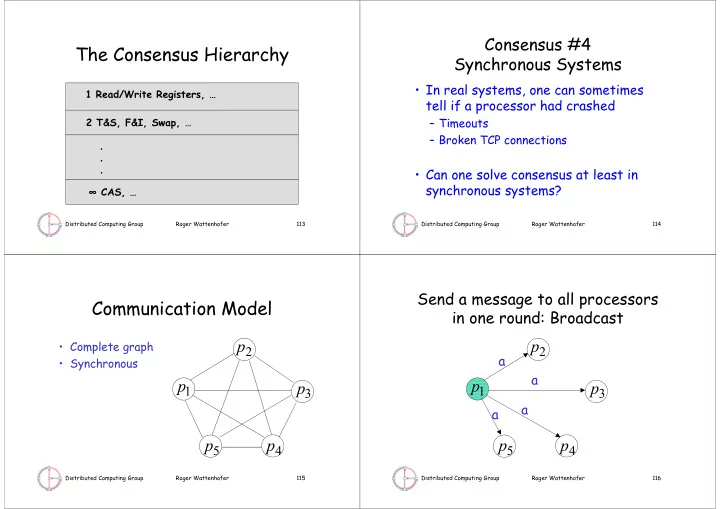
Consensus #4 The Consensus Hierarchy Synchronous Systems In real systems, one can sometimes 1 Read/Write Registers, tell if a processor had crashed 2 T&S, F&I, Swap, Timeouts Broken TCP connections . . .


slide-1
SLIDE 1

Distributed Computing Group Roger Wattenhofer 113

The Consensus Hierarchy

1 Read/Write Registers, … 2 T&S, F&I, Swap, … ∞ CAS, … . . .

Distributed Computing Group Roger Wattenhofer 114

Consensus #4 Synchronous Systems

  • In real systems, one can sometimes

tell if a processor had crashed

– Timeouts – Broken TCP connections

  • Can one solve consensus at least in

synchronous systems?

Distributed Computing Group Roger Wattenhofer 115

Communication Model

  • Complete graph
  • Synchronous

1

p

2

p

3

p

4

p

5

p

Distributed Computing Group Roger Wattenhofer 116

1

p

2

p

3

p

4

p

5

p

a a a a

Send a message to all processors in one round: Broadcast

slide-2
SLIDE 2

Distributed Computing Group Roger Wattenhofer 117

At the end of the round: everybody receives a

1

p

2

p

3

p

4

p

5

p

a a a a

Distributed Computing Group Roger Wattenhofer 118

1

p

2

p

3

p

4

p

5

p

a a a a b b b b

Broadcast: Two or more processes can broadcast in the same round

Distributed Computing Group Roger Wattenhofer 119

1

p

2

p

3

p

4

p

5

p

a,b a b a,b a,b

At end of round...

Distributed Computing Group Roger Wattenhofer 120

Crash Failures

Faulty processor 1

p

2

p

3

p

4

p

5

p

a a a a

slide-3
SLIDE 3

Distributed Computing Group Roger Wattenhofer 121

1

p

2

p

3

p

4

p

5

p

a a

Some of the messages are lost, they are never received

Faulty processor

Distributed Computing Group Roger Wattenhofer 122

1

p

2

p

3

p

4

p

5

p

a a

Effect

Faulty processor

Distributed Computing Group Roger Wattenhofer 123

Failure

1

p

2

p

3

p

4

p

5

p

Round

1

1

p

2

p

3

p

4

p

5

p

1

p

2

p

3

p

4

p

5

p

Round

2

Round

3

1

p

2

p

4

p

5

p

Round

4

1

p

2

p

4

p

5

p

Round

5

3

p

3

p After a failure, the process disappears from the network

Distributed Computing Group Roger Wattenhofer 124

Consensus:

Everybody has an initial value

1 2 3 4 Start

slide-4
SLIDE 4

Distributed Computing Group Roger Wattenhofer 125

3 3 3 3 3 Finish

Everybody must decide on the same value

Distributed Computing Group Roger Wattenhofer 126

1 1 1 1 1 Start If everybody starts with the same value they must decide on that value Finish 1 1 1 1 1 Validity condition:

Distributed Computing Group Roger Wattenhofer 127

A simple algorithm

  • 1. Broadcasts value to all processors
  • 2. Decides on the minimum

Each processor: (only one round is needed)

Distributed Computing Group Roger Wattenhofer 128

1 2 3 4 Start

slide-5
SLIDE 5

Distributed Computing Group Roger Wattenhofer 129

1 2 3 4 Broadcast values

0,1,2,3,4 0,1,2,3,4 0,1,2,3,4 0,1,2,3,4 0,1,2,3,4

Distributed Computing Group Roger Wattenhofer 130

Decide on minimum

0,1,2,3,4 0,1,2,3,4 0,1,2,3,4 0,1,2,3,4 0,1,2,3,4

Distributed Computing Group Roger Wattenhofer 131

Finish

Distributed Computing Group Roger Wattenhofer 132

This algorithm satisfies the validity condition 1 1 1 1 1 Start Finish 1 1 1 1 1 If everybody starts with the same initial value, everybody sticks to that value (minimum)

slide-6
SLIDE 6

Distributed Computing Group Roger Wattenhofer 133

Consensus with Crash Failures

  • 1. Broadcasts value to all processors
  • 2. Decides on the minimum

Each processor: The simple algorithm doesn’t work

Distributed Computing Group Roger Wattenhofer 134

1 2 3 4 Start fail The failed processor doesn’t broadcast its value to all processors

Distributed Computing Group Roger Wattenhofer 135

1 2 3 4

0,1,2,3,4 1,2,3,4

fail

0,1,2,3,4 1,2,3,4

Broadcasted values

Distributed Computing Group Roger Wattenhofer 136

1 1

0,1,2,3,4 1,2,3,4

fail

0,1,2,3,4 1,2,3,4

Decide on minimum

slide-7
SLIDE 7

Distributed Computing Group Roger Wattenhofer 137

1 1 fail

Finish - No Consensus!

Distributed Computing Group Roger Wattenhofer 138

If an algorithm solves consensus for f failed processes we say it is an f-resilient consensus algorithm

Distributed Computing Group Roger Wattenhofer 139

1 4 3 2 Start Finish 1 1 Example: The input and output of a 3-resilient consensus algorithm

Distributed Computing Group Roger Wattenhofer 140

New validity condition: all non-faulty processes decide on a value that is available initially. 1 1 1 1 1 Start Finish 1 1

slide-8
SLIDE 8

Distributed Computing Group Roger Wattenhofer 141

An f-resilient algorithm Round 1: Broadcast my value Round 2 to round f+1: Broadcast any new received values End of round f+1: Decide on the minimum value received

Distributed Computing Group Roger Wattenhofer 142

1 2 3 4 Start Example: f=1 failures, f+1=2 rounds needed

Distributed Computing Group Roger Wattenhofer 143

1 2 3 4 Round 1 fail Example: f=1 failures, f+1 = 2 rounds needed Broadcast all values to everybody

0,1,2,3,4 1,2,3,4 0,1,2,3,4 1,2,3,4

(new values)

Distributed Computing Group Roger Wattenhofer 144

Example: f=1 failures, f+1 = 2 rounds needed Round 2

Broadcast all new values to everybody

0,1,2,3,4 0,1,2,3,4 0,1,2,3,4 0,1,2,3,4

1 2 3 4

slide-9
SLIDE 9

Distributed Computing Group Roger Wattenhofer 145

Example: f=1 failures, f+1 = 2 rounds needed Finish Decide on minimum value

0,1,2,3,4 0,1,2,3,4 0,1,2,3,4 0,1,2,3,4

Distributed Computing Group Roger Wattenhofer 146

1 2 3 4 Start Example: f=2 failures, f+1 = 3 rounds needed Example of execution with 2 failures

Distributed Computing Group Roger Wattenhofer 147

1 2 3 4 Round 1 Failure 1 Broadcast all values to everybody

1,2,3,4 1,2,3,4 0,1,2,3,4 1,2,3,4

Example: f=2 failures, f+1 = 3 rounds needed

Distributed Computing Group Roger Wattenhofer 148

1 2 3 4 Round 2 Failure 1 Broadcast new values to everybody

0,1,2,3,4 1,2,3,4 0,1,2,3,4 1,2,3,4

Failure 2 Example: f=2 failures, f+1 = 3 rounds needed

slide-10
SLIDE 10

Distributed Computing Group Roger Wattenhofer 149

1 2 3 4 Round 3 Failure 1 Broadcast new values to everybody

0,1,2,3,4 0,1,2,3,4 0,1,2,3,4 O,1,2,3,4

Failure 2 Example: f=2 failures, f+1 = 3 rounds needed

Distributed Computing Group Roger Wattenhofer 150

3 Finish Failure 1 Decide on the minimum value

0,1,2,3,4 0,1,2,3,4 0,1,2,3,4 O,1,2,3,4

Failure 2 Example: f=2 failures, f+1 = 3 rounds needed

Distributed Computing Group Roger Wattenhofer 151

Example: 5 failures, 6 rounds 1 2 No failure 3 4 5 6 Round If there are f failures and f+1 rounds then there is a round with no failed process

Distributed Computing Group Roger Wattenhofer 152

  • Every (non faulty) process knows

about all the values of all the other participating processes

  • This knowledge doesn’t change until

the end of the algorithm

At the end of the round with no failure:

slide-11
SLIDE 11

Distributed Computing Group Roger Wattenhofer 153

Everybody would decide on the same value However, as we don’t know the exact position of this round, we have to let the algorithm execute for f+1 rounds

Therefore, at the end of the round with no failure:

Distributed Computing Group Roger Wattenhofer 154

when all processes start with the same input value then the consensus is that value This holds, since the value decided from each process is some input value

Validity of algorithm:

Distributed Computing Group Roger Wattenhofer 155

A Lower Bound

Any f-resilient consensus algorithm requires at least f+1 rounds Theorem:

Distributed Computing Group Roger Wattenhofer 156

Proof sketch: Assume for contradiction that f

  • r less rounds are enough

Worst case scenario: There is a process that fails in each round

slide-12
SLIDE 12

Distributed Computing Group Roger Wattenhofer 157

Round a 1 before process fails, it sends its value a to only one process i

p

k

p

i

p

k

p

Worst case scenario

Distributed Computing Group Roger Wattenhofer 158

Round a 1 before process fails, it sends value a to only one process m

p

k

p

k

p

m

p

Worst case scenario

2

Distributed Computing Group Roger Wattenhofer 159

Round 1 f

p Worst case scenario

2 ……… a n

p

f 3 At the end

  • f round f
  • nly one

process knows about value a n

p

Distributed Computing Group Roger Wattenhofer 160

Round 1

Worst case scenario

2 ……… f 3 Process may decide

  • n a, and all
  • ther

processes may decide

  • n another

value (b) n

p

n

p

a b decide

slide-13
SLIDE 13

Distributed Computing Group Roger Wattenhofer 161

Round 1

Worst case scenario

2 ……… f 3 n

p

a b decide Therefore f rounds are not enough At least f+1 rounds are needed

Distributed Computing Group Roger Wattenhofer 162

Consensus #5 Byzantine Failures

Faulty processor 1

p

2

p

3

p

4

p

5

p

a b a c Different processes receive different values

Distributed Computing Group Roger Wattenhofer 163

1

p

2

p

3

p

4

p

5

p

a a A Byzantine process can behave like a Crashed-failed process Some messages may be lost Faulty processor

Distributed Computing Group Roger Wattenhofer 164

Failure

1

p

2

p

3

p

4

p

5

p

Round

1

1

p

2

p

3

p

4

p

5

p

1

p

2

p

3

p

4

p

5

p

Round

2

Round

3

1

p

2

p

4

p

5

p

Round

4

1

p

2

p

4

p

5

p

Round

5

After failure the process continues functioning in the network

3

p

3

p Failure

1

p

2

p

4

p

5

p

Round

6

3

p

slide-14
SLIDE 14

Distributed Computing Group Roger Wattenhofer 165

Consensus with Byzantine Failures

solves consensus for f failed processes f-resilient consensus algorithm:

Distributed Computing Group Roger Wattenhofer 166

The input and output of a 1-resilient consensus algorithm 1 4 3 2 Start Finish 3 3 Example: 3 3

Distributed Computing Group Roger Wattenhofer 167

Validity condition: if all non-faulty processes start with the same value then all non-faulty processes decide on that value 1 1 1 1 1 Start Finish 1 1 1 1

Distributed Computing Group Roger Wattenhofer 168

Any f-resilient consensus algorithm requires at least f+1 rounds Theorem: follows from the crash failure lower bound Proof:

Lower bound on number of rounds

slide-15
SLIDE 15

Distributed Computing Group Roger Wattenhofer 169

There is no f-resilient algorithm for n processes, where f ≥ n/3 Theorem: Plan: First we prove the 3 process case, and then the general case

Upper bound on failed processes

Distributed Computing Group Roger Wattenhofer 170

There is no 1-resilient algorithm for 3 processes Lemma: Proof: Assume for contradiction that there is a 1-resilient algorithm for 3 processes

The 3 processes case

Distributed Computing Group Roger Wattenhofer 171

p

1

p

2

p

A(0) B(1) C(0) Initial value Local algorithm

Distributed Computing Group Roger Wattenhofer 172

p

1

p

2

p

1 1 1 Decision value

slide-16
SLIDE 16

Distributed Computing Group Roger Wattenhofer 173

3

p

4

p

2

p

A(0) B(1) C(1) 1

p

5

p p

A(1) C(0) B(0) Assume 6 processes are in a ring (just for fun)

Distributed Computing Group Roger Wattenhofer 174

3

p

4

p

2

p

A(0) B(1) C(1) 1

p

5

p p

A(1) C(0) B(0) B(1) 1

p p

A(1) 2

p

faulty

C(1) C(0)

Processes think they are in a triangle

Distributed Computing Group Roger Wattenhofer 175

3

p

4

p

2

p

A(0) B(1) C(1) 1

p

5

p p

A(1) C(0) B(0) 1 1

p p

1 2

p

faulty (validity condition)

Distributed Computing Group Roger Wattenhofer 176

3

p

4

p

2

p

A(0) C(1) 1

p

5

p p

A(1) C(0) B(0)

p

1 1

p

2

p

C(0) B(0)

p

A(0) A(1)

faulty B(1)

slide-17
SLIDE 17

Distributed Computing Group Roger Wattenhofer 177

3

p

4

p

2

p

A(0) B(1) C(1) 1

p

5

p p

A(1) C(0) B(0)

p

1 1

p

2

p

p

faulty (validity condition)

Distributed Computing Group Roger Wattenhofer 178

3

p

4

p

2

p

A(0) B(1) C(1) 1

p

5

p p

A(1) C(0) B(0)

p

1 2

p

2

p p

A(1) C(0) 1

p

B(1) B(0)

faulty

Distributed Computing Group Roger Wattenhofer 179

3

p

4

p

2

p

A(0) B(1) C(1) 1

p

5

p p

A(1) C(0) B(0)

p

1 2

p

2

p p

1 1

p

faulty

Distributed Computing Group Roger Wattenhofer 180

2

p p

1 1

p

faulty

Impossibility

slide-18
SLIDE 18

Distributed Computing Group Roger Wattenhofer 181

There is no algorithm that solves consensus for 3 processes in which 1 is a byzantine process

Conclusion

Distributed Computing Group Roger Wattenhofer 182

Assume for contradiction that there is an f -resilient algorithm A for n processes, where f ≥ n/3 We will use algorithm A to solve consensus for 3 processes and 1 failure (which is impossible, thus we have a contradiction)

The n processes case

Distributed Computing Group Roger Wattenhofer 183

1

p 1

2

p

n

p 1 … … 2 2 1 1 1 start failures

1

p 1 1

2

p

n

p … … 1 1 1 1 1 finish

Algorithm A

Distributed Computing Group Roger Wattenhofer 184

3 1 n

p p K

1

q

2

q

3

q

3 2 1 3 n n

p p K

+ n n

p p K

1 3 2 +

Each process q simulates algorithm A

  • n n/3 of “p” processes
slide-19
SLIDE 19

Distributed Computing Group Roger Wattenhofer 185

3 1 n

p p K

1

q

2

q

3

q

3 2 1 3 n n

p p K

+ n n

p p K

1 3 2 +

fails When a single q is byzantine, then n/3 of the “p” processes are byzantine too.

Distributed Computing Group Roger Wattenhofer 186

3 1 n

p p K

1

q

2

q

3

q

3 2 1 3 n n

p p K

+ n n

p p K

1 3 2 +

fails algorithm A tolerates n/3 failures Finish of algorithm A

k k k k k k k k k k k k k

all decide k

Distributed Computing Group Roger Wattenhofer 187

1

q

2

q

3

q

fails

Final decision

k k We reached consensus with 1 failure Impossible!!!

Distributed Computing Group Roger Wattenhofer 188

There is no f-resilient algorithm for n processes with f ≥ n/3

Conclusion

slide-20
SLIDE 20

Distributed Computing Group Roger Wattenhofer 189

The King Algorithm

solves consensus with n processes and f failures where f < n/4 in f +1 “phases” There are f+1 phases Each phase has two rounds In each phase there is a different king

Distributed Computing Group Roger Wattenhofer 190

Example: 12 processes, 2 faults, 3 kings

1 1 2 2 1 1 1 initial values Faulty

Distributed Computing Group Roger Wattenhofer 191

Example: 12 processes, 2 faults, 3 kings

Remark: There is a king that is not faulty 1 1 2 2 1 1 1 initial values King 1 King 2 King 3

Distributed Computing Group Roger Wattenhofer 192

Each processor has a preferred value i

p

i

v

In the beginning, the preferred value is set to the initial value

The King algorithm

slide-21
SLIDE 21

Distributed Computing Group Roger Wattenhofer 193

Round 1, processor : i

p

  • Broadcast preferred value
  • Set to the majority of

values received i

v

i

v

The King algorithm: Phase k

Distributed Computing Group Roger Wattenhofer 194

  • If had majority of less than

Round 2, king : k

p

  • Broadcast new preferred value

Round 2, process : i

p

k

v

i

v f n + 2

then set to i

v

k

v

The King algorithm: Phase k

Distributed Computing Group Roger Wattenhofer 195

End of Phase f+1: Each process decides on preferred value

The King algorithm

Distributed Computing Group Roger Wattenhofer 196

Example: 6 processes, 1 fault

Faulty 1

king 1 king 2

1 1 2

slide-22
SLIDE 22

Distributed Computing Group Roger Wattenhofer 197

1

king 1

1 1 2

Phase 1, Round 1

2,1,1,0,0,0 2,1,1,1,0,0 2,1,1,1,0,0 2,1,1,0,0,0 2,1,1,0,0,0

1 1 Everybody broadcasts

Distributed Computing Group Roger Wattenhofer 198

1

king 1

1 1

Phase 1, Round 1

Choose the majority Each majority population was

4 2 3 = + ≤ f n

On round 2, everybody will choose the king’s value

Distributed Computing Group Roger Wattenhofer 199

Phase 1, Round 2

1 1 1 1 1 2

king 1

The king broadcasts

Distributed Computing Group Roger Wattenhofer 200

Phase 1, Round 2

1 1 1 2

king 1

Everybody chooses the king’s value

slide-23
SLIDE 23

Distributed Computing Group Roger Wattenhofer 201

1

king 2

1 1 2

Phase 2, Round 1

2,1,1,0,0,0 2,1,1,1,0,0 2,1,1,1,0,0 2,1,1,0,0,0 2,1,1,0,0,0

1 1 Everybody broadcasts

Distributed Computing Group Roger Wattenhofer 202

1 1 1

Phase 2, Round 1

Choose the majority Each majority population is

4 2 3 = + ≤ f n

On round 2, everybody will choose the king’s value

king 2

2,1,1,1,0,0

Distributed Computing Group Roger Wattenhofer 203

Phase 2, Round 2

1 1 1 The king broadcasts

king 2

Distributed Computing Group Roger Wattenhofer 204

Phase 2, Round 2

1

king 2

Everybody chooses the king’s value Final decision

slide-24
SLIDE 24

Distributed Computing Group Roger Wattenhofer 205

In the round where the king is non-faulty, everybody will choose the king’s value v After that round, the majority will remain value v with a majority population which is at least

f n f n + > − 2

Invariant / Conclusion

Distributed Computing Group Roger Wattenhofer 206

Exponential Algorithm

solves consensus with n processes and f failures where f < n/3 in f +1 “phases” But: uses messages with exponential size

Distributed Computing Group Roger Wattenhofer 207

Consensus #6 Randomization

  • So far we looked at deterministic

algorithms only. We have seen that there is no asynchronous algorithm.

  • Can one solve consensus if we allow
  • ur algorithms to use randomization?

Distributed Computing Group Roger Wattenhofer 208

Yes, we can!

  • We tolerate some processes to be

faulty (at most f stop failures)

  • General idea: Try to push your initial

value; if other processes do not follow, try to push one of the suggested values randomly.

slide-25
SLIDE 25

Distributed Computing Group Roger Wattenhofer 209

Randomized Algorithm

  • At most f stop-failures (assume n > 9f)
  • For process pi with initial input x ∈ {0,1}:
  • 1. Broadcast Proposal(x, round)
  • 2. Wait for n-f Proposal messages.
  • 3. If at least n-2f messages have value v,

then x := v, else x := undecided.

Distributed Computing Group Roger Wattenhofer 210

Randomized Algorithm

  • 4. Broadcast Bid(x, round).
  • 5. Wait for n-f Bid messages.
  • 6. If at least n-2f messages have value v,

then decide on v. If at least n-4f messages have value v, then x := v. Else choose x randomly (p(0) = p(1) = ½)

  • 7. Go back to step 1 (next round).

Distributed Computing Group Roger Wattenhofer 211

What do we want?

  • Agreement: Non-faulty processes

decide non-conflicting values.

  • Validity: If all have the same input,

that input should be decided.

  • Termination: All non-faulty processes

eventually decide.

Distributed Computing Group Roger Wattenhofer 212

All processes have same input

  • Then everybody will agree on that

input in the very first round already.

  • Validity follows immediately
  • If not, then any decision is fine!
  • Validity follows too (in any case).
slide-26
SLIDE 26

Distributed Computing Group Roger Wattenhofer 213

What if process i decides in step 6a (Agreement)…?

  • Then process i has received at least

n-2f Bid messages with value v. vvv vvvvvvvvvvvvvvvvv www www

  • Then everybody else has received at least n-

3f messages will value v, and thus everybody will propose v next round, and thus decide v.

Distributed Computing Group Roger Wattenhofer 214

What about termination?

  • We have seen that if a process

decides in step 6a, all others will follow in the next round at latest.

  • If in step 6b/c, all processes choose

the same value (with probability 2-n), all give the same bid, and terminate in the next round.

Distributed Computing Group Roger Wattenhofer 215

Byzantine & Asynchronous?

  • The presented protocol is in fact

already working in the Byzantine case!

  • (That’s why we have “n-4f” in the

protocol and “n-3f” in the proof.)

Distributed Computing Group Roger Wattenhofer 216

But termination is awfully slow…

  • In expectation, about the same

number of processes will choose 1 or 0 in step 6c.

  • The probability that a strong

majority of processes will propose the same value in the next round is exponentially small.

slide-27
SLIDE 27

Distributed Computing Group Roger Wattenhofer 217

Naïve Approach

  • In step 6c, all processes should

choose the same value! (Reason: validity is not a problem anymore since for sure there exist 0’s and 1’s and therefore we can savely always propose the same…)

  • Replace 6c by: “choose x := 1”!

Distributed Computing Group Roger Wattenhofer 218

Problem of Naïve Approach

  • What if a majority of processes bid 0

in round 4? Then some of the processes might go into 6b (setting x=0), others into 6c (setting x=1). Then the picture is again not clear in the next round

  • Anyway: Approach 1 is deterministic!

We know (#2) that this doesn’t work!

Distributed Computing Group Roger Wattenhofer 219

Shared/Common Coin

  • The idea is to replace 6c with a

subroutine where all the processes compute a so-called shared (a.k.a. common, “global”) coin.

  • A shared coin is a random binary

variable that is 0 with constant probability, and 1 with constant probability.

Distributed Computing Group Roger Wattenhofer 220

Shared Coin Algorithm

Code for process i: 1. Set local coin ci := 0 with probability 1/n, else (w.h.p.) ci := 1.

  • 2. Use reliable broadcast* to tell all

processes about your local coin ci.

  • 3. If you receive a local coin cj of

another process j, add j to the set coinsi, and memorize cj.

slide-28
SLIDE 28

Distributed Computing Group Roger Wattenhofer 221

Shared Coin Algorithm

  • 4. If you have seen exactly n-f local

coins then copy the set coinsi into the set seeni (but do not stop extending coinsi if you see new coins)

  • 5. Use reliable broadcast to tell all

processes about your set seeni.

Distributed Computing Group Roger Wattenhofer 222

Shared Coin Algorithm

  • 6. If you have seen at least n-f seenj

which satisfy seenj ⊆ coinsi, then terminate with:

  • 7. If you have seen at least a single

local coin with cj = 0 then return 0, else (if you have seen 1-coins only) then return 1.

Distributed Computing Group Roger Wattenhofer 223

Why does the shared coin algorithm terminate?

  • For simplicity we look at f crash failures
  • nly, assuming that 3f < n.
  • Since at most f processes crash you will

see at least n-f local coins in step 4.

  • For the same reason you will see at least

n-f seen sets in step 6.

  • Since we used reliable broadcast, you will

eventually see all the coins that are in the

  • ther’s sets.

Distributed Computing Group Roger Wattenhofer 224

Why does the algorithm work?

  • Looks like magic at first…
  • General idea: a third of the local

coins will be seen by all the processes! If there is a “0” among them we’re done. If not, chances are high that there is no “0” at all.

  • Proof details: next few slides…
slide-29
SLIDE 29

Distributed Computing Group Roger Wattenhofer 225

Proof: Matrix

  • Let i be the first process to

terminate (reach step 7)

  • For process i we draw a matrix of all

the sets seenj (columns) and local coins ck (rows) process i has seen.

  • We draw an “X” in the matrix if and
  • nly if set seeni includes coin ck.

Distributed Computing Group Roger Wattenhofer 226

Proof: Matrix (f=2, n=7, n-f=5)

X X X X coin7 X X X X coin6 X X X X coin5 X X X X X coin3 X X X coin2 X X X X X coin1 seen7 seen6 seen5 seen3 seen1

  • Note that there are at least (n-f)2 X’s in

this matrix (≥n-f rows, n-f X’s in each row).

Distributed Computing Group Roger Wattenhofer 227

Proof: Matrix

  • Lemma 1: There are at least f+1 rows

where at least f+1 cells have an “X”.

  • Proof: Suppose by contradiction that

this is not the case. Then the number of X is bounded from above by f·(n-f) + (n-f)·f, …

Few rows have many X All other rows have at most f X

Distributed Computing Group Roger Wattenhofer 228

Proof: Matrix

|X| · 2f(n-f) we use 3f < n 2f < n-f < (n-f)2 but we know that |X| ≥ (n-f)2 · |X|. A contradiction!

slide-30
SLIDE 30

Distributed Computing Group Roger Wattenhofer 229

Proof: The set W

  • Let W be the set of local coins where the

rows in the matrix have more than f X’s.

  • Lemma 2: All local coins in the set W are

seen by all processes (that terminate).

  • Proof: Let w ∈ W be such a local coin.

With Lemma 1 we know that w is at least in f+1 seen sets. Since each process must see at least n-f seen sets (before terminating), these sets overlap, and w will be seen.

Distributed Computing Group Roger Wattenhofer 230

Proof: End game

  • Theorem: With constant probability all

processes decide 0, with constant probability all processes decide 1.

  • Proof: With probability (1-1/n)n ≈ 1/e all

processes choose ci = 1, and therefore all will decide 1.

  • With probability 1-((1-1/n)|W|) there is at

least one 0 in the set W. Since |W| ≈ n/3 this probability is constant. Using Lemma 2 we know that in this case all processes will decide 0.

Distributed Computing Group Roger Wattenhofer 231

Back to Randomized Consensus

  • Plugging the shared coin back into the

randomized consensus algorithm is all we needed.

  • If some of the processes go into 6b and,

the others still have a constant chance that they will agree on the same shared coin.

  • The randomized consensus protocol

finishes in a constant number of rounds!

Distributed Computing Group Roger Wattenhofer 232

Improvements

  • For crash-failures, there is a constant

expected time algorithm which tolerates f failures with 2f < n.

  • For Byzantine failures, there is a constant

expected time algorithm which tolerates f failures with 3f < n.

  • Similar algorithms have been proposed for

the shared memory model.

slide-31
SLIDE 31

Distributed Computing Group Roger Wattenhofer 233

Databases et al.

  • Consensus plays a vital role in many

distributed systems, most notably in distributed databases:

– Two-Phase-Commit (2PC) – Three-Phase-Commit (3PC)

Distributed Computing Group Roger Wattenhofer 234

Summary

  • We have solved consensus in a variety
  • f models; particularly we have seen

– algorithms – wrong algorithms – lower bounds – impossibility results – reductions – etc.

Distributed Computing Group Roger Wattenhofer 235

Credits

  • The impossibility result (#2) is from

Fischer, Lynch, Patterson, 1985.

  • The hierarchy (#3) is from Herlihy, 1991.
  • The synchronous studies (#4) are from

Dolev and Strong, 1983, and others.

  • The Byzantine studies (#5) are from

Lamport, Shostak, Pease, 1980ff., and

  • thers.
  • The first randomized algorithm (#6) is

from Ben-Or, 1983.

Distributed Computing Group Roger Wattenhofer

Questions?