The CRE Luc Reporter M ouse M odel A transgenic bioimaging mouse - - PowerPoint PPT Presentation

the cre luc reporter m ouse m odel
SMART_READER_LITE
LIVE PREVIEW

The CRE Luc Reporter M ouse M odel A transgenic bioimaging mouse - - PowerPoint PPT Presentation

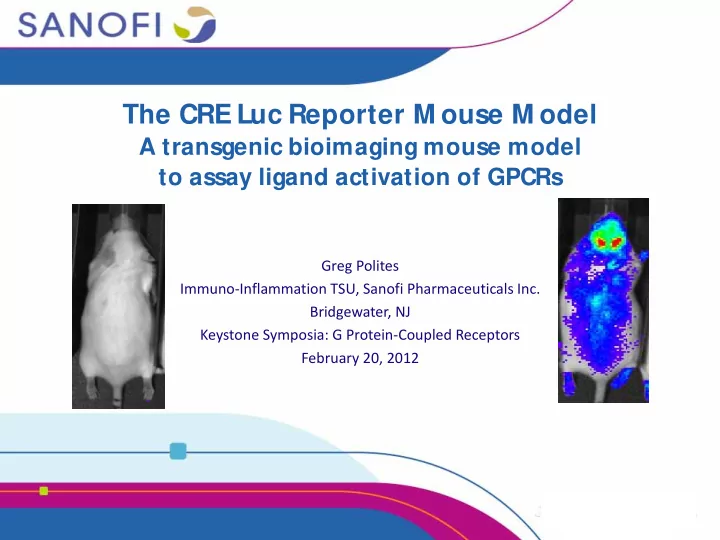
The CRE Luc Reporter M ouse M odel A transgenic bioimaging mouse model to assay ligand activation of GPCRs Greg Polites Immuno-Inflammation TSU, Sanofi Pharmaceuticals Inc. Bridgewater, NJ Keystone Symposia: G Protein-Coupled Receptors


slide-1
SLIDE 1

The CRE Luc Reporter M ouse M odel

A transgenic bioimaging mouse model to assay ligand activation of GPCRs

Greg Polites Immuno-Inflammation TSU, Sanofi Pharmaceuticals Inc. Bridgewater, NJ Keystone Symposia: G Protein-Coupled Receptors February 20, 2012

slide-2
SLIDE 2

2

The CRE Luc mouse model background and objectives

Real-time in vivo imaging utilizes the light emitted by a bioluminescent reporter gene (luciferase) expressed in vivo Allows for quantification of the signal non-invasively Temporal and spatial data can be collected from the same animal which reduces variation and allows each animal to be its own control

Bioimaging CRE-luciferase reporter system

Caliper IVIS Lumina

CRE promoter is responsive to the activation of CREB via the cAMP or PLC pathway Luciferase reporter expression is modulated to reflect GPCR activity through a transcriptional readout Assay can be used for all 3 GPCR classes: Gs ,Gi and indirectly Gq

Optics CCD Bioluminescent Source

IP3 Ca2+ as b g AC cAM P PKA

CREB

PLC

DAG PKC ai b g aq b g CaM K

luci

Gs Gi Gq

+

slide-3
SLIDE 3

3

In vivo In vitro Assay Dev Target ID Development Activity of selected compound in vivo (PK, PD), tissues or whole body imaging Source of cells for in vitro assays Clinical

The CRE Luc mouse model background and objectives

M odel goal: Combine a GPCR reporter system with real-time in vivo

bioimaging to assay GPCR ligand receptor interactions in primary cells, tissues or live animals.

Same reporter system utilized for both in vitro and in vivo assays Profiling of compounds selected from in vitro assays for rapid PK/PD CRE Luc mouse models support rapid application to ligand:receptor pharmacological assays in vitro GPCR ligand interactions can be assayed in a native system avoiding difficult to transfect primary cells and engineered cell lines

M odel application: The CRE Luc model has broad applications to GPCR

ligand and receptor interactions.

Addresses the transition from cells to animal model profiling of leads in GPCR drug development

slide-4
SLIDE 4

4

CRE Luc Reporter Mouse Model Application Strategy

Starting with a variety of luciferase expression profiles, pilot studies defined the model’s potential impact on drug development projects.

Typical pilots started with CRE Luc primary cell responses followed by in vivo experiments

Feasibility profiles T,B,macs. Pancreas Lung CNS Specific pilots to reach project application decision No-Go Go No-Go Go No-Go Go Project application 64 11, 16

Tg lines for model applications

CRE-Luc Liver Kidney Adipose 187 219 229 175

slide-5
SLIDE 5

5

Baseline imaging Compound dosing Re-imaging Compound dosing Tissue homogenates Luciferase assay

CRE-Luc

Ex vivo In vitro In vivo

Studying the GPCR cAMP signaling pathway using CRE Luc mouse

IVIS bioimaging Whole live animal imaging Simple, quick Limited resolution

Radiance/RLU Fold induction

Microplate reader Sensitive, accurate Better organ resolution Time-consuming

Next set of slides demonstrates this diversity of data with isoproterenol

slide-6
SLIDE 6

6

brain

baseline isoproterenol 100000 200000 300000 400000 500000

15X ***

treatment p/s/cm2

spinal cord

baseline isoproterenol 50000 100000 150000 200000

15X ***

treatment p/s/cm2

Isoproterenol in vivo response in CRE Luc

Response to Isoproterenol in line 187 with CNS predominate luci expression

Treatment: isoproterenol, 10MPK, ip Imaging at T=0 and 5 hours Statistically significant increase in quantitative CNS response over baseline

ROI

BRAIN SPINAL CORD

T=0 T=5hrs

slide-7
SLIDE 7

7

photo baseline ISO + AMN 1um ISO 1um photo baseline

Slice 2

CH1_DATA(cpm) 2000 4000 6000 8000 10000 12000 14000 16000 18000 20000

1440 2880 4320 5760 7200 8640 10080 11520 12960 14400

Vehicle (DMSO) Slice 1

CH1_DATA(cpm) 6000 7000 8000 9000 10000 11000 12000 13000 14000 15000 16000

1440 2880 4320 5760 7200 8640 10080 11520 12960 14400

Forskolin 50uM

1.93x

Isoproterenol ex vivo (brain slice) response in CRE Luc line 187

Compound induced changes in luciferase levels in brain slices can be detected and quantified by bioimaging

Gs agonist: isoproterenol signal is diminished by Gi agonist AM N087

Strategy to identify the region specific expression of the transgene and drug interaction

slide-8
SLIDE 8

8

Isoproterenol response of CRE Luc primary neurons (and Gs or Gi agonist profiles)

DMSO 10uM 1000 2000 3000 4000 * * * p<0.0001 * * * 11X [isoproterenol] cps

media 3uM 10uM 50 100 150 200 250 300 350 400 450 500 550 * * 3X * * p<0.01 [dopamine] cps

Gs: DRD, Gs: DRD, dopamine

  • E18, d 3 cor t i ca l

n e u r on s

  • t -t e st v s DMSO
  • 4 h ou r t r e a t m e n t
  • E14 , d 4 st r i a t a l n e u r on s
  • t -t e st v s m e d i a
  • 5 h ou r t r e a t m e n t

Gs: ADR Gs: ADRβ1/ 2 1/ 2 , isoproterenol

10uM F media DMSO F 1nM 10nM 100nM 1uM 5000 10000 15000 20000 25000 30000 35000 ns ns 40% 38% * * * * 9X

* * p<0.005

[AMN082] cps

Gi : Gi : mGluR7, A , AMN082 N082

  • E18, d3 cortical neurons
  • 10µM forskolin
  • 4 hour treatment
  • t-test vs Forskolin

Gi : Gi : CB1, , CP5 5 , CP5 5 ,94 0 4 0

DMSO F/R 100nM 1uM 10uM 50000 100000 150000 45%↓ 39%↓ 20%↓

* * * p<0.0005 * * p<0.005 * p<0.05

10uM F/ 10uM R 30X [CP55940] cps

  • E18, d3 cortical neurons
  • 10µM forskolin/ 10µM rolipram
  • 8 hour treatment
  • t-test vs Forskolin Rolipram
slide-9
SLIDE 9

9

Pancreatic specific induction of luciferase by the GLP1 agonist is blocked by streptozotocin treatment due to the destruction of β-cells

100 200 300 400 500 600 700 2 4

Days Glucose (mg/ dL)

Control STZ

STZ increases blood glucose STZ (day 4) blocks the induction of luci by GLP1 agonist

200 400 600 800 1000 1200 1400

Before After Fold induction

Control STZ

STZ treatment

Pancreatic specific induction of luciferase by a GLP1 agonist

Induction by GLP1 agonist Induction by GLP1 after STZ treatment STZ Control Basal Induction by Forskolin/ rolipram Basal

slide-10
SLIDE 10

10

GLP1 agonist induces luciferase expression mainly in the pancreas

Ex vivo assay on tissue homogenates

Compound dependent patterns of luciferase expression, suggesting that pancreas- specific activity of the GLP1 agonist is unlikely an transgenic artifact. Strong induction in the pancreas by the GLP1 agonist, isoproterenol, and forskolin plus rolipram was observed.

Vehicle GLP1 agonist (0.1 mpk) Forskolin (5 mpk), rolipram (10 mpk) Isoproterenol (20 mpk) Glucose (1 g/kg) Luciferase (RLU/μg protein) 100 200 300 400 500 600 700 1 10 102 103 104 105 106 Fold induction ** * * * * * * * * * * * * * * *

*P<0.05, one-way ANOVA

GLP1R found in multiple tissues, however compound activity is only seen in pancreas. CRE Luc model defines the site of action for a compound in vivo (rapid PK/PD).

slide-11
SLIDE 11

11

Pancreatic luciferase response in CRE Luc-Ins2Akita mice

Ins2Akita is an autosomal dominant mutation that causes early onset hyperglycemia in the absence of obesity, due to a missense mutation resulting in mis-folding of proinsulin and death of β cells. Crossed CRE Luc with Ins2Akita (FVB/ N background) to see if CRE-Luc induction is correlated with β cell function in this T1DM model. 8-week old mice were subject to baseline imaging on day 1 and treatment with GLP1 agonist (0.1mpk, sc) followed by re-imaging at 4 hr on day 2.

Akita/+ Akita/+ Akita/+ Akita/+ WT

100 200 300 400 500 600 Male Female

Fold induction

WT Akita/+

*

*P < 0.05, Akita/+ vs WT Two-way ANOVA model.

Females Males

Decreased CRE Luc induction by the GLP1 agonist (0.1 mpk, sc, 4 hrs) in the highly diabetic male mice. This effect was not significant in the less diabetic female littermates. In vivo signals were confirmed by ex vivo luciferase assay in a subset of animals.

slide-12
SLIDE 12

12 12

From initial studies, we have demonstrated the utility of the CRE Luc model to profile compounds in whole animals, tissue extracts, slices, and primary cells in vitro.

Profiling responses for various GPCRs have been tested in the following combinations Gs agonist:

In vitro with microglia, neurons, cardiomyocytes, M EFs and brain slices In vivo in the pancreas, brain, spinal cord

Gs antagonists:

In vitro: microglia, neurons, and T cells In vivo: brain, spinal cord

Gi agonists:

In vitro: neurons, Tcells, brain slices

Gi antagonists:

In vitro: neruons, Tcells, brain slices

Summary

slide-13
SLIDE 13

13

Characterization of the CRE Luc lines

Details of the profiling assays with the CRE Luc transgene have been summarized in a single table (available upon request) Eight CRE Luc lines are available through Taconic Biosciences

slide-14
SLIDE 14

14 14

Acknowledgements and Model Availability

Immunology Experimental Pharmacology

Holly Dressler (PTL, model generation, development, and applications) Fernando Camacho (psoriasis) Kyriakos Economides (psoriasis) Andy Giovanni (brain slices) Sarah Favara (linage profiling, CNS) Zhen Pang (diabetes, Metabolism) Nancy Wu (dibaetes, Metabolism)

CRE-Luc model information Greg Polites: greg.polites@sanofi-aventis.com or hgpolites3@gmail.com CRE-Luc model availability

Taconic Biosciences email: info@taconic.com