
SLIDE 1
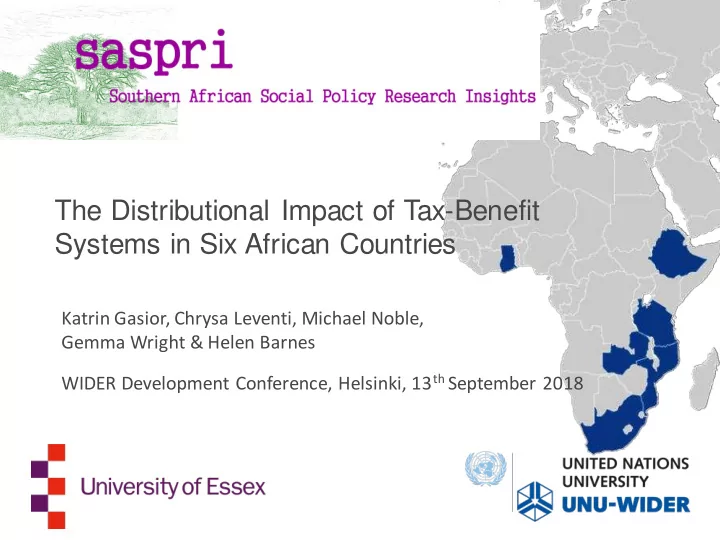
The Distributional Impact of Tax-Benefit Systems in Six African Countries
Katrin Gasior, Chrysa Leventi, Michael Noble, Gemma Wright & Helen Barnes WIDER Development Conference, Helsinki, 13th September 2018
The Distributional Impact of Tax-Benefit Systems in Six African - - PowerPoint PPT Presentation
The Distributional Impact of Tax-Benefit Systems in Six African Countries Katrin Gasior, Chrysa Leventi, Michael Noble, Gemma Wright & Helen Barnes WIDER Development Conference, Helsinki, 13 th September 2018 Background Taxation and
Katrin Gasior, Chrysa Leventi, Michael Noble, Gemma Wright & Helen Barnes WIDER Development Conference, Helsinki, 13th September 2018
governments to pursue distributional goals of reducing inequality and poverty
– An assessment of the distributional impact of public policies and the effects
– Ex-ante evaluation of reform ideas – Estimates of the fiscal impact of public policies and potential reforms
benefit microsimulation models but few developing countries have access to such tools.
very few studies focus on lower and middle-income countries (LMICs) in Africa (Inchauste & Lustig, 2017, Younger at al., 2016 & 2017)
– Our focus is on poverty and inequality measured (mostly) in terms of income – We use six state-of-the-art tax-benefit microsimulation models developed or updated under the SOUTHMOD project – We assess the distribution and composition of incomes and the effects of taxes and benefits on poverty and inequality in six African countries for a common time point (tax-benefit rules as of 30 June 2015, 1 July 2015 for Tanzania)
Insights (SASPRI), the EUROMOD team at the University of Essex together with local country teams.
– Use of common platform and well-tested methodological approach – Flexible and freely-available EUROMOD software as a shortcut to the process of building tax-benefit models
(Ethiopia, Mozambique, Tanzania), 2 Lower-middle income countries (Ghana, Zambia), 1 Upper-middle income country (South Africa)
direct taxes and indirect taxes
More details in: Barnes, H., Noble, M., Wright, G., Gasior, K., Leventi, C. (forthcoming) Improving the comparability of the SOUTHMOD tax-benefit microsimulation models. UNU-WIDER Technical Note.
+ all benefits + all benefits – SIC + all benefits – direct taxes + pension
taxes Employment income Self-employment (incl. farming) Other market incomes + Benefits (cash and in-kind)
Original income Disposable income Post-fiscal income Consumption
ET GH MZ SA TZ ZM Average age 22 25 21 28 23 22 Average household size 5 4 5 4 5 5 Aged 0-14 45% 39% 49% 30% 44% 43% Aged 15-59 55% 61% 51% 70% 56% 57% Aged 60+ 6% 7% 5% 8% 6% 4% Single 17% 21% 13% 37% 18% 21% Married/partnership 32% 32% 32% 26% 32% 29% Separated/divorced 3% 4% 3% 2% 3% 3% Widowed 3% 4% 3% 4% 4% 3% % with earnings 4% 11% 6% 25% 6% 7% % with self-empl. income 18% 25% 9% 6% 10% 17% Note: Marital status does not include observations below the age of 15.
ET GH MZ SA TZ ZM 1st quintile share 1% 1% 2% 2% 0% 0% 2nd quintile share 3% 3% 3% 4% 1% 1% 3rd quintile share 5% 7% 5% 9% 4% 5% 4th quintile share 8% 14% 10% 19% 11% 14% 5th quintile share 84% 75% 80% 67% 84% 79% Median 263 1,666 136 3,056 260 283 Mean 1,153 4,928 651 7,386 1,470 1,221
Source: Own calculations. Notes: Annual values in international dollars; per capita incomes; household-level results.
Source: Own calculations, World Bank (Consumption WDI). Note: All income-based results are in per capita terms; consumption-based results are presented both in per capita terms (PC) and using national equivalence scales (NES). Results for Consumption (WDI) refer to different years (2012 in Ghana, 2014 in Mozambique, 2011 in Tanzania and 2015 in Zambia).
ET GH MZ SA TZ ZM
85.9 31.1 83.8 12.9 72.6 70.8
92.9 44.9 90.8 28.9 81.2 79.2
96.7 60.6 95.4 46.6 89.0 86.2 Post-fiscal < $1.9/day 87.3 32.3 85.7 15.6 74.9 71.7 Post-fiscal < $3.2/day 93.5 46.4 91.9 31.5 83.0 79.7 Post-fiscal < $5.5/day 96.9 61.6 96.0 49.4 90.0 86.6 Consumption < $1.9/day . 9.2 54.7 . 35.0 52.6 Consumption < $3.2/day . 27.2 79.8 . 69.6 69.9 Consumption < $5.5/day . 54.4 92.3 . 89.2 84.2 Consumption < nat. poverty . 38.7 40.9 . 46.2 60.1
. 24.2 40.9 . 29.9 55.1
(24.2) (46.1) (28.2) (54.4)
Source: Own calculations. Note: All results are in per capita terms.
ET GH MZ SA TZ ZM
85.0 30.7 83.2 35.1 72.5 70.1 + pensions 84.9 30.7 82.8 27.9 72.5 70.1 + all benefits 84.9 30.6 82.3 12.9 72.4 70.0 + all benefits - SIC 85.0 30.7 82.5 12.9 72.4 70.2 + all benefits - taxes 85.4 31.0 83.5 12.9 72.6 70.5 Disposable income 85.9 31.1 83.8 12.9 72.6 70.8 Post-fiscal income 87.3 32.3 85.7 15.6 74.9 71.7
Source: Own calculations, World Bank (Gini WDI) Notes: Household-level results, in per capita terms. Results for Gini (WDI) are based on national equivalence scales and refer to different years (2012 in Ghana, 2008 in Mozambique, 2011 in Tanzania and 2015 in Zambia).
ET GH MZ SA TZ ZM
86.2 71.3 75.0 66.3 79.9 73.4 + pensions 86.1 71.3 74.9 66.2 79.9 73.4 + all benefits 86.0 71.3 75.8 65.2 80.0 73.4 + all benefits - SIC 86.0 71.3 75.5 65.2 79.9 73.1 + all benefits - taxes 81.8 70.8 75.1 62.4 77.7 72.5 Disposable income 81.8 70.8 74.8 62.4 77.6 72.0 Post-fiscal income 83.4 71.1 76.3 63.0 77.5 71.5 Consumption based . 44.0 52.3 . 38.9 59.0 Consumption (WDI) . (42.4) (54.0) . (37.8) (57.1)
In case of further suggestions and comments, please contact: k.gasior@essex.ac.uk Further information:
Gasior, K., Leventi, C., Barnes, H., Noble, M., Wright, G. (forthcoming) The Distributional Impact
Barnes, H., Noble, M., Wright, G., Gasior, K., Leventi, C. (forthcoming) Improving the comparability of the SOUTHMOD tax-benefit microsimulation models. UNU-WIDER Technical Note. EUROMOD: https://www.euromod.ac.uk/ SOUTHMOD: https://www.wider.unu.edu/project/southmod-simulating-tax-and-benefit-policies-development
The results presented here are based on revised and harmonised versions of ETMOD v1.0, GHAMOD v1.1, MOZMOD v2.0, SAMOD v6.1, TAZMOD v1.6 and MicroZAMOD v2.0. With the exception of SAMOD, the country models are developed, maintained and managed by UNU- WIDER in collaboration with the EUROMOD team at ISER at the University of Essex, SASPRI (Southern African Social Policy Research Insights) and local partners in the scope of the SOUTHMOD project. The country model local partners are respectively the Ethiopian Development Research Institute for ETMOD, the University of Ghana for GHAMOD, the Ministry
TAZMOD, and the Zambia Institute for Policy Analysis and Research for MicroZAMOD. SAMOD is developed, maintained and managed by SASPRI. We are indebted to the many people who have contributed to the development of SOUTHMOD and the country models. The results and their interpretation presented in this publication are solely the authors’ responsibility. Earlier versions
ECPR Conference (Hamburg, August, 2018).