The dual tree of a recursive triangulation of the disk Henning - - PowerPoint PPT Presentation

the dual tree of a recursive triangulation of the disk
SMART_READER_LITE
LIVE PREVIEW

The dual tree of a recursive triangulation of the disk Henning - - PowerPoint PPT Presentation

The model and its background Main results Variations of the scheme The dual tree of a recursive triangulation of the disk Henning Sulzbach, INRIA Paris-Rocquencourt Journes Alea, Luminy, March 2014 joint work with Nicolas Broutin (INRIA)


slide-1
SLIDE 1

The model and its background Main results Variations of the scheme
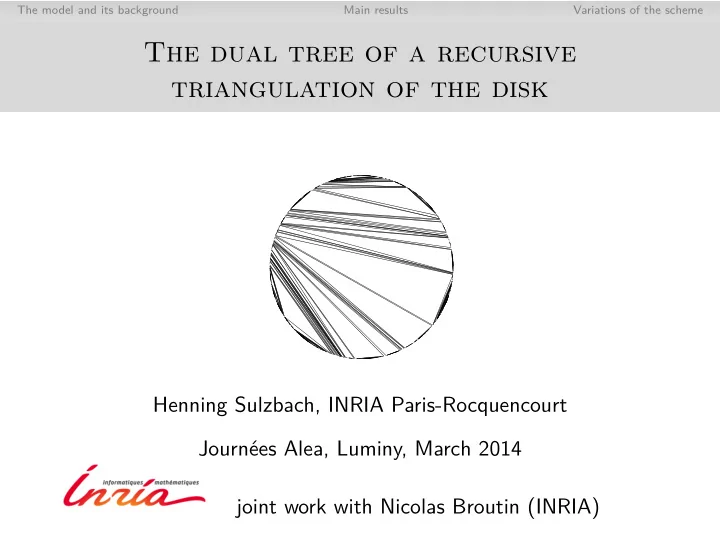
The dual tree of a recursive triangulation of the disk

Henning Sulzbach, INRIA Paris-Rocquencourt Journées Alea, Luminy, March 2014 joint work with Nicolas Broutin (INRIA)

slide-2
SLIDE 2

The model and its background Main results Variations of the scheme

Outline

  • 1. The model and its background
  • 2. Main results
  • 3. Variations of the scheme
slide-3
SLIDE 3

The model and its background Main results Variations of the scheme

Outline

  • 1. The model and its background
  • 2. Main results
  • 3. Variations of the scheme
slide-4
SLIDE 4

The model and its background Main results Variations of the scheme

Recursive laminations of the disk

Curien and Le Gall 2011: In each step, connect two uniformly chosen points unless the chord intersects any previously inserted.

slide-5
SLIDE 5

The model and its background Main results Variations of the scheme

Recursive laminations of the disk

Curien and Le Gall 2011: In each step, connect two uniformly chosen points unless the chord intersects any previously inserted.

slide-6
SLIDE 6

The model and its background Main results Variations of the scheme

Recursive laminations of the disk

Curien and Le Gall 2011: In each step, connect two uniformly chosen points unless the chord intersects any previously inserted.

slide-7
SLIDE 7

The model and its background Main results Variations of the scheme

Recursive laminations of the disk

Curien and Le Gall 2011: In each step, connect two uniformly chosen points unless the chord intersects any previously inserted.

slide-8
SLIDE 8

The model and its background Main results Variations of the scheme

Recursive laminations of the disk

Curien and Le Gall 2011: In each step, connect two uniformly chosen points unless the chord intersects any previously inserted.

X

slide-9
SLIDE 9

The model and its background Main results Variations of the scheme

Recursive laminations of the disk

Curien and Le Gall 2011: In each step, connect two uniformly chosen points unless the chord intersects any previously inserted.

slide-10
SLIDE 10

The model and its background Main results Variations of the scheme

Recursive laminations of the disk

Curien and Le Gall 2011: In each step, connect two uniformly chosen points unless the chord intersects any previously inserted. Number of inserted chords at time n is about √πn. Lamination: Ln = set of inserted chords at time n.

slide-11
SLIDE 11

The model and its background Main results Variations of the scheme

The limit triangulation

Theorem (Curien, Le Gall)

L∞ :=

n≥1 Ln is a triangulation, that is, its complement consists

  • f triangles with vertices on the circle.

Observe: Triangulations are maximal, that is, they cannot be increased by additional chords.

slide-12
SLIDE 12

The model and its background Main results Variations of the scheme

The dual tree

s Cn(s) Tn: dual tree, dgr: graph distance on Tn. Cn(s) = depth of node at s ∈ [0, 1] in Tn. Scaling limit of the dual tree Tn ? Scaling limit of the contour process Cn(s) ?

slide-13
SLIDE 13

The model and its background Main results Variations of the scheme

Trees encoded by excursions

Let f : [0, 1] → R+ be a continuous excursion.

1

T

f

x y [x] [y] d (x,y)

f

Tf = [0,1]/∼ where s ∼ t with s ≤ t if df (s, t) = 0 where df (s, t) = f (s) + f (t) − 2 inf{f (x) : s ≤ x ≤ t}. (Tf , df ) is a compact tree-like metric space (an R-tree).

slide-14
SLIDE 14

The model and its background Main results Variations of the scheme

Triangulations encoded by excursions

Let f : [0, 1] → R+ be a continuous excursion with distinct local minima. Lf contains chords connecting s ≤ t if and only if df (s, t) = 0.

1

Lf

Inner nodes of Tf correspond to triangles in Lf .

slide-15
SLIDE 15

The model and its background Main results Variations of the scheme

The Brownian world - Aldous ’94

Consider uniform triangulations of the n-gon Pn:

4n-6 contour process (Dyck path)

slide-16
SLIDE 16

The model and its background Main results Variations of the scheme

The Brownian world - Aldous ’94

Consider uniform triangulations of the n-gon Pn:

4n-6 contour process (Dyck path)

↓ δHaus ↓ dGH ↓ · ∞

0.0 0.2 0.4 0.6 0.8 1.0 0.0 0.5 1.0 1.5 2.0 t

slide-17
SLIDE 17

The model and its background Main results Variations of the scheme

Outline

  • 1. The model and its background
  • 2. Main results
  • 3. Variations of the scheme
slide-18
SLIDE 18

The model and its background Main results Variations of the scheme

The dual tree of the lamination

s Cn(s) Cn(s) = depth of node at s ∈ [0, 1] in Tn.

Theorem (Broutin, S. ’14)

There exists a random continuous process Z(s), s ∈ [0, 1], such that, uniformly in s ∈ [0, 1], almost surely, Cn(s) nβ/2 → Z(s), β = √ 17 − 3 2 = 0.561 . . .

slide-19
SLIDE 19

The model and its background Main results Variations of the scheme

The dual tree of the lamination

Theorem (Broutin, S. ’14)

There exists a random continuous process Z(s), s ∈ [0, 1], such that, uniformly in s ∈ [0, 1], almost surely, Cn(s) nβ/2 → Z(s), β = √ 17 − 3 2 = 0.561 . . . Moreover, L∞ = LZ (already proved by Curien and Le Gall). Almost surely, (Tn, n−β/2dgr) → (TZ, dZ) in the Gromov-Hausdorff topology on the space of (isometry classes of) compact metric spaces.

slide-20
SLIDE 20

The model and its background Main results Variations of the scheme

A simulation of the limit

0.0 0.1 0.2 0.3 0.4 0.5 0.6 0.7 0.8 0.9 1.0 0.0 0.1 0.2 0.3 0.4 0.5 0.6 0.7 0.8 0.9 1.0

E [Z(s)] ∼ (s(1 − s))β Optimal Hölder exponent: β = 0.561 . . . .

slide-21
SLIDE 21

The model and its background Main results Variations of the scheme

Recursive decomposition

U V In

(0)

In

(1)

Attempted insertions in subfragments I(0)

n d

= Bin(n − 1, (1 − (V − U))2) ∼ n(1 − (V − U))2 I(1)

n d

= Bin(n − 1, (V − U)2) ∼ n(V − U)2

slide-22
SLIDE 22

The model and its background Main results Variations of the scheme

Recursive decomposition

U V s

slide-23
SLIDE 23

The model and its background Main results Variations of the scheme

Recursive decomposition

U V s

Cn(s)

d

=1[0,U](s)C (0)

I(n)

  • s

1 − (V − U)

slide-24
SLIDE 24

The model and its background Main results Variations of the scheme

Recursive decomposition

U V s

Cn(s)

d

=1[0,U](s)C (0)

I(n)

  • s

1 − (V − U)

  • + 1(V ,1](s)C (0)

I(n)

s − (V − U) 1 − (V − U)

slide-25
SLIDE 25

The model and its background Main results Variations of the scheme

Recursive decomposition

U V s

Cn(s)

d

=1[0,U](s)C (0)

I(n)

  • s

1 − (V − U)

  • + 1(V ,1](s)C (0)

I(n)

s − (V − U) 1 − (V − U)

slide-26
SLIDE 26

The model and its background Main results Variations of the scheme

Recursive decomposition

U V s

Cn(s)

d

=1[0,U](s)C (0)

I(n)

  • s

1 − (V − U)

  • + 1(V ,1](s)C (0)

I(n)

s − (V − U) 1 − (V − U)

  • + 1(U,V ](s)
  • 1 + C (0)

I(n)

  • U

1 − (V − U)

  • + C (1)

I(n)

1

s − U V − U

slide-27
SLIDE 27

The model and its background Main results Variations of the scheme

Characterizing Z

(U, V ) min and max of two ind. uniforms, here U = 0.32, V = 0.56

Z (0) Z (1)

slide-28
SLIDE 28

The model and its background Main results Variations of the scheme

Characterizing Z

(U, V ) min and max of two ind. uniforms, here U = 0.32, V = 0.56

Z (0), (1 − (V − U))βZ (0) Z (1), (V − U)βZ (1)

slide-29
SLIDE 29

The model and its background Main results Variations of the scheme

Characterizing Z

(U, V ) min and max of two ind. uniforms, here U = 0.32, V = 0.56

Z (0), (1 − (V − U))βZ (0) Z (1), (V − U)βZ (1)

slide-30
SLIDE 30

The model and its background Main results Variations of the scheme

The fractal dimension

Theorem (Broutin, S.)

Almost surely, we have dim(TZ) = 1

β = 1.781 . . . both for

Minkowski and Hausdorff dimension. Compare: dim(Te) = 2 for the CRT. Very roughly, dim(Tf ) = s means that, as r → 0, |Br(x)| ≈ r s with Br(x) = {y ∈ Tf : df (x, y) < r}.

slide-31
SLIDE 31

The model and its background Main results Variations of the scheme

Outline

  • 1. The model and its background
  • 2. Main results
  • 3. Variations of the scheme
slide-32
SLIDE 32

The model and its background Main results Variations of the scheme

A homogeneous model

In each step

  • choose one fragment

uniformly at random

  • insert a chord uniformly

at random Observe: I(n) is uniformly distributed (Polya urn!), hence I(n) n → W , n → ∞, where W is uniform on [0, 1] and independent of (U, V ).

slide-33
SLIDE 33

The model and its background Main results Variations of the scheme

A homogeneous model

Theorem (Broutin, S. ’14)

There exists a random continuous process H(s), s ∈ [0, 1], such that, uniformly in s ∈ [0, 1], almost surely, Ch

n (s)

n1/3 → H(s). Moreover, E [H(s)] ∼ (s(1 − s))1/2.

slide-34
SLIDE 34

The model and its background Main results Variations of the scheme

A simulation of H

0.0 0.5 1.0 0.0 0.1 0.2 0.3 0.4 0.5 0.6 0.7 0.8 0.9 1.0

Optimal Hölder exponent: 3−2

√ 2 3

= 0.057 . . .

slide-35
SLIDE 35

The model and its background Main results Variations of the scheme

The characterization of H

(U, V ): as before and W another independent uniform.

H(0) H(1)

slide-36
SLIDE 36

The model and its background Main results Variations of the scheme

The characterization of H

(U, V ): as before and W another independent uniform.

H(0), (1 − W)1/3H(0) H(1), W1/3H(1)

slide-37
SLIDE 37

The model and its background Main results Variations of the scheme

The characterization of H

(U, V ): as before and W another independent uniform.

H(0), (1 − W)1/3H(0) H(1), W1/3H(1)

slide-38
SLIDE 38

The model and its background Main results Variations of the scheme

The fractal dimension

Theorem (Broutin, S.)

Almost surely, we have dim(TH) = 3 both for Minkowski and Hausdorff dimension.

slide-39
SLIDE 39

The model and its background Main results Variations of the scheme

The last slide

Note: Ln2 and Lh

n and their dual trees are significantly different.

log Mn2 log n → −1 log Mh

n

log n → √ 8 − 3 = −0.18 . . . On the other hand: LH = LZ, dim LZ = 1 + β.

slide-40
SLIDE 40

The model and its background Main results Variations of the scheme

References

  • D. Aldous. Triangulating the circle, at random. Amer. Math.

Monthly, 101: 223–233, 1994

  • D. Aldous. Recursive self-similarity for random trees, random

triangulations and Brownian excursion. Ann. Probab., 22: 527–545, 1994

  • N. Curien and J.-F. Le Gall. Random recursive triangulations
  • f the disk via fragmentation theory. Ann. Probab., 39:

2224-2270, 2011

  • N. Broutin and H. Sulzbach. The dual tree of a recursive

triangulation of the disk. to appear in Ann. Probab., 2014 Merci bien