
SLIDE 1
The ¡Ecology ¡of ¡Microbial ¡ Communi5es ¡
Simon ¡Levin ¡ ¡Trieste ¡2017 ¡
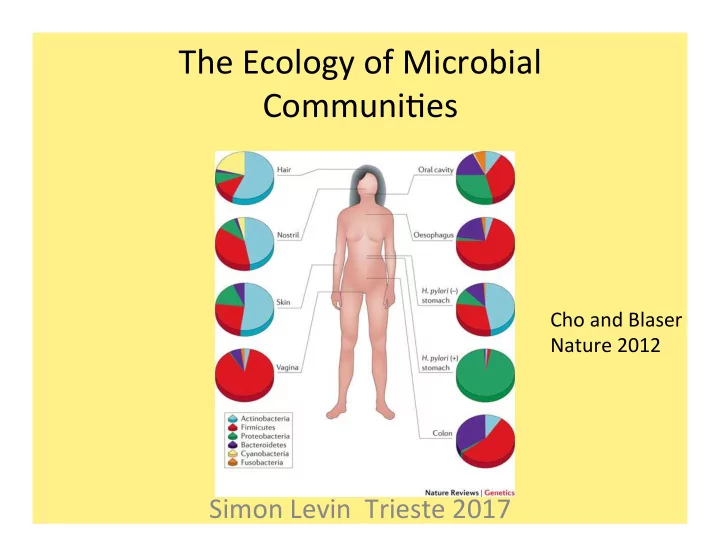
Cho ¡and ¡Blaser ¡ Nature ¡2012 ¡
The Ecology of Microbial Communi5es Cho and Blaser - - PowerPoint PPT Presentation
The Ecology of Microbial Communi5es Cho and Blaser Nature 2012 Simon Levin Trieste 2017 With thanks to Objec5ves Raise challenges, following up
Cho ¡and ¡Blaser ¡ Nature ¡2012 ¡
From ¡physical ¡systems ¡to ¡biological ¡systems, ¡ macroscopic ¡features ¡emerge ¡from ¡microscopic ¡ interac5ons, ¡largely ¡independent ¡of ¡details ¡
hMp://en.wikipedia.org/wiki/ Biofilm ¡
Courtesy ¡of ¡Claudio ¡Carere ¡/ ¡StarFLAG ¡EU ¡FP6 ¡ project ¡
hMp://www.icmp.lviv.ua/ ising/galam.html ¡
www.piM.edu/~jdnorton ¡
the ¡biosphere ¡ and ¡to ¡ask ¡ ¡
relate ¡to ¡ecological ¡and ¡evolu5onary ¡dynamics ¡on ¡ finer ¡scales? ¡
systems ¡and ¡the ¡ecosystems ¡of ¡which ¡they ¡are ¡part ¡ ¡? ¡
Levin, ¡Hein, ¡Hagstrom, ¡Stocker ¡ A ¡New ¡Framework ¡for ¡Ecological ¡Kine5cs ¡in ¡Natural ¡Environments ¡ ¡
u ¡and ¡K ¡from ¡ECCO2 ¡GCM ¡ Phyto ¡ ¡growth ¡ Remineraliza5on ¡ & ¡other ¡sources ¡ Growth ¡ Mortality ¡ Grazing ¡ Sinking ¡
MJ ¡Follows ¡et ¡al, ¡Science ¡315, ¡1843 ¡(2007) ¡
Ocean ¡dynamics: ¡The ¡MIT-‑DARWIN ¡Model ¡
C ¡Wunsch ¡& ¡P ¡Heimbach, ¡Physica ¡D ¡230,197 ¡(2007) ¡
N/P/Z= ¡nutrients/phytoplankton/ zooplankton ¡ Simplis5c ¡movement ¡
Diatoms ¡ Prochlorococcus ¡ Synechococcus ¡ Large ¡eukaryotes ¡
Follows, ¡Dutkiewicz, ¡Chisholm, ¡ ¡… ¡
Courtesy ¡Follows ¡and ¡Dutkiewicz ¡
20TH ANNIVERSARY PAPER
Marine Ecosystems as Complex Adaptive Systems: Emergent Patterns, Critical Transitions, and Public Goods
George I. Hagstrom* and Simon A. Levin
Ecology and Evolutionary Biology, Princeton University, Guyot Hall, Princeton, New York 08544, USA
ABSTRACT
Complex adaptive systems provide a unified framework for explaining ecosystem phenomena. In the past 20 years, complex adaptive systems have been sharpened from an abstract concept into a series of tools that can be used to solve concrete
development of new techniques for coupling eco- logical and evolutionary dynamics, for integrating dynamics across multiple scales of organization, and for using data to infer the complex interactions among different components of ecological systems. Focusing on the development and usage of these new methods, we discuss how they have led to an improved understanding of three universal features
tipping points and critical phenomena; and coop- erative behavior. We restrict our attention primarily to marine ecosystems, which provide numerous successful examples of the application of complex adaptive systems. Many of these are currently undergoing dramatic changes due to anthropogenic perturbations, and we take the opportunity to dis- cuss how complex adaptive systems can be used to improve the management of public goods and to better preserve critical ecosystem services. Key words: complex adaptive systems; public goods; emergent patterns; critical transitions; mar- ine ecosystems; evolution of cooperation; theoret- ical ecology.
INTRODUCTION
Twenty years ago, as Ecosystems was setting out on its path to become one of the leading-edge outlets for progress in ecosystems research, it featured a special systems (Hartvigsen and others 1998; Levin 1998). Since that time, this perspective has seen impressive development, from both theoretical and applied perspectives (Scheffer and others 2012; Filotas and
Ecosystems DOI: 10.1007/s10021-017-0114-3 2017 Springer Science+Business Media New YorkAuthor's personal copy
12 ¡
hMp://ses.jrc.ec.europa.eu/agent-‑based-‑modelling-‑smart-‑grids ¡
13 ¡
Claudio ¡Carere ¡+ ¡StarFLAG ¡EU ¡FP6 ¡project ¡ Couzin/BBC ¡ Source ¡Unknown ¡
14 ¡
hMp:// www.physicalgeography.net/ fundamentals/9i.html ¡
levels, ¡to ¡the ¡mutual ¡benefit ¡of ¡host ¡and ¡ microbiota ¡
mul5ple ¡levels, ¡some5mes ¡to ¡the ¡mutual ¡benefit ¡
cells ¡(cancer ¡is ¡an ¡example) ¡
wikipedia ¡ hMp://
22 ¡
hMp://www.cienciahoje.pt/ ¡ index.php?oid ¡ hMp://sweet.ua.pt/sdorogov/ ¡ photos-‑networkers.html ¡ hMp://www. ¡ the-‑scien5st.com/ ¡ David ¡Dingli ¡ Jorge ¡Pacheco ¡ Corina ¡Tarnita ¡
Scheffer ¡et ¡al. ¡2003 ¡
Alterna5ve ¡states ¡and ¡cri5cal ¡transi5ons ¡
Marten Scheffer1, Jordi Bascompte2, William A. Brock3, Victor Brovkin5, Stephen R. Carpenter4, Vasilis Dakos1, Hermann Held6, Egbert H. van Nes1, Max Rietkerk7 & George Sugihara8
Complex dynamical systems, ranging from ecosystems to financial markets and the climate, can have tipping points at which a sudden shift to a contrasting dynamical regime may occur. Although predicting such critical points before they are reached is extremely difficult, work in different scientific fields is now suggesting the existence of generic early-warning signals that may indicate for a wide class of systems if a critical threshold is approaching.
t is becoming increasingly clear that many complex systems have criticalthresholds—so-calledtippingpoints—atwhichthesystem shifts abruptly from one state to another. In medicine, we have spontaneous systemic failures such as asthma attacks1 or epileptic seizures2,3; in global finance, there is concern about systemic market crashes4,5; in the Earth system, abrupt shifts in ocean circulation or climate may occur6; and catastrophic shifts in rangelands, fish popula- tions or wildlife populations may threaten ecosystem services7,8. Itisnotablyhardtopredictsuchcriticaltransitions,becausethestate
enough to predict reliably where critical thresholds may occur. Interestingly, though, it now appears that certain generic symptoms considered to capture the essence of shifts at tipping points in a wide range of natural systems ranging from cell signalling pathways14 to ecosystems7,15 and the climate6. At fold bifurcation points (F1 and F2, Box 1), the dominant eigenvalue characterizing the rates of change around the equilibrium becomes zero. This implies that as the system approaches such critical points, it becomes increasingly slow in re- covering from small perturbations (Fig. 1). It can be proven that this phenomenon will occur in any continuous model approaching a fold
slowing down typically starts far from the bifurcation point, and that recovery rates decrease smoothly to zero as the critical point is
The most straightforward implication of critical slowing down is
Vol 461j3 September 2009jdoi:10.1038/nature08227
25 ¡
Generic Indicators for Loss of Resilience Before a Tipping Point Leading to Population Collapse
Lei Dai,1* Daan Vorselen,2* Kirill S. Korolev,1 Jeff Gore1† Theory predicts that the approach of catastrophic thresholds in natural systems (e.g., ecosystems, the climate) may result in an increasingly slow recovery from small perturbations, a phenomenon called critical slowing down. We used replicate laboratory populations of the budding yeast Saccharomyces cerevisiae for direct observation of critical slowing down before population
became more vulnerable to disturbance closer to the tipping point. Fluctuations of population density increased in size and duration near the tipping point, in agreement with the theory. Our results suggest that indicators of critical slowing down can provide advance warning of catastrophic thresholds and loss of resilience in a variety of dynamical systems.
atural populations can experience cat- astrophic collapse in response to small changes in environmental conditions, and recovery after such a collapse can be ex- ceedingly difficult (1, 2). Tipping points mark- ing population collapse and other catastrophic thresholds in natural systems may correspond to a fold bifurcation in the dynamics of the system (3–6). Even before crossing a tipping point, a system may become increasingly vulnerable to perturbations due to loss of “ecological resil- ience” (i.e., size of the basin of attraction) (4, 7). There has been a growing interest in the pos- sibility of using generic statistical indicators, primarily based on critical slowing down, as early warning signals of impending tipping points in various systems (8–16). In dynamical systems theory, critical slowing down refers to the slow recovery from small perturbations in the vicinity
a bifurcation, the time needed to recover from perturbations becomes longer (11, 18) and hence the system becomes more correlated with its past, leading to an increase in autocorrelation. In ad- dition, the perturbations accumulate and result in an increase in the size of the fluctuations (10). Other statistical indicators, such as skewness, have also been proposed as warning signals be- cause of the change in stability landscape before bifurcations (19). An increase in variance or autocorrelation of fluctuations of the system has been observed to precede a regime shift in a lake ecosystem (13), abrupt climate change (9, 14), transitions in coor- dinated biological motion (20), and the cascading failure of the North America Western Intercon- nection power system in 1996 (21); these findings suggest the existence of bifurcation-type tipping points and associated critical dynamics in many
lying these systems makes it difficult to determine the nature of the transitions, studies in controlled systems are required. Recent studies in labora- tory water fleas (12) and cyanobacterial mono- culture (16) measured the warning signals under controlled conditions. However, the transition in the deteriorating-environment experiment of water fleas, probably due to a transcritical bi- furcation, was noncatastrophic (fig. S1). More-
determined directly by experiments. Thus, neither study constituted a demonstration of early warn- ing signals before an experimentally mapped fold bifurcation in a live system. Such a study can also test directly the possibility of using crit- ical slowing down to indicate loss of ecological
1Department of Physics, Massachusetts Institute of Technology,Cambridge, MA 02139, USA. 2Department of Physics and Astronomy, VU University, 1081 HV Amsterdam, Netherlands. *These authors contributed equally to this work. †To whom correspondence should be addressed. E-mail: gore@mit.edu 10
310
410
510
6Population density (cells/µl)
Unstable fixed point Stable fixed point
2 4 6 10 3 10 4 10 5 10 6Dilution factor 750 Day Population density (cells/µl)
2 4 6 10 3 10 4 10 5 10 6Dilution factor 1400 Day
10 1 10 1A B C D E
REPORTS
www.sciencemag.org Downloaded from
hMp://en.wikipedia.org/wiki/Ren%C3%A9_Thom ¡ hMp://en.wikipedia.org/wiki/Catastrophe_theory ¡
ecosystems? ¡
permanent ¡or ¡nearly ¡permanent ¡effect ¡on ¡ community ¡dynamics? ¡
transient ¡with ¡regard ¡to ¡community ¡composi5on, ¡ can ¡there ¡be ¡long-‑las5ng ¡ecosystem ¡effects, ¡e.g. ¡
¡ ¡ ¡
distribu1ons ¡of ¡consumers ¡and ¡resources, ¡and ¡ the ¡ability ¡of ¡organisms ¡to ¡ac1vely ¡exploit ¡this ¡ heterogeneity ¡ ¡
– Applica5on ¡of ¡foraging ¡theory ¡from ¡ecology ¡ – Complicated ¡by ¡problem ¡of ¡detec5on ¡and ¡uncertainty ¡
A ¡New ¡Framework ¡for ¡Ecological ¡Kine5cs ¡in ¡Natural ¡Environments ¡ ,,,,,,,,,,,,,,,,,,, ¡
Simons grant: predict dynamic region where cells can do chemotaxis from first principles of sensory noise:
Hein ¡et ¡al. ¡2016 ¡J. ¡Roy. ¡Soc. ¡Interface ¡
900 µm t = 5 s t = 30 t = 60 t = 90 t = 120 t = 140
Ben-‑Jacob ¡and ¡Levine ¡
www.marieMa.edu ¡
Flipboard.com ¡
Suzuki ¡and ¡Worobey, ¡Biology ¡LeMers, ¡2014 ¡ ¡
12 9 10 11 13 17 16 15 14 4 6 7 5 8 20 21 23 22 19 18 3 1 2
Figure 1. Distribution map of human populations used in this study. Pie chart indicates the relative abundance of two bacterial phyla: Firmicutes (dark grey) and Bacteroidetes (light grey). The numbers indicate Map ID (see table 1).
rsbl.royalsocietypublishing.org
3
http://rsbl.royalsocietypublishing.org/ Downloaded from
Meinhardt ¡ ¡ Alan Turing (1912-1 954)
hMp://geoblog.weebly.com/environmental-‑sciences-‑blog/-‑change ¡ Ehud ¡Meron ¡
disc.sci.gsfc.nasa.gov
www2.le.ac.uk
ncbi.nlm .nih.gov ¡
Flierl et at, 1999
20TH ANNIVERSARY PAPER
Marine Ecosystems as Complex Adaptive Systems: Emergent Patterns, Critical Transitions, and Public Goods
George I. Hagstrom* and Simon A. Levin
Ecology and Evolutionary Biology, Princeton University, Guyot Hall, Princeton, New York 08544, USA
ABSTRACT
Complex adaptive systems provide a unified framework for explaining ecosystem phenomena. In the past 20 years, complex adaptive systems have been sharpened from an abstract concept into a series of tools that can be used to solve concrete
development of new techniques for coupling eco- logical and evolutionary dynamics, for integrating dynamics across multiple scales of organization, and for using data to infer the complex interactions among different components of ecological systems. Focusing on the development and usage of these new methods, we discuss how they have led to an improved understanding of three universal features
tipping points and critical phenomena; and coop- erative behavior. We restrict our attention primarily to marine ecosystems, which provide numerous successful examples of the application of complex adaptive systems. Many of these are currently undergoing dramatic changes due to anthropogenic perturbations, and we take the opportunity to dis- cuss how complex adaptive systems can be used to improve the management of public goods and to better preserve critical ecosystem services. Key words: complex adaptive systems; public goods; emergent patterns; critical transitions; mar- ine ecosystems; evolution of cooperation; theoret- ical ecology.
INTRODUCTION
Twenty years ago, as Ecosystems was setting out on its path to become one of the leading-edge outlets for progress in ecosystems research, it featured a special systems (Hartvigsen and others 1998; Levin 1998). Since that time, this perspective has seen impressive development, from both theoretical and applied perspectives (Scheffer and others 2012; Filotas and
Ecosystems DOI: 10.1007/s10021-017-0114-3 2017 Springer Science+Business Media New YorkAuthor's personal copy
upload.wikimedia.org ¡
¡
hMp://2011.igem.org/Team:Tokyo_Tech ¡
The ¡evolu9on ¡of ¡allelopathy:Compe99on ¡between ¡
Localiza5on ¡again ¡makes ¡a ¡difference ¡ DurreM ¡and ¡Levin ¡
Competing interests statement
The authors declare that they have no competing financial interests. Correspondence and requests for materials should be addressed to M.E.P. (e-mail: matt@gps.caltech.edu).
..............................................................
Local dispersal promotes biodiversity in a real-life game of rock–paper–scissors
Benjamin Kerr*, Margaret A. Riley†, Marcus W. Feldman* & Brendan J. M. Bohannan*
* Department of Biological Sciences, Stanford University, Stanford, California 94305, USA † Department of Ecology and Evolutionary Biology, Yale University, New Haven, Connecticut 06511, USA
.............................................................................................................................................................................
One of the central aims of ecology is to identify mechanisms that maintain biodiversity1,2. Numerous theoretical models have shown that competing species can coexist if ecological processes such as dispersal, movement, and interaction occur over small spatial scales1–10. In particular, this may be the case for non- transitive communities, that is, those without strict competitive hierarchies3,6,8,11. The classic non-transitive system involves a community of three competing species satisfying a relationship growth-rate advantage) and C can displace S (because C kills S). That is, the C–S–R community satisfies a rock–paper–scissors relationship. Using a modification of the lattice-based simulation of Durrett and Levin6, we theoretically explored the role of the spatial scale of
www.cs.montana.edu/~ross ¡
The Evolution of Quorum Sensing in Bacterial Biofilms
Carey D. Nadell1*[, Joao B. Xavier2[, Simon A. Levin1, Kevin R. Foster2*
1 Department of Ecology and Evolutionary Biology, Princeton University, Princeton, New Jersey, United States of America, 2 Center for Systems Biology, Harvard University, Bauer Laboratory, Cambridge, Massachusetts, United States of America
Bacteria have fascinating and diverse social lives. They display coordinated group behaviors regulated by quorum- sensing systems that detect the density of other bacteria around them. A key example of such group behavior is biofilm formation, in which communities of cells attach to a surface and envelope themselves in secreted polymers. Curiously, after reaching high cell density, some bacterial species activate polymer secretion, whereas others terminate polymer secretion. Here, we investigate this striking variation in the first evolutionary model of quorum sensing in
differ in their polymer production and quorum-sensing phenotypes. The benefit of activating polymer secretion at high cell density is relatively straightforward: secretion starts upon biofilm formation, allowing strains to push their lineages into nutrient-rich areas and suffocate neighboring cells. But why use quorum sensing to terminate polymer secretion at high cell density? We find that deactivating polymer production in biofilms can yield an advantage by redirecting resources into growth, but that this advantage occurs only in a limited time window. We predict, therefore, that down-regulation of polymer secretion at high cell density will evolve when it can coincide with dispersal events, but it will be disfavored in long-lived (chronic) biofilms with sustained competition among strains. Our model suggests that the observed variation in quorum-sensing behavior can be linked to the differing requirements of bacteria in chronic versus acute biofilm infections. This is well illustrated by the case of Vibrio cholerae, which competes within biofilms by polymer secretion, terminates polymer secretion at high cell density, and induces an acute disease course that ends with mass dispersal from the host. More generally, this work shows that the balance of competition within and among biofilms can be pivotal in the evolution of quorum sensing.
Citation: Nadell CD, Xavier JB, Levin SA, Foster KR (2008) The evolution of quorum sensing in bacterial biofilms. PLoS Biol 6(1): e14. doi:10.1371/journal.pbio.0060014
Introduction
Once perceived as organisms that rarely interact, bacteria are now known to lead highly social lives [1–3]. Central to this sociality is an ability to detect local cell density and thereby coordinate group behaviors [4–6]. This ability, termed quorum sensing, functions through the secretion and detection of depend upon both the species under observation and the experimental conditions [28]. Four studies have emphasized how the potential for competition and conflict among strains
34], but none have addressed biofilm formation. An open challenge for microbiology, therefore, is to disentangle the
PLoS BIOLOGY
Link ¡between ¡group ¡living ¡and ¡communica5on ¡ Quorum Sensing Slime Biofilms
Low cell density High cell density Pseudomonas aeruginosa Slime OFF Slime ON Vibrio cholerae Slime ON Slime OFF
Extracellular Polymers (Slime)
Key
Cell that makes polymer Cell that cannot make polymer Extracellular polymer Nutrient Diffusion
Nadell, ¡Xavier, ¡Levin, ¡Foster ¡
Trait ¡based ¡models: ¡ Biofilm ¡forma5on ¡and ¡quorum ¡sensing ¡
Constitutive Slime-producer Slime QS Strain (below quorum) QS Strain (above quorum) Nadell, ¡Xavier, ¡Levin, ¡Foster ¡ PLoSBiology ¡ r ¡
www.neofo rmix.com ¡
57 ¡
hMp://organiza5onsandmarkets.files.wordpress.com ¡
58 ¡
59 ¡
hMp://organiza5onsandmarkets.files.wordpress.com ¡
60 ¡