The EM Algorithm The EM algorithm Mixture models Why EM works EM - - PDF document

the em algorithm
SMART_READER_LITE
LIVE PREVIEW

The EM Algorithm The EM algorithm Mixture models Why EM works EM - - PDF document

Preview The EM Algorithm The EM algorithm Mixture models Why EM works EM variants Learning with Missing Data The EM Algorithm Goal: Learn parameters of Bayes net with known structure Initialize parameters ignoring missing


slide-1
SLIDE 1

The EM Algorithm

Preview

  • The EM algorithm
  • Mixture models
  • Why EM works
  • EM variants

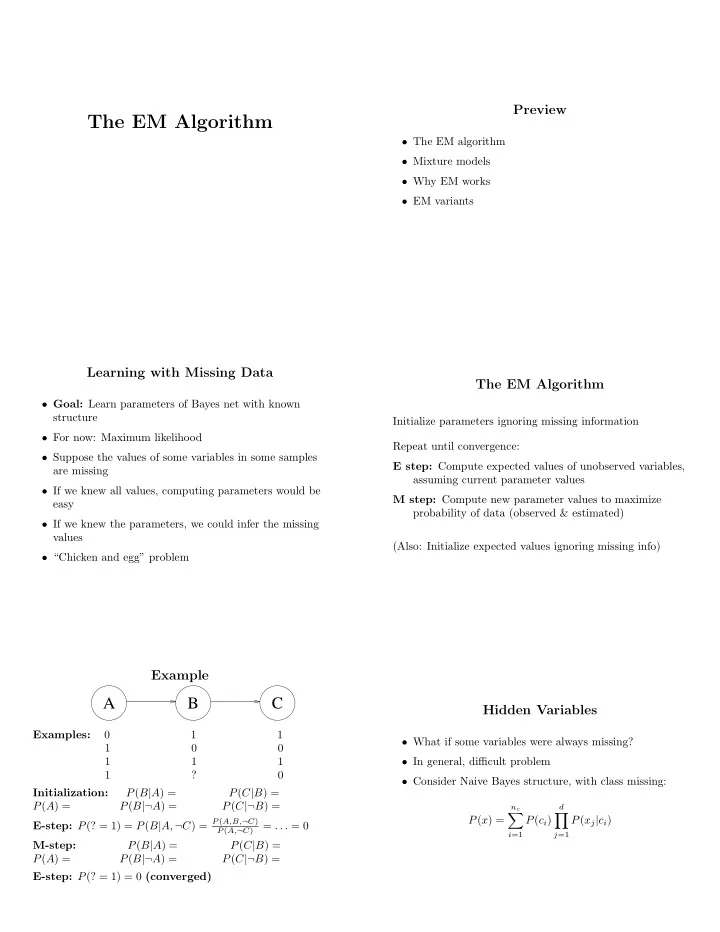
Learning with Missing Data

  • Goal: Learn parameters of Bayes net with known

structure

  • For now: Maximum likelihood
  • Suppose the values of some variables in some samples

are missing

  • If we knew all values, computing parameters would be

easy

  • If we knew the parameters, we could infer the missing

values

  • “Chicken and egg” problem

The EM Algorithm

Initialize parameters ignoring missing information Repeat until convergence: E step: Compute expected values of unobserved variables, assuming current parameter values M step: Compute new parameter values to maximize probability of data (observed & estimated) (Also: Initialize expected values ignoring missing info)

Example

A B C

Examples: 1 1 1 1 1 1 1 ? Initialization: P(B|A) = P(C|B) = P(A) = P(B|¬A) = P(C|¬B) = E-step: P(? = 1) = P(B|A, ¬C) = P (A,B,¬C)

P (A,¬C)

= . . . = 0 M-step: P(B|A) = P(C|B) = P(A) = P(B|¬A) = P(C|¬B) = E-step: P(? = 1) = 0 (converged)

Hidden Variables

  • What if some variables were always missing?
  • In general, difficult problem
  • Consider Naive Bayes structure, with class missing:

P(x) =

nc

  • i=1

P(ci)

d

  • j=1

P(xj|ci)

slide-2
SLIDE 2

Naive Bayes Model

(a) (b)

Wrapper Flavor Bag

P( 1) Bag= Bag 1 2

1

F

2

F P(F=cherry | B)

C X Holes

Clustering

  • Goal: Group similar objects
  • Example: Group Web pages with similar topics
  • Clustering can be hard or soft
  • What’s the objective function?

Mixture Models

P(x) =

nc

  • i=1

P(ci)P(x|ci) Objective function: Log likelihood of data Naive Bayes: P(x|ci) = nd

j=1 P(xj|ci)

AutoClass: Naive Bayes with various xj models Mixture of Gaussians: P(x|ci) = Multivariate Gaussian In general: P(x|ci) can be any distribution

Mixtures of Gaussians

p(x) x

P(x|µi) = 1 √ 2πσ2 exp

  • −1

2 x − µi σ 2

EM for Mixtures of Gaussians

Simplest case: Assume known priors and covariances Initialization: Choose means at random E step: For all samples xk: P(µi|xk) = P(µi)P(xk|µi) P(xk) = P(µi)P(xk|µi)

  • i′ P(µi′)P(xk|µi′)

M step: For all means µi: µi =

  • xk x P(µi|xk)
  • xk P(µi|xk)

Mixtures of Gaussians (cont.)

  • K-means clustering ≺ EM for mixtures of Gaussians
  • Mixtures of Gaussians ≺ Bayes nets
  • Also good for estimating joint distribution of

continuous variables

slide-3
SLIDE 3

Why EM Works

LL(Onew) LL(Onew) LLold + Q(Onew) Oold LLold Onew

θnew = argmax

θ

Eθold[log P(X)]

EM Variants

MAP: Compute MAP estimates instead of ML in M step GEM: Just increase likelihood in M step MCMC: Approximate E step Simulated annealing: Avoid local maxima Early stopping: Faster, may reduce overfitting Structural EM: Missing data and unknown structure

Summary

  • The EM algorithm
  • Mixture models
  • Why EM works
  • EM variants