The Entity-Relationship Requirements analysis Model Conceptual - - PDF document

the entity relationship
SMART_READER_LITE
LIVE PREVIEW

The Entity-Relationship Requirements analysis Model Conceptual - - PDF document

Overview of Database Design The Entity-Relationship Requirements analysis Model Conceptual design data model Logical design Schema refinement: Normalization Physical tuning


slide-1
SLIDE 1

The Entity-Relationship Model

Overview of Database Design

Requirements analysis Conceptual design data model Logical design Schema refinement: Normalization Physical tuning

Conceptual Design

Conceptual design: (ER Model is used at this stage.)

What are the entities and relationships in the

enterprise?

What information about these entities and

relationships should we store in the database?

What are the integrity constraints or business rules

that hold?

A database `schema’ in the ER Model can be

represented pictorially (ER diagrams).

Can map an ER diagram into a relational schema.

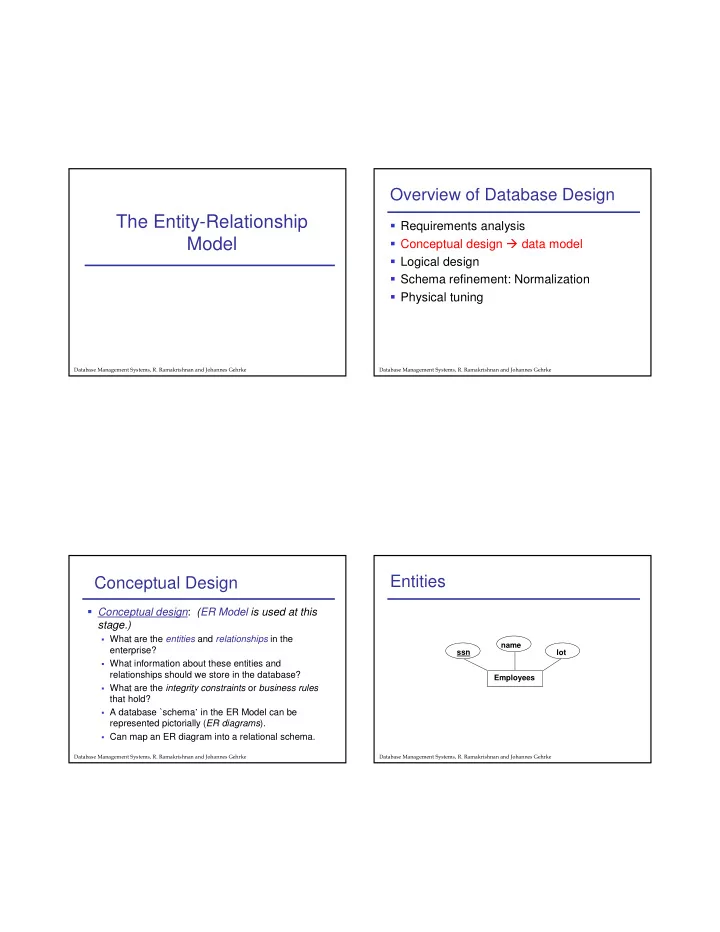
Entities

Employees ssn name lot

slide-2
SLIDE 2

ER Model Basics

Entity: Real-world object distinguishable from other objects. An entity is

described (in DB) using a set of attributes

Entity Set: A collection of similar entities. E.g., all employees

All entities in an entity set have the same set

  • f attributes

Each entity set has a key Each attribute has a domain

Relationships

lot dname budget did name Departments Employees ssn since Works_In

ER Model Basics (Contd.)

Relationship: Association among two or more entities.

E.g., Attishoo works in Pharmacy department.

Relationship Set: Collection of similar relationships.

An n-ary relationship set R relates n entity

sets E1 ... En

Each relationship in R involves entities e1 in

E1, ..., en in En

Relationships (Contd.)

lot name Employees ssn Reports_To subor- dinate super- visor

Want to capture supervisor-subordinate relationship

slide-3
SLIDE 3

Relationships (Contd.)

name Suppliers id

Want to capture information that a Supplier s supplies Part p to Department d

name Departments id name Parts id

Ternary Relationship

name Suppliers id name Departments id name Parts id Contract

How are these different?

name Employees ssn lot Works_In2 from to dname budget did Departments dname budget did name Departments ssn lot Employees Works_In3 Duration from to

Key Constraints

An employee can work in many departments; a dept can have many employees Each dept has at most one manager, according to the key constraint on Manages.

dname budget did since lot name ssn Manages Employees Departments lot dname budget did name Departments Employees ssn since Works_In

slide-4
SLIDE 4

Key Constraints: Examples

Example Scenario 1: An inventory database contains information about parts and

  • manufacturers. Each part is constructed by

exactly one manufacturer. Example Scenario 2: A customer database contains information about customers and sales

  • persons. Each customer has exactly one primary

sales person. What do the ER diagrams look like?

Participation Constraints

An employee can work in many departments; a dept can have many employees Each employee works in at least

  • ne department

according to the participation constraint on Works_In

lot dname budget did name Departments Employees ssn since Works_In lot dname budget did name Departments Employees ssn since Works_In

Participation Constraints: Examples

Example Scenario 1 (Contd.): Each part is constructed by exactly one or more manufacturer. Example Scenario 2: Each customer has exactly one primary sales person.

Exercise: What does this mean?

lot name dname budget did since name dname budget did since Manages since Departments Employees ssn Works_In

slide-5
SLIDE 5

Weak Entities

A weak entity can be identified uniquely only by considering the primary key of another (owner) entity.

Owner entity set and weak entity set must participate in a one-

to-many relationship set (one owner, many weak entities).

Weak entity set must have total participation in this identifying

relationship set.

lot name age pname Dependents Employees ssn Policy cost

ISA (`is a’) Hierarchies

Contract_Emps name ssn Employees lot hourly_wages ISA Hourly_Emps contractid hours_worked

  • !"# $%

#"$

  • Overlap constraints: Can Joe be an Hourly_Emps as well

as a Contract_Emps entity? (Allowed/disallowed) Covering constraints: Does every Employees entity also have to be an Hourly_Emps or a Contract_Emps entity? (Yes/no) Reasons for using ISA:

To add descriptive attributes specific to a subclass. To identify entities that participate in a relationship.

Aggregation

Used when we have to model a relationship involving (entitity sets and) a relationship set.

Aggregation allows

us to treat a relationship set as an entity set for purposes of participation in (other) relationships.

&

"#'

!"'%

#""''

'#

budget did pid started_on pbudget dname until Departments Projects Sponsors Employees Monitors lot name ssn since

Class Exercise

Give two real-life examples where each of the following would occur:

A key constraint A participation constraint A weak entity set
slide-6
SLIDE 6

Class Exercise

Draw ER diagram for a database used to manage SI440 class (at least 3 entities)

Specify entities, attributes, identifiers Specify relationships Specify constraints

Class Exercise

Drugwarehouse.com has offered you a free life- time supply of prescription drugs (no questions asked) if you design its database schema. Given the rising cost of health care, you agree. Here is the information that you gathered: Patients are identified by their SSN, and we also store their names and age Doctors are identified by their SSN, and we also store their names and specialty Each patient has one primary care physician Each doctor has at least one patient

Conceptual Design Using the ER Model

Design choices:

Should a concept be modeled as an entity or an attribute? Should a concept be modeled as an entity or a

relationship?

Identifying relationships: Binary or ternary? Aggregation?

Constraints in the ER Model:

A lot of data semantics can (and should) be captured. But some constraints cannot be captured in ER diagrams.

Summary of Conceptual Design

Conceptual design follows requirements analysis ER model popular for conceptual design Basic constructs: entities, relationships, and attributes Some additional constructs: weak entities, ISA hierarchies, and aggregation. Note: There are many variations on ER model.