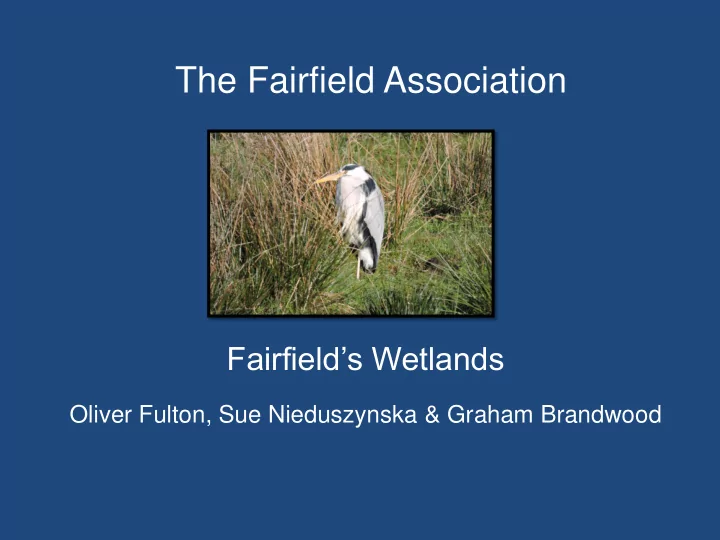
The Fairfield Association Fairfields Wetlands Oliver Fulton, Sue - - PowerPoint PPT Presentation

the fairfield association
SMART_READER_LITE
LIVE PREVIEW

The Fairfield Association Fairfields Wetlands Oliver Fulton, Sue - - PowerPoint PPT Presentation

The Fairfield Association Fairfields Wetlands Oliver Fulton, Sue Nieduszynska & Graham Brandwood Wetlands and their importance Wetland : Water at or near the surface for much of the year, supporting aquatic species Importance:


slide-1
SLIDE 1

The Fairfield Association

Fairfield’s Wetlands

Oliver Fulton, Sue Nieduszynska & Graham Brandwood

slide-2
SLIDE 2

Wetlands and their importance

Wetland: Water at or near the surface for much of the year, supporting aquatic species Importance: Biodiversity Ecosystem services

  • Water quality
  • Water supply
  • Flood control
  • Urban air quality
  • Carbon sink
  • Human wellbeing

Worldwide decline 65-70% during 20th century

slide-3
SLIDE 3

Wetland Then and Now

slide-4
SLIDE 4

Why have we lost wetlands?

  • Human intervention
  • Agricultural Drainage
  • Flood control … flood diversion!
  • Building and development
  • Climate change
  • Natural succession
slide-5
SLIDE 5

Pond to Woodland Succession

Sediments washed in, or algae bloom on surface and decay; some plants start to grow Deep water, no plants (not enough light / nutrition) More sediment, more plants, reeds and grasses grow in shallows Marsh emerges at margins, reeds & grass take over more of the pond Soil dries out at edges, trees like willow and alder establish

slide-6
SLIDE 6

Managing wetlands for nature…

… can be a constant battle against natural processes!

slide-7
SLIDE 7

Some Important Types of Wetland

  • Fen
  • Bog
  • Blanket bog
  • Raised bog
  • Coastal / estuarine
  • Carr / wet woodland
  • Reedbed / swamp
  • Wet meadow / wet pasture
  • Open water
slide-8
SLIDE 8

Fen

  • Water from multiple

sources (groundwater, surface run-off and river flooding, as well as rainfall)

  • Water level close to the

surface throughout the year

  • Chemistry from acid to

alkaline, nutrient from low to high

slide-9
SLIDE 9

Bog

  • Rain fed
  • Acidic
  • Low nutrient
  • Sphagnum moss and

acid loving plants dominate Blanket bog: Upland, permanently wet including slopes Raised bog: Developed by succession Lowland raised bogs

slide-10
SLIDE 10

Coastal/Estuarian Sites

  • Brackish / salty water
  • Specialist plant

communities

  • International

significance for birds

  • Ramsar process

Ramsar sites

slide-11
SLIDE 11
  • Develops through natural succession
  • Water level above surface for most of the year.
  • But drying out as trees take over.
  • Eventually dominated by water tolerant trees (e.g. willow and

alder). Understory may be tall herbs (e.g. water figwort), tall sedges or large tussock- forming grasses.

Carr and Wet Woodland

slide-12
SLIDE 12

Swamp and Reedbed

  • Water table at or above

the surface for most of the year

  • Dominated by single,
  • ften tall, species e.g.

Common Reed, Great Fen Sedge

  • Specialist bird population

Reedbeds (England)

slide-13
SLIDE 13

Other Types of Wetland

  • Wet Meadow / Wet Pasture
  • Subject to frequent flooding, unsuitable for hay

cropping

  • Suitable for cattle grazing
  • Specialist habitat for some wading birds
  • [Open Water (streams, rivers, ponds, lakes…) ]
  • Mires, marshes, lagoons, mudflats etc etc…!
slide-14
SLIDE 14

Variety is the Spice of Life

  • … many more species like a broader mosaic of habitats
  • Although there are some habitat specialists, e.g. bittern,

snipe…

slide-15
SLIDE 15

Variety is the Spice of Life

  • Big or small wetlands can support a wide range of

biodiversity

  • Diverse landform, management, vegetation & hydrology is

important

slide-16
SLIDE 16

Seasonal pools

Summer draw down level Autumn flood level Exceptional winter flood Seasonal pool - unconnected to the main area of water and

  • ccasionally drying out

Permanent pool – connected to main area of water and never drying out

Almost all natural wetland habitats will have fluctuating water levels

slide-17
SLIDE 17

On the edge – the ‘Blue Zone’

Winter water levels Cattle grazing in this area Summer water levels

slide-18
SLIDE 18

Bittern Snipe

Quiz Answers

slide-19
SLIDE 19

Emperor Dragonfly Orange Tip with Lady’s Smock

slide-20
SLIDE 20

Moorhen

slide-21
SLIDE 21

Freshwater Shrimp Eel

slide-22
SLIDE 22

Reed Bunting Water Rail

slide-23
SLIDE 23

What do these species need?

  • Reeds
  • Open water
  • Some open space around

ponds

  • Rush with grassy areas in

between

  • Some scrub

i.e. diversity of habitats

slide-24
SLIDE 24

Practical Issues & Management

slide-25
SLIDE 25

Higher Level Stewardship – Natural England

  • 5 – 75% standing water.
  • Ground moist enough for a 6inch nail.
  • Grass grazed by rare breed cattle.
  • Cattle access restricted at certain times and if

poaching excessive.

  • No in field scrub.

Big Meadow, Lower Sowerholme and West Field

slide-26
SLIDE 26

Higher Level Stewardship – Natural England

  • Creation of a reedbed
  • 50 % reeds
  • 150 stems/sq. metre
  • Reeds at least 100cms before cutting
  • No more than 5% scrub
  • 10 – 30% open water (100cms deep)
  • 50 – 95% surface water (10 – 50cms deep,

Apr – Oct, 10 – 100cms deep, Nov – Mar) Upper Sowerholme

slide-27
SLIDE 27

West Field

  • Two scrapes
  • Dries up – northern

scrape has a leak so dries more quickly.

  • Water source for

cattle when grazing in field.

  • Not used by

nesting waterfowl

  • r by overwintering

birds to date.

slide-28
SLIDE 28

Flora Field

  • Two ponds and

wetland area.

  • Permanent water.
  • Northern pond

leaks so holds lower level of water.

  • Not used by nesting

waterfowl or by

  • verwintering birds

to date.

slide-29
SLIDE 29

Upper Sowerholme

  • Pond + channel

(leading off from Lucy Brook)

  • Establishing reedbed.
  • Some use by

waterfowl and

  • verwintering birds.
  • Foxes have had a den

in brambles and area also used by roe deer.

slide-30
SLIDE 30

Lower Sowerholme

  • Willow pond.
  • Has developed a

serious leak – currently under investigation.

  • Not used by

nesting waterfowl

  • r by overwintering

birds to date.

  • Can be used as

water source by cattle grazing Lower Sowerhome.

slide-31
SLIDE 31

Big Meadow – Alder Pond

  • 4 ponds – Alder, Loxam’s,

Ashtree & Friars – all have permanent water.

  • Alder Pond – ‘signature’

pond as visible from path.

  • Others all now have open

water.

  • Extensive wetland area

with overwintering birds and regular waterfowl nests on Alder Pond.

  • Prolific amount of

frogspawn in Ashtree, Loxam’s and Friars Ponds.

slide-32
SLIDE 32

School Pond

  • School Pond and

enclosed wetland area.

  • Not permanent – can

dry up in summer.

  • Major area for
  • verwintering waders

and nesting by wildfowl.

  • Water source for cattle

particularly in winter.

  • Willow screen planted

to help bird life.

slide-33
SLIDE 33

Hay Meadow

  • Wetland area to east
  • f meadow.
  • Cromwell pond.
  • Anna;s and Lucy

pond and Lucy Brook on southern edge.

  • Permanent ponds.
  • Area used by
  • verwintering birds

and nesting waterfowl.

slide-34
SLIDE 34

Lucy Brook

  • Only external

water source into the reserve.

  • Land drains feed

into it off fields.

  • Very overgrown in

places.

  • Currently being

cleared and investigated.

slide-35
SLIDE 35
slide-36
SLIDE 36

Challenges encountered in maintaining and enhancing the wetland and reedbed for wintering waders and wildfowl.

Challenges

  • White Park Cattle.
  • Domestic cats/ foxes/

magpies

  • Various plants – soft rush, water figwort, mare’s tail,

aquatic grasses, brambles and bullrush.

slide-37
SLIDE 37

White Park Cattle (and Algae)

  • Key feature of reserve.
  • A rare breed herd.
  • HLS contract agreement

to use cattle to control grass growth.

  • Can over-crop the soft rush, if grass in short supply.
  • Can cause poaching.
  • Can introduce “nutrients” into ponds.
  • Some ponds suffer from algal blooms as a result.
  • In summer algal growth can be prolific and unsightly.

Currently treated with barley straw and/or removed by hand.

slide-38
SLIDE 38

Soft Rush

  • In all wet areas.
  • Habitat for birds & animals.
  • Seeds for birds.

Traditional uses

  • Medicinal
  • Basket weaving
  • Early candles
  • Edible
  • Prolific growth – each stem

produces >800 seeds.

  • Cattle graze it but prefer

grass.

  • Needs to be controlled.
  • Cutting
  • Weed wiping
  • Scything
slide-39
SLIDE 39

Water Figwort

Traditional Uses Medicinal – anti-inflammatory – reduces bruising – poultices.

  • Also called water

betony or fiddler.

  • In most areas of

wetland.

  • Competes with soft

rush and reeds.

  • Can clog up ponds.
  • Nectar source for

bumblebees.

  • Once thought to be a

problem on the reserve.

  • Not currently

controlled.

slide-40
SLIDE 40

Mare’s Tail (Horsetail)

  • Problem in Hay Meadow and

Upper Sowerholme.

  • Ancient plant (pre-dates the

dinosaurs) >60 Mya.

  • Roots can go down >5 ft.
  • Brittle so difficult to pull out.
  • Dies back in winter.
  • Attempts made to pull out in

Upper Sowerholme pond, channel and Lucy Pond.

  • Plan to use tarpaulin on Lucy

pond to prevent photosynthesis. Traditional Uses

  • Medicinal - tea from

young stems is good for joints

  • Scourer
slide-41
SLIDE 41

Various Aquatic Grasses

  • Problem in most of the ponds.
  • Can be removed by hand in

deeper water but difficult on pond edges where deeply rooted.

  • If not removed can lead to no
  • pen water in ponds.
  • Controlled by pulling out from

ponds.

  • May experiment with pond dye

which forms a film, preventing photosynthesis.

  • Can only do this on ponds

without sluices.

slide-42
SLIDE 42

Brambles

  • Encroaches when

ground conditions are dry enough,

  • Problem in Upper

Sowerholme at the drier edges – encroaching from the bramble thicket and from Lucy Brook.

  • Also extensive brambles

in and around Lucy Brook.

  • Currently controlled by cutting back on an annual basis.
slide-43
SLIDE 43

Bullrushes

  • Problematic – particularly

in Upper Sowerholme pond and channel. Also in Cromwell pond.

  • Deep root and rhizome

system clogs water courses and prevents water flow.

  • Currently controlled by

digging out. Traditional Uses

  • Medicinal – various
  • Food – a superfood

– high starch content – shoots can be cooked like asparagus

  • Thatching, candles, etc.
slide-44
SLIDE 44
slide-45
SLIDE 45
slide-46
SLIDE 46

The Fairfield Association

  • World Wetland Day

Guided Walk Friday Feb. 2nd 10 a.m. Meet at the shed . Wellingtons needed Forthcoming Events:

  • Volunteers’ Buffet

Thursday Feb. 22nd 7 – 9 p.m. The Storey All Fairfield’s volunteers and helpers and long- suffering spouses and partners welcome