
SLIDE 1
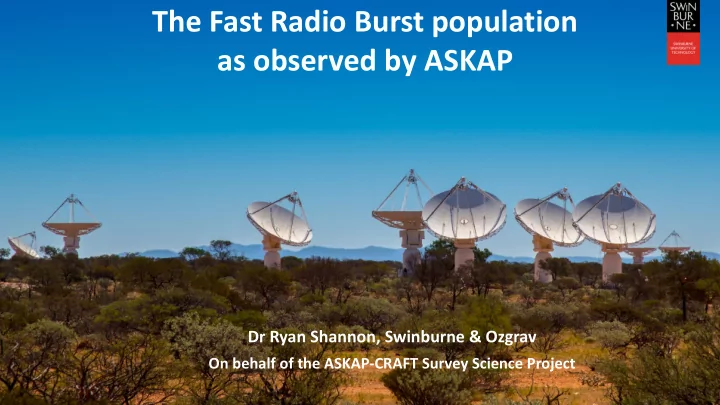
The Fast Radio Burst population as observed by ASKAP Dr Ryan - - PowerPoint PPT Presentation
The Fast Radio Burst population as observed by ASKAP Dr Ryan Shannon, Swinburne & Ozgrav On behalf of the ASKAP-CRAFT Survey Science Project Overview Fast radio bursts ASKAP + CRAFT The flys eye survey Special snowflakes Connection
CRAFT: Commensal Realtime ASKAP Fast Transient Survey PIs: K. Bannister, J.-P. Macquart, R. M. Shannon CASS/Curtin/Swin/UCSC/USyd++
redit: Mia Walker (ICRAR-Curtin)
Discovered in pulsar surveys with the Parkes telescope as highly dispersed, short, bright single pulses of radio emission
– High Galactic latitudes – Dispersion measure (DM) well in excess of any credible model of Milky Way DM – Very good agreement with t ~ frequency-2 – Some show evidence for being broadened by scattering
No definitive emission mechanism – Cosmological (Gamma-ray bursts?) – Galactic (flare stars?) – Terrestrial (lightning?) – Anthropogenic (RFI?)
Frequent – 2000 – 6000 per day over the entire sky at Parkes sensitivity levels – Difficult to associate with other classes of known transient – Measure brightness in integral units of “fluence”
Rarely detected given limited field of view of current telescopes (1 per 10 days of observing with Parkes) Why care? Represent a new unusual class of (coherent) radio emission If cosmological, opportunity to probe diffuse intercluster plasma – Sensitive to entire column density of electrons along line of sight – Find missing baryons (via electrons) – Study intergalactic plasma: (is it clustered around galaxies more more diffusely spread through space) – With polarisation (rotation measure), study magnetic field of Universe
telescope/ 20cm multibeam system
bursts in “hi-fi”
bespoke searches
900 pc cm-3 1630 pc cm-3 952 pc cm-3 470 pc cm-3 861 pc cm-3
Arecibo FRB 121102
– Spitler et al. 2014
Detected in Pulsar ALFA survey – ALFA – 7 beam equivalent to Parkes multibeam system – 0.4 Jy peak flux – Inverted spectrum: instrumental effect? Galactic plane, but anti-centre Only 2x galactic DM – No reason to expect overdensity of plasma along this line of sight
– Single element (GB) – Sparsely sampled focal planes (Parkes, Arecibo) – Uncertain location within beam pattern (0.25 deg for Parkes)
– Uncertainty about burst attenuation/implied brightness – Unable to determine unique host (star/galaxy/etc.)
– Real time searches – Look for transients at other wavelengths
ALFA@ Arecibo Parkes multibeam
Time since FRB Keane et al. (2016) Williams & Berger (2016)
Time since FRB Williams & Berger (2016) Keane et al. (2016)
Follow up observations with radio interferometers (VLA, EVN) Identified to reside in dwarf galaxy at redshift z~ 0.2 (Chaterjee et al. 2017) – Coincident with unusual radio nebula (Marcote et al. 2017)
– Within H-alpha emission region (Bassa et al. 2017) Association with magnetar/superluminous supernova/long gamma-ray bursts?
Chatterjee et al. (2017) Bassa et al. (2017)
Burst profiles Burst polarization Michilli et al. (2018)
– Significant fraction of population could be detected with smaller wider field telescopes
Murchison Shire, Western Australia 36 x 12-metre antennas Focal plane arrays: 36 digital beams on the sky Each PAF: 30 deg2 field of view 336 MHz available bandwidth Available frequency band: 0.7-1.8 GHz Ssys: 1800 Jy Signal path:
– PAF (RfoF) -> Digital Receiver -> Beamformer (don’t use correlator)
Dominant sources of interference: satellites, lightning (rare), chirps and 300 Hz. Currently in commissioning and early-science phase
– Each antenna: 30 deg2 : (currently 180-360 deg2; in principle up to 1080 deg2with full ASKAP)
– Rates higher at high latitude? (Petroff et al 2014, Macquart & Johnston 2015, but see Bhandari et al . 2018) – Lower DM contribution from Milky Way (30-40 pc cm-3) – 57 fields, 57 minutes per pointing: re-observe fields regularly
– Direct comparison to Parkes
– Digital beamforming done with Sun (beam weighs change from set to set) – For each set of beam weights, observe pulsar in all beams – Observe pulsar (Vela, B1641-45) at centre of a central beam (15)
Backround: CHIpass map (Calabretta et al. 2014) FRB 170107 field
“Easy”: detected FRB with 3.5 days of observing Dispersion measure: 609.5(5) pc cm-3 Peak flux density > 20 Jy – Confirms presence of population of bright FRBs Strong spectral cutoff
Background: NVSS map of galaxies Blue: ASKAP pixels for one antenna Red: region where FRB could be coming from Pulse profile Pulse spectrum after de-dispersion
Overlapping beams: expect multiple detections Use detections (and non-detections) to determine localization of burst – Account for uncertainties in beam gain (sensitivity), width, and position – Bayesian search methods using multinest algorithm to sample posterior distribution – Achieve precision of ~ beam width/ (Signal- to-noise ratio) as expected
Burst profiles in different beams
Localize FRB to ~ 8x8 arcmin region (90% containment) Insufficient precision to identify unique host galaxy – Improvement over other single-dish measurements – Enables follow up with larger aperture facilities Strong constraints (upper and lower limits on burst fluence) – Important for constraining source brightness distribution and luminosity function Confirm technique by localizing pulsars to < arminute precision
Posterior localization region Posterior energy distribution
– Remaining digital systems on site this year – Detection rate will depend on access to antennas but will roughly proportional to Nant
– Real time incoherent sum searches
than fly’s eye
– Trigger voltage buffers – Off-line correlation – Enables localisation + polarimetry, coherent dedispersion
CSIRO-MRO team with 36th PAF installed