The First Annual New Mexico Home Visiting Annual Outcomes Report, - - PowerPoint PPT Presentation

the first annual new mexico home visiting annual outcomes
SMART_READER_LITE
LIVE PREVIEW

The First Annual New Mexico Home Visiting Annual Outcomes Report, - - PowerPoint PPT Presentation

The First Annual New Mexico Home Visiting Annual Outcomes Report, Fiscal Year 2013 Presentation to the Legislative Finance Committee Rep. Luciano Lucky Varela, Chairman Sen. John Arthur Smith, Vice-Chairman May 7, 2014 Room 307, State


slide-1
SLIDE 1

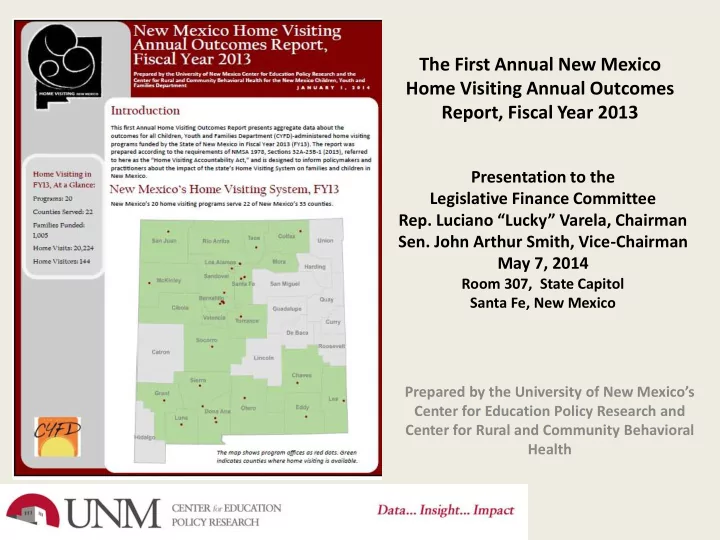
The First Annual New Mexico Home Visiting Annual Outcomes Report, Fiscal Year 2013

Prepared by the University of New Mexico’s Center for Education Policy Research and Center for Rural and Community Behavioral Health

Presentation to the Legislative Finance Committee

  • Rep. Luciano “Lucky” Varela, Chairman
  • Sen. John Arthur Smith, Vice-Chairman

May 7, 2014

Room 307, State Capitol Santa Fe, New Mexico

slide-2
SLIDE 2

Thanks to the Governor, Legislature and Early Childhood Community

2

Over the past decade, New Mexico has committed itself to improving the lives

  • f young children and their families. The State of New Mexico, its Governor,

and its Legislature have increased funding, passed key legislation, implemented programs, developed infrastructure, and positively impacted the lives of numerous infants, young children and families. As importantly, New Mexicans from all political persuasions, diverse communities, and geographic regions have forged a powerful alliance that focuses on the care and education of our youngest residents. New Mexico is nationally recognized as a leader in early childhood, and these efforts should be a point of pride for our state. This Home Visiting Accountability Act reflects the combined efforts of policymakers, professionals, advocates, communities and families to support home visiting as an important strategy for prevention of adverse childhood experiences and promotion of child well-being. Thanks are due to all of these New Mexicans who supported passage of the Act, which has successfully established a framework of transparency and support for ongoing program improvement and accountability.

slide-3
SLIDE 3

New Mexico’s Investment In Home Visiting

3

$2.3m 645 slots $5.9m 1,005 slots $8.1m 1,891 slots $0 $2,000,000 $4,000,000 $6,000,000 $8,000,000 $10,000,000 $12,000,000 2006 2007 2008 2009 2010 2011 2012 2013 2014 2015 $10.6m

Source: LFC post-session reviews and budget documents. Includes state and federal funding sources.

slide-4
SLIDE 4

New Mexico Home Visiting System, FY13

Home Visiting, FY13 At a Glance:

Programs: 20 Counties Served: 22 Families Funded: 1,005 Home Visits: 20,224 Home Visitors: 144

4

slide-5
SLIDE 5

Family Openings Funded and Counties Served, FY13, by Home Visiting Program

Home Visiting Program Approximate Number Of Families Funded In FY2013 Counties Served Ben Archer Health Center Welcome Baby Program 69 Doña Ana, Luna, Otero, Sierra Colfax County Home Visiting Program 17 Colfax Española Hospital Rio Arriba County First Born 36 Rio Arriba Gallup-McKinley County Schools Parents As Teachers * 80 McKinley Gila Regional Hospital First Born 60 Grant Holy Cross Hospital, Taos First Steps 90 Colfax, Mora, Taos La Clinica de la Familia Home Visiting Services 70 Doña Ana Las Cumbres Rio Arriba 17 Rio Arriba Las Cumbres Santa Fe Community Infant Program 18 Santa Fe Los Alamos Hospital First Born 27 Los Alamos Luna County Parents as Teachers * 75 Luna Native American Professional Parent Resources, Inc. Parents as Teachers 35 Bernalillo, Cibola, Sandoval, Valencia Peanut Butter & Jelly Therapeutic Family Services 37 Bernalillo, Sandoval Presbyterian Medical Services Parents as Teachers 75 Chaves, Eddy, Lea, San Juan Socorro General Hospital First Born Socorro 57 Socorro Torrance County Amigas de la Familia 61 Torrance United Way of Santa Fe County First Born 71 Santa Fe UNM Center for Development and Disability VISION 27 Bernalillo UNM Center for Development and Disability Nurse-Family Partnership* 50 Bernalillo UNM Young Children's Health Center 33 Bernalillo Total 1,005 * Program received federal funding during FY13 5

slide-6
SLIDE 6

The Home Visiting Accountability Act: Reporting Provisions

“The department and the providers of home visiting services, in consultation with one or more experts in home visiting program evaluation, shall: (1) jointly develop an outcomes measurement plan to monitor outcomes for children and families receiving services through home visiting programs; (2) develop indicators that measure each objective established pursuant to subsection D of this section; and (3) complete and submit the outcomes measurement plan by November 1, 2013 to the legislature, the governor and the early learning advisory council. Beginning in January 1, 2014 and annually thereafter, the department shall produce an annual outcomes report to the governor, the legislature and the early learning advisory council” (SB365/NMSA 32A-23B, Section 3, G & H).”

6

slide-7
SLIDE 7

Joint Development of Outcomes Monitoring Plan and Measurement Indicators

Our Process:

  • We analyzed the state’s extensive home visiting database and its relationship

to the New Mexico Home Visiting System’s research-based practices, in order to understand what data is already collected and available.

  • We surveyed federal evidence-based programs and state home visiting

programs across the U.S. to review what “best practice” measurement indicators are being used nationally.

  • We consulted with national experts in the home visiting field on their

recommendations for meeting state-level challenges in outcomes measurement.

  • We convened and consulted with New Mexico home visiting stakeholders –

including all programs currently funded by the state – for joint selection of measurement indicators and development of the state’s measurement plan.

7

slide-8
SLIDE 8

Joint Development of Outcomes Monitoring Plan and Measurement Indicators

8

Our Partners:

As required by the Act, representatives from CYFD, experts in the field, and all currently contracted Home Visiting met in October for joint plan development. Apple Tree Educational Center  Avance  Ben Archer Health Center  Center for Development and Disability-UNM, Early Childhood Learning Network  Center for Development and Disability-UNM, Home Visiting Training  Center for Development and Disability-UNM, Home Visiting Programs  Colfax County Home Visiting Program  Gallup-McKinley County Schools  Gila Regional Hospital  Las Cumbres Community Services  Los Alamos National Laboratory Foundation  Luna County Home Visiting Program  Native American Professional Parent Resources, Inc.  New Mexico Early Childhood Development Partnership  New Mexico Legislative Finance Committee  Northern New Mexico First Born  Peanut Butter & Jelly Therapeutic Family Services  Presbyterian Medical Services  Quay County  Rio Arriba First Born  Socorro General Hospital  Taos First Steps  Torrance County Home Visiting Program  United Way of Santa Fe County  UNM Continuing Education, Early Childhood Services Center, Data Management  UNM Young Children’s Health Center

slide-9
SLIDE 9

The Home Visiting

Goals, Outcomes and Reporting Data Outlined in the Home Visiting Accountability Act

9

slide-10
SLIDE 10

The Home Visiting

Goals, Outcomes and Reporting Data Outlined in the Home Visiting Accountability Act (cont’d)

10

slide-11
SLIDE 11

We Selected Measures That Focus On:

11

  • Mothers’ connection to prenatal care
  • Mothers’ discontinued substance use during pregnancy
  • Mothers screened for postpartum depression and referred for services
  • Babies receiving breastfeeding
  • Infants and children receiving on-schedule immunizations
  • Infants and children receiving well-child check-ups
  • Infants and children regularly screened for potential delays in

development and referred for services

  • Reduction in cases of child maltreatment after program entry
  • Parents coached in high-impact positive parent-child interactions
  • Families screened for risk of domestic violence and referred for services
  • Family safety and child injury prevention plans
  • Families referred and connected to community support services
slide-12
SLIDE 12

Overview of Annual Outcomes Report

12

  • The goal of the report is to inform policymakers, practitioners and the

public about the current status and impact of the state’s Home Visiting System on the New Mexico families and children that it serves.

  • The report provides data on the extent of home visiting services

provided in FY13, on effective implementation of home visiting services, and on what impacts we’re seeing on families and children served.

  • Data were analyzed and reported in the aggregate, across all state-

funded programs, in order to present a picture of the current Home Visiting System as a whole.

  • The report was prepared by the University of New Mexico’s Center for

Education Policy Research and Center for Rural and Community Behavioral Health, on behalf of the New Mexico Children, Youth and Families Department.

slide-13
SLIDE 13

Some Important Notes About Outcomes

13

  • New Mexico’s Home Visiting System has begun to establish a number of valid and reliable
  • utcomes measures, and provided infrastructure for uniform reporting across programs,

through CYFD’s extensive and well-maintained database.

  • Data collected and analyzed in this FY13 report are most usefully considered as a baseline

from which to compare future performance.

  • Measurement of some stated outcomes of the home visiting system will require

policymakers to advance several pressing data development agendas in the state:

  • Some truly long-term goals outlined for the Home Visiting System will require an

effective state system for tracking children as they move through early childhood programs into K-12 education and beyond.

  • Other critical goals, such as reducing child maltreatment, will require development
  • f new protocols for sharing data across administrative systems.
  • We believe that individual families and children have benefitted from participation in

home visiting services. It is important, however, to understand that many more families will have to be served by home visiting programs in order to achieve statewide improvement in child and family well-being.

slide-14
SLIDE 14

Summary of Findings: Home Visiting System Extent FY13

14

FY13 Capacity

  • New Mexico’s Home Visiting System is currently in a well-supported and

structured state of expansion. Its most significant funding from the Governor and Legislature have come just in the past several years.

  • Since FY06, funding for home visiting has increased from $500,000 for a small

pilot program to $10.6 million in state and federal funds in FY15.

  • In FY13, CYFD received $5.9 million in state and federal home visiting funding.
  • In FY13, CYFD funded 20 home visiting programs with the capacity to provide

regular services to 1,005 families at any one time.

  • During this time of expansion, CYFD has worked to keep contracted programs in

compliance with its standards for service delivery, screenings and data reporting.

slide-15
SLIDE 15

Summary of Findings: Home Visiting System FY13 Implementation

15

FY13 Participation Programs are designed to engage families for varying numbers of visits and lengths of time, depending on the family’s needs and goals:

  • During FY13, the state’s 20 programs

provided at least one home visit to 1,911 families and 1,630 children.

  • 72.3% of the families participating in

FY13 had been in the program for two months or more. 13.1% had been in the program for more than two years.

  • 39% were enrolled for the first time;

61% were continuing services begun in a previous year.

  • 33% have received a cumulative total
  • f 20 or more home visits.

19.7% (n= 376) 8% (n= 152) 32.7% (n= 624) 7.6% (n= 146) 18.9% (n= 362) 13.1% (n= 251) 100 200 300 400 500 600 700 <2 months: Exited <2 months: Active/In Process 2 to 8 months 9 to 11 months 12 to 24 months >24 months

Total Duration of Family Participation, from Initial Date of Enrollment, in Months (Total FY13 Families = 1,911)

slide-16
SLIDE 16

Summary of Findings: Home Visiting System FY13 Implementation

16

FY13 Cost

  • The average cost per family in state funded programs was $2,998, and the

average cost per family in federally funded programs was $5,614. FY13 Workforce

  • In FY13, 144 professionals provided home visiting services.
  • Their credentials range from high school

diplomas to doctoral degrees, and they receive professional development in curriculum, working with children and families, and use of screening tools and data.

  • Better understanding of the capacities

and training needs of the home visiting workforce will be a focus of our research this year.

22% 12% 46% 18% 2%

High School Diploma or GED Associate's Degree Bachelor's Degree Master's Degree Doctoral Degree

Highest Education of Home Visitors (n=72 of 144 total)

*Educational attainment data was not reported for 50% of home visiting staff.

slide-17
SLIDE 17

Summary of Findings: Home Visiting Goal Outcomes

17

Goal 1: Babies Are Born Healthy:

  • Pregnant women in home visiting

accessed prenatal care earlier and more often than pregnant women statewide.

  • Research shows that children of

depressed mothers face increased difficulties in health, cognition, and emotional development.

  • In FY13, 75.3% of eligible mothers

identified as having symptoms of postpartum depression were referred for services, where available, and more than half of those mothers engaged in referral supports.

100% 67% 98% 59%

50% 55% 60% 65% 70% 75% 80% 85% 90% 95% 100%

Prenatal Care Accessed Early (1st Trimester) Start of Care

CYFD Home Visiting (total = 87) Women Statewide (average total=16,565)

536 158 (29.5% of screened) 119 (75.3% of "At Risk") 67 (56.3% of referred) 100 200 300 400 500 600 All Screened Scored on Screen as "At Risk" Referred for Services Mother Engaged with Services

Comparison of Prenatal Care Starts, Home Visiting Mothers (FY13) and Mothers Statewide (2008-12) % of Postpartum Mothers Screened for Depression and Connected to Available Services

slide-18
SLIDE 18

Summary of Findings: Home Visiting Goal Outcomes

Goal 2: Children Are Nurtured

  • A new, research-validated tool was piloted for use in promoting and measuring nurturing

parenting interactions in the Home Visiting System in FY13. All programs were trained, and full data is being collected for reporting in FY14. Goal 3: Children Are Physically and Mentally Healthy

  • 85% of eligible children who received at least five home visits were screened for potential

delay in development using the Ages & Stages Questionnaire. Of the 16% identified as having possible characteristics of delay, 60% were referred to early intervention services. 68% of those referred are recorded as having engaged with services.

Children Screened on Schedule for Potential Delay in Development with the ASQ-3, and Connected to Early Intervention Services

18

927 792 (85% of Eligible) 127 (16% of Screened) 76 (60% of At Risk) 52 (68% of Referred)

  • 200

400 600 800 1,000

Eligible* # Screened # At-Risk Referred Engaged *See full report for definition of “eligible”

slide-19
SLIDE 19

Summary of Findings: Home Visiting Goal Outcomes

19

Goal 4: Children Are Ready For School

  • The existing ASQ screening and referral data show that crucial early connections were

made between families of infants and young children and early intervention services.

  • Tracking the impact of home visiting out to the point of school entry will require

continued state development of a kindergarten readiness assessment and an effective system for tracking children through early childhood into K-12 education. Goal 5: Children and Families Are Safe

  • Domestic violence risk screens were administered to 1,092 caregivers. Of these, 9%

scored at risk on the Woman Abuse Screening Tool (WAST). Of these, 26% were referred for services and 50% of these were recorded as engaging in services.

Caregivers Screened for Domestic Violence Risk and Connected to Services

*Referral data was missing for 11.2% of clients screened as “at risk” and engagement data was missing for 11.2% of referrals made.

1,092 9% At Risk (n= 98) 26.5% of At Risk Referred (n= 26)* 50% Referrals Engaged (n= 13)*

200 400 600 800 1,000

Screened for Domestic Violence Risk Scored on Screen as "At Risk" Referred for Services Engaged in Services

Number of Families

slide-20
SLIDE 20

Summary of Findings: Home Visiting Goal Outcomes

20

Goal 5: Children and Families Are Safe (continued)

  • Efforts to measure decreases in child maltreatment or abuse will require

continued development of protocols for sharing data across state systems. Goal 6: Families Are Connected To Formal And Informal Community Supports

  • Key screens of potential risk to children and families guide home visitors to

identify where additional supports may be needed. Those supports may be connections to formal social or clinical service agencies, where available in a given community. The highest rates of referral to available formal supports were to early intervention for infants and young children (59.8%) and postpartum depression services for mothers (75.3%).

927 1,911 911 792 1,092 536 127 98 158 76 26 119 52 13 67 500 1000 1500 2000 2500 ASQ (Child Clients) WAST (Caregivers) EPDS (Caregivers)

Total Eligible Total Screened Total At-Risk

Screenings and Referrals for Enrolled Families

slide-21
SLIDE 21

Outcomes Report: Next Steps

21

  • Develop a plan to enhance the quality and completeness of the data collected and

reported by home visiting programs. This includes collecting new data points and more thorough collection of existing required data points.

  • Work toward better defining a family’s goals for home visiting in order to measure

and collect data on program success in a more meaningful way.

  • Continue discussions on stable and predictable funding for home visiting, informed

by our work with programs to better understand their full direct service and infrastructure costs.

  • The passage of New Mexico’s Home Visiting Accountability Act has placed our state

firmly in the midst of the national discussion on how to support young children during their most critical developmental period. It will be important that New Mexico continue to participate in national level work -- with other leading states, the Pew Charitable Trusts, and the Federal Maternal Infant and Early Childhood Home Visiting Program -- to grapple with emerging questions and issues, including the challenging outcomes measurement issues that the field is rapidly defining and addressing.