The future for water availability in South-west Western Australia in - - PowerPoint PPT Presentation
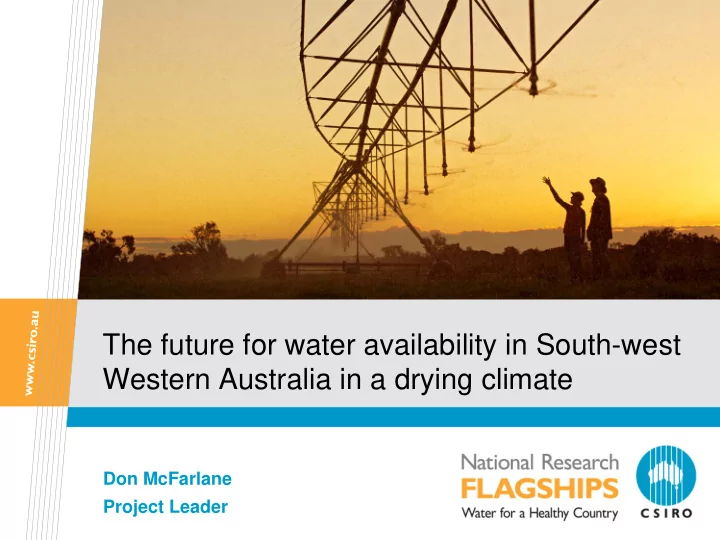
The future for water availability in South-west Western Australia in a drying climate Don McFarlane Project Leader Broad terms of reference Estimate the current and 2030 yield of water for catchments and aquifers in the south-west of WA
CSIRO South-West Western Australia Sustainable Yields Project
Broad terms of reference
- Estimate the current and 2030 yield of water for
catchments and aquifers in the south-west of WA considering climate change and development (plantations, farm dams, groundwater abstraction)
- Compare the estimated current and future water
yields to those needed to meet the current levels of extractive use, future demands and environmental needs This talk will cover the main findings but concentrate
- n water for irrigated agriculture especially
CSIRO South-West Western Australia Sustainable Yields Project
Sustainable Yields Projects – 2007 to 2009
Murray-Darling Basin Northern Australia South-West Western Australia Tasmania
CSIRO South-West Western Australia Sustainable Yields Project
South-West WA Sustainable Yields – Publications
Main reports Executive summaries Factsheets Web:
www.csiro.au/partnerships/SWSY.html
CSIRO South-West Western Australia Sustainable Yields Project
The ‘south-west’ as defined in this talk
- All fresh, marginal and
brackish surface water catchments between Gingin Brook and the Hay River
- All aquifers within the
Perth and Collie basins, plus the western Bremer Basin
- Combined area = 62,500
km2
CSIRO South-West Western Australia Sustainable Yields Project CSIRO South-West Western Australia Sustainable Yields Project – Overview
Project area topography
- Short streams that arise in
the Darling Ranges are fresh
- Darling Fault separates Perth
Basin from Darling Plateau
- Coastal plains are flat and
low lying – Swan Coastal Plain; Scott Costal Plain; South Coast
- Perth Basin Plateaux are
higher in elevation
CSIRO South-West Western Australia Sustainable Yields Project
Land cover
- Surface water catchments
are mainly forested
- About 60% of the Perth
Basin is cleared about 56% of this being under dryland agriculture
- The uncleared areas
include coastal areas north of Perth, the Gnangara Mound and the Blackwood Plateau
Gnangara Mound Blackwood Plateau
CSIRO South-West Western Australia Sustainable Yields Project
Landforms
Geomorphic landforms affect groundwater response to climate change
CSIRO South-West Western Australia Sustainable Yields Project
Features of south-west WA
- We are relatively isolated from other irrigation areas
- South Australia – lower Murray and Lower SE ca. 3000 road kms
- Carnarvon mainly groundwater – sub-tropical crops – 900 km
- Ord – sub-tropical crops – 3200 km
- Has experienced a drier, hotter climate in the last 35 years
which has impacted on surface and groundwater yields
100 200 300 400 500 600 1900 1910 1920 1930 1940 1950 1960 1970 1980 1990 2000 2010 Total rainfall (mm)
- 18%
- 8%
May – July August October –
CSIRO South-West Western Australia Sustainable Yields Project
Features of south-west WA (cont.)
- Is experiencing some of the fastest growth in the economy and
population in Australia, and in its own short history
- Aspects of water use and irrigation are different in south-west
WA so we need to find our own solutions in some cases
1.0 1.5 2.0 2.5 3.0 3.5 2006 2010 2014 2018 2022 2026 2030 High growth Medium growth Low growth Population (Million) Year
CSIRO South-West Western Australia Sustainable Yields Project
Water use in the project area
- Total use is about 1200 GL/y of which 71% is self supplied
(on-site bores and farm dams) and three quarters is groundwater
- About 35% is used for irrigated agriculture – elsewhere in
Australia it is 66 to 75%
- Can be competition for water between water sectors –
residential, industry, mining and agriculture
- Most irrigation water in south-west is used for high value
products
- This, in addition to it being self supply and mostly
groundwater, makes transfers and trading less feasible
Current agricultural irrigation water use
CSIRO South-West Western Australia Sustainable Yields Project
Surface water use is highest in central catchments and demand will grow in future
Current use = 299 GL/y Growth in demand
Metro basins are fully used
CSIRO South-West Western Australia Sustainable Yields Project
Current abstraction by groundwater areas
Most groundwater abstraction currently occurs close to Perth because of high demand and water availability
CSIRO South-West Western Australia Sustainable Yields Project
Scenarios
- The ‘historical climate’ assumed that the climate of the last 33 years
(1975 to 2007) would continue until 2030. Used as a base case
- The ‘recent climate’ assumed that the climate of the last 11 years
(1997 to 2007) would continue until 2030
- The ‘future climate’ used 15 GCMs with 3 greenhouse gas emission
levels which would result in 0.7, 1.0 and 1.3oC of warming by 2030 = 45 possible climates. They are reported as
- wet future climate
- median future climate, and
- dry future climate
- Current levels of abstraction and land use were assumed to continue
for all scenarios above
- The ‘future climate and development’ assumed a median future climate
and full groundwater abstraction
CSIRO South-West Western Australia Sustainable Yields Project
Some terminology clarification
- Runoff = amount of surface water flow expressed as a depth (mm)
- Streamflow = amount of surface water flow expressed as a volume
(runoff x area)
- Surface water yield = streamflow that can be diverted for use.
Takes account of water for the environment and the location of nature reserves, national parks, irrigable land, etc.
- Use = water that is currently being used (metered, estimated)
- Yield = the amount of surface water and groundwater that is available
for use – either under license and as unlicensed ‘stock and domestic’
- Demand – as estimate of the future requirement for water as a result
- f economic, demographic and industry growth. Unmet demand may
result in higher water prices, reuse, water conservation, trading, desalination, etc. as well as the curtailment of growth
CSIRO South-West Western Australia Sustainable Yields Project CSIRO South-West Western Australia Sustainable Yields Project – Surface Water
Rainfall, runoff and runoff coefficient under historical climate
CSIRO South-West Western Australia Sustainable Yields Project
14 of 15 GCMs predict it will get drier
Mid warming Low warming High warming
- Median future climate
- 7%
- Wet extreme future
- 1%
climate (90 percentile)
- Dry extreme future
- 14%
climate (10 percentile) Change in annual rainfall
CSIRO South-West Western Australia Sustainable Yields Project
Averaged across the surface water basins 15 global climate models project less runoff
- 50
- 40
- 30
- 20
- 10
inmcm ncar_pcm iap cccma_t63 ipsl miroc cnrm cccma_t47 ncar_ccsm mri mpi gfdl csiro giss_aom miub Change in runoff from historical (%) Global climate models Mid warming Low warming High warming
Wet future climate
- 10%
Median future climate -25% Dry future climate
- 42%
Runoff change across all basins
CSIRO South-West Western Australia Sustainable Yields Project
Projected change in runoff relative to the historical climate
- Major decline in north and central region under recent climate
- Major impact in high rainfall areas under median and dry future climate
CSIRO South-West Western Australia Sustainable Yields Project
Current surface water yields
Total yield Yield per unit area Total yield = 425 GL/y
- Public Water Supply 24%
- Irrigation schemes 27%
- Self supply 49%
- Harvey and Collie Basins
contribute 43% of the total yield
CSIRO South-West Western Australia Sustainable Yields Project
Surface water yields are projected to change by -24% under a median future climate. Range of -4 to -49%
IWSS yields reduced by 18% to 77 GL/y under a median future climate
CSIRO South-West Western Australia Sustainable Yields Project
Gaps in surface water yields and demands in areas where irrigation is important
CSIRO South-West Western Australia Sustainable Yields Project
Yield and demand gap in the Harvey, Collie and Preston surface water basins
50 100 150 200 250 Current yield A B Cw et Cmid Cdry Available SW/GW yield (GL/y) Yarragadee Mirrabooka Leederville Superficial Fractured rock Other aquifer SW self-supply SW dams
50 100 150 200 250 2005 2010 2015 2020 2025 2030 2035 Total demand v Total available yield (GL/y) 2030 Low demand 2030 Scenario B 2030 Medium demand 2030 Scenario Cwet 2030 High demand 2030 Scenario Cmid 2030 Scenario A 2030 Scenario Cdry
CSIRO South-West Western Australia Sustainable Yields Project
Groundwater models
- The PRAMS model as
used in the Gnangara Sustainability Strategy was used
- A new model (PHRAMS)
was developed for the Peel Harvey area
- The SWAMS model was
linked to a recharge model and recalibrated
- The Collie model was
linked to a recharge model and recalibrated
Perth Regional Aquifer Modeling System (PRAMS) Peel Harvey Regional Aquifer Modeling System (PHRAMS) South West Aquifer Modeling System (SWAMS) Collie model
CSIRO South-West Western Australia Sustainable Yields Project
Land cover likely to affect recharge / discharge
Groundwater assessment areas
- 56% dryland agriculture
- 38% native vegetation
- 6% plantations, urban,
irrigated, open water
CSIRO South-West Western Australia Sustainable Yields Project
Maximum depth of the watertable in the southern half of the Perth Basin in 2007
- Coloured areas are potential
GDEs if not cleared
- Coastal plain soils have very
shallow watertables except Gnangara and Spearwood Dunes
- Plateaux areas mainly
have deep watertables
22% 14% 10%
46%
CSIRO South-West Western Australia Sustainable Yields Project
Change in groundwater levels between 2008 and 2030 under climate and development scenarios
CSIRO South-West Western Australia Sustainable Yields Project
Current groundwater yields as estimated by adding the 2009 Allocation Limits
Total yield Yield per unit area
Total yield = 1556 GL/y Main aquifers:
- Superficial 58%
- Leederville 12%
- Yarragadee 26%
CSIRO South-West Western Australia Sustainable Yields Project
Groundwater use and future demand is highest near Perth and Bunbury
Current use = 808 GL/y
(2.2 x surface water)
Perth – Peel area Bunbury
Additional
Growth in demand
CSIRO South-West Western Australia Sustainable Yields Project
Groundwater yields are projected to change by -2% under a median future climate. Range = +2 to -7%
Yield reductions are low because
- 1. Drain and ET losses reduce as watertables fall
- 2. Areas under dryland agriculture (56% of Perth Basin) have rising levels
- 3. Allocation Limits account for a future drier climate
Recent climate Median future climate Dry future climate
CSIRO South-West Western Australia Sustainable Yields Project
Groundwater deficits may develop near Perth, Collie and Albany
Recent climate 2030 gap Median future climate 2030 gap Dry future climate 2030 gap
CSIRO South-West Western Australia Sustainable Yields Project
Current yield Historical Recent Wet extreme Median Dry extreme Available SW/GW yield (GL/y) 2005 2010 2015 2020 2025 2030 2035 2030 Low demand Recent 2030 Medium demand Wet extreme 2030 High demand Median Historical Dry extreme Total demand v Total available yield (GL/y) Yarragadee Mirrabooka Leederville Superficial Other aquifer Self-supply dams Scheme dams Fractured rock 400 500 600 700 800 100 200 300 400 500 600 700
Combined yield and demand for the Perth Demand Region
Median demand = median future climate yield
Potential gap under median future climate and medium demand within 15 years
Current agricultural irrigation water use
CSIRO South-West Western Australia Sustainable Yields Project
500 1000 1500 2000 2500 C u r r e n t y i e l d H i s t
- r
i c a l R e c e n t W e t e x t r e m e M e d i a n D r y e x t r e m e Available SW/GW yield (GL/y) 500 1000 1500 2000 2500 2005 2010 2015 2020 2025 2030 2035 2030 Low demand Recent 2030 Medium demand Wet extreme 2030 High demand Median Historical Dry extreme Total demand v Total available yield (GL/y) Yarragadee Mirrabooka Leederville Superficial Other aquifer Self-supply dams Scheme dams Fractured rock
The project area can meet all except high demands until 2030 under a median future climate
250 GL
A 250 GL/y deficit may develop under a dry future climate and high demand
CSIRO South-West Western Australia Sustainable Yields Project
Key findings
- 1. South-west Western Australia has experienced a
significant climate shift since 1975 which is thought to include a component of climate change. Climate models project that rainfall could decline further by about 7% by 2030 (up to 14%)
- 2. Surface water yields are projected to decrease by
about 24% (up to 49%)
- The yields have already decreased in northern catchments
and may decrease further by 2030
- Central catchments are higher yielding and the decrease
could be less
- Streamflows are projected to decrease the most in the
Southern catchments
CSIRO South-West Western Australia Sustainable Yields Project
Key findings (cont.)
- 3. Groundwater levels are projected to fall most under
areas of perennial vegetation, e.g. Gnangara, Blackwood Plateau, Collie and Albany. Levels are least affected in areas with high watertables such as coastal areas under dryland agriculture, e.g. Swan and Scott Coastal Plains; Dandaragan Plateau As watertables fall, drainage and evaporation from GDEs decrease and this slows the rate of fall
- 4. Water dependent ecosystems have already been
impacted and these impacts are projected to worsen, especially for high streamflows and GDEs with a watertable depth of 6 to 10 m
CSIRO South-West Western Australia Sustainable Yields Project
Key findings (cont.)
- 5. Water deficits between yields and demands are
likely in:
- Surface water irrigation catchments
- Aquifers near Perth, Collie and Albany
- 6. Overall there is enough water to meet all except
high demands under a median future climate. However if there is a dry extreme climate and a high demand the deficit may be as much as 250 GL/y
CSIRO South-West Western Australia Sustainable Yields Project
Key findings – agriculture focus
- 7. Competition for available water for irrigating agricultural crops
and pasture is likely to become more intense as Perth, Bunbury and Busselton expand and require more residential
- water. This includes water for outdoor use
- 8. There appears to be available groundwater with increasing
distance from Perth for irrigation, especially where dryland agriculture is currently raising groundwater levels. Lower value irrigation uses may also be replaced by crops that can be transported to urban centers
- 9. Water, not land, seems to be the main constraint to irrigation,
although the fertile and well-drained Spearwood Dune system is a premium landform for many uses.
CSIRO South-West Western Australia Sustainable Yields Project
Acknowledgements
- DEWHA – funding and policy guidance
- Department of Water – data, models, researchers, report review
- Water Corporation – data, report review
- Department of Agriculture and Food WA – soils data
- Bureau of Meteorology – climate data, surface water modelling
- Queensland Department of Environment and Resource Management – SILO data
- Contracts and consultancies
- URS – Peel Harvey groundwater model
- CyMod Systems Pty Ltd – groundwater model calibration
- Resource Economics Unit – demand estimation
- Geographic Information Analysis – model data preparation
- Jim Davies and Associates – yield and demand analyses
- External reviewers:
Peter Davies (University of Tasmania); Andy Pitman (University of New South Wales); Tony Jakeman (Australian National University): Don Armstrong (Lisdon Associates) and Murray Peel (University of Melbourne)
CSIRO South-West Western Australia Sustainable Yields Project
Contributors
Project Director Tom Hatton Sustainable Yields Coord. Mac Kirby Project Leader Don McFarlane Project Support Frances Parsons, Therese McGillion, Paul Jupp, Josie Grayson Data Management Geoff Hodgson, Jeannette Crute, Christina Gabrovsek, Mick Hartcher, Malcolm Hodgen DOW – Aidan Belouardi DAFWA – Damien Shepherd, Dennis van Gool, Noel Schoknecht Climate Stephen Charles, Francis Chiew, Randall Donohue, Guobin Fu, Ling Tao Li, Steve Marvanek, Tim McVicar, Ian Smith, Tom Van Niel NSW Dept of Water and Energy – Jin Teng Surface Water Richard Silberstein, Santosh Aryal, Neil Viney, Ang Yang DOW – Mark Pearcey, Jacqui Durrant, Michael Braccia, Kathryn Smith, Lidia Boniecka, Simone McCallum BOM – Mohammad Bari Geographic Information Analysis – Geoff Mauger Groundwater Riasat Ali, Warrick Dawes, Sunil Varma, Irina Emelyanova, Jeff Turner, Glen Walker, John Byrne, Phil Davies, Steve Gorelick, Mahtab Ali DOW – Chris O’Boy, Binh Anson, Phillip Commander, Cahit Yesertener, Jayath de Silva, Jasmine Rutherford Water Corporation – Mike Canci, Chengchao Xu Cymod Systems – Neil Milligan URS Australia – Wen Yu, Andrew Brooker, Amandine Bou, Andrew McTaggart Water Yields and Demands Olga Barron, Natalie Smart, Michael Donn DOW – Roy Stone, Phillip Kalaitzis, Rob Donohue, Fiona Lynn, Adrian Goodreid, Andrew Paton, Susan Worley, Kylie La Spina Resource Economics Unit – Jonathan Thomas Jim Davies and Associates – Sasha Martens, Kate Smith Reporting Viv Baker, Becky Schmidt, Susan Cuddy, Simon Gallant, Heinz Buettikofer, Elissa Churchward, Chris Maguire, Linda Merrin Communications Anne McKenzie, Helen Beringen, Mary Mulcahy
CSIRO South-West Western Australia Sustainable Yields Project