The future of Colombian coal exports International steam coal - - PowerPoint PPT Presentation

the future of colombian coal exports international steam
SMART_READER_LITE
LIVE PREVIEW

The future of Colombian coal exports International steam coal - - PowerPoint PPT Presentation

The future of Colombian coal exports International steam coal market in the era of climate policies IAEE European Conference; Vienna, 6 th September, 2017 Dr. Pao-Yu Oei, Dr. Roman Mendelevitch Workgroup for Infrastructure Policy (WIP; TU


slide-1
SLIDE 1
  • 0 -

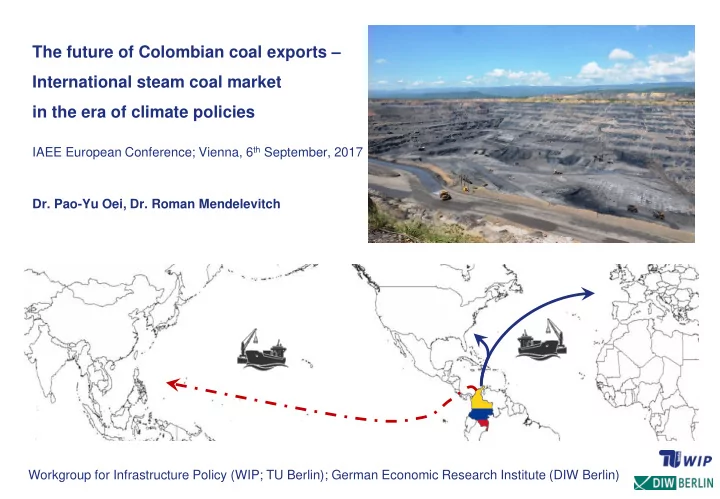
The future of Colombian coal exports – International steam coal market in the era of climate policies

IAEE European Conference; Vienna, 6th September, 2017

  • Dr. Pao-Yu Oei, Dr. Roman Mendelevitch

Workgroup for Infrastructure Policy (WIP; TU Berlin); German Economic Research Institute (DIW Berlin)

slide-2
SLIDE 2
  • 1 -

Agenda

1. Motivation 2. Colombia`s role in the international steam coal market 3. Trends in current import partners, mainly Europe and US 4. Perspectives for possible new export partners in South-East Asia 5. Implications of the upcoming global coal phase-out

slide-3
SLIDE 3
  • 2 -

Motivation: 70-90% of coal, 30-60% of gas and 30-60% of oil reserves has to stay unmined to reach the 2°C target

Source: McGlade & Ekins (2015)

slide-4
SLIDE 4
  • 3 -

Times are changing for coal

The success of renewables (and lower gas prices in some regions) have lead to a reduction of coal demand in the western world. Several smaller countries in the EU are already coal- free or will phase-out in the 2020s. The Republic of China has introduced a moratorium on new coal power plants and mines and India is observing a much slower increase of coal demand than expected. As a result, steam coal production declined by around 28% between 2005 and 2015. Coal companies world-wide are struck with low prices and are challenged by ongoing divestment movements.

50 100 150 200 USD Eurozone CIF FOB Richards Bay FOB Newcastle Crude oil

Source: HWWI commodity prices in the Thompson Reuters Datastream database.

slide-5
SLIDE 5
  • 4 -

Colombia`s future as 4th largest exporter of steam coal

There already exists a wide range of studies that put foci on various environmental and social implications of the coal mining industry in Colombia (e.g., see Moor and van de Sandt 2014; CAN 2016b; Hawkins 2014; Chomsky and Striffler 2014; CINEP/PPP 2014; Schücking 2013). Our research focus lies on: How will coal exporting countries, such as Colombia, be affected by the decline of the coal industry? Doing so, requires an analysis of

  • the competitiveness of the coal exporting country (in this case: Colombia),
  • current market development in other coal producing and consuming countries,
  • prospects for future Colombian coal exports.
slide-6
SLIDE 6
  • 5 -

Agenda

1. Motivation 2. Colombia`s role in the international steam coal market 3. Trends in current import partners, mainly Europe and US 4. Perspectives for possible new export partners in South-East Asia 5. Implications of the upcoming global coal phase-out

slide-7
SLIDE 7
  • 6 -

Colombia: Coal mining activities and its electricity system based mostly on hydropower

The Colombian coal sector is dominated by three international firms:

  • Cerrejón, owned by a consortium of BHP

Billiton, Anglo American and Glencore;

  • US-based Drummond; and
  • Prodeco, a Glencore subsidiary.

In Colombia, two areas – La Guajira and Cesar – account for over 90% of the annual production. Currently, around 30.000 people are directly employed by the three biggest coal companies.

Source: Own illustration based on UPME (2014) and USGS (2006).

Electricity from Hydro Gas Coal Port

slide-8
SLIDE 8
  • 7 -

The competitiveness of Colombian steam coal: High quality…

  • The degree to which a particular supplier of steam coal can be substituted depends on the

specifics of the power plant and on the coal it is designed for.

  • Colombian high quality coal is compatible with modern high efficiency power plants. Coal

from Indonesia and South Africa on average is of lower quality and needs future preparation and beneficiation before it could substitute Colombian coal in high efficiency supercritical and ultra-supercritical boilers.

  • Coal-fired power plants in India and South-East Asia are designed for low quality coal and

cannot easily switch to other suppliers offering high quality coal, such as from Colombia.

Region Calorific value in kcal/kg Energy content in GJ/t USA Appalachia 6949 29.075 China Shanxi, Shaanxi, Inner Mongolia 6597 27.600 Australia Queensland 6500 27.196

Colombia 6375 26.673

Australia New South Wales 6300 26.359 South Africa 5500 23.013 Indonesia 5450 22.803 India West 5209 21.793 USA Powder River Basin 4781 20.004

slide-9
SLIDE 9
  • 8 -

… at relatively low supply costs.

In Colombia, much of the infrastructure for transport to and at the export terminals is undergoing expansion or has recently been expanded despite the negative outlook. The widening of the Panama Canal in 2016 is expected to increase the competitiveness of Colombian steam coal exports also on the Pacific market. Potential drawbacks for this route are, however, an additional fee of $300,000 per capesize ship (resulting in a mark-up

  • f ~2$/t coal) and maximum loading restrictions due to the canal's draft restrictions.

Indicative steam coal supply costs to North West Europe by supply chain component and by country, 2012-15, excluding taxes and royalties (in USD/t). Source: OECD/IEA (2016)

slide-10
SLIDE 10
  • 9 -

Coal exports from Colombia

Colombia increased its export volumes steadily from 14Mt of coal in 1990 to 82Mt in 2012. Having become the 4th largest exporter of steam coal, its export figures stayed relatively constant until 2015. The value of these coal exports ranks second with 14% (behind Crude Petroleum comprising a share of 34%) of overall Colombian exports. Most coal exports are bound to the USA and the European Union. These export volumes make Colombia vulnerable to changes of global resources’ demand and

  • prices. A reduction of international steam coal prices resulted in a strong decrease of

Colombia´s coal rents from an all-time high of 2.3% of GDP in 2008 to 0.5 in 2015.

Main export destinations of Colombian steam coal Source: VDKI and IEA/OECD (2016).

slide-11
SLIDE 11
  • 10 -

Agenda

1. Motivation 2. Colombia`s role in the international steam coal market 3. Trends in current import partners, mainly Europe and US 4. Perspectives for possible new export partners in South-East Asia 5. Implications of the upcoming global coal phase-out

slide-12
SLIDE 12
  • 11 -

Coal capacities in Europe observe a decreasing trend. Coal free countries in the EU: BE, CY, EE, LT, LU, LV, MT

Source: CAN database / Sandbag (2016) 2025 2025 2025 2020 2020s ? 2016

slide-13
SLIDE 13
  • 12 -

The outlook for coal in the US is negative. The change of national government will not influence the global dynamics.

The share of coal in total electricity generation declined from 52.3% in 2000 to 34.3% in 2015. This is largely on economic grounds and in particular, due to the boom in production of low- priced domestic shale gas, and the availability of cheap renewable technologies. Further important drivers are federal and state level promotion of wind and solar energy as well as environmental policies for coal-fired power plants. Given the aging coal-fired power plant fleet (with 85% older than 30 years and 50% older than 40 years) the environmental policies mentioned above were supposed to lead to power plants increasingly being decommissioned rather than refurbished. Numerous U.S. coal producers (including Peabody Energy Cooperation, Arch Coal Inc., and Alpha Natural Resources, listed first, second and forth in the top four U.S. coal mining companies) have filed for bankruptcy and 271 mines were closed in the last years. The current U.S. administration, however, targets to take back measures introduced in the Climate Action Plan and instead to support clean coal technology, soften emission standards for new coal-fired power plants, lift the moratorium on new coal mine leases and announced to withdraw from the Paris Agreement. However, for the next years the competitiveness of the US domestic coal sector will be governed by the evolution of the gas price and cost of renewables rather than by the rollback of environmental regulation by the Trump Administration.

Source: SPON (2017).

slide-14
SLIDE 14
  • 13 -

Agenda

1. Motivation 2. Colombia`s role in the international steam coal market 3. Trends in current import partners, mainly Europe and US 4. Perspectives for possible new export partners in South-East Asia 5. Implications of the upcoming global coal phase-out

slide-15
SLIDE 15
  • 14 -

The global coal power pipeline is currently observing a major hault, dominated by the happenings in China and India [MW]

Coal capacities are displayed in GW; Source: Shearer et al. (2017).

Emerging countries are expecting rising energy demands due to population growth and economic development resulting in the construction of numerous new coal power plants. China and India accounted for 86% of global installed coal power capacity 2006-2016. Many projects, however, were shelved in the last year; see coal power plant pipeline in 2017:

slide-16
SLIDE 16
  • 15 -

Dramatic changes to China’s coal pathway with a big uncertainty about future developments

  • Electricity generated by coal peaked in

2013, coal power capacity cap of 1,100GW to be reached in 2020 (921 GW installed as

  • f January 2017; representing 47% of global

installed power capacity).

  • Capacity factor of power plants

decreased below 50% in 2015 and 2016.

  • Plans to retire older coal power plants.
  • Suspension of new plant approvals and

halt on construction in several provinces; Total amount of cancelled projects between 2010 and 2016: 203 GW. Cancellation of 100 specific plant projects from September 2016 to January 2017.

Sources: Climate Action Tracker (2017a); Endcoal (2017a, 2017b); Isoaho (2016); Shearer et al. (2017).

The implemented climate and environmental policies have already resulted in a hault

  • f coal consumption and the beginning of a Chinese coal phase-out earlier than

expected.  China, therefore, needs alternative renewable energy sources.

slide-17
SLIDE 17
  • 16 -

Status-quo of coal in India

  • Installed coal capacity grew from 71 GW in 2007 to

212 GW in January 2017 (11% of global capacity).

  • Rapid expansion resulted in falling capacity factors.
  • Leading coal power producers (e.g. Adani) suspended

investments and further development.

  • Draft Electricity Plan: No new coal capacity needed

between 2022-27, apart from the 48 GW already under construction.

  • India implemented a tax on coal of US$ 3.2/t coal;

revenues go to the National Clean Environment Fund.  Indian coal consumption has grown much slower than expected.  India needs alternative energy sources to provide all people with cheap electricity.

Sources: Climate Action Tracker (2017b); CoalSwarm (2017); Shearer et al. (2017)

Installed capacity Put on hold in total (end 2016) Previously under construction put on hold Cancelled during 2016 Pre- construction Active construction 212 82 13 115 129 48 Coal capacities in 2017 [GW]

slide-18
SLIDE 18
  • 17 -

Agenda

1. Motivation 2. Colombia`s role in the international steam coal market 3. Trends in current import partners, mainly Europe and US 4. Perspectives for possible new export partners in South-East Asia 5. Implications of the upcoming global coal phase-out

slide-19
SLIDE 19
  • 18 -

The upcoming coal phase out effects countries differently and therefore needs a combination of various political instruments

Need to differentiate between countries:

that only mine coal (e.g. Colombia)

  • employment
  • income from exports

those burning coal (e.g. UK and many countries in Europe)

  • energy security
  • (employment)

those doing both (e.g. US, China, India, South-Africa, Germany)

  • energy security
  • employment
  • (income from exports)

that only mine coal (e.g. Colombia)

  • employment
  • income from exports

those burning coal (e.g. UK and many countries in Europe)

  • energy security
  • (employment)

those doing both (e.g. US, China, India, South-Africa, Germany)

  • energy security
  • employment
  • (income from exports)
slide-20
SLIDE 20
  • 19 -

Coal phase-out concepts need to incorporate different regional aspects

Financial payments as compensation for a moratorium on new mines

  • Support for RES to

meet rising energy demand, enable energy access & create jobs Active & passive labour market instruments to enable a just transition e.g. Colombia Moratorium on new mines Existing coal power plant fleets need to be closed Support for RES to replace fossil capacities & create jobs Active & passive labour market instruments to enable a just transition e.g. Europe or US Moratorium on new mines; maybe linked with compensations Moratorium for new plants to prevent (stranded) assets Support for RES to meet rising energy demand, enable energy access & create jobs Active labour market instruments to create new jobs e.g. China or India Financial payments as compensation for a moratorium on new mines

  • Support for RES to

meet rising energy demand, enable energy access & create jobs Active & passive labour market instruments to enable a just transition e.g. Colombia Moratorium on new mines Existing coal power plant fleets need to be closed Support for RES to replace fossil capacities & create jobs Active & passive labour market instruments to enable a just transition e.g. Europe or US Moratorium on new mines; maybe linked with compensations Moratorium for new plants to prevent (stranded) assets Support for RES to meet rising energy demand, enable energy access & create jobs Active labour market instruments to create new jobs e.g. China or India

slide-21
SLIDE 21
  • 20 -

Direct effects of the upcoming coal phase-out for Colombia

The speed of the coal phase-out will not be driven by the remaining coal reserves. The main driver for the coal phase-out will be shrinking global demand due to climate and environmental policies as well as direct competition from cheaper and cleaner energy sources. This trend can be seen in the Atlantic as well as Pacific steam coal market. Coal exporting countries, such as Colombia, are at risk not only to lose high shares of their state income but also to be left alone with mono-industrialized regions with low chances for a transition towards alternative and more sustainable industry

  • sectors. Not needed mining investments can be categorized as stranded and

should be redirected to prevent unnecessary use of financial means and resources. Divestment strategies or bankruptcy of coal firms might lead to insufficient provisions for mining recultivation and result in additional costs for the Colombian state and its

  • people. The Colombian case is at risk of becoming another example of the

“resource curse”. A consistent global and national policy mix and strategies are needed for the closure

  • f older coal plants, the ban on new coal mines and plants, the diversification of the

technology mix, and investments into lucrative renewables to manage this transition.

slide-22
SLIDE 22
  • 21 -

The future of Colombian coal exports – International steam coal market in the era of climate policies

IAEE European Conference; Vienna, 6th September, 2017

  • Dr. Pao-Yu Oei, Dr. Roman Mendelevitch

Workgroup for Infrastructure Policy (WIP; TU Berlin); German Economic Research Institute (DIW Berlin)

slide-23
SLIDE 23
  • 22 -

Colombia´s electricity system is mostly based on hydropower Steam coal is therefore mostly exported

Installed Capacities and future capacity expansions:

Source: UPME (2014).

slide-24
SLIDE 24
  • 23 -

Port

slide-25
SLIDE 25

Port Electricity from Hydro Gas Coal

slide-26
SLIDE 26
  • 25 -

Different policy instruments exist to enable a coal phase-out (demand and supply side, technology support, labour)

PROPOSED MEASURE EXPECTED EFFECT Forbidding new mines Terminating current plans for new minings sites Closing existing mines Reducing mining volumes of active mines Increasing the CO2 price / EU-ETS reform Price signal through the introduction of market stability reserve (MSR); CO2 floor price CO2 certificates would become more expensive Minimum efficiency Closure of inefficient power plants Flexibility requirements Closure or singling out of inflexible power plants Coal phase-out law Maximum production [TWh] or emissions allowances [tCO2] for plants Emissions performance standard (per unit; for new plants and retrofits) Restrictions for new plants and retrofits (without CO2 capture) [< x g/MWh] Emissions performance standard (emissions cap for existing plants) Reduce load factor for depreciated coal-fired power plants (e.g., >30y) [< x g/MW] Capacity mechanisms or reserve plants Incentive for construction of less CO2-intensive power plants Climate contribution fee Additional levy for old CO2-intensive power plants

Support of RES & technology transfer Enabling suffcient clean energy sources to replace coal plants Active & Passive labour policies Creation of new job opportunities; ease potential job losses

Source: Updated from Oei et al. (2014).

slide-27
SLIDE 27
  • 26 -

Coal phase-out concepts need to incorporate different regional aspects

Existing coal power plant fleets need to be closed Support for RES to replace conventional capacities Active & passive labour market instruments to enable a just transition

e.g. Europe

  • r US

Moratorium for new plants/ mines to prevent (stranded) assets Support for RES to meet rising energy demand and enable energy access

e.g. China

  • r India
slide-28
SLIDE 28
  • 27 -

Main Findings on the upcoming global coal phase-out

  • 1. The climate targets of Paris imply a global phase-out of coal. The majority
  • f resources has to stay in the ground.
  • 2. There is a global trend to phase-out coal power plants in several

countries, which is economically efficient.

  • 3. A global energy system based on 100% renewable energy sources until

2050 is technically possible and can be achieved at low costs.

  • 4. A consistent global and national strategies and policy mix is needed

for the closure of older plants, the ban on new coal mines, the diversification of the technology mix, and investments into lucrative renewables.

  • 5. The access of all citizens to avordable renewable electricity is a major

challenge for some emerging countries. A just energy transition, however, also creates new jobs and opportunities for various regions and sectors.

slide-29
SLIDE 29
  • 28 -

Coal mining in Colombia

The coal mine “Cerrejon Zona Norte”, run by Cerrejon and located in La Guajira, is the largest

  • pen pit mine in South America. Its annual production reached 34 Mt in 2014.

The second largest steam coal producer with around 20 Mt/year is US-based Drummond Ltd, which operates two major mines near La Loma in the department of Cesar. The third biggest operator Prodeco, a subsidiary of Glencore, is operating its mine Calenturitas located between the municipalities El Paso, La Jagua de Ibirico and Becerril; in the department

  • f Cesar. Its production reached 11 Mt in 2015.

Production from smaller coal mining companies operating in Colombia sum up to 7.6 Mt/a.

slide-30
SLIDE 30
  • 29 -

Coal mining

slide-31
SLIDE 31
  • 30 -
slide-32
SLIDE 32
  • 31 -
slide-33
SLIDE 33
  • 32 -
slide-34
SLIDE 34
  • 33 -

The importance of coal for Colombia

slide-35
SLIDE 35
  • 34 -
slide-36
SLIDE 36
  • 35 -

Articles (selection)

  • Oei et al. (2016): „Kohlereserve“ vs. CO2-Grenzwerte in der

Stromwirtschaft – Ein modellbasierter Vergleich“, Energiewirtschaftliche Tagesfragen, 1-2/2016

  • Collins, and Mendelevitch (2015): Leaving Coal Unburned: Options

for Demand-Side and Supply-Side Policies, DIW Berlin, DIW Roundup 87, Berlin, Germany.

  • Richter, Mendelevitch and Jotzo (2015): Market Power Rents and

Climate Change Mitigation: A Rationale for Coal Taxes?, DIW Berlin, DIW Discussion Paper 1471, Berlin, Germany.

  • Holz, Haftendorn, Mendelevitch, and Hirschhausen (2015): The

COALMOD-World Model: Coal Markets until 2030, in R. K. Morse and M.C. Thurber (Eds.) “The Global Coal Market - Supplying the Major Fuel for Emerging Economies”. Cambridge University Press.

  • Oei et al. (2014): Modeling a Carbon Capture, Transport, and Storage

Infrastructure for Europe“. Journal of Environmental Modeling and Assessment 05/2014 Politikberatung kompakt and DIW Wochberichte (selection):

  • Oei et al. (2015): 104: Auswirkungen von CO2-Grenzwerten

für fossile Kraftwerke auf Strommarkt und Klimaschutz in Deutschland. Politikberatung 104.

  • Oei et al. (2014): 84: Braunkohleausstieg – Gestaltungsoptionen im

Rahmen der Energiewende. Politikberatung 84.

  • Oei et al. (2014): Kohle und Klimaschutz. DIW Wochbericht 14-26

Publications by DIW Berlin on coal and lignite (Selection)
slide-37
SLIDE 37
  • 36 -

Electricity Generation in the EU: Coal vs. Gas Phase-out

Source: Agora Energiewende 2016

slide-38
SLIDE 38
  • 37 -

Reserves of lignite and hard coal in Europe (2012): The majority has to remain in the ground to meet climate targets

Source: Euracoal (2013)

slide-39
SLIDE 39
  • 38 -

Most coal power plants in China are located at the east-coast

Sources: Climate Action Tracker (2017a); Government of China (2015); Coal Swarm (2017). Note: The numbers tell the number of generating units at each location.

slide-40
SLIDE 40
  • 39 -

Share of installed capacity in 2015 Coal RES (without hydro) Northern Region 58% 2% Western Region 64% 17% Southern Region 47% 28% Eastern Region 83% 3% North Eastern Region 15% 7% Islands 0% 24% India Total 59% 17%

The coal phase-out will have different structural effects shown by an analysis of current dependencies on coal & renewables

Especially the Northern and Eastern Region are vulnerable to the upcoming structural changes of the energy transition, as they have a high dependence on coal and very small amounts of renewable energy capacities.

Source: Own calculation based on Central Electricity Authority (2017): Installed capacity. http://www.cea.nic.in/reports/monthly/installedcapacity/2017/installed_capacity-05.pdf

slide-41
SLIDE 41
  • 40 -

Modeling a 100% Renewable Energy Scenario for China with the Energy System Model ReMSYS based on wind and PV

Source: Own modeling results with ReMSYS..

2000 4000 6000 8000 10000 12000 14000 2015 2020 2025 2030 2035 2040 2045 2050 Electricity generation [TWh]

slide-42
SLIDE 42
  • 41 -

Modeling a 100% RES Scenario for India with the Energy System Model ReMSYS: Rising electricity demand met by PV

2000 4000 6000 8000 10000 12000 2015 2020 2025 2030 2035 2040 2045 2050 Electricity generation [TWh]

Source: Own modeling results with ReMSYS..

slide-43
SLIDE 43
  • 42 -

Hypotheses about India‘s future energy transformation

Hypothesis 1: Cheaper than expected renewables can satisfy India’s growing electricity demand without any more added coal capacity than the power plants already under construction. Hypothesis 3: A change in leadership (Prime Minister Narendra Modi) brought about a new vision

  • f a solar future, threatening the old fossil fuel based power structures in industries and politics.

Hypothesis 2: To create a successful Indian sustainability energy transition, the access of all citizens to electricity and a drastic reduction of poverty are indispensable. Hypothesis 4: The current complex energy sector governance hinders policy developments. The transition will be led by state governments, and has to be fostered across classes and castes.

slide-44
SLIDE 44
  • 43 -

Dramatic changes to China’s coal pathway with a big uncertainty about future developments

  • Electricity generated by coal peaked most likely in 2013, capacity factor of power plants was

below 50% in 2015 and 2016, coal accounted for 66% of total energy consumption in 2014

  • China’s 13th Five-Year-Plan: maximum 58% share of coal in national energy consumption by 2020
  • Increasingly low utilisation rate of coal plants, reaction by China’s National Energy Administration

and National Development and Reform Commission:  Suspension of new plant approvals in 13 provinces and regions  Ban on new coal mines from 2016-2018  A halt on construction in 15 provinces and regions  Exception for projects in poor areas and old revolutionary base areas  Plans to retire older coal power plants

  • Coal power capacity cap of 1,100GW (921 GW installed as of January 2017; representing 47%
  • f global installed power capacity)
  • Cancellation of 100 specific plant projects from September 2016 to January 2017 (Allowed

projects in 2015:142 GW, in 2016: 22 GW. Total pre-construction capacity in the pipeline: 134 GW

  • Total amount of cancelled projects between 2010 and 2016: 203 GW.
  • Additional 35 GW are under construction since 2016, 55 GW were put on hold since 2016.

Sources: Climate Action Tracker (2017a); Endcoal (2017a, 2017b); Isoaho (2016); Shearer et al. (2017).

slide-45
SLIDE 45
  • 44 -

China’s Nationally Determined Contribution (NDC)

  • Commitment to peak CO2 emissions around 2030, “making the best effort to peak early”
  • Lower carbon intensity of GDP by 60%–65% below 2005 levels by 2030
  • Increase share of non-fossil energy carriers in total primary energy supply to ~20% by 2030
  • Increase forest stock volume by 4.5 billion cubic metres compared to 2005 levels
  • Total GHG emissions likely to continue increasing until 2030: no sufficient policies addressing non-

CO2 GHG emissions (CH4, N2O, HFCs etc.)

  • => China’s Paris Agreement NDC is less ambitious than China’s current policies and its national
  • targets. The NDC is not in line with a fair share of the 2°C (or the 1.5°C) target

Sources: Climate Action Tracker (2017a); Government of China (2015); Coal Swarm (2017). Note: The numbers tell the number of generating units at each location.

slide-46
SLIDE 46
  • 45 -

Additional Info China (1/2)

  • Most populated country globally, second largest economy in the world, second largest

concentration of poverty in the world, large-scale urbanization still ongoing

  • Autocracy; main parties: Chinese Communist Party (CCP) and 8 other small parties controlled by

the CCP

  • National Program on Climate Change, the12th and 13th Five-Year Plan for Energy Conservation

and Emission Reduction, the Action Plan for Energy Conservation, Emission Reduction and Low- Carbon Development, and the National Plan on Climate Change (2014-2020).

  • Mix of regulatory approaches, financial support and market-based mechanisms to promote

renewables; long-term feed-in tariffs for solar, wind and biomass

  • Less than 1% of China‘s 500 largest cities meet WHO air quality standards
  • Rising societal pressures on ruling elite due to air pollution and environmental degradation =>

Clear shift in energy policies since 2005: implementation of renewable energy law

  • State Council (i.e. the central government) sets broad directions for renewable energy policy

development; ministries and departments draft specific policies

  • Advisory and coordination role in energy issues established in 2007: National Leading Group on

Climate Change Energy Conservation and Emissions Reduction (NLGACCERCER); members are leaders of the State Council and 20 key ministries

Sources: Government of India (2015); Isoaho (2016); Shearer et al. (2017).

slide-47
SLIDE 47
  • 46 -

Additional Info China (2/2)

  • National Development and Reform Commission (NDRC): central role in climate policy and energy;

National Energy Administration (NEA) agency under NDRC responsible for renewable energy policy formulation and implementation at the national level

  • National Energy Commission (NEC): ‘super ministry’ in charge of drafting the national energy

development strategy

  • => energy and climate change are located within the most influential agencies; implementation

remains nevertheless a challenge

  • Regionally differing societal pressures: shut-down of plants in Inner Mongolia, pledges to build

power plants in inland provinces

  • State council puts efforts on ‘clean coal’ and other fossil fuels: gasification, CCS, natural gas and

nuclear

  • Lack in grid infrastructure
  • China’s National Emissions Trading System to start in 2017
slide-48
SLIDE 48
  • 47 -

India and China in global Context

Source: Shearer et al. (2017).

slide-49
SLIDE 49
  • 48 -

Recent developments coal in China and India

Put on hold in 2016 On hold in total (end 2016) Put on hold, which was already under construction Active construction China 300 442 56 146 India no data 82 13 48 Coal capacities as of January 2017, in GW.

Source: Shearer et al. (2017).

slide-50
SLIDE 50
  • 49 -
  • Solar capacity especially strong in Gujarat, Rajasthan, Tamil Nadu and Madhya Pradesh (together

>60% of total capacity); dependent on solar radiation, coal availability and political feasibility

  • Main barriers to renewable expansion: difficult finance environment (makes renewable projects

more costly than in other countries, political elites vested interests in fossil fuels, a corruption-prone system requires bribes for new projects, difficult process of land acquisition for private companies

  • The “discoms”, the state-government owned electricity companies, are highly indebted (electricity

theft, badly implemented subsidies and technical losses) and do not fulfill their renewable purchase

  • bligations, do not make necessary investments to integrate renewables and thereby scare away

investors of renewables

  • Gujarat can be seen as a leading example for the transition away from coal => lessons to be

learned for other states on governance

  • Split of electricity for agriculture from the rest, controls of necessity for subsidies,

stable political coalition

  • The Indian population of very polluted regions do not protest against coal but instead against

higher environmental standards => because they are economically dependent coal and other polluting industries

  • :

Governance and regional differences

slide-51
SLIDE 51
  • 50 -

Recent developments coal in China and India

Put on hold in 2016 On hold in total (end 2016) Put on hold, which was already under construction Active construction India no data 82 13 48 Coal capacities as of January 2017, in GW.

Source: Shearer et al. (2017).

slide-52
SLIDE 52
  • 51 -

India’s Nationally Determined Contribution (NDC)

  • 40% non-fossil fuel capacity of installed power capacity by 2030 (~26-30% of generation;

conditional on the provision of resources by industrialised countries)

  • Lower GDP emissions intensity by 33-35% by 2030 below 2005 levels (-20-25% by 2020)
  • Additional cumulative carbon sink of 2.5-3 GtCO2e through additional forests by 2030
  • Current policy developments:
  • 175 GW installed renewable energy by 2022 (NDC pledge 100 GW). Despite rapid

expansion not enough to satisfy growing electricity demand

  • 100 GW solar capacity by 2022
  • Draft Electricity Plan: After 2022 no new coal capacity apart from the one already under

construction (48GW) needed

Sources: Climate Action Tracker (2017b); Central Electricity Authority (2016); Government of India (2015).

India’s NDC is less ambitious than current policies, both pathways are not in line with the 2°C (or the 1.5°C) target

slide-53
SLIDE 53
  • 52 -

Additional Info India

  • Solar power revolution: government proposal to install 215 GW renewables by 2027
  • Estimated total CO2 emissions for 2021-22 and 2026-27 are 983 million t and 1,165 million t respectively
  • Around 17.5% of the world population (second most populated country), around 363 million people (30% of the

population) live in poverty (largest concentration of poverty globally), around 24% of the global population without access to electricity (304 million), about 30% of the global population relying on solid biomass for cooking and 92 million without access to safe drinking water, wide disparities amongst its people and regions.

  • Democracy; 6 national, 49 state and >1700 unrecognized parties, strong autonomy of states in India
  • Policy framework on environment and climate change: National Environment Policy (NEP) 2006: promotes

sustainable development along with respect for ecological constraints and the imperatives of social justice.

  • National Action Plan on Climate Change (NAPCC): sharper focus on required intervention
  • implemented through eight National Missions, outlining priorities for mitigation and adaptation to combat

climate change

  • supplemented by actions of the State Governments, Non-governmental Organizations (NGOs), initiatives of the

private sector and other stakeholders. 32 States and Union Territories have State Action Plan on Climate Change (SAPCC) including climate change concerns in their planning process.

  • Energy Conservation Act encourages efficient use of energy and its conservation
  • The National Electricity Policy (NEP) focuses on universalizing access to electricity and promoting renewable

sources of energy, as does the Integrated Energy Policy (IEP).

Sources: Government of India (2015); Shearer et al. (2017).

slide-54
SLIDE 54
  • 53 -

Additional Info Energy Market India

  • Other policies include fiscal instruments like a coal tax, cuts in subsidies, increase in taxes on petrol and diesel,

market mechanisms including Perform Achieve and Trade (PAT), Renewable Energy Certificates (REC) and a regulatory regime of Renewable Purchase Obligation (RPO).

  • No great societal pressures regarding air pollution, although 13 of the 20 most polluted cities worldwide are in

India; poor population dependent on polluting industries for economic growth and job creation

  • Federal level only partly responsible for energy policy-making, more the state governments‘ responsibility, nodal

state agencies responsible for implementation

  • Various mechanisms to promote renewables: grants, tax incentives and generation-based incentives
  • Fifth largest wind energy producer worldwide
  • At COP21 Prime minister Modi launched the International Solar Alliance (120 states commit to install >1 TW of

solar power by 2030)

  • Difficult finance environment in India, which makes renewable energy projects more costly than in other countries
  • Corruption-prone political elite with vested interests in the fossil fuel industry
  • Other major problems: electricity thievery, and long problematic process land acquisition
slide-55
SLIDE 55
  • 54 -

1) The Indian Energy Sector 2) Modeling approach & Input Data 3) Results

Agenda

slide-56
SLIDE 56
  • 55 -

Modeling approach & Input Data

Key Data

  • A total of 10 regions is being considered.
  • The years 2020 - 2050 are modeled in 5-year steps, with 2015 as a baseline.
  • Existing capacities in 2015 are included as residual capacities in our model.
  • Demands are fixed and based on IEA 450ppm (World Energy Outlook 2015) datasets.

Source: Own Illustration, based on Gulagi, et al. (2017)

slide-57
SLIDE 57
  • 56 -

India - Demands

5 10 15 20 25 30 35 40 2015 2020 2025 2030 2035 2040 2045 2050

Exajoule

Power Low-temp. Heat High-temp. Heat 1000 2000 3000 4000 5000 6000 2015 2020 2025 2030 2035 2040 2045 2050

Gpkm

Passenger Transport Freight Transport

Power & process heat demands more than triple between 2015 and 2050. Overall heavy increase of energy demands over the years.

slide-58
SLIDE 58
  • 57 -
  • Sets:

y Year f Fuel t Technology m Mode of Operation r Region l Time Slice

  • Objective Function

min 𝑑𝑝𝑡𝑢𝑡 = ෍

𝑧

𝑢

𝑠

𝑈𝑝𝑢𝑏𝑚𝐸𝑗𝑡𝑑𝑝𝑣𝑜𝑢𝑓𝑒𝐷𝑝𝑡𝑢𝑧,𝑢,𝑠 + ෍

𝑧

𝑠

𝑈𝑝𝑢𝑏𝑚𝐸𝑗𝑡𝑑𝑝𝑣𝑜𝑢𝑓𝑒𝑈𝑠𝑏𝑒𝑓𝐷𝑝𝑡𝑢𝑡𝑧,𝑠 𝑈𝑝𝑢𝑏𝑚𝐸𝑗𝑡𝑑𝑝𝑣𝑜𝑢𝑓𝑒𝐷𝑝𝑡𝑢𝑧,𝑢,𝑠 = 𝐸𝑗𝑡𝑑𝑝𝑣𝑜𝑢𝑓𝑒𝑃𝑞𝑓𝑠𝑏𝑢𝑗𝑜𝑕𝐷𝑝𝑡𝑢𝑧,𝑢,𝑠 + 𝐸𝑗𝑡𝑑𝑝𝑣𝑜𝑢𝑓𝑒𝐷𝑏𝑞𝑗𝑢𝑏𝑚𝐽𝑜𝑤𝑓𝑡𝑢𝑛𝑓𝑜𝑢𝑧,𝑢,𝑠 + 𝐸𝑗𝑡𝑑𝑝𝑣𝑜𝑢𝑓𝑒𝑈𝑓𝑑ℎ𝑜𝑝𝑚𝑝𝑕𝑧𝐹𝑛𝑗𝑡𝑡𝑗𝑝𝑜𝑡𝑄𝑓𝑜𝑏𝑚𝑢𝑧𝑧,𝑢,𝑠 − 𝐸𝑗𝑡𝑑𝑝𝑣𝑜𝑢𝑓𝑒𝑇𝑏𝑚𝑤𝑏𝑕𝑓𝑊𝑏𝑚𝑣𝑓𝑧,𝑢,𝑠 ∀ 𝑧 ∈ 𝑍, 𝑢 ∈ 𝑈, 𝑠 ∈ 𝑆

Model Formulation – Objective Function

slide-59
SLIDE 59
  • 58 -

1) The Indian Energy Sector 2) Modeling approach & Input Data 3) Results

Agenda

slide-60
SLIDE 60
  • 59 -

100% Renewables Scenario

slide-61
SLIDE 61
  • 60 -

Development of Power Generation in PJ

Source: Own Illustration

2000 4000 6000 8000 10000 12000 2015 2020 2025 2030 2035 2040 2045 2050 TWh

slide-62
SLIDE 62
  • 61 -

100% Renewables – Heat low

1000 2000 3000 4000 5000 6000 7000 8000 9000 2015 2020 2025 2030 2035 2040 2045 2050 Petajoule Biomass Solar Thermal Heatpump Oil Coal

slide-63
SLIDE 63
  • 62 -

100% Renewables – Heat high

5000 10000 15000 20000 25000 2015 2020 2025 2030 2035 2040 2045 2050 Petajoule Biomass H2 Electric Furnace Gas Oil Coal

slide-64
SLIDE 64
  • 63 -

Development of Freight Transportation

Source: Own Illustration

500 1000 1500 2000 2500 3000 3500 2015 2020 2025 2030 2035 2040 2045 2050 million freight km Rail Petro Rail ELC Road Conv Road Bio Road H2 Ship Conv Ship Bio

slide-65
SLIDE 65
  • 64 -

India – Regional Power Production

Source: Own Illustration

slide-66
SLIDE 66
  • 65 -

India – Power Production per Timeslice w/ Storages

Source: Own Illustration

  • 1000

1000 2000 3000 4000 5000 2050 ID 2050 IN 2050 SD 2050 SN 2050 WD 2050 WN TWh

slide-67
SLIDE 67
  • 66 -

Installed Capacity in 2050

slide-68
SLIDE 68
  • 67 -

Wind & PV Production Profiles, 2050

slide-69
SLIDE 69
  • 68 -

Trade Between Regions in 2050

slide-70
SLIDE 70
  • 69 -

450ppm Scenario

slide-71
SLIDE 71
  • 70 -

450 ppm - Power

1000 2000 3000 4000 5000 6000 7000 8000 9000 2015 2020 2025 2030 2035 2040 2045 2050 TWh

slide-72
SLIDE 72
  • 71 -

450ppm – Heat low

1000 2000 3000 4000 5000 6000 7000 8000 9000 2015 2020 2025 2030 2035 2040 2045 2050 Petajoule Biomass Solar Thermal Heatpump Oil Coal

slide-73
SLIDE 73
  • 72 -

450ppm – Heat high

5000 10000 15000 20000 25000 2015 2020 2025 2030 2035 2040 2045 2050 Petajoule Biomass Electric Furnace Gas Oil Coal

slide-74
SLIDE 74
  • 73 -

Global CO2 Emissions per Energy Carrier in billion tons – 0% fossil fuels in 2050

Source: Own Illustration

500 1000 1500 2000 2500 3000 2015 2020 2025 2030 2035 2040 2045 2050 2015 2020 2025 2030 2035 2040 2045 2050 2015 2020 2025 2030 2035 2040 2045 2050 100percent 450ppm newpolicies Coal Gas Oil

slide-75
SLIDE 75
  • 74 -

Source: Oei, et al.(2014).

Germany‘s national GHG reduction target implies further measures…

200 400 600 800 1.000 1.200 1.400 GHG Emissions in Megatons CO2 equiv.

Non-ETS-Sector EU-ETS Coal_Non_ETS Coal_ETS Lignite_Non_ETS Lignite_ETS

2050 target*:

  • 80-95%

2020 Ziel*:

  • 40%

2030 target*:

  • 55%

*) Base line: 1990 Trend of the last years: emissions going up!

slide-76
SLIDE 76
  • 75 -

Rhine basin Helmstedt basin Lusatia Central Germany

Power plant Mining site

Lignite power plant capacities built [GW] before 1980 1981- 2000 after 2001 Rhine basin 7 0.3 3 Helmstedt basin – 0.3 – Central Germany – 3 – Lusatia 1 6 0.6

Lignite in Germany

The electricity sector is responsible for ~40% of GHG emissions in Germany

  • ~50% lignite power plants; of which

>50% built before 1990 (esp. in NRW).

  • ~33% hard coal power plants; of

which 50% built after 2000 Effect of electricity prices below 30 €/MWh:

  • Old hard coal power plants are shut

down for economic reasons

  • Political measures could regulate

which power plants are closed down:

  • Lignite power plants
  • Newly built hard coal power plants
  • Gas fired power plants
slide-77
SLIDE 77
  • 76 -

No need for new lignite mining pits in Germany; constitutional conformity of new fields are being contested

Projected fields and Displacements :

Welzow Süd II (~210 Mio. t CO2 / 800 inhabitants) Nochten II (~300 Mio. t CO2 / 1,700 inhabitants) Jänschwalde Nord (~270 Mio. t CO2 / 900 inhabitants)

(Vision: Bagenz-Ost and Spremberg-Ost)

Exproprietation (relocalisation of inhabitants):

  • Public interest needed for legality of new fields
  • Energiewende: neither public interest nor necessity
  • Possibility to sell electricity from lignite is not a reason

to justify expropritations

slide-78
SLIDE 78
  • 77 -
  • 1. Standard to be respected at any moment (plant-specific limit per kWh)
  • Prevents construction of new coal power plants (without CO2 capture)
  • Discussed in USA for new-built, in force in Canada as of mid-2015
  • 2. Limit of annual emissions
  • Can incentivize emission reductions of existing power plants
  • In force in the UK since 2013

Different instruments to reduce CO2 emissions are discussed; among them emissions performance standard (EPS)

ELMOD: Introduction of a German EPS that uses a gas power plant (450 gCO2/kWh) as benchmark to achieve Germany´s climate targets:

  • limit annual emissions of all plants (EPS)
  • nly those older than 35 years (EPS 35)
slide-79
SLIDE 79
  • 78 -

Climate and energy policy has various proven instruments at hand to account for external effects of electricity generation from fossil fuels.

Research Question

  • Examining current trends of the German energy market with respect to

their compatibility with climate targets. Identifying additional instruments besides a reform of the EU-ETS. Publications

  • Chapter in the book Energiewende (forthcoming)
  • DIW Economic Bulletin, Wochenbericht,

Politikberatung kompakt (2012-2015)

  • Newspaper articles (2014-2015)

Main Findings

  • Coal-based power generation puts climate targets at risk.
  • A market-driven transition from coal to gas is unlikely to occur in the near
  • future. Additional instruments could be a CO2 floor price, minimum

efficiency levels and flexibility requirements, a coal phase-out law, emissions performance standard, capacity mechanisms or a strategic reserve for coal plants, a climate contribution fee or reduced transmission grid expansion

slide-80
SLIDE 80
  • 79 -

Share of rising renewables lead to new job opportunities

Quelle: BMWI (2013) & BDEW (2014), Daten für 2014 sind auf Basis des ersten Halbjahres geschätzt: German Ministry of Economy and Energy (BMWI).[1]

0% 5% 10% 15% 20% 25% 30% 1990 1991 1992 1993 1994 1995 1996 1997 1998 1999 2000 2001 2002 2003 2004 2005 2006 2007 2008 2009 2010 2011 2012 2013 2014

9 10 5 14 2 12 13 5 26 4 3 2 1 6 3 8 5 6 1 1 5 6 7 1 8 1 6 32 4 16 2 17 11 1 17 4 5 2 5 1 1 1 5 5 6 1 12 4 8 9 1 5 2 4 5

slide-81
SLIDE 81
  • 80 -

Comparing number of jobs in the coal and renewables sector

50 100 150 200 250 300 350 400 450 1998 2002 2004 2008 2010 2013 Beschäftigte in Tausende BK - Tagebau BK - Kraftwerke SK - Bergbau Erneuerbare

Die Lignite sector used to employ more than 150000 people in 1980. The hardcoal industry in the 1950s-60s employed 500000 people.

Source: Own depiction based on Ulrich und Lehr (2014) and Statistik der Kohlewirtschaft (2015).

slide-82
SLIDE 82
  • 81 -

Average age in the lignite sector: 75 % are aged over 40

0% 5% 10% 15% 20% 25% 30%

Source: Own depiction based on Statistik der Kohlewirtschaft (2015).

slide-83
SLIDE 83
  • 82 -

Lignite and hard coal production and imports in Europe (2015)

Source: Euracoal (2016)

slide-84
SLIDE 84
  • 83 -

Structure of Power Generation in selected EU-Countries (2013)

Source: Euracoal (2015)

slide-85
SLIDE 85
  • 84 -

Upcoming “Coal Reserve“ in Germany Notification 11 days ahead; overall payments of 1.6 billion €

Owner Unit Power [MW] Age in 2020 Start of reserve (shut down after 4 years) Particularities Mibrag / EPH Buschhaus 352 35 10 / 2016 Plant was moved into reserve already in September as the mining site was fully exploited RWE Frimmersdorf P 284 54 10 / 2017 Last 2 (out of 8) units; facing economic problems for several years. Frimmersdorf Q 278 50 10 / 2017 Niederaußem E 295 50 10 / 2018 Were already listed in the official list of expected closures „Kraftwerksliste Bundesnetzagentur zum erwarteten Zu- und Rückbau 2015 bis 2019“ with the closing date 2019 Niederaußem F 299 49 10 / 2018 Neurath C 292 47 10 / 2019 Similar efficiency factors as other 300 MW units Vattenfall / EPH Jänschwalde E 465 33 10 / 2018 Most recent units at the site Jänschwalde (start

  • f operation of the 6 units 1981-1989); it is

sometimes easier to start shutting down the last units first. Jänschwalde F 465 31 10 / 2019

Quelle: Eigene Recherchen basierend auf Daten der Bundesregierung, der BNetzA und Webseiten der Unternehmen

slide-86
SLIDE 86
  • 85 -

Longterm trends of CO2 emissions in Germany until 2035

The results show that the long-term decline of German CO2 emissions (301 Mt in 2014). The green scenario resembles a faster coal phase-out by additionally restricting the full load hours of coal power plants (e.g. due to limited coal reserves or an additional climate levy), while the black scenario is a moderate business-as-usual (BAU) scenario. The results are also influenced by developments in neighboring states. It is therefore in the interest of Germany that other neighboring countries also take action and complement the EU-ETS with national instruments to enable a generation portfolio in line with the European climate targets (Visions 3 & 4).

127 136 120 110 119 127 115 107 100 105 110 115 120 125 130 135 140 Vision 1 Vision 2 Vision 3 Vision 4 CO2-Emissions in Mt black green

slide-87
SLIDE 87
  • 86 -

The Role of Coal for Power Generation in Europe 2013

Source: Euracoal (2014)

slide-88
SLIDE 88
  • 87 -

The Phasing-Out of Coal is Politically Unanymous: Different additional instruments are under discussion

PROPOSED MEASURE EXPECTED EFFECT POSSIBLE ADVANTAGES POSSIBLE SHORTCOMINGS Forbidding new lignite mines Terminating current plans for new minings sites in Eastern Germany No displacements of villagers; no retrofits for lignite power plants; investment security for all affected people No effect for regions with sufficient already granted mining rights Closing existing lignite mines Reducing mining volumes of active mines in North-Rhine Westfalia (NRW) Concentration on one mine (instead of three) reduces fixed costs and less displacements;

  • verall volumes insufficient for entire lignite

fleet leading to some clusures Does not necessarily hit the oldest inefficient power plants first EU-ETS reform Price signal through the introduction of market stability reserve (MSR); additional measures: 900 mn EUA from backloading directly in MSR, start of MSR in 2017 instead of 2021 EU-wide instrument; thus, no cross-border leakage effects targets several sectors besides electricity Structural reforms uncertain from today's perspective; the extent of the impact is unpredictable due to high surplus of certificates CO2 floor price CO2 certificates would become more expensive Investment security for operators Feasible prices probably too low to result in a switch from lignite to natural gas in the short term Minimum efficiency Closure of inefficient power plants More efficient utilization of raw materials Open cycle gas turbines (OCGT) could also be affected; complex and time-consuming test and measurement processes Flexibility requirements Closure or singling out of inflexible power plants Better integration of fluctuating renewable energy sources Combined cycle gas turbines (CCGT) could also be affected; complex and time-consuming test and measurement processes Coal phase-out law Maximum production [TWh] or emissions allowances [tCO2] for plants Fixed coal phase-out plan & schedule investment security Outcome of auctioning of allowances would be difficult to predict Emissions performance standard (per unit; for Restrictions for new plants and retrofits (without CO2 capture) [< x g/MWh] Prevention of CO2-intensive (future stranded) investments Minor short-term reduction in emissions

slide-89
SLIDE 89
  • 88 -

Reduction

  • f nuclear

energy Share of Renewable Energy Reduction GHG- Emissions Reduction of Energy Demand Gross final energy Electricity Productio n Primary Energy Domestic Heat Final Energy Transport Electricity Demand 2015 2017 2019

  • 47%
  • 56%
  • 60%

2020 18% 35%

  • 40%
  • 20%
  • 20%
  • 10%
  • 10%

2021 2022 2025

  • 80%
  • 100%

40-45% 2030 2035 30% 50% 55-60%

  • 55%

2040 45% 65%

  • 70%

2050 60% 80%

  • 80% bis

95%

  • 50%
  • 80%
  • 40%
  • 25%

Basis 2010

  • 1990

2008 2008 2005 2008

Source: Own Depiction based on BReg (2010, 2011, 2013)

„Energy Transformation“ in Germany (Energiewende)

slide-90
SLIDE 90
  • 89 -

**) CCGT: Combined Cycle Gas Turbine OCGT: Open Cycle Gas Turbine

Lignite power plants are not flexible enough for an electricity system with a high share of renewable sources

Lignite CCGT** OCGT** Change of load [%Pmax

  • p. minute]

1 / 2,5 / 4

2 / 4 / 8 8 / 12 / 15 Hot start-up (<8h) [h]

6 / 4 / 2

1,5 / 1 / 0,5

< 0,1

Cold start-up (>48h) [h]

10 / 8 / 6

4 / 3 / 2

< 0,1

Source: Agora Energiewende (2014). Source: VDE (2012)*

*) Read data as follows : „current power plants / state of the art / optimization potential“

slide-91
SLIDE 91
  • 90 -

… including a coal phase-out probably until 2040

Germany risks missing the -40% GHG reduction target until 2020 (base: 1990). This is why additional national instruments, employed alongside the EU ETS, come into play and are currently discussed by all relevant actors. Official projections by the Federal Network Agency / Bundesnetzagentur (BNetzA) include a reduction of lignite capacities from 21,2 GW in 2013 to 12,6 GW in 2025. Resulting emission targets for the electricity sector are 187 Mt CO2 (2025) and 134 Mt CO2 (2035) compared to 317 Mt CO2 in 2014. This implies a decarbonization of the electricity sector and a coal phase-out. Barbara Hendricks (Federal Minister for the Environment) and the German Advisory Council on the Environment (SRU) target the year 2040.

slide-92
SLIDE 92
  • 91 -

Planned reserve of lignite capacites

The current proposal includes moving 2,7 GW of lignite capacity into a “lignite reserve”

  • three times 0,9 GW in 2017, 2018 and 2019
  • each block is shut down completely after four years in the reserve

The reserve of 2,7 GW include

  • 1 GW of lignite capacity in Lusatia (2 blocks of Jänschwalde) by Vattenfall and the
  • power plant Buschhaus (350 MW) in Central Germany which was recently bought by Mibrag

(owned by EPH)

  • 1,5 GW of lignite capacity run by RWE in North Rhine-Westphalia (NRW)
slide-93
SLIDE 93
  • 92 -

Economic Risks for utilities: Significantly reduced profitability for old and newer plants

Current Phelix Futures: 2017: EUR 24,05 2018: EUR 23,90 2019: EUR 24,00 2020: EUR 25,20 Development of Phelix Future

(Phelix: physical electricity  German wholesale power price)

Source: EEX, May 2016

slide-94
SLIDE 94
  • 93 -

Technical and Environmental Risks: Iron Ocre: Threat for aquatic life and tourism in the Spreewald

Source: RBB Source: www.reiseland-brandenburg.de Source: dapd

slide-95
SLIDE 95
  • 94 -

Comparing jobs in lignite (BK) & renewables (EE) in affected regions in Eastern Germany

Source: Own depiction based on Ulrich und Lehr (2013) and Statistik der Kohlewirtschaft (2013).

5000 10000 15000 20000 25000 30000 Indirekte Jobs Jobs Climate measures lead to additional annual investments of 15 – 30 billion € in Germany. Meeting the 2020 climate targets would result in additional:

  • 50.000 – 200.000 new jobs
  • economic increase of 20 – 40 billion €.
slide-96
SLIDE 96
  • 95 -

Kohlelieferungen aus Mitteldeutschland nach Tschechien

2012 sind 160.000 t als Probelieferung aus dem Mitteldeutschen Revier nach Tschechien geliefert worden. „Das tschechische Kraftwerk hat mit der mitteldeutschen Kohle funktioniert.“ Das tschechische Kraftwerk Opatovice befindet sich 100 Kilometer östlich von Prag und ist ungefähr 300 km vom Mitteldeutschen Revier entfernt Bei einem Interesse aus Tschechien kündigte Mibrag-Chef Joachim Geisler an, werde man auch weitere Kohle zukünftig dorthin

  • liefern. Dies wären dann deutlich

größere Lieferungen. In 2015 bestätigte die Mibrag, dass keine weitere Transporte nach Tschechien geplant sind.

slide-97
SLIDE 97
  • 96 -

Es gibt keinen Bedarf für neue Tagebaue in der Lausitz

Darstellungen basierend auf eigenen Berechnungen 40 80 120 2013 2030 2042

Jänschwalde

100 200 300 400 2013 2030 2042

Welzow-Süd I

100 200 300 400 2013 2030 2042

Nochten I

5 10 15 20 2013 2030 2042

Cottbus-Nord

100 200 300 400 2013 2030 2042

Reichwalde

slide-98
SLIDE 98
  • 97 -

Das Braunkohlegebiet in NRW besitzt die größten Reserven

Quelle: Eigene Darstellung

slide-99
SLIDE 99
  • 98 -

Die Braunkohle aus dem mitteldeutschen Revier wird bis zu 150 km transportiert

2 4 6 Profen 2 4 6 8 10 12

  • Ver. Schleenhain

1 2 3 4 2013 2014 2015 2016 2017 2018 2019 2020 2021 2022 2023 2024 2025 2026 2027 2028 2029 2030 Profen Schöningen 100 200 300 2013 2030 2040

Restmenge Profen [mio. t]

100 200 300 2013 2030 2040

Vereinigtes Schleenhain KW Mumsdorf wurde 2013 nach 45 Jahren abgeschaltet Belieferung KW Schkopau [mio. t/a] Belieferung KW Lippendorf [mio. t/a] Belieferung KW Buschhaus [mio. t/a]

slide-100
SLIDE 100
  • 99 -

E.ON verkauft das Helmstedter Braunkohlerevier an MIBRAG

Im September 2013 hat E.ON den Verkauf des Helmstedter Braunkohlereviers bei Braunschweig an die Mibrag angekündigt. Der Verkauf umfasst den Tagebau Schöningen mit allen bestehenden Rückbau- und Rekultivierungsverpflichtungen sowie das Kraftwerk Buschhaus. Die Veräußerung ist Teil einer Umstrukturierung. E.ON trennt sich auch von Anteilen des Gazprom-Konzerns, von Regionaltöchtern und vom Gasnetzbetreiber Open Grid Europe, um zusätzliche Erlöse zu erzielen. Das Kraftwerk Buschhaus wurde 1985 in Betrieb genommen und hat eine Brutto-Leistung von 390 MW. Ursprünglich war die Stilllegung des Kraftwerkes zum Jahr 2017, gemeinsam mit dem Auslaufen des Tagebaus, geplant. Die Mibrag will Buschhaus ab 2014 bis 2030 hauptsächlich mit Kohle aus dem 150 km entfernten mitteldeutschen Revier aus bereits genehmigten Braunkohlefeldern weiterbetreiben. Durch den Aufkauf des Kraftwerks bleiben ca.120 Arbeitsplätze am Standort Buschhaus in Niedersachsen erhalten. Es gibt jedoch auch Kritik an einer verstärkten Auskohlung der Tagebaufelder zu Gunsten niedersächsischer Arbeitsplätze.

slide-101
SLIDE 101
  • 100 -

Investments in fossil fuels to decline on a global scale

Quelle: Extract from figure SPM.9 of IPCC Working Group III report 2014, p. 30

slide-102
SLIDE 102
  • 101 -

Carbon Capture, Transport, and Storage (CCTS) stellt auf absehbare Zeit keine Option für die Dekarbonisierung dar

No EU-funding through NER-300 Longannet (UK, 1 bn. £) No CO2-priority infrastructure projects Mongstad (Norway) 0 finished, 10 delayed, 9 canceled projects 19.10.2011 Jänschwalde (De, Vattenfall) 05.12.2011 08.12.2010 Hürth (De, RWE) "Ob [CCS] in Deutschland zur Anwendung kommt ist eher zweifelhaft. [...]“ 18.12.2012 14.07.2012 14.10.2013 20.09.2013

Source: Own illustration based on Tagesspiegel (2010), BBC (2011), Märkische Rundschau (2011), Vattenfall (2011), Bundesregierung (2012), EC (2012), Bellona (2013), EC (2013), GCI (2013), EUWID (2014), BBC (2015); GCCSI (2011, 2015).

27.01.2014 Schleswig-Holstein (De) forbids CO2- storage 25.09.2015 Drax pulls out of White Rose project (UK) 15.12.2015

slide-103
SLIDE 103
  • 102 -

Lignite power plants are not flexible enough for an electricity system with a high share of renewable sources (2/2)

Fraunhofer ISE (2013).

slide-104
SLIDE 104
  • 103 -

A Vision for the Future ??? (Train Station in Welzow, Sep. 2014)

slide-105
SLIDE 105
  • 104 -

70-90% of coal, 30-60% of gas and 30-60% of oil reserves has to stay under the ground, even if available

(*) http://www.nature.com/nature/journal/v458/n7242/full/nature08017.html

Potsdam Institute for Climate Impact Research (PIK): 2°C target corresponds to 890 Gt CO2 (*):

Source: IPCC SRREN(2011), fig. 1.7

slide-106
SLIDE 106
  • 105 -

The CCS-Illusion: Pilot Plant in Jänschwalde cancelled on Dec. 5th 2011

slide-107
SLIDE 107
  • 106 -

Development of the CCS Projects since 2011

? ? ? ? ? ? ? ?

cancelled. delayed

?

? ?

Source: Own depiction based on GCI (2011, 2013) and MIT (2014).

slide-108
SLIDE 108
  • 107 -

Phasing-out Coal is Economically „Efficient“:

The social costs of lignite, including externalities, are way above the revenue! 2 4 6 8 10 12

Wholesale price (2014) FÖS (2012) AEE (2011) DIW Berlin & Fh-ISI (2010)

Costs / Price [ct/kWh] External costs of lignite according to different studies compared to the current electricity price in Germany

slide-109
SLIDE 109
  • 108 -

Vattenfall’s hybrid structure: Lignite dominates German business

10 20 30 40 50 60 70 80 90 SE FI DK DE NL UK Produced Electricity in 2013 [TWh] Biomass Wind Oil Hard Coal Gas Hydro Power Nuclear Lignite

slide-110
SLIDE 110
  • 109 -

Vattenfall‘s CO2 reduction target

Source: Own depiction based on Vattenfall (2014), Thru.de (2014).

65 4,1 4,1 8,4 8,4 10,4 10,4 60,3 42,2 20 40 60 80 100 Vattenfall Emissions 2012 Possible solution 2020 Target 2020

Emissions in Megatons CO2 per year

GER lignite GER non-lignite NL DK Target „A cornerstone of Vattenfall´s long-term strategy is to reduce negative exposure to rising CO2 prices by reducing emissions from the Group´s portfolio […]” (Vattenfall Annual and sustainability Report, 2013)

Jänschwalde 2012: 24.8 Mt CO2 Boxberg 2012: 15.9 Mt CO2 Lippendorf 2012: 5.3Mt CO2 (Share Vattenfall) Schwarze Pumpe 2012: 12.8 Mt CO2 * *) Total CO2 emissions 2013 have risen to 88.4 Megatons

slide-111
SLIDE 111
  • 110 -

How to get rid of 15 Mt of CO2?

Source: Vattenfall Annual and Sustainability Report 2013

slide-112
SLIDE 112
  • 111 -

Überführung von Braunkohlekraftwerken in die Sicherheitsbereitschaft / „Kohlereserve“

Quelle: Eigene Recherchen basierend auf Daten der Bundesregierung und der BNetzA

900 MW 350 MW 1.500 MW Summe: 2.700 MW 5 10 15 20 25 30 >0 >5 >10 >15 >20 >25 >30 >35 >40 >45 >50 >55 >60 Kraftwerkspapazität Braunkohlkraftwerke [GW] Anlagenalter in Jahren Lausitzer Revier Mitteldeutsches Revier Rheinisches Revier Buschhaus/MIBRAG (350 MW) Jänschwalde/Vattenfall (900 MW) „300-MW-Flotte“ (Frimmersdorf/Niederaußem/Neurath)/ RWE (1.500MW)

slide-113
SLIDE 113
  • 112 -

„Kohlereserve“: Technische Anforderungen und wer bekommt/zahlt wieviel

Technische Anforderungen: Startbereit innerhalb von 10 Tagen + 11 Stunden bis zur Mindestteillast + 13 Stunden bis zur Nettonennleistung Kosten: Jährlich 230 Millionen € für sieben Jahre  1,6 Milliarden € Gesamtkosten Kraftwerke sind jeweils vier Jahre in Reserve  150 Mil. €/Jahr pro GW = 150.000 €/MW ≈ Erlöse am Strommarkt – Variable Kosten Kosten werden über eine Erhöhung des Netzentgeltes um 0,05 Cent/kWh umgelegt. Vom Netzentgelt befreite Akteure sind somit nicht betroffen. Vereinbarkeit mit EU-Beihilferecht: Es gab Gespräche mit der Europäischen Kommission. Ergebnis bei einer möglichen Klage unklar.

Quelle: Eigene Recherchen basierend auf Daten der Bundesregierung, der BNetzA und Webseiten der Unternehmen

slide-114
SLIDE 114
  • 113 -

Fazit zu regulatorischen Ansätzen für eine Dekarbonisierung der Stromerzeugung

Zur Erreichung des Klimaschutzziels 2020 (-40% weniger THG ggü. 1990) und auch für die langfristigen Klimaziele sind u.a. zusätzliche Maßnahmen im Stromsektor nötig. Die „Kohlereserve“ von 2,7 GW Braunkohlekapazitäten (mit anschließender Schließung) ist ein erster Schritt in Richtung Dekarbonisierung des Stromsektors. In Bezug auf das Treibhausgas-Minderungsziel 2020 wird der Effekt gering ausfallen, für einen echten Beitrag ist die Reserve zu klein. Die Einigung stellt eine teure „Abwrackprämie“ dar, die insb. von den Haushalten finanziert wird; ein Teil der Anlagen würde in den 2020er Jahren größtenteils ohnehin abgeschaltet. Überprüfung im Jahr 2018, (wo erst 1 GW in der Reserve ist,) ob durch die Klimareserve die geplanten 12,5 Mil. t CO2 – im Vergleich zum Basisszenario – eingespart werden.  Möglichkeit des Nachsteuerns, zur Erreichung der Reduktionsziele für 2020. Die Einführung von anderen diskutierten Optionen wie dem ursprünglichen Klimabeitrag oder CO2-Grenzwerten wären für eine Dekarbonisierung des Stromsektors besser geeignet. Über Umweltauflagen sind weitere regulatorische Ansätze zur Dekarbonisierung des Stromsektors abbildbar. Hierbei sind insb. die Europäische Wasserrahmenrichtlinie bzgl. Quecksilber und die Umsetzung der IED RL bzgl. der NOx und SO2 Grenzwerte zu nennen. Die Kosten der technischen Nachrüstungen verteuern die Kohleverstromung und können im Einzelfall zur Unrentabilität von alten ineffizienten Anlagen führen.