The Future of Mars Exploration Dr. Anita Sengupta Research - - PowerPoint PPT Presentation

the future of mars exploration
SMART_READER_LITE
LIVE PREVIEW

The Future of Mars Exploration Dr. Anita Sengupta Research - - PowerPoint PPT Presentation

The Future of Mars Exploration Dr. Anita Sengupta Research Professor, University of Southern California How do we land on Mars? Why Are We so Interested In Mars? Parameter Mars Earth Distance (AU) 1.4 1 The Terrestrial Planets Look Very

slide-1
SLIDE 1
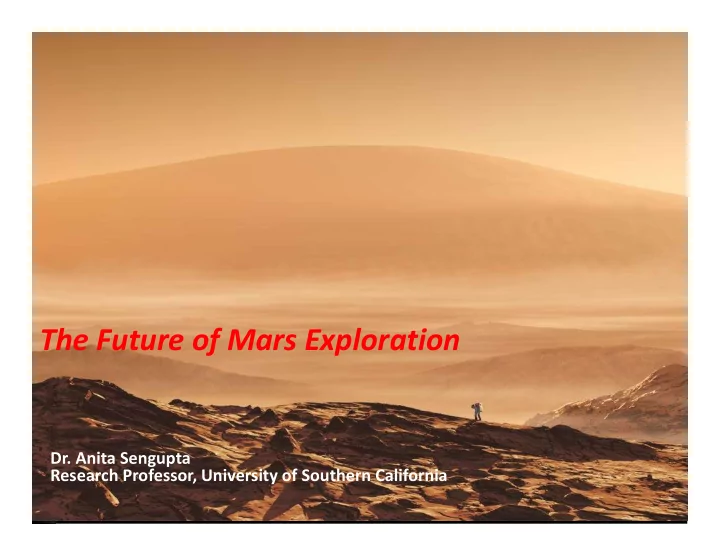
  • Dr. Anita Sengupta

Research Professor, University of Southern California

The Future of Mars Exploration

slide-2
SLIDE 2

How do we land on Mars?

slide-3
SLIDE 3

Why Are We so Interested In Mars?

The Terrestrial Planets Look Very Different, but what about at the beginning of time?

Parameter Mars Earth Distance (AU) 1.4 1 Mass( Earth) 1/10 1 Radius (km) 1/2 1 Gravity (Earth) 1/3 1 Pressure (Earth) 1/100 1 Atmosphere CO2 N2/O2 Temp (F)

  • 120

60 Day (hrs) 24.6 24

slide-4
SLIDE 4

Active Geological History – What Happened?

Olympus Mons Valles Marineres

slide-5
SLIDE 5

Does Mars Have Moons?

slide-6
SLIDE 6

Waters of Mars

  • Large bodies of water once flowed on

the surface

Have We Found Water on Mars?

slide-7
SLIDE 7

Is there Water Flowing on Mars Today?

  • MRO that Mars has wet mud flowing on

the surface

  • Mars is tilted on its axis resulting in

seasonal freezing and thawing

Have We Found Flowing Water on Mars?

slide-8
SLIDE 8

8

Landing on Mars

  • How many times have we landed on mars?
  • 7 times

– Viking Landers (2) – Pathfinder Sojourner – Spirit and Opportunity (2) – Phoenix Lander – Curiosity: Aug 2012 – Next: Insight and Mars 2020

slide-9
SLIDE 9

Learning from Past and Building the Future Evolution of Technology, Complexity and Size

slide-10
SLIDE 10

Did Mars Once Support Life?

  • Biological Potential
  • Geology and

Geochemistry

  • Role of Water
  • Surface Radiation
slide-11
SLIDE 11

Picking a Landing Site: Gale Crater

slide-12
SLIDE 12

150-km Gale Crater contains a 6-km high mound of stratified rock. Strata in the lower section of the mound vary in mineralogy and texture, suggesting that they may have recorded environmental changes over time. Curiosity will investigate this record for clues about habitability, and the ability of Mars to preserve evidence about habitability or life.

  • Mt. Sharp in the middle of Gale

Crater is as tall base-to-peak as Mt. McKinley in Alaska, which is the tallest mountain in North America

Gale Crater Gale Crater Targets a 20 km Landing Ellipse

slide-13
SLIDE 13

Bulls Eye on Mars

slide-14
SLIDE 14

Bulls Eye on WA

slide-15
SLIDE 15

Faster than a bullet 50 times as fast as an airplane

slide-16
SLIDE 16

It’s a Bird, It’s a Plane?

16

slide-17
SLIDE 17

Do We Use Agile? I Googled Agile -> wait for it

slide-18
SLIDE 18

Bulls Eye on Mas

slide-19
SLIDE 19

Parachute Testing (On Earth) More like Agile

slide-20
SLIDE 20

Team Work and Diversity to Solve Engineering Challenges

slide-21
SLIDE 21

The Future: Advanced Power Systems

slide-22
SLIDE 22

ChemCam

(Chemistry)

Mastcam

(Imaging)

REMS

(Weather)

DAN

(Subsurface Hydrogen)

SAM

(Chemistry and Isotopes)

CheMin

(Mineralogy)

MARDI

(Imaging)

APXS

(Chemistry)

MAHLI

(Imaging)

RAD

(Radiation)

Drill Scoop Brush Sieves

Mars Essentials

slide-23
SLIDE 23

What would be your choice

  • f

Science Instruments?

Photon Torpedos of course

slide-24
SLIDE 24

How long does it take to get to Mars?

7 - 9 months November 2011

slide-25
SLIDE 25

Landing Night

slide-26
SLIDE 26

The Future: Terrain Relative Nav

slide-27
SLIDE 27

Curiosity landed in an ancient lake on Mars

slide-28
SLIDE 28

Simulations versus Reality

slide-29
SLIDE 29

Post Landing Assessment

slide-30
SLIDE 30

Autonomous Systems

slide-31
SLIDE 31

Intelligent Systems

Curiosity took a ‘selfie’ made from 55 images taken with camera on its arm.

slide-32
SLIDE 32

Life on Mars?

Curiosity Killed the …..

slide-33
SLIDE 33

Future Landing Site Assessment

slide-34
SLIDE 34

Understanding the Environment

NASA/JPL- Caltech/SwR I

slide-35
SLIDE 35

Key Observables for Landing Site Selection

slide-36
SLIDE 36

What is the Future?

Getting Larger Payloads to the surface

slide-37
SLIDE 37

What is the Future?

Environmental Control Systems

slide-38
SLIDE 38

What is the Future?

Surface Mobility

slide-39
SLIDE 39

In Situ Resource Utilization (ISRU) Power Radiation Protection Water Methane Extremophiles

slide-40
SLIDE 40

Growing Food

slide-41
SLIDE 41

41

Would You Want to Live on Mars?

slide-42
SLIDE 42

The Future is Mars

@Doctor_Astro

  • Engineers and scientists make Mars

exploration a reality

  • Space Agencies from around the

world are going to Mars

  • All data are returned to Earth are

publically available minutes after they arrive because this is our future

http://facebook.com/DrAnitaSengupta

slide-43
SLIDE 43

What is Next After Mars?

slide-44
SLIDE 44

What Does an Aerospace Engineer Do?

Europa the Ice Moon

slide-45
SLIDE 45

Titan

slide-46
SLIDE 46

What Does an Aerospace Engineer Do?

Enceladus

slide-47
SLIDE 47

The Future is Mars

@Doctor_Astro

  • Engineers and scientists make Mars

exploration a reality

  • Space Agencies from around the

world are going to Mars

  • All data are returned to Earth are

publically available minutes after they arrive because this is our future

http://facebook.com/DrAnitaSengupta