The Future of Urban Mobility: Autonomous Vehicles and AI Stewart - - PowerPoint PPT Presentation

the future of urban
SMART_READER_LITE
LIVE PREVIEW

The Future of Urban Mobility: Autonomous Vehicles and AI Stewart - - PowerPoint PPT Presentation

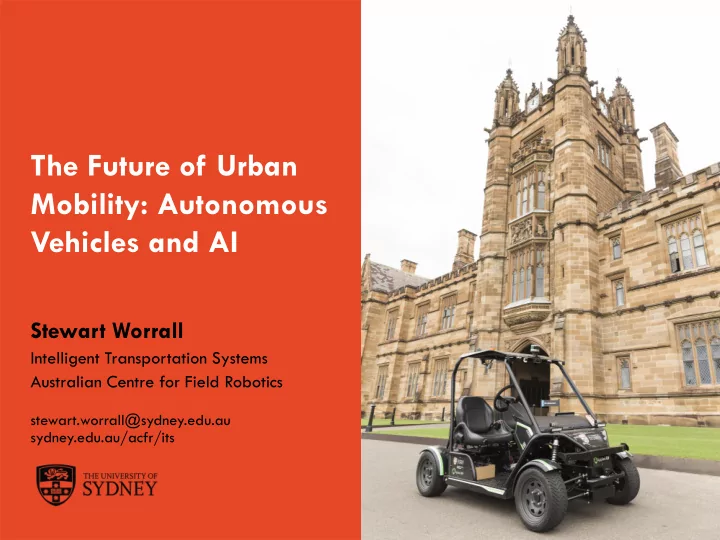
The Future of Urban Mobility: Autonomous Vehicles and AI Stewart Worrall Intelligent Transportation Systems Australian Centre for Field Robotics stewart.worrall@sydney.edu.au sydney.edu.au/acfr/its The University of Sydney Page 1 Imagine

slide-1
SLIDE 1

The University of Sydney Page 1

The Future of Urban Mobility: Autonomous Vehicles and AI

Stewart Worrall

Intelligent Transportation Systems Australian Centre for Field Robotics

stewart.worrall@sydney.edu.au sydney.edu.au/acfr/its

slide-2
SLIDE 2

The University of Sydney Page 2

Imagine the Future – the promise of automation

slide-3
SLIDE 3

The University of Sydney Page 3

Our vision – last mile transport

slide-4
SLIDE 4

The University of Sydney Page 4

University Campus Olympic Park Construction Sites

Precinct scale transport on demand

Retirement Villages

slide-5
SLIDE 5

The University of Sydney Page 5

ACFR-ITS: Connected Autonomous vehicles

slide-6
SLIDE 6

The University of Sydney Page 6

Modular platform design

slide-7
SLIDE 7

The University of Sydney Page 7

How to make an autonomous vehicle

Part 1: Where am I? Where am I going? How do I get there?

slide-8
SLIDE 8

The University of Sydney Page 8

How to make an autonomous vehicle

Part 2: Who/What is around me? Where can I safely move?

Range

slide-9
SLIDE 9

The University of Sydney Page 9

How to make an autonomous vehicle

Part 3: How do things behave? Where is everyone else going?

slide-10
SLIDE 10

The University of Sydney Page 10

How to make an autonomous vehicle

Part 4: Move !..... without hitting anything of course

slide-11
SLIDE 11

The University of Sydney Page 11

Why don't we have autonomous vehicles yet?

uncertainty

in measurement, classification

unpredictability

drivers, pedestrians, cyclists, etc

unobservable

hidden variables (attention, capability, etc) partial obstructions

slide-12
SLIDE 12

The University of Sydney Page 12

Why don't we have autonomous vehicles yet?

Sensor advantages/disadvantages

noise, weather, context, partial observations

slide-13
SLIDE 13

The University of Sydney Page 13

Low dimensional problems

Certain tasks are well understood – Engineering solution: motion model/uncertainty – Robust through sensor fusion – Explainable, testable and verifiable

slide-14
SLIDE 14

The University of Sydney Page 14

High dimensional problems

There are millions of variables in a typical urban scene e.g. behaviour of a pedestrian/driver can be influenced by – Paying attention (or not) – Talking with friends – Old, young, disabled – Drunk/drugged/tired – In a hurry – Local/tourist – Many many more Human brains are good at this Many are not directly observable

slide-15
SLIDE 15

The University of Sydney Page 15

Detecting a child next to the road – context is important

slide-16
SLIDE 16

The University of Sydney Page 16

Predicting the future is hard

The main challenge in autonomous driving is to predict the future Problem 1: Classification of objects is hard and presents uncertainty Problem 2: Predicting what people/objects will do in the future is very hard and presents even more uncertainty Both are very high dimensional problems that have not been solved using traditional approaches

slide-17
SLIDE 17

The University of Sydney Page 17

Data driven approach

Step 1: Record examples of every possible type of object, or scenario Step 2: Select an appropriate machine learning technique Step 3: Training and cross validation Basically, it is a magic black box that is difficult to explain

slide-18
SLIDE 18

The University of Sydney Page 18

CNN: Detecting a vehicle - KITTI benchmark

slide-19
SLIDE 19

The University of Sydney Page 19

CNN: Detecting a pedestrian – KITTI benchmark

slide-20
SLIDE 20

The University of Sydney Page 20

RNN: predicting vehicle trajectories in intersections

Built using 23000 vehicle trajectories The movement of vehicles through an intersection is like a language that as humans we learn to read over many years.

slide-21
SLIDE 21

The University of Sydney Page 21

So this is a solved problem then ?

Edge case scenarios? Explainable? Statistically correct? 90% is hard, 99% is very hard, ..... what is good enough?

slide-22
SLIDE 22

The University of Sydney Page 22

So where from here?

Remember, lives are at stake - people need to sign off on this – Safety drivers – Restricted domains (highways, good weather, low speed) – Slowly introduce new domains – Convince people/insurers/governments/investors

slide-23
SLIDE 23

The University of Sydney Page 23

Thank you!