
SLIDE 1
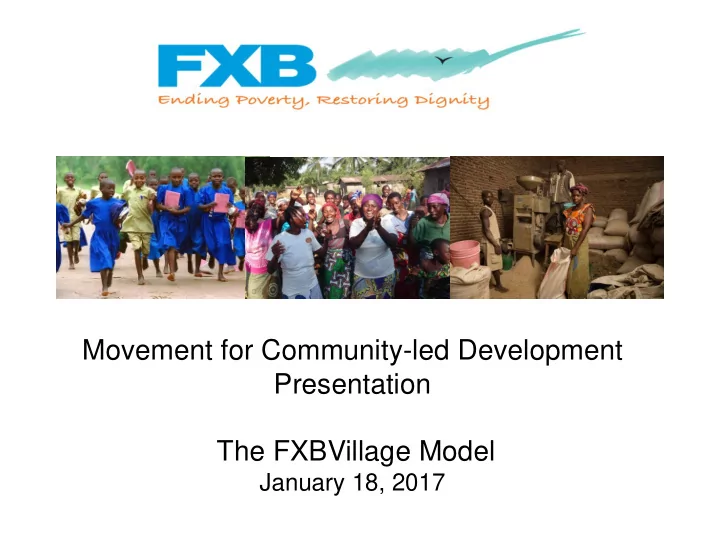
Movement for Community-led Development Presentation The FXBVillage Model
January 18, 2017
The FXBVillage Model January 18, 2017 Who We Are Established in - - PowerPoint PPT Presentation
Movement for Community-led Development Presentation The FXBVillage Model January 18, 2017 Who We Are Established in 1989, FXB is an international development organization which works to create a world where everyone has a chance not just to
January 18, 2017
Established in 1989, FXB is an international development organization which
works to create a world where everyone has a chance not just to survive but to thrive.
Our mission is to provide the poorest of the poor families with the tools and
support they need to become self-sufficient and give their children a future.
Through our FXBVillage Model, we don’t just hand people money. We hand them
a multidimensional solution to permanently escape extreme poverty.
In addition to health, education, and protection programs, FXB currently
implements 16 FXBVillages in Colombia, Burundi, China, India, Mongolia, Rwanda and Uganda.
Image Source: http://www.poverty-action.org/impact/ultra-poor-graduation-model
increase participant’s contribution and involvement
medical and educational expenses during second year and 50% during third year.
the end of the third year
Assessed with vulnerability assessment tool
Assessed through interview with family and discussion with community leaders
Assessed through interview with family and discussion with community leaders
households
Assessed with vulnerability assessment tool
children,
training opportunities, and
FXB builds organizational, community and individual capacities.
implemented in every participant household at the beginning and end of the 3-year FXBVillage Model.
Evaluation data: 90% of the households achieve self-sufficiency by the end
conducted by external partners in order to assess sustainability of impacts (1 year, 2 years, 3 years and/or 4 years after graduation)
Uganda (2014): former FXB beneficiaries were less multidimensionally poor than their peers, even three years after graduation.
participating children enroll, remain and advance in school at higher rates than their peers, and 86% of participating families live above the poverty line four years after the program’s completion.
culmination
compared against national data collected by the Demographic and Health Surveys during the time of the FXB programs, using an asset-based wealth index
household characteristics, food security, economic status, access to education, psychosocial status and well-being.
An assessment of the FXBVillage Program in Uganda and Rwanda
Food security: Health and HIV:
>3 meals/day from 5% to 88% Head of household has been tested for HIV from 77% to 100%
Water and Sanitation: Psychosocial wellbeing among adults:
Improved latrine from 67% to 99% Communal financial support if needed from 27% to 98%
Schooling: Household economics and durable goods:
A positive shift in the distribution of the wealth index from baseline to year 3
Range of asset based wealth index (lowest (left) to highest wealth)
The FXBVillage Model has been recognized by both UNAIDS (2002) and UNICEF (2008) as a best practice.
Component Description Health Basic hygiene training and education (e.g. latrines, water supply, hygiene materials and use, family planning), HIV/AIDS prevention and treatment, up to 100% support for all health-related expenses during the first year, 75% during the second year and 50% the third year, referrals to health centers and clinics, and distribution of mosquito bed nets Nutrition In-kind nutritional support for 9 to 12 months during the first year. Nutrition/diet
“Biochar – Agricultural Innovative Program,”enabling 80 families and 1,200 farmers to ensure their food security, increase their yields and productivity while simultaneously offsetting carbon emissions. Housing FXB provides material to rehabilitate or reconstruct houses on an as-needed
Additionally, FXB trains participants on various skills including creating dish racks for drying, constructing stables for livestock, utilizing hand washing stations, improved kiln for cooking, and the benefits of maintaining a clean home.
Component Description Economic Empowerment Each family received an in-kind grant worth $120-160 USD. In-kind grants are distributed in two or three installments during the first year
groups of 8 to 12 people. Through these associations, members engage in collective weekly savings. Then, they establish collective IGAs in order to generate more income and to further increase group savings. Technical skills training Training on topics such as financial literacy, management, microcredit, income diversification, banking, agriculture, kitchen gardening, establishing a cooperative, and Village Savings and Loans Groups. Savings Once enrolled, families must open a bank account to begin saving. Participants are encouraged to save a portion of their income to cope with unexpected economic shocks. Savings are also established through beneficiary groups in which all heads of household are enrolled.
Component Description Education The program identifies and re-enrolls all school-aged children, pays up to 100% of all school-related costs (including fees, uniforms and other materials) during the first year, 75% during the second year and 50% the third year, closely monitors the children’s academic performance, and psychosocial
are enrolled in vocational trainings Psychosocial support Psychosocial support sessions are held in groups and on a one-on-one basis to encourage participants to seek assistance as required Lifeskills Coaching Throughout the FXBVillage program, trainings are provided on a wide range
children’s rights, early childhood development, water treatment, family planning, and environmental conservation. Home visits These are conducted weekly during the first 2 years, and bi-weekly or monthly during the third year in order to monitor participants’ economic and social development