
SLIDE 1
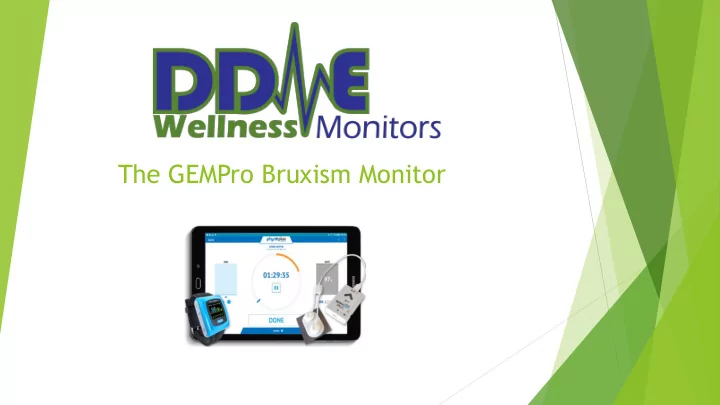
The GEMPro Bruxism Monitor DDMEs GEMPro Dentists Dilemma Sleep - - PowerPoint PPT Presentation
The GEMPro Bruxism Monitor DDMEs GEMPro Dentists Dilemma Sleep apnea is a medical disease and cannot be diagnosed by a dentist. However, tooth wear may be a result of sleep apnea. Dentists concerned about excessive tooth wear cannot
Dentist’s Dilemma
Sleep apnea is a medical disease and cannot be diagnosed by a dentist. However,
tooth wear may be a result of sleep apnea. Dentists concerned about excessive tooth wear cannot ignore airway disturbances much like dentists should not ignore a suspicious lesion under the tongue. The GEMPro was developed to quantify the severity of parafunctional activity and give dentists enough information about airway disturbances to refer/resolve the patient correctly, minimizing potential tooth wear.
“Dentists are encouraged to screen for airway issues” 2017
Major Dental Companies recognize the contribution of the GEMPro and have elected to distribute:
Glidewell, Great Lakes, Whip Mix, Sleep Group Solutions
1.
Bruxism – Presence and severity are NOT being diagnosed – (GEMPro does)
2.
Occlusal Guards, based on published data, create unintended medical issues (GEMPro detects)
3.
In many cases, bruxism causes can be identified leading to a differentiated treatment protocol (GEMPro does)
4.
Restoration’s longevity can be improved by managing Bruxism related overloading (GEMPro helps)
5.
20-30% of all dental office adult patients have untreated airway issues which likely will result in excessive tooth wear (GEMPro can detect)
GEMPro’s Unique EMG Calibration Establishes 2 Vectors of Evaluation
Frequency – How many and what type of parafunction Magnitude – How strong is the parafunction
Calibration Graph: Documents Strongest Waking Bite Force
Waking Maximum Force Sleeping Maximum Force
Waking Maximum Force Sleeping Maximum Force
Any appliance placed in the oral cavity may change tongue and tissue locations Independent research has validated changes in Sleep Apnea with Occlusal guards Occlusal guards will help one of these patients and potentially hurt the other The GEMPro answers these issues
Distinguish Between Airway Triggered Parafunction and Bruxism
The one they will wear instead of sitting on the night stand
1. 2.
The #1 Complication for Restoration Protection is Lack of Compliance
Description Code Occlusal Guard (bruxism-grinding) D9951 Limited (equilibration) Occlusal Guard (bruxism-grinding) D9952 Complete (equilibration) Occlusal Guard Adjustment D9943 Occlusal Orthotic – Reduce Bruxism D7880 Reduction\Dislocation Occlusal Orthotic Device Adjustment D7881 Sleep Apnea Appliance E0486 DME-Medical Diagnostic Cast (impression) D0470
Oxygen desaturations alone do not diagnose OSA However, OSA cannot exist without oxygen desaturations Dental patients testing positive for oxygen desaturations with the
GEMPro need to have follow up
Purchase a Home Sleep Monitor + DDME Sleep Physician GEMPro owners can refer their patients to DDME
DDME provides the Home Sleep Monitor DDME’s Physicians provide a patient diagnosis for the dentist This service is part of DDME’s Customer Service package
Refer to a sleep lab
Does the patient show signs of excessive Tooth Wear or Bruxism?
Yes – We have a new test that is performed at your home through the night. This test will give me information as to the cause of this tooth wear and allow me to give you the appropriate treatment protocol to protect your teeth. (approximately 50% of adult patients will test positive for potential airway disfunction and the dentist may intervene and positively improved the patients overall health and dentition)
No – Although you have no signs of excessive tooth wear at this time, we would like to screen you for the
to insure your teeth stay healthy (approximately 20% of adult patients will test positive for potential excessive tooth wear and the dentist may intervene and positively improve the patients overall health and dentition before damage begins to occur)
Benefits to the patient:
Patient’s dentist can differentiate between dental issues and potential medical issues Medical issues have large potential consequences if undetected and treated; cardiac disease, diabetes, depression,
weight gain, cancer. The dentist may positively impact the overall health of their patient.
Patients gain information about their own sleep wellness, a subject that is in the news and generates significant
Method of discussing with patient
your jaw muscles can fire at several times the magnitude you can make them fire when you are awake. This can be very destructive to your teeth. I would like to do a simple test on you to see if you are having this problem. With this test you and I will learn if your teeth are in danger of excessive wear or damage and if so, is it because of you snoring or stopping breathing at night, or is it caused by stress or other factors in your life. With this information, I can do the appropriate treatment protocol to protect your beautiful
blood oxygen levels are compromised. If so this is a serious medical problem we will discuss, This graph tells me if your are clenching or grinding your teeth at night and how often and how hard. We have therapies that can protect your teeth if necessary. This graph tells me if you snore at night and how much and how loud. If you do we can address that condition also. The test is (FREE OR $50 OR $89) and very easy to do. Would it be ok if my staff shows what you need to do and sets you up with a night study?
Patients with both Significant Parafunction and Oxygen Desaturations
If Oxygen Desaturations are significant (non artifact minimums under 85%, significant time under 88%), the patient should be referred/diagnosed for Sleep Apnea by a Sleep Physician. After treatment for Sleep Apnea (CPAP or Oral Sleep Appliance), retest to assure significant parafunctional activity does not exist. In many cases, the parafunctional activity will be minimized when Sleep Apnea is treated.
Dentition should be protected when significant number of events above 75% Maximum Waking Bite Force are present. An occlusal splint is suggested if Oxygen Desaturations are not
instruct patient and sleep lab that significant parafunctional activity is present. After treatment for Sleep Apnea (either CPAP or Oral Sleep Appliance), the patient should be retested while wearing therapy for the continued presence of significant parafunctional activity.
Patients with Significant Parafunction and no significant Oxygen Desaturations
Dentition should be protected when significant events above 75% Maximum Waking Bite Force are present. An occlusal splint is suggested if Oxygen Desaturations are not significant. Occlusal Splints have been shown to both worsen and improve oxygen desaturations. After administering the appropriate tooth protection strategy, retest for Oxygen Desaturations. If the Occlusal Splint created Oxygen Desaturations, refer/diagnose patients, noting to the diagnosing physician, the patient dentition should be protected. A different appliance selection might need to be made.
Whatever the results from the GEMPro, the dentist has intervened in determining if the Dentition is being subjected to damaging forces and if the overall health of the patient is potentially being compromised by an airway disfunction
Patient Experience
Patient enters 4 digit code to start Only 2 sensors, a wrist watch and
finger probe, EMG lead on cheek
Report may be emailed to dentist
automatically in the morning or saved until the device is returned
Report is color coded to body
position and shows Oxygen Saturation, Heart Rate, Parafunction of Masseter, and Snore
Two Bluetooth devices and tablet
GEMPro’s purchase price is $1900.00 Cost per test is an EMG sensor, 50 sensors in a bag for $40/bag Finger probe is reusable and cleaned with an alcohol swab between tests DDME’s Optional Service Contract is $420/year
Unlimited technical and clinical support Extended warranty for 1 year on all failures of devices Retraining of Clinical Staff Insurance on device if lost or stolen. All devices and case (except tablet) replaced
with a $250 deductible. Tablet can be purchased from DDME or retail outlets.
Access to DDME’s Sleep Apnea Home test device if a medical diagnosis from a
licensed Medical Sleep Physician is desired, $250/patient, DDME manages the patient ($200 discount)
National exposure of this new technology device is growing
Glidewell, Spear Group, Great Lakes, Dr. Christensen are performing seminars
promoting GEMPro’s
Glidewell, Great Lakes, Whip Mix and SGS are distributing the devices from
seminars
DDME is creating a social media program, advertising, and video access programs
DDME wishes to partner with grass roots dental groups such as study clubs and
reginal meetings.