The Geometry of Least Squares Mathematical Basics Inner / dot - - PowerPoint PPT Presentation

the geometry of least squares
SMART_READER_LITE
LIVE PREVIEW

The Geometry of Least Squares Mathematical Basics Inner / dot - - PowerPoint PPT Presentation

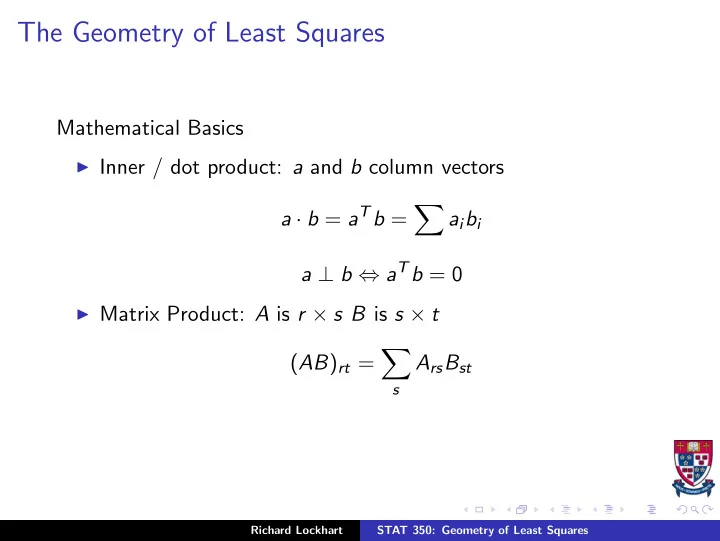
The Geometry of Least Squares Mathematical Basics Inner / dot product: a and b column vectors a b = a T b = a i b i a b a T b = 0 Matrix Product: A is r s B is s t ( AB ) rt = A rs B st s Richard Lockhart STAT


slide-1
SLIDE 1

The Geometry of Least Squares

Mathematical Basics

◮ Inner / dot product: a and b column vectors

a · b = aTb =

  • aibi

a ⊥ b ⇔ aTb = 0

◮ Matrix Product: A is r × s B is s × t

(AB)rt =

  • s

ArsBst

Richard Lockhart STAT 350: Geometry of Least Squares

slide-2
SLIDE 2

Partitioned Matrices

◮ Partitioned matrices are like ordinary matrices but the entries

are matrices themselves.

◮ They add and multiply (if the dimensions match properly) just

like regular matrices but(!) you must remember that matrix multiplication is not commutative.

◮ Here is an example

A = A11 A12 A13 A21 A22 A23

  • B =

  B11 B12 B21 B22 B31 B32  

Richard Lockhart STAT 350: Geometry of Least Squares

slide-3
SLIDE 3

◮ Think of A as a 2 × 3 matrix and B as a 3 × 2 matrix. ◮ multiply them to get C = AB a 2 × 2 matrix as follows:

AB = A11B11 + A12B21 + A13B31 A11B12 + A12B22 + A13B32 A21B11 + A22B21 + A23B31 A21B12 + A22B22 + A23B32

  • ◮ BUT: this only works if each of the matrix products in the

formulas makes sense.

◮ So, A11 must have the same number of columns as B11 has

rows and many other similar restrictions apply.

Richard Lockhart STAT 350: Geometry of Least Squares

slide-4
SLIDE 4

First application: X = [X1|X2| · · · |Xp] where each Xi is a column of X. Then Xβ = [X1|X2| · · · |Xp]    β1 . . . βp    = X1β1 + X2β2 + · · · + Xpβp which is a linear combination of the columns of X. Definition: The column space of X, written col(X) is the (vector space of) set of all linear combinations of columns of X also called the space “spanned” by the columns of X. SO: ˆ µ = Xβ is in col(X).

Richard Lockhart STAT 350: Geometry of Least Squares

slide-5
SLIDE 5

Back to normal equations: X TY = X TX ˆ β

  • r

X T Y − X ˆ β

  • = 0
  • r

   X T

1

. . . X T

p

  

  • Y − X ˆ

β

  • = 0
  • r

X T

i

  • Y − X ˆ

β

  • = 0

i = 1, . . . , p

  • r

Y − X ˆ β ⊥ every vector in col(X)

Richard Lockhart STAT 350: Geometry of Least Squares

slide-6
SLIDE 6

Definition: ˆ ǫ = Y − X ˆ β is the fitted residual vector. SO: ˆ ǫ ⊥ col(X) and ˆ ǫ ⊥ ˆ µ Pythagoras’ Theorem: If a ⊥ b then ||a||2 + ||b||2 = ||a + b||2 Definition: ||a|| is the “length” or “norm” of a: ||a|| =

  • a2

i =

√ aTa Moreover, if a, b, c, . . . are all perpendicular then ||a||2 + ||b||2 + · · · = ||a + b + · · · ||2

Richard Lockhart STAT 350: Geometry of Least Squares

slide-7
SLIDE 7

Application

Y = Y − X ˆ β + X ˆ β = ˆ ǫ + ˆ µ so ||Y ||2 = ||ˆ ǫ||2 + ||ˆ µ||2

  • r
  • Y 2

i =

  • ˆ

ǫ2

i +

  • ˆ

µ2

i

Definitions:

  • Y 2

i = Total Sum of Squares (unadjusted)

  • ˆ

ǫ2

i = Error or Residual Sum of Squares

  • ˆ

µ2

i = Regression Sum of Squares

Richard Lockhart STAT 350: Geometry of Least Squares

slide-8
SLIDE 8

Alternative formulas for the Regression SS

  • ˆ

µ2

i = ˆ

µT ˆ µ = (X ˆ β)T(X ˆ β) = ˆ βT X TX ˆ β Notice the matrix identity which I will use regularly: (AB)T = BTAT.

Richard Lockhart STAT 350: Geometry of Least Squares

slide-9
SLIDE 9

What is least squares?

Choose ˆ β to minimize

  • (Yi − ˆ

µi)2 = ||Y − ˆ µ||2 That is, to minimize ||ˆ ǫ||2. The resulting ˆ µ is called the Orthogonal Projection of Y onto the column space of X. Extension: X = [X1|X2] β = β1 β2

  • p = p1 + p2

Imagine we fit 2 models:

  • 1. The FULL model:

Y = Xβ + ǫ(= X1β1 + X2β2 + ǫ)

  • 2. The REDUCED model:

Y = X1β1 + ǫ

Richard Lockhart STAT 350: Geometry of Least Squares

slide-10
SLIDE 10

If we fit the full model we get ˆ βF ˆ µF ˆ ǫF ˆ ǫF ⊥ col(X) (1) If we fit the reduced model we get ˆ βR ˆ µR ˆ ǫR ˆ µR ∈ col(X1) ⊂ col(X) (2) Notice that ˆ ǫF ⊥ ˆ µR . (3) (The vector ˆ µR is in the column space of X1 so it is in the column space of X and ˆ ǫF is orthogonal to everything in the column space of X.) So: Y = ˆ ǫF + ˆ µF = ˆ ǫF + ˆ µR + (ˆ µF − ˆ µR) = ǫR + ˆ µR

Richard Lockhart STAT 350: Geometry of Least Squares

slide-11
SLIDE 11

You know ˆ ǫF ⊥ ˆ µR (from (3) above) and ˆ ǫF ⊥ ˆ µF (from (1) above). So ˆ ǫF ⊥ ˆ µF − ˆ µR Also ˆ µR ⊥ ˆ ǫR = ˆ ǫF + (ˆ µF − ˆ µR) So 0 = (ˆ ǫF + ˆ µF − ˆ µR)T ˆ µR = ˆ ǫT

F ˆ

µR +(ˆ µF − ˆ µR)T ˆ µR so ˆ µF − ˆ µR ⊥ ˆ µR

Richard Lockhart STAT 350: Geometry of Least Squares

slide-12
SLIDE 12

Summary

We have Y = ˆ µR + (ˆ µF − ˆ µR) + ˆ ǫF All three vectors on the Right Hand Side are perpendicular to each

  • ther.

This gives: ||Y ||2 = ||ˆ µR||2 + ||ˆ µF − ˆ µR||2 + ||ˆ ǫF||2 which is an Analysis of Variance (ANOVA) table!

Richard Lockhart STAT 350: Geometry of Least Squares

slide-13
SLIDE 13

Here is the most basic version of the above: X = [1|X1] Yi = β0 + · · · + ǫi The notation here is that 1 =    1 . . . 1    is a column vector with all entries equal to 1. The coefficient of this column, β0, is called the “intercept” term in the model.

Richard Lockhart STAT 350: Geometry of Least Squares

slide-14
SLIDE 14

To find ˆ µR we minimize

  • (Yi − ˆ

β0)2 and get simply ˆ β0 = ¯ Y and ˆ µR =    ¯ Y . . . ¯ Y    Our ANOVA identity is now ||Y ||2 = ||ˆ µR||2 + ||ˆ µF − ˆ µR||2 + ||ˆ ǫF||2 = n ¯ Y 2 + ||ˆ µF − ˆ µR||2 + ||ˆ ǫF||2

Richard Lockhart STAT 350: Geometry of Least Squares

slide-15
SLIDE 15

This identity is usually rewritten in subtracted form: ||Y ||2 − n ¯ Y 2 = ||ˆ µF − ˆ µR||2 + ||ˆ ǫF||2 Remembering the identity (Yi − ¯ Y )2 = Y 2

i − n ¯

Y 2 we find

  • (Yi − ¯

Y )2 =

µF,i − ¯ Y )2 +

  • ˆ

ǫ2

F,i

These terms are respectively:

◮ the Adjusted or Corrected Total Sum of Squares, ◮ the Regression or Model Sum of Squares and ◮ the Error Sum of Squares.

Richard Lockhart STAT 350: Geometry of Least Squares

slide-16
SLIDE 16

Simple Linear Regression

◮ Filled Gas tank 107 times. ◮ Record distance since last fill, gas needed to fill. ◮ Question for discussion: natural model? ◮ Look at JMP analysis.

Richard Lockhart STAT 350: Geometry of Least Squares

slide-17
SLIDE 17

The sum of squares decomposition in one example

◮ Example discussed in Introduction. ◮ Consider model

Yij = µ + αi + ǫij with α4 = −(α1 + α2 + α3).

◮ Data consist of blood coagulation times for 24 animals fed

  • ne of 4 different diets.

◮ Now I write the data in a table and decompose the table into

a sum of several tables.

◮ The 4 columns of the table correspond to Diets A, B, C and

D.

◮ You should think of the entries in each table as being stacked

up into a column vector, but the tables save space.

Richard Lockhart STAT 350: Geometry of Least Squares

slide-18
SLIDE 18

◮ The design matrix can be partitioned into a column of 1s and

3 other columns.

◮ You should compute the product X TX and get

    24 −4 −2 −2 −4 12 8 8 −2 8 14 8 −2 8 8 14    

◮ The matrix X TY is just

 

ij

Yij ,

  • j

Y1j −

  • j

Y4j ,

  • j

Y2j −

  • j

Y4j ,

  • j

Y3j −

  • j

Y4j  

Richard Lockhart STAT 350: Geometry of Least Squares

slide-19
SLIDE 19

◮ The matrix X TX can be inverted using a program like Maple. ◮ I found that

384(X T X)−1 =     17 7 −1 −1 7 65 −23 −23 −1 −23 49 −15 −1 −23 −15 49    

◮ It now takes quite a bit of algebra to verify that the vector of

fitted values can be computed by simply averaging the data in each column.

Richard Lockhart STAT 350: Geometry of Least Squares

slide-20
SLIDE 20

That is, the fitted value, ˆ µ is the table             61 66 68 61 61 66 68 61 61 66 68 61 61 66 68 61 66 68 61 66 68 61 61 61            

Richard Lockhart STAT 350: Geometry of Least Squares

slide-21
SLIDE 21

On the other hand fitting the model with a design matrix consisting only of a column of 1s just leads to ˆ µR (notation from the lecture) given by             64 64 64 64 64 64 64 64 64 64 64 64 64 64 64 64 64 64 64 64 64 64 64 64            

Richard Lockhart STAT 350: Geometry of Least Squares

slide-22
SLIDE 22

Earlier I gave identity: Y = ˆ µR + (ˆ µF − ˆ µR) + ˆ ǫF which corresponds to the following identity:

2 6 6 6 6 6 6 6 6 6 4 62 63 68 56 60 67 66 62 63 71 71 60 59 64 67 61 65 68 63 66 68 64 63 59 3 7 7 7 7 7 7 7 7 7 5 = 2 6 6 6 6 6 6 6 6 6 4 64 64 64 64 64 64 64 64 64 64 64 64 64 64 64 64 64 64 64 64 64 64 64 64 3 7 7 7 7 7 7 7 7 7 5 + 2 6 6 6 6 6 6 6 6 6 4 −3 2 4 −3 −3 2 4 −3 −3 2 4 −3 −3 2 4 −3 2 4 −3 2 4 −3 −3 −3 3 7 7 7 7 7 7 7 7 7 5 + 2 6 6 6 6 6 6 6 6 6 4 1 −3 −5 −1 1 −2 1 2 5 3 −1 −2 −2 −1 −1 2 3 2 −2 3 7 7 7 7 7 7 7 7 7 5 Richard Lockhart STAT 350: Geometry of Least Squares

slide-23
SLIDE 23

Pythagoras identity: ANOVA

◮ The sums of squares of the entries of each of these arrays are

as follows.

◮ Uncorrected total sum of squares: On the left hand side

622 + 632 + · · · = 98644.

◮ The first term on the right hand side gives 24(642) = 98304. ◮ This term is sometimes put in ANOVA tables as the Sum of

Squares due to the Grand Mean.

◮ But it is usually subtracted from the total to produce the

Total Sum of Squares which we usually put at the bottom of the table

◮ This is often called the Corrected (or Adjusted) Total Sum of

Squares.

Richard Lockhart STAT 350: Geometry of Least Squares

slide-24
SLIDE 24

In this case the corrected sum of squares is the squared length of the table             −2 −1 4 −8 −4 3 2 −2 −1 7 7 −4 −5 3 −3 1 4 −1 2 4 −1 −5             which is 340.

Richard Lockhart STAT 350: Geometry of Least Squares

slide-25
SLIDE 25

◮ Treatment Sum of Squares: The second term on the right

hand side of the equation has squared length 4(−3)2 + 6(2)2 + 6(4)2 + 8(−3)2 = 228.

◮ The formula for this Sum of Squares is I

  • i=1

ni

  • j=1

( ¯ Xi· − ¯ X··)2 =

I

  • i=1

ni( ¯ Xi· − ¯ X··)2

◮ but I want you to see that the formula is just the squared

length of the vector of individual sample means minus the grand mean.

◮ The last vector of the decomposition is called the residual

vector.

◮ It has squared length 12 + (−3)2 + 02 + · · · = 112.

Richard Lockhart STAT 350: Geometry of Least Squares

slide-26
SLIDE 26

Degrees of freedom: dimensions of spaces

◮ Corresponding to the decomposition of the total squared

length of the data vector is a decomposition of its dimension, 24, into the dimensions of subspaces.

◮ For instance the grand mean is always a multiple of the single

vector all of whose entries are 1;

◮ this describes a one dimensional space ◮ this is just another way of saying that the reduced ˆ

µR is in the column space of the reduced model design matrix.

◮ The second vector, of deviations from a grand mean lies in the

three dimensional subspace of tables which are constant in each column and have a total equal to 0.

◮ Similarly the vector of residuals lies in a 20 dimensional

subspace – the set of all tables whose columns sum to 0.

Richard Lockhart STAT 350: Geometry of Least Squares

slide-27
SLIDE 27

Degrees of Freedom

◮ This decomposition of dimensions is the decomposition of

degrees of freedom.

◮ So 24 = 1 + 3 + 20 and the degrees of freedom for treatment

and error are 3 and 20 respectively.

◮ The vector whose squared length is the Corrected Total Sum

  • f Squares lies in the 23 dimensional subspace of vectors

whose entries sum to 1.

◮ This produces the 23 total degrees of freedom in the usual

ANOVA table.

Richard Lockhart STAT 350: Geometry of Least Squares