SLIDE 1
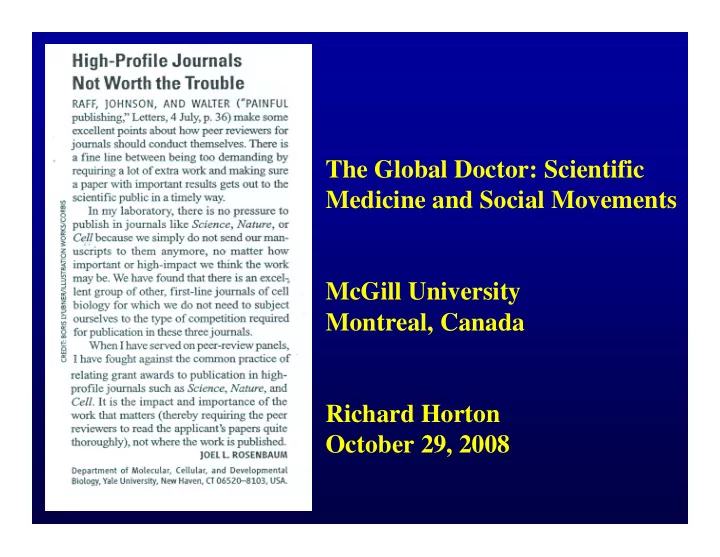
The Global Doctor: Scientific Medicine and Social Movements McGill University Montreal, Canada Richard Horton October 29, 2008
SLIDE 2 In the beginning…
“To Colonial Practitioners”! “…a correct description of all the important cases that may occur, whether in England or on any part
- f the civilised Continent.”
SLIDE 3
A revolution in knowledge
SLIDE 4
- Science is a catalyst for
policy change
deliver global impact
- Doctors can trigger social
action
- Doctors can be leaders of
political as well as clinical change
SLIDE 5 MDGs
- 1. Eradicate poverty
- 2. Achieve universal education
- 3. Promote gender equality
- 4. Reduce child mortality
- 5. Improve maternal health
- 6. Combat HIV, malaria, TB
- 7. Ensure environmental
sustainability
- 8. Develop global partnerships
SLIDE 6 Global Development Organisation
What does globalisation mean to medicine? “To advocate for global action on human development; to be the lead scientific and technical agency for development; to co-ordinate bilateral and multilateral development programmes; and to set standards for development work.”
Lancet 2002; 360: 582-83
- Sustainable human development
- MDGs
- Collect evidence
- Build institutions
- Create partnerships
- Disseminate information
- Promote research
- Strengthen information capacity
SLIDE 7
MDG 4 MDG 5 Reduce child mortality Improve maternal health
Reduce under 5 mortality rate Reduce maternal mortality ratio by by two-thirds (1990-2015) three-quarters (1990-2015) Achieve, by 2015, universal access to reproductive health
SLIDE 8 Child survival: science, advocacy, and a call to action
“We, a group of concerned scientists and public-health managers, call
- n: WHO, UNICEF, the World
Bank, the UNDP, and their other UN partners to act on behalf of children by putting child survival at the top of their list of priorities.”
Lancet 2003; 362: 323-27
SLIDE 9 The result?
Countdown 2005 Newborn health
- Profile
- Policy
- Partnership
- Financial support
- Programme monitoring
Lawn JE et al Lancet 2006; 367: 1541-47
SLIDE 10
SLIDE 11
SLIDE 12
SLIDE 13
SLIDE 14
SLIDE 15
Maternal and child undernutrition
SLIDE 16
SLIDE 17
SLIDE 18
SLIDE 19 Strategic partnerships
- Ministerial Summit on Health Research
- Global Forum for Health Research
- Mexico: Nov 2004
SLIDE 20
SLIDE 21
SLIDE 22
SLIDE 23
September 25, 2008, UNGA, NY
SLIDE 24
SLIDE 25
SLIDE 26
SLIDE 27
SLIDE 28
SLIDE 29
SLIDE 30
SLIDE 31
SLIDE 32
SLIDE 33 Global science for global policy
- Chronic disease (2005, 2007)
- Indigenous health (2006)
- Energy and health (2007)
- Health and human rights (2007)
- HIV prevention (2008)
Pipeline: 8 global health reports in progress (2008-2009)
SLIDE 34
SLIDE 35
SLIDE 36
SLIDE 37
SLIDE 38 Call to Action
- WHO
- World Bank
- Countries
- NGOs
- Food and drinks industry
- Pharmaceutical industry
- Civil society
- Academic community
SLIDE 39
WHO: Getting political
SLIDE 40 Energy and climate change
- Climate change is a critical planetary
issue
- It is part of a larger challenge: energy
equity
- Health is a neglected aspect of energy
1.6 billion people are exposed to adverse health risks because of lack of access to electricity
Wilkinson P. et al Lancet 2007; 370: 117-87.
SLIDE 41
Future reports: 2008-09
Right to health India Trade Pakistan Malaria South Africa Cancer Palestine
SLIDE 42 Mental health
- 1. No health without mental health
- 2. Resource scarcity, inequity, inefficiency
- 3. Treatment evidence
- 4. Mental health systems
- 5. Barriers to change
- 6. Call to Action
Partners: MacArthur Foundation; KCL; WHO; LSHTM Lancet Mental Health Steering Group
SLIDE 43
SLIDE 44
“And fast by hanging in a golden chain This pendent world…”
SLIDE 45