The Guaranty Building: The Restoration of a Terra Cotta Landmark - - PowerPoint PPT Presentation

the guaranty building the restoration of a terra cotta
SMART_READER_LITE
LIVE PREVIEW

The Guaranty Building: The Restoration of a Terra Cotta Landmark - - PowerPoint PPT Presentation

The Guaranty Building: The Restoration of a Terra Cotta Landmark Photo by Jim Cavanaugh Student Scholar: Jon Sargent Savannah College of Art and Design Candidate, Masters of Historic Preservation Overview I. Building Details II.


slide-1
SLIDE 1

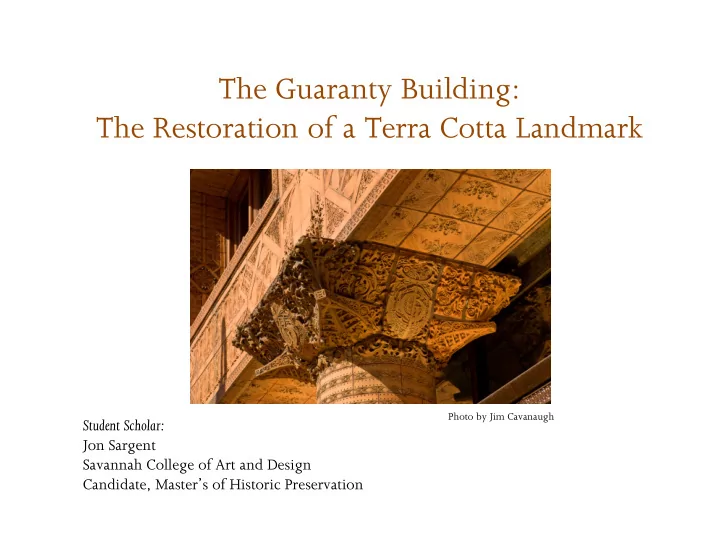
The Guaranty Building: The Restoration of a Terra Cotta Landmark

Student Scholar: Jon Sargent Savannah College of Art and Design Candidate, Master’s of Historic Preservation

Photo by Jim Cavanaugh
slide-2
SLIDE 2

Overview

  • I. Building Details
  • II. Restoration Details
  • III. Contributing Factors to Terra Cotta’s Survival:

Original Design

  • a. Building Siting
  • b. Unglazed Terra Cotta
  • c. Anchoring System
  • d. Recessed Window System
  • IV. Contributing Factors to Terra Cotta’s Survival:

Restoration a. Crack, Surface and Joint Repair b. Corrosion Prevention

  • c. Material Matching
  • V. Conclusion

Photo by Jim Cavanaugh

slide-3
SLIDE 3

Building Details

  • Pinnacle of Louis Sullivan’s work
  • Early steel skyscraper
  • Downtown Buffalo
  • Constructed 1896

(Prudential Building)

  • 13 stories
  • Northwestern Terra Cotta Co., Chicago
  • 1974 – Fire (30% occupancy

pre-fire/15% post-fire)

  • 1975 - NHL Designation
slide-4
SLIDE 4

Restoration Details: 1980

1980: Initial Restoration

  • Cannon Design
  • Scope of work:

– Replacement of all windows – Restoration of terra cotta at lower two floors – 60-80 locations of tile repair/ replacement – Cleaning of façade

Photo by Pat Bazelon Photo by Pat Bazelon

slide-5
SLIDE 5

1980 Restoration

  • Complete cleaning of two facades

– Prosoco masonry cleaner – Pressure wash (750-1000 psi), bristle brushes

Photo by Pat Bazelon Photo by Pat Bazelon Photo by Jon Sargent

slide-6
SLIDE 6

Restoration Details: 2002

2002: Second Restoration

  • Hodgson Russ purchases building

and funds restoration

  • Flynn Battaglia Architects
  • Swing staging used for window

and minor cornice repairs

Photo by Michael Lennon, Flynn Battaglia Architects Photo by Michael Lennon, Flynn Battaglia Architects

slide-7
SLIDE 7

Restoration Details: 2007-2010

2007-2010: Third Restoration

  • Flynn Battaglia Architects
  • Morris Masonry Restoration, LLC
  • Details:

– Mast climbing scaffold tower anchored to building – Nearly all replacement tiles occurred at floor level where water infiltration had

  • ccurred

– Petrographic testing in some cases to match makeup of mortar – Popped tiles at column due to rust jacking – Repairs to terra cotta at first two floors

Photo by Michael Lennon, Flynn Battaglia Architects

slide-8
SLIDE 8

Factors for Terra Cotta Survival: Original Design

  • Building siting
  • Nature of unglazed terra cotta
  • Successful anchoring system
  • Recessed window system

Photo by Michael Lennon, Flynn Battaglia Architects

slide-9
SLIDE 9

Building Siting

  • Decorative facades facing

North and East – Lee side of prevailing winds – Protection from elements coming off of Lake Erie

  • Focus on city rather than lake

1849 Map of Buffalo, www.buffaloresearch.com

slide-10
SLIDE 10

Unglazed Terra Cotta

  • Manufactured in Chicago

– Northwestern Terra Cotta known as quality supplier with 500 employees at that time

  • Unglazed 4” terra cotta tiles
  • Building allowed to breathe, similar to

brick construction

  • Material worked hand-in-hand with

surrounding mortar

Photo by Jon Sargent

slide-11
SLIDE 11

Anchoring Systems

  • Primarily built-in masonry with outrigger elements (Transitional phase)

– Mortar packed tight (8 inch thick typical) – Surrounded steel angles and j-hooks – Steel cramps welded back to steel at cornice, tiles notched to sit on flange of I-beam

Tile failure at steel outrigger prior to 2007 restoration

Photo by Michael Lennon, Flynn Battaglia Architects

Damaged tiles showing built-in masonry attachment

Photo by Michael Lennon, Flynn Battaglia Architects

slide-12
SLIDE 12

Built-in Masonry Steel J-Hooks

Elements from Typical Terra Cotta Applications

Anchoring Systems

Photos care of Jeff Morris, Morris Masonry Restoration, LLP

slide-13
SLIDE 13

Recessed Window System

  • 8” setback at windows
  • Originally painted yellow pine
  • Replaced with mahogany sash

with thermal glass in 1980

  • Lion’s head gargoyles to divert

water at cornice windows

Photo by Michael Lennon, Flynn Battaglia Architects Photo by Mary Ann Sullivan Photo by Sarah Reid, Flynn Battaglia Architects

slide-14
SLIDE 14

Factors for Terra Cotta Survival: Restoration

  • Crack, surface and joint repair
  • Corrosion prevention
  • Material matching

Photo by Jim Cavanaugh Photo by Pat Bazelon

slide-15
SLIDE 15

Crack, Surface, and Joint Repair

  • Hairline cracks at nearly all steel columns

– No structural concerns – Significant cracks: Silicone injection with color match

  • Surface rust at columns and cornice

Photos by Michael Lennon, Flynn Battaglia Architects

slide-16
SLIDE 16

Crack, Surface, and Joint Repair

  • Removal of past joint treatments

– Urethane used in joints at 12th and 13th floor in 1960s – Alligatored surface/ flowing out of joints

  • Original: Local mortar with classic 1:1:6 ratio
  • Restoration: Jahn mortar

– Different colors used depending on surrounding tiles – 200 areas of application (none larger than 6”)

Photo by Michael Lennon, Flynn Battaglia Architects

slide-17
SLIDE 17

Corrosion Prevention

  • Tile failures at cornice and column surround both linked to rust jacking

– Steel cramps primary culprit at cornice

  • Steel exposed by failed tiles painted with zinc-rich primer
  • Cramps replaced with stainless steel counterparts

Photo by Michael Lennon, Flynn Battaglia Architects

slide-18
SLIDE 18

Material Matching

Photo by Pat Bazelon

  • Compatibility of materials
  • Sandblasted finish in areas where tiles were blasted in 1958
  • Thoroughbody clay in first two restorations
  • Red thoroughbody clay with red slip used in 2007 restoration
  • Color matching
  • Faced issues during 1980 restoration
  • 12 different shades in color (purple to red to bright orange)
  • Use of cleaned control samples

Photo by Jon Sargent

slide-19
SLIDE 19

Conclusion

  • Ideal siting and selection of materials

based on environmental conditions

  • Built-in masonry system successful at

preventing water infiltration

  • Careful attention to compatibility of

materials

  • Owner’s dedication to building

preservation and maintenance

Photo by Jon Sargent

slide-20
SLIDE 20

Credits

Thank you to the following parties for providing valuable information and images:

  • Flynn Battaglia Architects
  • Morris Masonry Restoration LLC
  • Boston Valley Terra Cotta
  • Hodgson Russ LLP

Photo by Michael Lennon, Flynn Battaglia Architects