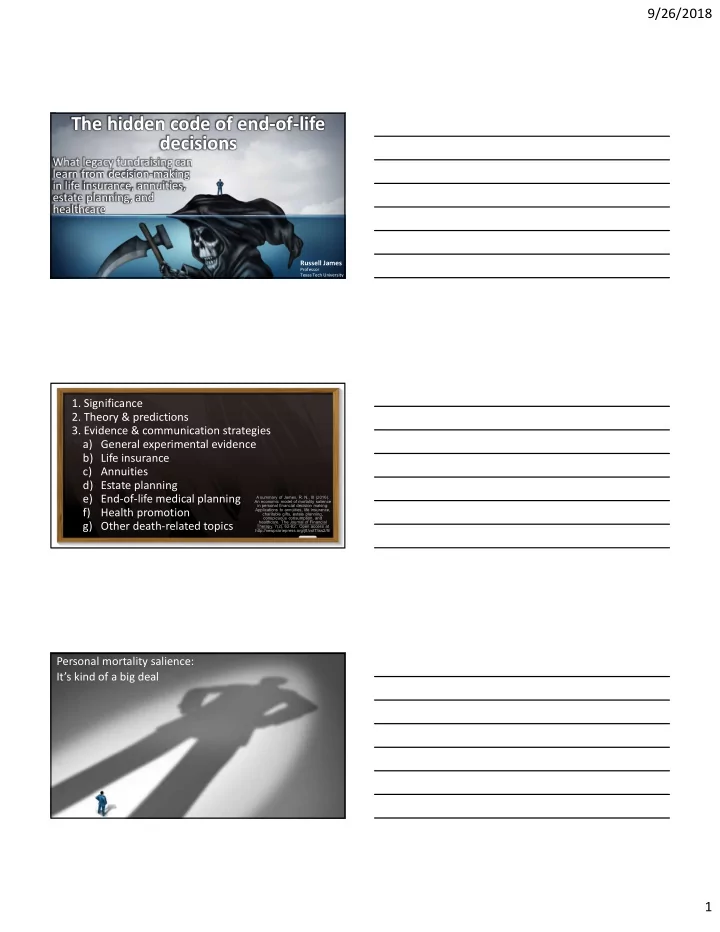
The hidden code of end-of-life decisions What legacy fundraising - - PDF document

the hidden code of end of life decisions
SMART_READER_LITE
LIVE PREVIEW

The hidden code of end-of-life decisions What legacy fundraising - - PDF document

9/26/2018 The hidden code of end-of-life decisions What legacy fundraising can learn from decision-making in life insurance, annuities, estate planning, and healthcare Russell James Professor Texas Tech University 1. Significance 2.


slide-1
SLIDE 1

9/26/2018 1

What legacy fundraising can learn from decision-making in life insurance, annuities, estate planning, and healthcare

The hidden code of end-of-life decisions

Russell James

Professor Texas Tech University

  • 1. Significance
  • 2. Theory & predictions
  • 3. Evidence & communication strategies

a) General experimental evidence b) Life insurance c) Annuities d) Estate planning e) End-of-life medical planning f) Health promotion g) Other death-related topics

A summary of James, R. N., III (2016). An economic model of mortality salience in personal financial decision making: Applications to annuities, life insurance, charitable gifts, estate planning, conspicuous consumption, and

  • healthcare. The Journal of Financial
  • Therapy. 7(2), 62-82. Open access at

http://newprairiepress.org/jft/vol7/iss2/5/

Personal mortality salience: It’s kind of a big deal

slide-2
SLIDE 2

9/26/2018 2

Mortality reminders are inherent in a variety of decisions with major financial planning implications

Seminar Tonight:

Estate Planning What you see What the client’s subconscious sees

Seminar Tonight:

Your Upcoming Death

Seminar Tonight:

Life Insurance What you see What the client’s subconscious sees

Seminar Tonight:

Your Upcoming Death

slide-3
SLIDE 3

9/26/2018 3

Seminar Tonight:

Long-Term Care Insurance What you see What the client’s subconscious sees

Seminar Tonight:

Your Upcoming Death

Seminar Tonight:

Annuities What you see What the client’s subconscious sees

Seminar Tonight:

Your Upcoming Death

Seminar Tonight:

Spending Down Your Retirement Assets What you see What the client’s subconscious sees

Seminar Tonight:

Your Upcoming Death

slide-4
SLIDE 4

9/26/2018 4

Seminar Tonight:

Advance Healthcare Directives What you see What the client’s subconscious sees

Seminar Tonight:

Your Upcoming Death

Seminar Tonight:

Become an Organ Donor What you see What the client’s subconscious sees

Seminar Tonight:

Your Upcoming Death

  • Regardless of terminology
  • r packaging, these topics

involve consciously planning for one’s own death.

  • These are strong

reminders of the reality of one’s own mortality.

  • Theory and experimental

research have identified consistent reactions to such mortality reminders.

slide-5
SLIDE 5

9/26/2018 5

People respond differently to personal mortality reminders than to other types

  • f objective information

Both economic and psychological approaches predict that mortality reminders can lead to

  • 1. Avoidance

(initial and induced)

  • 2. Pursuit of lasting social

impact (“symbolic immortality”)

Hero

slide-6
SLIDE 6

9/26/2018 6

The economic model

As personal mortality awareness grows, the desire for investing in lasting future social impact, R2, becomes relatively more attractive.

H

Pursuit of symbolic immortality: something reflecting the person’s life story (community and values) will live beyond them

W = u(c1, R1) + δu(ĉ2, R2) + sβu(c2, R2)

current anticipated future

Experimental examples

  • 1. Avoidance
  • 2. Pursuit of lasting social

impact (“symbolic immortality”)

slide-7
SLIDE 7

9/26/2018 7

People often express an aversion to focusing on their

  • wn death. In a

standard work on the psychology of death, Kastenbaum

(2000, p. 98) explains that

there is “general agreement that most

  • f us prefer to

minimize even our cognitive encounters with death.”

Initial avoidance

Beyond this general tendency towards avoidance, experimentally- induced mortality reminders actually increase subsequent tendencies to suppress death-related interactions (Arndt et al., 1997; Greenberg et al., 2000). For example, experimentally

  • induced mortality

reminders lead to increased denial of personal characteristics said to result in early death (Greenberg et al., 2000).

Induced avoidance

T echnical note: Diminishing marginal utility of anticipated experience predicts increasing desire for death denial following its exogenous reduction

Distract: I’m too busy to think

about that right now

Differentiate: It doesn’t apply to

me now because I (exercise, have good cholesterol, don’t smoke…)

Deny: These worries are

  • verstated

Delay: I definitely plan to think

about this… later

Depart: I am going to stay away

from that reminder

Forms of avoidance

slide-8
SLIDE 8

9/26/2018 8

Hero

What will survive is the community,

  • R. Thus, the community becomes

relatively more important, including the community’s lasting well-being and approval. As a result, people become more supportive of their surviving community and its values.

Pursuit of lasting social impact (“Symbolic Immortality”)

W = u(c1, R1) + δu(ĉ2, R2) + sβu(c2, R2) Death reminders increase support for one’s surviving community (“in-group”)

Death reminders increase …

  • Giving among Americans to U.S. charities but not to foreign charities

(Jonas, Schimel, Greenberg, et al., 2002)

  • Negative ratings by Americans of anti-US essays (many)
  • Predicted number of local NFL football team wins (Dechesne, Greenberg, Arndt, et al., 2000)
  • Ethnic identity among Hong Kong Chinese (Hong, Wong & Liu, 2001)
  • Willingness of English participants to die or self-sacrifice for England

(Routledge, et al, 2008)

  • German preference for German mark v. euro (Jonas, Fritsche, & Greenberg, 2005)
slide-9
SLIDE 9

9/26/2018 9

Support for the community can include

  • pposition to
  • utsiders. In the

model, R includes

  • thers with

positive (friends)

  • r negative

(enemies) interdependence W = u(c1, R1) + δu(ĉ2, R2) + sβu(c2, R2)

  • Negative ratings of foreign soft

drinks (Friese & Hoffmann, 2008)

  • Acceptance of negative

stereotypes of residents of other cities (Renkema, et al., 2008), or nations (Schimel, et

  • al. 1999)
  • Support by Iranian students for

martyrdom attacks against the U.S. (Pyszczynski ,

, et al. 2006)

  • Support by Israeli participants of military

action against Iran (Hirschberger, Pyszczynski & Ein-Dor, 2009)

  • Dutch agreement (disagreement) with

art opinions given by Dutch (Japanese) critics (Renkema, et al., 2008)

Death reminders increase support for community through resistance to outsiders, such as by increasing…

In consumer purchase decisions, “when mortality is salient, people are more willing to act in concert with the opinions of others”

(Maheswaran and Agrawal, 2004, p. 214).

Mortality salience increased the desire for luxury products – Lexus car, Jaguar car, Rolex watch, famously expensive sweets – but not for products without such features – economy car, potato chips, or non-luxury brands (Heine, Harihara, & Niiya,

2002; Mandel & Heine, 1999; van Bommel, O'Dwyer, Zuidgeest, & Poletiek, 2015).

Mortality salience combined with reminders of pro-environmental social norms increased the desire for an environmentally-friendly vehicle, Toyota Prius, and an environmentally-friendly reusable cup while decreasing the desire for a less environmentally-friendly vehicle, Ford Expedition, and a less environmentally-friendly disposable cup (Fritsche, Jonas, Kayser, & Koranyi, 2010).

Social approval by the community becomes more important in spending

slide-10
SLIDE 10

9/26/2018 10

  • Desire for fame (Greenberg, Kosloff, Solomon, et al., 2010)
  • Interest in naming a star after one’s

self (ibid)

  • Perception of one’s past significance

(Landau, Greenberg, & Sullivan, 2009)

  • Likelihood of describing positive

improvements when writing an autobiographical essay (Landau, Greenberg,

Sullivan, et al, 2009)

  • Perceived accuracy of a positive

personality profile of one’s self (Dechesne,

Pyszczynski, Janssen, et al., 2003)

Death reminders increase attraction to positive remembrance Death reminders increase attraction to personal heroism

H

Pursuit of symbolic immortality: something reflecting the person’s life story (community and values) will live beyond them

  • 1. Death reminders after delay

increase self-reported similarity with a hero

  • 2. After a death reminder, describing
  • ne’s own hero (but not

another’s) reduces death-related thoughts

  • 3. After a death reminder, reading of

a heroic act reduces death-related thoughts only when the hero is reported to share the participant’s birthdate

McCabe, S., Carpenter, R. W., & Arndt, J. (2016). The role of mortality awareness in hero

  • identification. Self and Identity, 15(6), 707-726.

1. The hero goes forth 2. Struggles with a gatekeeper, enters a horrible place, undergoes an ordeal 3. Then gains reward 4. And returns to his place of beginning 5. With a gift to improve his world

Joseph Campbell’s “monomyth” universal hero story

Ex: a successful entrepreneur giving to her alma mater, a cancer survivor giving to cancer research

Campbell, J. (1949), The Hero with a Thousand Faces. New York: Pantheon. pp. 245-246

slide-11
SLIDE 11

9/26/2018 11

Practical Applications for Financial Decision Making and Marketing

Life insurance Life insurance is a death reminder

Showing people a life insurance company logo increased their mortality salience.

(Fransen, M. L., Fennis, B. M., Pruyn, A. T. H., & Das, E. (2008). Rest in peace? Brand- induced mortality salience and consumer behavior. Journal of Business Research, 61(10), 1053-1061)

Asking a question about owning life insurance triggers mortality salience.

Rockloff, M. J., Browne, M., Li, E., & O'Shea, T. (2014). It's a sure bet you're going to die: Existential terror promotes gambling urges in problem players. Gambling Research,26(1), 33.

slide-12
SLIDE 12

9/26/2018 12

Life insurance: Waiting too long, holding too long

  • 1. Avoidance will cause

uninsureds to postpone purchase contemplation

  • 2. Avoidance will cause

insureds to postpone cancellation contemplation

Another study of life insurance holdings by those in their 50s and early 60s, found nearly half of married people “were protected by life insurance even though they faced no underlying vulnerabilities” Bernheim,

  • B. D., Forni, L., Gokhale, J., & Kotlikoff, L. J.

(2003). The mismatch between life insurance holdings and financial vulnerabilities: evidence from the Health and Retirement Study. American Economic Review, 93(1), 354-365.

A study of life insurance holdings found that among secondary earners in their 20s and 30s, only one-in- five “held sufficient life insurance to avert significant or severe financial consequences”

Bernheim, B. D., Carman, K. G., Gokhale, J., & Kotlikoff, L. J. (2003). Are life insurance holdings related to financial vulnerabilities? Economic Inquiry, 41(4), 531-554.

Waiting too long Holding too long

Relative to their risk exposure, older adults tend to be

  • ver-insured, while

younger families tend to be under-insured. Based on standard consumption smoothing models, the peak value for life insurance arises at age 30, yet the propensity to own life insurance actually peaks in the late 60s.

Chambers, M., Schlagenhauf, D., & Young, E. (2011). Why Aren't More Families Buying Life Insurance? Center for Retirement Research at Boston College Working Paper, (2011-7)

slide-13
SLIDE 13

9/26/2018 13

Life insurance: Sold, not bought

Consumers will tend to avoid mortality salience, such as contemplating life insurance purchases. However, if a salesperson were able to induce mortality salience – by forcing contemplation of life insurance or otherwise – then the consumer’s attraction to the bequest benefit, R2, of the product would increase. This results in a product that could be “sold” even if, without a salesperson, it would not be “bought.”

Strategies If you want a larger audience, don’t lead with death

Reduces avoidance response, thus increasing general audience willingness to engage with initial, preparatory, lead-in topics

Strategies If you want a larger audience, don’t lead with death

  • It’s “life” insurance, not “death”

insurance

  • This explains the tendency for life

insurance agents to adopt substitute titles such as financial advisor Rosh, R. M.

(2015). Death of a salesman: The rise & unfortunate potential demise of the fulltime life insurance salesman. St. John's Law Review, 88(4), 3

  • Explains the attraction of whole life

products that allow for initial discussion of non-death-related savings goals, albeit with an ancillary death-related component, as compared with the pure death planning of term life insurance

slide-14
SLIDE 14

9/26/2018 14

Strategies When to lead with death

  • 1. Captive audience:

Increase mortality salience to heighten interest in lasting social impact through bequest

  • 2. Low-hanging fruit:

Intentionally limiting audience only to those ready for death planning (often related to some other external shock such as death

  • f a loved one, negative

diagnosis, estate planning)

Strategies: Emphasize lasting social impact

H

Something reflecting the person’s life story (community and values) will live beyond them

Strategies: Emphasize lasting social impact

No: Big pile of money for heirs to throw a party or take a trip. Yes: Education for heirs. Retirement for spouse. Funding a family dynasty trust or private family foundation.

slide-15
SLIDE 15

9/26/2018 15

Strategies: Present a social norm default

  • Pursuit of lasting social impact suggests that once mortality salience

is induced, social approval becomes more important.

  • Induced avoidance suggests increased resistance to contemplation

after death reminders. A simple default limits contemplation effort.

“Many of our customers like to…”

Annuities Annuities are a death reminder

An annuity involves an explicit bet on one’s own longevity. When asked to list their thoughts, 1% of those contemplating an IRA mentioned death-related thoughts, as compared with 40% of those contemplating an annuity.

Salisbury, L. C., & Nenkov, G. Y. (2016). Solving the annuity puzzle: The role of mortality salience in retirement savings decumulation decisions. Journal of Consumer Psychology, 26(3), 417-425.

slide-16
SLIDE 16

9/26/2018 16

Initial avoidance suggests resistance to contemplation

Changing annuity description from “each year you live” to “each year you live until you die”, and “if the annuity holder lives up to different ages” with “depending on the age when the annuity holder dies” increased death-related thoughts and consequently lowered interest in purchasing annuities. The reduction in interest was fully mediated by the change in death- related thoughts.

Salisbury, L. C., & Nenkov, G. Y. (2016). Solving the annuity puzzle: The role of mortality salience in retirement savings decumulation decisions. Journal of Consumer Psychology, 26(3), 417-425.

Induced avoidance suggests increased resistance to contemplation after death reminders

Participants were randomly assigned to write an essay about either dental pain or their own death before indicating their interest in purchasing an annuity at age 65. Among those who first wrote about their own death, only 23% expressed interest in purchasing an annuity at age 65, while 41% of the comparison group did so. Salisbury, L. C., & Nenkov, G. Y. (2016). Solving the annuity puzzle: The role

  • f mortality salience in retirement savings decumulation decisions. Journal of Consumer

Psychology, 26(3), 417-425.

Pursuit of lasting social impact suggests that once mortality salience is induced, a bequest benefit will become more attractive

Both increasing death wording and writing a death essay increased preference for an annuity with a bequest benefit instead of a standard annuities (Williams & James, 2017) Increasing bequest motivation will decrease interest in standard annuities (Friedman & Warshawsky, 1990;

Lockwood, 2012).

Three-fourths of all annuities owned by recent retirees actually contain survivor benefits (Lockwood, 2012).

slide-17
SLIDE 17

9/26/2018 17

Strategies If you want a larger audience, don’t lead with death

Reduces avoidance response, thus increasing general audience willingness to engage with initial, preparatory, lead-in topics

Strategies If you want a larger audience, don’t lead with death

  • It’s “each year you live” not “each

year you live until you die”

  • It’s “if the annuity holder lives up to

different ages” not “depending on the age when the annuity holder dies”

Salisbury, L. C., & Nenkov, G. Y. (2016). Solving the annuity puzzle: The role of mortality salience in retirement savings decumulation decisions. Journal of Consumer Psychology, 26(3), 417-425.

Strategies: Emphasize lasting social impact

H

Something reflecting the person’s life story (community and values) will live beyond them

  • Consider annuities

with survivor benefits

  • Reframe a standard

annuity as protecting a bequest benefit from other assets. Without an annuity, excessive longevity will eat through all assets leaving no bequest for future generations.

slide-18
SLIDE 18

9/26/2018 18

Strategies: Present a social norm default

  • Pursuit of lasting social impact suggests that once mortality salience

is induced, social approval becomes more important.

  • Induced avoidance suggests increased resistance to contemplation

after death reminders. A simple default limits contemplation effort.

“Many of our customers like to…”

Estate planning is a death reminder Because, duh

slide-19
SLIDE 19

9/26/2018 19

Estate planning avoidance

  • In the U.S., half of adults age

55+ have no estate planning documents (James, 2015).

  • Poterba (2001) and Kopczuk and

Slemrod (2003) demonstrated that those with taxable estates substantially underutilize gifts to family. Kopczuk and Slemrod (2005) attributed this to “the refusal to face up to one’s mortality” (p. 19)

Distract: I’m too busy to think

about that right now

Differentiate: It doesn’t apply to

me now because I (exercise, have good cholesterol, don’t smoke…)

Deny: These worries are

  • verstated

Delay: I definitely plan to

think about this… later

Depart: I am going to stay

away from that reminder

Examples of avoidance

  • There are tax advantages to

current gifting in estate planning, but this generates immediate impact, R1, rather than the desired lasting impact, R2.

  • In practice, taxpayers gift to an ILIT
  • r dynasty trust that will not

benefit the recipient until well after the donor’s death (Willms, 2000). Pursuit of lasting social impact

current anticipated future

W = u(c1, R1) + δu(ĉ2, R2) + sβu(c2, R2)

slide-20
SLIDE 20

9/26/2018 20

A poverty relief charity was described as an organization that focused on either … Normal Average Gift Death Reminded Average Gift “meeting the immediate needs of people” or R1

$257.77 $80.97

“creating lasting improvements that would benefit people in the future” R2

$100.00 $235.71

*participants giving share of potential $1,000 award

  • K. A., Tost, L. P., Hernandez, M., & Larrick, R. P. (2012). It’s

Only a Matter of Time Death, Legacies, and Intergenerational

  • Decisions. Psychological Science, 23(7), 704-709.)

↓d=> ↓ŝ=> ↓ĉ2=> ↓δu(ĉ2, R2)=> ↑u(R2) W = u(c1, R1) + δu(ĉ2, R2) + sβu(c2, R2); ĉ2 = ŝ*c2; ŝ = s + d*(1-s)

↓d ↔ d Pursuit of lasting social impact Strategies If you want a larger audience, don’t lead with death

Reduces avoidance response, thus increasing general audience willingness to engage with initial, preparatory, lead-in topics

Strategies If you want a larger audience, don’t lead with death

  • Removing extraneous death-related

terms (“that will take effect at my death”) when describing a charitable gift in a will significantly increased interest in making such gifts (James 2016).

  • Consider non-death related

descriptions, motivations or lead-in topics: Asset protection, saving taxes, key legal issues, important senior concerns.

slide-21
SLIDE 21

9/26/2018 21

Strategies When to lead with death

  • 1. Captive audience:

Increase mortality salience to heighten interest in lasting social impact through thoughtful planning (e.g., dynasty planning)

  • 2. Low-hanging fruit:

Intentionally limiting audience only to those ready for death planning (often related to some other external shock such as death

  • f a loved one or negative

diagnosis)

Strategies: Emphasize lasting social impact

H

Something reflecting the person’s life story (community and values) will live beyond them

  • Dynasty trusts, private

foundations, and other long term plans become attractive

  • Without planning: Big pile of

money for heirs to quickly blow, violating client values.

  • With planning: Lasting

impact expressing client values, e.g., education for

  • ffspring, retirement for

spouse, wage matching trust payments.

Strategies: Present a social norm default

  • Inclusion of a charitable bequest increased more than three-fold

when the drafting professional mentioned, “Many of our customers like to leave money to charity in their will” (p. 22). Sanders, Halpern, and Service (2013)

  • James (2016) reported a similar effect for a social norm (“Many people

like to ….”) statement in the charitable bequest context.

slide-22
SLIDE 22

9/26/2018 22

Medical end-of-life planning Initial avoidance suggests resistance to contemplation Despite the importance for fulfillment of patient desires and for financial outcomes, even with free availability from medical care providers, only about 8% to 17% of adults

  • ver age 65 have

advance directives (Musa,

Seymour, Narayanasamy, Wada, & Conroy, 2015).

Pursuit of lasting social impact suggests that once subjective, d, or objective, s, longevity is reduced, social impact will become more attractive.

  • A terminal diagnosis can

lead to a rapid shift in attitudes to become more

  • ther-centered (Vail et al., 2012; Yalom, 2015).
  • Generativity or “the

concern in establishing and guiding the next generation” is a particularly important focus at older ages (Schoklitsch and

Baumann, 2012, p. 262).

slide-23
SLIDE 23

9/26/2018 23

Strategies: If you want a larger audience, don’t lead with death

Payne, Prentice-Dunn, and Allen (2009) found that a more death- focused, threatening intervention was less successful in generating completed advance directives than a positive intervention encouraging healthy aging.

Strategies: Emphasize lasting social impact

  • A “pioneer” setting an example that inspires loved ones
  • Communicating important values to others by the act
  • Helping others by relieving the burden of painful decisions
  • How (or in what condition) do I want to be remembered?

Strategies: Presenting a social norm default in end-of-life medical decisions

slide-24
SLIDE 24

9/26/2018 24

What is the most common response to an organ donation request?

YES NO

I don’t want to think about it

No, people don’t want to donate organs Yes, people do want to donate

  • rgans

No, people don’t want to donate organs

slide-25
SLIDE 25

9/26/2018 25

Johnson, E. J., & Goldstein, D. (2003). Do Defaults Save Lives? Science, 302, 1338-1339.

I don’t want to

  • pt in

Johnson, E. J., & Goldstein, D. (2003). Do Defaults Save Lives? Science, 302, 1338-1339.

I don’t want to opt out

Johnson, E. J., & Goldstein, D. (2003). Do Defaults Save Lives? Science, 302, 1338-1339.

slide-26
SLIDE 26

9/26/2018 26

I don’t want to think about it!

Johnson, E. J., & Goldstein, D. (2003). Do Defaults Save Lives? Science, 302, 1338-1339.

Because I don’t want to think about it,

the default or social norm becomes powerful

Johnson, E. J., & Goldstein, D. (2003). Do Defaults Save Lives? Science, 302, 1338-1339.

Examples of other financial issues

Ameriks and associates (2015) identified a “long- term care insurance puzzle” where people hold far less insurance than is economically justified. Similarly, the relatively low level of participation in prepaid funeral plans (Hickey & Quinn, 2012) is unsurprising. In retirement, spending no more than current income (from assets or

  • therwise), is the

highest level of spending that does not require contemplation of the timing of one’s

  • wn death.
slide-27
SLIDE 27

9/26/2018 27

Strategy summary

  • 1. If you want a larger audience, don’t

lead with death

  • 2. Leading with death is OK for “low

hanging fruit” strategy or captive audience.

  • 3. Emphasize LASTING social impact
  • 4. Present a social norm default