
SLIDE 1
latrobe.edu.au
CRICOS Provider 00115M
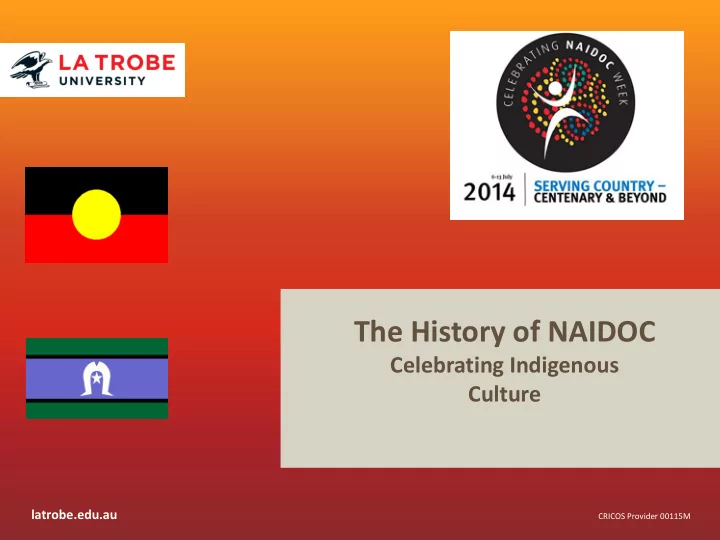
The History of NAIDOC
Celebrating Indigenous Culture
The History of NAIDOC Celebrating Indigenous Culture - - PowerPoint PPT Presentation
The History of NAIDOC Celebrating Indigenous Culture latrobe.edu.au CRICOS Provider 00115M Wominjeka Welcome La Trobe University 2 2 Acknowledgement La Trobe University acknowledges the Wurundjeri people of the Kulin Nations as the
latrobe.edu.au
CRICOS Provider 00115M
Celebrating Indigenous Culture
2 La Trobe University 2
Welcome
3 La Trobe University 3
La Trobe University
4 La Trobe University 4
La Trobe University
5 La Trobe University 5
NAIDOC stands for the ‘National Aborigines and Islanders Day Observance Committee’. This committee was responsible for organising national activities during NAIDOC Week and its acronym has since become the name of the week itself.
6 La Trobe University 6
NAIDOC Week celebrations are held across Australia each July to celebrate the history, culture and achievements of Aboriginal and Torres Strait Islander peoples. NAIDOC is celebrated not only in Indigenous communities, but by Australians from all walks
7 La Trobe University 7
8 La Trobe University 8
In 1935, William Cooper, founder
to King George V, asking for special Aboriginal electorates in Federal
Government believed that the petition fell outside its constitutional Responsibilities William Cooper (c. 1861 - 1941),
Australian Aboriginal leader
9 La Trobe University 9
On Australia Day, 1938, protestors marched through the streets of Sydney, followed by a congress attended by over a thousand people. One of the first major civil rights gatherings in the world, it was known as the Day of Mourning.
Jack Patten reads the resolution at the Day of Mourning Conference on 26 January 1938: "We, representing the
Aborigines of Australia… on the 150th Anniversary of the whitemen’s Seizure of our country, hereby make protest against the callous treatment of our people… and we appeal to the Australian nation
and equality within the community."
10 La Trobe University 10
La Trobe University
January 26 1938 was the 150th anniversary of the landing of the First Fleet in Australia, for some a day to celebrate, for others a day to mourn. For those who celebrated there was a parade and a re-enactment of the arrival of the First Fleet was performed.
In this 1938 re-enactment of Governor Phillip's landing, Aborigines (specially brought in for the
boats of the First Fleet marines land at Farm
comfortable safety watching the invasion.
11 La Trobe University 11
La Trobe University
Those who mourned, were kept waiting until the parade passed by before they could march in ‘silent protest from the Town Hall to the Australian Hall in Elizabeth Street. The first Day of Mourning, was held at the Cyprus Hellene Club in the Australian Hall. It was the first time that Aboriginal people from around Australia joined together to campaign for equality and citizenship rights.
12 La Trobe University 12
La Trobe University
A LARGE BLACKBOARD displayed outside the Australian Hall proclaims, "Day of Mourning".
William Ferguson, Jack Kinchela, Isaac Ingram, Doris Williams, Esther Ingram, Arthur Williams, Phillip Ingram, Louisa Agnes Ingram OAM holding daughter Olive Ingram, Jack Patten.
13 La Trobe University 13
La Trobe University
From 1940 until 1955, the Day of Mourning was held annually on the Sunday before Australia Day and was known as Aborigines Day. In 1955 Aborigines Day was shifted to the first Sunday in July after it was decided the day should become not simply a protest day but also a celebration of Aboriginal culture
14 La Trobe University 14
La Trobe University
1956 - National Aborigines Day Observance Committee (NADOC) was formed with support from Aboriginal
churches. 1975 – NADOC Week was adopted and runs from the 1st Sunday – 2nd Sunday in July
15 La Trobe University 15
La Trobe University
1972 – the first NADOC Poster & National theme was adopted
16 La Trobe University 16
La Trobe University
NADOC was expanded to recognise Torres Strait Islander people and culture. The committee then became known as the National Aborigines and Islanders Day Observance Committee (NAIDOC). This new name has become the title for the whole week, not just the day. Each year, a theme is chosen to reflect the important issues and events for NAIDOC Week.
17 La Trobe University 17
La Trobe University
Serving Country: Centenary & Beyond.
Artist: Harry Alfred Pitt
Torres Strait Islander artist, Harry Pitt, won the 2014 National NAIDOC Poster Competition with his artwork depicting three brothers with their land behind them & the horizon before them. Their Elders are reflected in the water, giving the brothers the strength to overcome the challenges that may lie over the horizon.
18 La Trobe University 18
La Trobe University
Designed by Indigenous Elder Harold Thomas in 1971, this flag symbolises Aboriginal identity. Yellow represents the sun (giver of life) and yellow ochre. Red represents the red earth (the relationship to the land) and the red ochre used in ceremonies. Black represents the Aboriginal people. The Aboriginal flag was first displayed on 12th July 1971, National Aborigines' Day, at Victoria Square in Adelaide. It was also used at the 'Tent Embassy' in Canberra in 1972.
19 La Trobe University 19
La Trobe University
The flag was created as a symbol of unity and identity for Torres Strait Islander peoples & was designed in 1992 by the late Bernard Namok from Thursday Island. The dharri or deri (a type of headdress) is a symbol for all Torres Strait Islanders. The colours of the flag represent the following:
The star alludes to the five main Island zones and is sometimes interpreted as a symbol of the "Coming
20 La Trobe University 20
La Trobe University
21 La Trobe University 21
La Trobe University
22 La Trobe University 22
La Trobe University
For further information contact the following staff within the Office of Indigenous Strategy and Education:
Mick Coombes Indigenous Employment Co-ordinator 03 9479 6678 m.coombes@latrobe.edu.au Nellie Green Manager, Indigenous Student Services 03 9479 3817 n.green@latrobe.edu.au
Thank you
latrobe.edu.au
CRICOS Provider 00115M