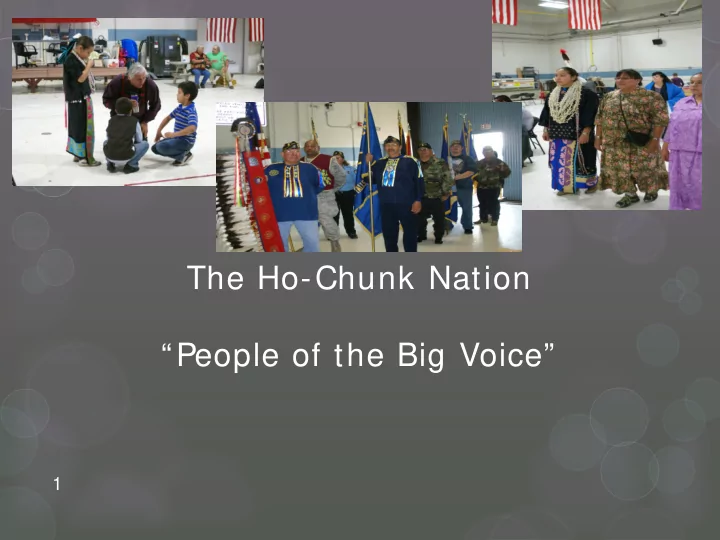
SLIDE 1
The Ho-Chunk Nation “People of the Big Voice”
1
SLIDE 2
Charge of the constitution:
… … grants the Legislature the power “to promote public health” and to establish a health department. … … requires the Health Department “to promote the individual and collective health of the members of the Nation” and “to collaborate with the tribal, state and federal agencies.”
SLIDE 3
Tribal Government
SLIDE 4 Health is an Executive Department
Executive Director is Appointed by the President and oversees the following Departments: Behavioral Health Community Health Environmental Health Quality Improvement Medical Services Finance Pharmacy Health Information Systems
SLIDE 5
SLIDE 6
Historically… …
Very little interaction between the Counties and the Tribal Health Department. The Ho-Chunk Nation Health Program was very territorial.
SLIDE 7
The Ho-Chunk Tribal Health Department l985-95
Services influenced by Indian Health Service Programs and Guidance Little or no direct services Many community based programs No specialized programming The Nation felt obligated to take care of their own health issues. Long range goals were just beginning to form
SLIDE 8
An Evolving Process of Change The need to engage partners..
Direct Services for the delivery of health care Participation in State Electronic reporting Systems Funding sources began requiring partners. Community Health Assessments and Improvement plans engaged partners. Emergency Response demanded a unified community.
SLIDE 9
First Catalyst of Change—9/ 11
Homeland Security Mandated that states and counties work with tribes to plan emergency response to biological, terrorist and natural disasters.
SLIDE 10
States, Counties and Tribes working together… …
The earliest response plans focused on terrorism. Early response plans focused on anthrax response This moved forward to all disaster response Finally we discussed plans for disease outbreak response
SLIDE 11
Second Catalyst of Change- Public Health Accreditation
Ho-Chunk Tribal Health Department began studying Public Health Accreditation Meeting the standards meant formalizing some of our practices Establishing formal agreements for collaborating services that we had with counties.
SLIDE 12
The Three Essential Documents
Community Health Assessment 2013 Community Health Improvement Plan 2014 Strategic Plan 2014
SLIDE 13 Community Health Assessment
Events in each of six communities consisting
survey. Compilation of results Results were compiled to a report which was used for the Community Health Improvement Plan
SLIDE 14
Evaluation of the CHA
Benefits Large survey sample The community gatherings were a positive experience The final document seemed to meet our needs. Challenges The data was difficult to analyze Expensive & time- consuming Community opinions did not reflect hard data from medical records Tribal specific data was not available to compare
SLIDE 15
Community Health Improvement Plan
Focus Groups of tribal, county, state and community members met The four health priorities identified in the CHA were addressed by this group. Goals with measurable objectives were identified. Follow-up meetings report progress to all partners, legislators, and health staff.
SLIDE 16 Strategic Plan
A contract was established with Action Strategy to help develop a strategic plan An educational meeting was held with staff directors, key personnel, health board members and other tribal partners. The plan is written to provide goals and measurable
- bjectives. The program is electronic and can easily be
accessed and updated by staff. Documents can be attached to goals.
SLIDE 17 1 0 / 2 9 / 2 0 1 5
Description Ow ner Resource Notes Budget End Date %
1.0 ADMI NI STRATI ON 1.1 Secure Funding and manage budgets for all programs under Env. Health Carol Rollins Finance 12/ 30/ 2015 80% 1.2 Organize documentation and plans for Public Health Accreditation Long Term Pam Thunder; PHAC 12/ 30/ 2016 30% 1.2.1 Complete the CHA, CHI P and Strategic Plan Long Term Pam and Carol 12/ 30/ 2014 100% 1.2.2 formalize relationships with public health partners.Goal is 5 counties . Long Term Pam Thunder; PHAC 12/ 30/ 2015 20% 1.2.3 Hold regular monthly meetings to gather documentation Long Term Pam 100% 1.3 Community Health I mprovement Plan Carol Rollins Pam Thunder 6/ 30/ 2018 100% 1.4 Plan, fund and construct new satellite health offices in Wittenberg, Nekoosa and Tomah Long Term
Directors; Staff 12/ 30/ 2017 30% 1.4.1 Complete the preliminery plan for the Nekoosa Health Office Carol Rollins Carol 9/ 30/ 2014 100% 1.4.2 Work with Administration to plan the Wittenberg Office Carol Rollins Carol 6/ 1/ 2015 5% 1.5 Develop a program to educate community and tribal staff about program services Carol Rollins OEH Group 10/ 30/ 2015 5% 1.6 Coordinate space needs and remodeling for Contract Health 10/ 30/ 2014 100%
Strategic Plan Sample
SLIDE 18
Ho-Chunk Health and Communicable Disease
2009 H1N1 Response Realization that we did not have the means to isolate or quarantine Issue was presented to the President and Legislature Referred to District Meetings
SLIDE 19
Five District Meetings Attended
Reactions were luke warm! Some tribal members recognized the needs Others felt we should focus on more immediate health needs. Culturally, the older tribal members were reluctant to discuss a disease outbreak.
SLIDE 20 Meeting Domain 2
In 2012, we began to study the domains and realized that we should formalize
Local County Health
- Departments. We planted the
seed at the tribal government Level… … .
SLIDE 21
2012 First Draft of an MOU
Jackson County and the Ho-Chunk Nation Health Department agree to formalize communicable disease follow-up A first draft of a Memorandum of Understanding was drafted Jackson County approved the first draft
SLIDE 22
Ho-Chunk Nation Approvals
Community Health Nursing Medical Providers Executive Director of Health Health Board Department of Justice Tribal Court Judge Legislature
SLIDE 23
Main Points of the Original MOU
Agreement assures that the County will coordinate communicable disease follow-ups with the Tribal Health Department Agreement assures that the Nation will report communicable disease cases If the Nation declare a public health emergency, the Agreement would allow the county to implement mandatory isolation and quarantine.
SLIDE 24
MOU Fails … .
Sovereign Immunity was not protected Too much power was given to the County Lack of involvement of the Ho-Chunk Health Department Misunderstanding about the role that county health departments play in disease follow-up. Mistrust and hesitation to formally give up control.
SLIDE 25 2014 Final MOU
Jackson County agrees to exercise its authority in accordance with State and Tribal Laws, as well as procedures outlined in our Public Health Emergency Plan. Language was strengthened regarding communication especially in the event of voluntary quarantine. Any mandatory court-ordered isolation and quarantine
- rders from Jackson County must be recognized in the
tribal court. Nation has the right to withdraw permission granted in the MOU.
SLIDE 26
Why the Ho-Chunk Nation pursued a MOU… .
The Tribal Health Department did not have a method to conduct surveillance. The Ho-Chunk Nation has scattered tribals lands across 15 counties. Their populations are integrated with the general populace of the state. Contacts of communicable disease often cross jurisdictional boundaries Lack the capacity to complete follow-ups and arrange treatment.
SLIDE 27
Quality Improvement
Quality Improvement Plan Regular Monthly Meetings Ongoing Projects Reports to the Health Board No written plan
SLIDE 28
Workforce Development
Workforce Development Plan
Develop a suitable survey Pilot the survey to all levels of staff Conduct the survey Compile the results Complete a written plan
SLIDE 29
Performance Management
Performance Management Plan
Identify health indicators that reflect population health Prepare a dashboard to track data Share the dashboard with staff, health board members and legislators Complete a written plan
SLIDE 30
Current Status
Formed Domain Teams to gather data and identify gaps Each team has a leader and two members Goal is to identify documentation for each standard in the domain and to identify gaps. The Domain Teams will meet quarterly to review status.
SLIDE 31
Next Steps
Letter of Intent in December 2015 Application in April 2016
SLIDE 32
Result???
SLIDE 33