The impact of regeneration strategies on revitalising housing - - PDF document

the impact of regeneration strategies on revitalising
SMART_READER_LITE
LIVE PREVIEW

The impact of regeneration strategies on revitalising housing - - PDF document

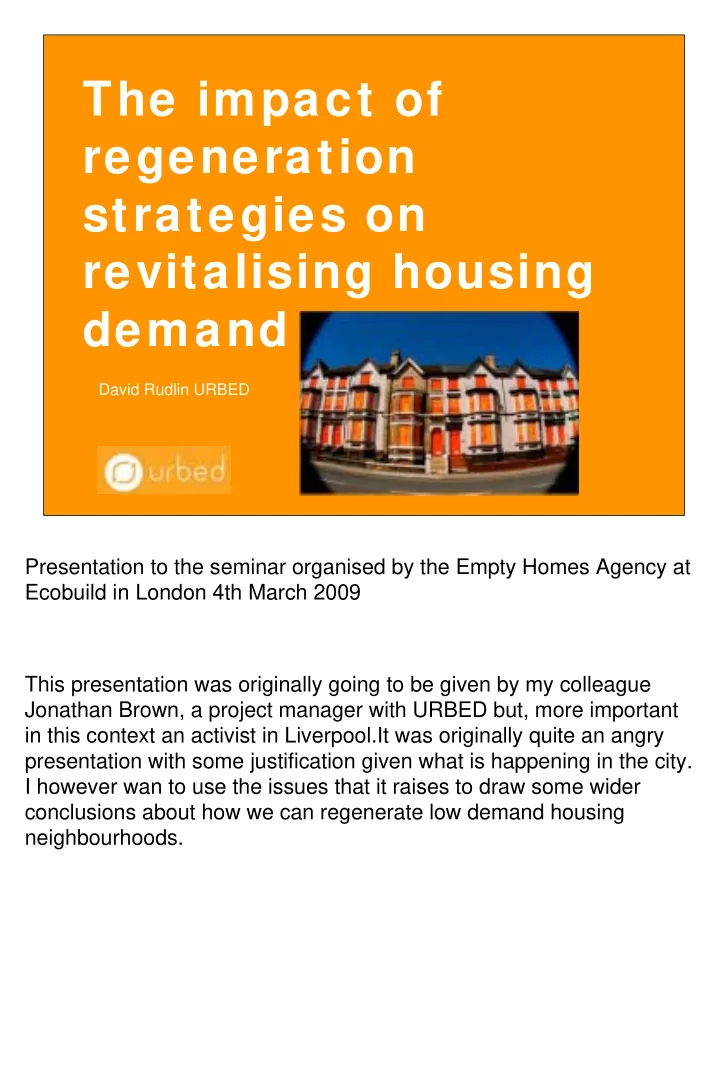
The impact of regeneration strategies on revitalising housing demand David Rudlin URBED Presentation to the seminar organised by the Empty Homes Agency at Ecobuild in London 4th March 2009 This presentation was originally going to be given


slide-1
SLIDE 1

The impact of regeneration strategies on revitalising housing demand

David Rudlin URBED

Presentation to the seminar organised by the Empty Homes Agency at Ecobuild in London 4th March 2009 This presentation was originally going to be given by my colleague Jonathan Brown, a project manager with URBED but, more important in this context an activist in Liverpool.It was originally quite an angry presentation with some justification given what is happening in the city. I however wan to use the issues that it raises to draw some wider conclusions about how we can regenerate low demand housing neighbourhoods.

slide-2
SLIDE 2

Part 1: A sad story

Lets Start with a sad story that started off with good intensions - Housing Market Renewal.

slide-3
SLIDE 3

The Slow Death of Great Cities 1999

The first I was aware of this was when I wandered into Beswick (the cleared area on the above plan) with a bunch of students to find it entirely abandoned. The student group the previous year had found the same area to be a fully occupied if not thriving community. The reasons for this was explained by Anne Power in her JRF report with Katherine Mumford - of which more in a moment.

slide-4
SLIDE 4

Changing housing markets and regeneration in the M62 Corridor 2001

A few years later this was backed up by a more comprehensive report by Birmingham University that seems to have panicked policy-makers. It identified a band of market collapse along the M62 and the fear, I guess, was that all of these neighbourhoods would go the way of

  • Beswick. The study identified areas where 25% of house sales were of

values of less that £30K (or was it 30% less than £25K?).

slide-5
SLIDE 5

1 Billion

since 2003

These areas became the focus for the Housing Market Renewal programme that has since 2003 spent almost £1 Billion…

slide-6
SLIDE 6

5 years trying to acquire property in a housing boom

…buying up homes in a property boom. I remember conferences where people would complain how difficult their job had become because houseprices had risen and land assembly costs had gone through the

  • roof. The of course begged the question of what HMR was seeking to

achieve if not rising houseprices!

slide-7
SLIDE 7

Now trying to develop new housing in a recession

The tragedy is that, in many areas, having acquired neighbourhoods in times of boom, we are trying to redevelop them in times of bust. Developers are waking away and we find that communities have been destroyed with little prospect of redevelopment.

slide-8
SLIDE 8

Meanw hile….

Meanwhile…. Neighbourhoods that escaped HMR or where HMR has focussed on refurbishment have regenerated themselves like this street in Liverpool.

slide-9
SLIDE 9

Part 2: That’s not to say there wasn’t a problem

Sorry this wasn’t supposed to be an angry presentation! Because of course there were problems, lots of them in the housing areas of the

  • north. Its just that the net of Housing Market Renewal caught many

kinds of fish. We need to understand how these fish differ if we are to devise strategies for their regeneration - To illustrate this lets look at three very different situations:

slide-10
SLIDE 10

The story of Besw ick

Lets start by returning to the story of Beswick (and yest I know that’s not a picture of Beswick, it didn’t have bay windows but I couldn’t find a picture of the original neighbourhood). The abandonment of Beswick was the result of the success of

  • Manchester. As more jobs became available in the city people were

empowered to move away from places like Beswick. The city was building lots of subsidised new housing in places like Hulme so that first time buyers had lots of alternative places to buy. At the same time the council was getting serious with the management of social housing which has improved greatly in Manchester. This led to the eviction of many problem families who ended up in private rented accommodation in places like Beswick. These forces in a prosperous city conspired to cause the collapse of Beswick in just 6 months. Soon the housing was being abandoned and homes that once cost £30K were changing hands in the pub for £1500.

slide-11
SLIDE 11

The story of East Lancs.

The situation in East Lancs is quite different. Here abandonment has also taken place but it has been a result of decline. As the towns of East Lancs have lost their economic role they have also lost population. It is therefore not surprising that the least populat neighbourhoods have emptied out. There are, of course, other factors - the worst hit neighbourhoods tend to be white and there is often an element of white flight as the neighbouring Asian community grows. There is also an element of suburbanisation as people seek to move out of places like Burnley to the rural parts of Pendle which along with other authorities has been struggling with both HMR and a housing moritorium.

slide-12
SLIDE 12

The story of Rochdale

A third type of area is typified by Rochdale where there is no abandonment but where the housing market is very weak and housng conditions poor. These areas often have a growing Asian community and the problem is overcrowding rather than abandonment. The community don’t have the resources to maintain the property eading to decline. There is also a possibility that in a strong Muslim community where mortgages are forbidden as usery, the housing market is not being accurately measured by the usual statistics and is stronger than it seems.

slide-13
SLIDE 13

The story

  • f Holbeck

As a contrast - lets look quickly at Holbeck in Leeds. In terms of housing conditions this is probably the poorest of the areas that we have looked at - the entire neighbourhood is made up of back-to-backs hence the washing across the street and the external soil stacks. Yet it seems to remain popular and well occipied and has been untouched by

  • HMR. Why this is, I’m not sure I understand, but it should cause those

people who can’t see a future for terraces to think again.

slide-14
SLIDE 14

Part 3: So why was the answer demolition?

Give the range of circumstances caught by HMR - why was the answer in the early years at least, always demolition?

slide-15
SLIDE 15

Radical Change

First it was seem as radical - the research had identified a serious problem and serious problems require radical surgery. This is Werneth in oldham where we did our first HMR masterplan. I remember siting down with the Audit Commission of all people being told that the plan needed more demolitions if it was to transform the area and if they were to recommend that it be funded.

slide-16
SLIDE 16

Developer needs

Here is our final masterplan for Werneth which included more demolition than we were happy with and less than the council or Audit commission wanted. However the clincher was developer needs. The area was to be marketed to developers to implement the programme and they had certain needs - control of a site, sufficient numbers to make it worth while setting up site infrastructure and a marketing suite, and a main road frontage for visibility.

slide-17
SLIDE 17

Middle class Values?

Underlying much f the concern to seep away terraces was a lack of understanding of these neighbourhoods. I have written about this with regard to the redevelopments of the 1960s and 70s where middle class professions saw slums where locals saw strong commuties. There is little doubt that this is still the case. The slides above are from a photo project that Charlie Baker of URBED undertook in Orchard Park Hull funded by HMR. It showed the richness of community that lay just beneath the hostile image of the area.

slide-18
SLIDE 18

Bricks not people

Regardless of class, it was, of course, the classic problem of dealing with a physical problem of buildings and their condition rather than the people who live in them. Try telling a couple who have kept their home immaculate for 50 years that it is to be demolished because it is unfit. If you conceptualise a problem as a housing problem or even a housing market problem that’s what happens. Yet the communities that inhabit these areas are far more difficult to rebuild that the houses.

slide-19
SLIDE 19

Part 4: Why is demolition almost always a bad idea?

Because…

slide-20
SLIDE 20

Because a neighbour- hood is like a forest

Communities are like the rich ecosystem of a rain forest. They take years to develop and yet can be cut down in hours and will never grow

  • again. The diversity of a good community in terms of the people who

live there, the social networks and the range of facilities and shops that it supports can never be recreated in the monoculture of a modern housing estate.

slide-21
SLIDE 21

Because the process is too painful

Because even the most efficient redevelopment process will take years and during that time people like those behind the net curtains in this photo will be surrounded by tinned up properties.

slide-22
SLIDE 22

Take the main road access to one of the UK’s great cities that once looked like this…

slide-23
SLIDE 23

And now looks like this - every building in this photo except for the church is slated for demolition.

slide-24
SLIDE 24

Because people can’t afford it

Then there is the issue of how the people of the area can afford the new housing. Their existing housing was typically being acquired for £60K and the new housing was retailing for £100K or more. Even with Homeloss compensation and disturbance payments there was often a

  • gap. The reality is that most of the completed redevelopment schemes

have been sold to incomers and the existing community have had to move elsewhere.

slide-25
SLIDE 25

Because I’m not sure w e can do better

Which housing is better, Which will last longer - the left or right? If we are not sure, we must ask whether all the pain of redevelopment is really worth it.

slide-26
SLIDE 26

Part 5: Alternative regeneration strategies

So now I can return to my original brief - What alteernative strategies are there for regenerating these areas, particularly in a recession?

slide-27
SLIDE 27

Rochdale

Having faith in the terrace

We used to have a model called Housing Action Areas where concerted action was taken to improve the housing and the environment like these streets in Rochdale done in the 1970s (you can tell by the age of the trees). Some people said quite glibly at the start of HMR that Housing Action Areas had given housing a 25 year life so it was not surprising that we needed to do them again. However in many places like these streets in Rochdale HAAs kick-started a process of self-perpetuating renewal that could continue for many years.

slide-28
SLIDE 28

Northmoor

Repair and Home Zones

The modern day equivalent is North Moor in Manchester. This is not HMR, it was done through a combination of SRB investment in the public realm and Manchester Methodist Housing Association buying up and refurbishing empty units. There is also some sensitive infilling of

  • gaps. The result is the lasting renewal of not just the area but also the

surrounding streets.

slide-29
SLIDE 29

Rochdale

Small scale infill

This another example of sensitive infill by Barratts (I know that sounds wrong but its true). It was a scheme that we were involved in and involved careful infill designed by OMI Architects on vacant sites leaving all of the existing housing in place.

slide-30
SLIDE 30

Rochdale

Reinventing the terrace

The key to doing this was to find a way of building new housing on a terraced plot. Which is typically 25-30m from street to street. This housing from OMI creates large family homes with the potential of either a separate smaller home or a granny flat on the street at the back.

slide-31
SLIDE 31

Colne

Complementary infill

Infill can take place on a much wider scale. This is an area in Colne that we masterplanned as part of HMR. There was no housing in the area that justified demolition but lots of underused industrial land…

slide-32
SLIDE 32

Colne

Complementary infill

The masterplan therefore concentrated on new build on the employment land to transform the valley floor from the neglected rear of the neighbourhood to its centre, thereby generating value to invest in the existing stock.

slide-33
SLIDE 33

Chimney Pot Park

Making the terrace desirable

We won’t unfortunately be hearing from urban Splash today but Chimney pot Park in Salford is worth a mention. This of course is not refurbishment but new build behind retained facades, largely because

  • f the VAT Issue that has already been mentioned this morning.

What is interesting to me was Tom Bloxham’s reaction to being shown the terraces initially. He realised that all they needed was marketing, just as US had marketed space in vacant warehouses. It worked like a dream - people camped out for a week to secure one of the houses that two years earlier had been abandoned.

slide-34
SLIDE 34

But what’s really impressive is that the surrounding streets look like this and are lived in not by Urban Splash groupies but the community that has always lived there. Given the age of the trees this is probably a former HAA but it seems to show that the Chimney Pot Park effect has spread.

slide-35
SLIDE 35

The back of the same homes.

slide-36
SLIDE 36

Anfield

Contemporary Refurbishment

Then there is Rockfield Street in Anfield (where the lady on the left hand side of slide 18 lives). This was almost completely empty and slated for demolition but has been refurbished for same by the Affordable Housing Development Corporation…

slide-37
SLIDE 37

Anfield

Contemporary Refurbishment

And successfully marketed to first time buyers and renters.

slide-38
SLIDE 38

Community action

Gyroscope Housing Coops Homesteading CLTs

Which brings us to community action. We were talking last night about Gyroscope - a group of young guys from Hull in the 1980s who used money from their gyros to refurbish a terraced house. Having finished they sold it and bought another to refurbish. In the end they completed a series of homes and even got dispensation from the DHS as it then was allowing them to work while signing on. I have no idea what happened to Gyroscope, but I suspect that people with that much drive and determination will have been employed for much of the last

  • decade. We have forgotten the exciting things that can happen when

bright people have time on their hands as many of the people currently being made redundant do. One model is the housing coops that refurbished so much housing in the 1970s. Another concept is homesteading where people are give vacant homes if they agree to invest their time in refurbishment. Community Land Trusts are a way in which this might be funded as a community asset.

slide-39
SLIDE 39

Evolution is better than revolution

So in conclusion...

slide-40
SLIDE 40

Terraced neighbourhoods can be transformed

slide-41
SLIDE 41

Except follow ing abandonment or drastic population loss

slide-42
SLIDE 42

All difficult, fiddly and expensive and involves dealing w ith people - but alw ays better than demolition if the housing is occupied

Thank you. David Rudlin February 2009