The importance of Lucretjus Lucretjus brings together the worlds of - - PowerPoint PPT Presentation

the importance of lucretjus
SMART_READER_LITE
LIVE PREVIEW

The importance of Lucretjus Lucretjus brings together the worlds of - - PowerPoint PPT Presentation

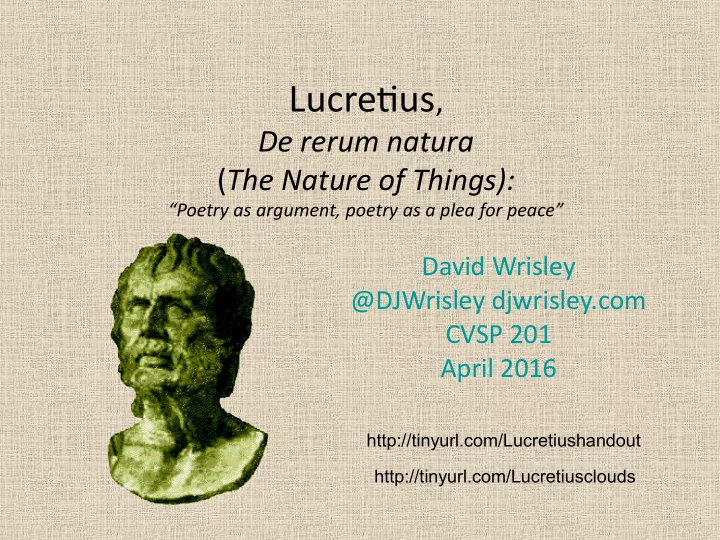
Lucretjus , De rerum natura ( The Nature of Things): Poetry as argument, poetry as a plea for peace David Wrisley @DJWrisley djwrisley.com CVSP 201 April 2016 http://tinyurl.com/Lucretiushandout http://tinyurl.com/Lucretiusclouds The


slide-1
SLIDE 1

Lucretjus,

De rerum natura (The Nature of Things):

“Poetry as argument, poetry as a plea for peace”

David Wrisley @DJWrisley djwrisley.com CVSP 201 April 2016

http://tinyurl.com/Lucretiusclouds http://tinyurl.com/Lucretiushandout
slide-2
SLIDE 2

The importance of Lucretjus

  • Lucretjus brings together the worlds of poetry and

philosophy

– his poetry makes a philosophical argument!

  • he blends scientjfjc inquiry of the universe with an

ethical theory

– understanding the material elements of the universe helps us live richer lives!

  • he redefjnes the object of human marvel and

admiratjon, from the supernatural to the natural

– Stop worrying about the gods, look into nature!

slide-3
SLIDE 3

A word cloud of the Leonard translatjon of Lucretjus’ The Nature of Things

slide-4
SLIDE 4

Al Jazeera vs Al Akhbar, top stories on Syria 12 April 2016

slide-5
SLIDE 5
  • A word cloud of the Leonard translation of

Lucretius’ The Nature of Things

A world cloud of Lucretjus’ Nature of Things – with highlightjng circles

slide-6
SLIDE 6

A word cloud of Lucretjus’ Nature of Things – highlighted again

slide-7
SLIDE 7

Lucretius and Ancient Rome

Aspects of today’s lecture:

  • Lucretius the poet
  • 1st century BCE Roman history
  • aspects of the poem
  • Macro-readings of Lucretius’

language

  • Brief comparison and contrast

with other readings you have done this semester

slide-8
SLIDE 8

Lucretjus and 1st c. BCE Rome

  • Adapted elements of Greek thought.
  • Wrote “our land is in her hour of need.” (1:43)
  • Was disillusioned with the glorious claims of

republic, and empire, as well as the corruptjon

  • f his day
  • Does not put his society on trial, does not

discuss an ideal society.

slide-9
SLIDE 9

What do you think a poet like Lucretjus, disillusioned with his city, and disappointed by corruptjon in his tjme, would do?

Questjon #1: Educated Guess

1. He would write a satjrical book about it. 2. He collect his family and travel. 3. He would retreat into a philosophical life. 4. He would start an antj- corruptjon party.

slide-10
SLIDE 10
  • Examined “by what principle the sun and moon run
  • n their courses / and all phenomenon upon the

earth, and governing forces” (1:128-129)

  • “these shadows of the mind, [which] must be swept

away / Not by rays of the sun nor by the brilliant beams of day / But by observing Nature and her laws.” (1:146-148)

slide-11
SLIDE 11

Lucretjus Book 1

slide-12
SLIDE 12

Poetry of Argument - Latjn didactjc epic

image: translatjon of Lucretjus, Englished in 1651

slide-13
SLIDE 13

A Google n-gram of “Lucretius”

slide-14
SLIDE 14

Epic descriptjon of Epicurus

  • “When human life lay on the ground obscenely, in full view, /

Prostrate, crushed beneath the weight of Superstjtjon, … / … the fjrst among them who dared raise / His human eyes to her was Greek, the fjrst man to withstand her / … He was the fjrst man who desired / To break the close-barred gates of Nature down. The vital force /

  • f his intelligence prevailed, and he advanced his course /

Far past the blazing bulwarks of the world, and roamed the whole / immeasurable Cosmos in his mind and in his soul. / In triumph he returns to us, and brings us back this prize: / To know what things can come about, and what cannot arise, / And what law limits the power of each, with deep-set boundary stone. / Therefore it is the turn of Superstjtjon to lie prone, / Trod underfoot, while by his victory we reach the heavens.” Lucretjus, I: 62-79

slide-15
SLIDE 15

Lucretjus’ work versus epic

  • It is a philosophical voyage; he “roamed the

whole / immeasurable Cosmos in his mind ”

  • This poem is not primarily narratjve, that is, it

does NOT tell a story

  • The gods play no signifjcant role in human life
slide-16
SLIDE 16

Word cloud based on Maureen Gallery Kovacs’ translation available at ancienttexts.org

slide-17
SLIDE 17

A word cloud of Samuel Butler’s translation of the Odyssey

slide-18
SLIDE 18

Word cloud from Storr translation (Loeb edition) available at ancient-mythology.com

slide-19
SLIDE 19

A word cloud of the Leonard translation of Lucretius’ The Nature of Things

slide-20
SLIDE 20

Lucretjus and Religion

  • “One thing I am concerned about: you might,

as you commence / Philosophy, decide you see impiety therein, / And that the path you enter is the avenue to sin. / More ofuen, on the contrary, it is Religion breeds / Wickedness and that has given rise to wrongful deeds…” (I: 80-85)

slide-21
SLIDE 21

Who is the Greek “hero” of Lucretjus’ philosophical poem?

Questjon #2 – Comprehension

  • 1. Superstjtjon
  • 2. Epicurus
  • 3. Nature
  • 4. Philosophy
slide-22
SLIDE 22

If the gods no longer control us, which answer do you think best describes what they are doing now…?

Questjon #3 : Thought questjon

1. They have disappeared 2. They live in far away mountains 3. They sit on Olympus drinking ambrosia 4. They have died

slide-23
SLIDE 23

Other “non-clickable” questjons raised by Lucretjus

  • If the gods no longer control us, what is the

source of what happens in the world? Man’s will? Chance?

  • What can an ethical life—a life directed towards

happiness—be like in a world without divine infmuence? What happens to ethics in a materialist framework?

  • What can life, or even heroism, be like in a world

without the infmuence of the gods?

slide-24
SLIDE 24

Epicureanism:

Greek Thought Reinvented Across the Centuries

  • Principle beliefs
  • 1. Natural science rests on the

evidence of the senses

  • 2. A theory of what is invisible to

the naked eye that makes up the visible universe

  • 3. The gods exist, but they have no

importance in the lives of men

  • 4. The principle of carpe diem (seize

the day).

  • 5. Moral theory of happiness –

tranquility

  • Some followers/admirers of

Epicurus (341–270 B.C.)

  • Lucretjus (99–55 B.C., Epicurean

poet)

  • Cicero (106–43 B.C., critjc who

recorded Epicurean monologues)

  • Horace (65–8 B.C., poet)
  • Diogenes Laertjus (early 200s A.D.,

biographer of Epicurus)

  • Pierre Gassendi (17th c.), French
  • pponent of Descartes
  • Thomas Jefgerson (1743 - 1826), 3rd

president of the United States

slide-25
SLIDE 25

Lucretius Book 4

slide-26
SLIDE 26

Lucretius, Book 4, Latin version

slide-27
SLIDE 27

Superstjtjon and the Gods

  • Superstjtjon: believing too much in the importance of the

gods and fearing their retributjon.

  • They are “removed from us and far from mortal strife.” (46).
slide-28
SLIDE 28

Lucretjus says that superstjtjon means believing too much in the importance of the gods and fearing their retributjon. What is the logical conclusion you might draw from this?

Questjon #4 : Inference

1. The gods do not require sacrifjce. 2. They are indifgerent to our morality. 3. There is no reason to fear an afuerlife. 4. The gods come to be seen like forces in the natural world. 5. All of the Above

slide-29
SLIDE 29

Superstjtjon, cont.

  • No reason to fear.
  • Dispelling reliance on religion -> dispelling

human fear

  • There is no afuerlife.
slide-30
SLIDE 30

Tityus

  • Odysseus sees Tityus, the

son of Earth, in the underworld perpetually devoured by vultures. (Odyssey, 11: 576-581)

  • “There is no Tityus

prostrate in Hell, who’s ripped apart / Forever by fmapping vultures. Nor when they probe his giant heart / Is there suffjcient sustenance for them on which to dine / Throughout eternity” (Lucretjus 3:91-92)

slide-31
SLIDE 31

Sisyphus

  • Myth of Sisyphus: must

roll the rock up the hill (Odyssey,11:593-600 )

  • We have created the

stories of sufgering in myth to explain the way we sufger in life.

  • Humans, like Sisyphus, are

“driven to seek power— an illusion afuer all—which is never given” (3:996- 997)

slide-32
SLIDE 32

Superstjtjon and the Gods

  • Superstjtjon: believing too much in the importance of

the gods and fearing their retributjon.

  • There is no afuerlife.

– Debunking of myths – Demystjfjcatjon of legends

  • The absence of the fear of death allows us to

imagine a life free from worry and the pain of worry.

slide-33
SLIDE 33

Afuer all I have said so far, on what do you think Lucretjus is going to base his understanding of the world?

Questjon #5: Speculatjon

1. writjng on cave walls 2. the words of oracles 3. A theory of partjcles 4. a hybrid theory somewhere between Plato and Aristotle

slide-34
SLIDE 34

Partjcle theory (atoms)

The visible universe is made up of invisible component partjcles

  • Axioms of Lucretjus’ atomic theory of the universe

– nature resolves everything into its component atoms and never reduces anything to nothing – there is vacuity in things – material objects are of two kinds: atoms and compounds of atoms.

  • ALSO the building blocks for his ethical theory
  • the universe is one large stable system.

– It neither shrinks nor expands. – The number of atoms neither decreases nor increases. – Order is constantly being destroyed and recreated.

slide-35
SLIDE 35

Telos

Lucretjus evacuates the universe of telos, the belief that a supernatural force is determining actjon on earth and that all things which happen have a purpose, and of the importance of the gods

– There is no “ghost in the machine.”

slide-36
SLIDE 36

Clinamen

  • Democritus’ (mid-5th

century) model of the universe:

  • atoms moved through

space with absolute linearity.

  • Lucretjus following

Epicurus: Atoms do not Atoms do not always fall in a straight always fall in a straight line line.

  • “When bodies fall through empty

space / Straight down, under their own weight, at a random tjme and place, / They swerve a

  • litule. Just enough of a swerve for

you to call / It a change of course.” (2: 217-221).

slide-37
SLIDE 37

Importance of Clinamen

  • (1) man is not the slave of a

determined world, but rather ‘lord of himself’

  • (2) human free will exists
  • (3) a powerful principle for creatjon

in the universe

  • For Lucretjus the accidental

encounter is the primary cause of motjon and actjon in the natural

  • world. This is fundamentally difgerent

from a principle of motjon leading us toward a fjnal end.

slide-38
SLIDE 38

What is telos? Questjon #6 : Factual Recall

1. the Greek word for atom 2. the “directjon” in which the gods are taking us 3. a synonym of nature 4. a bituer syrup served in a Greek frappe

slide-39
SLIDE 39

Defjne Clinamen Questjon #7 : Factual Recall

1. the linear movement of atoms 2. complex groups of atoms, i.e. molecules 3. Lucretjus’ sister 4. The random swerve of atoms

slide-40
SLIDE 40

Which of these is not a consequence of clinamen? Questjon #8 : Factual Recall

1. it introduces uncertainty into systems 2. it guarantees change in the universe 3. it makes the accidental encounter into a principle of creatjon 4. it means the order of the universe is always decreasing

slide-41
SLIDE 41

“Clinamen” (2005) Carlos Planchon

slide-42
SLIDE 42

Lucretius Book 3

slide-43
SLIDE 43

Lucretjus on human history

“[T]his world is the product of Nature, … things colliding into each other by pure chance / …, no aim in view, at random, blind, / Till … certain atoms suddenly combined / [the source] Of earth, of sea, of sky, of all the species of living beings.” (2:1058-1063)

Phases in the development of the mankind :

– Plants  animals  monsters  bush people  humans

– Monstrositjes were created, mutants, accidents of nature, but not the sort described in classical mythology. Phases in the development of human society :

– communal living  spoken language  mutual alliances  inventjon of property  discovery of gold  human corruptjon  poverty/piety/fear

slide-44
SLIDE 44

Disasters in human history

  • When “the whole earth

moves beneath our feet, and citjes tumble, / To the ground, hit hard citjes badly shaken, threaten to crumble, / Is it surprising mortal men are suddenly made humble, / And are ready to believe in the awesome might and wondrous force / Of gods, the powers at the rudder of the universe?” (5:1236-1240).

slide-45
SLIDE 45
slide-46
SLIDE 46
slide-47
SLIDE 47

FIN