The importance of small gallery forest strips as biological - - PowerPoint PPT Presentation

the importance of small gallery forest strips as
SMART_READER_LITE
LIVE PREVIEW

The importance of small gallery forest strips as biological - - PowerPoint PPT Presentation

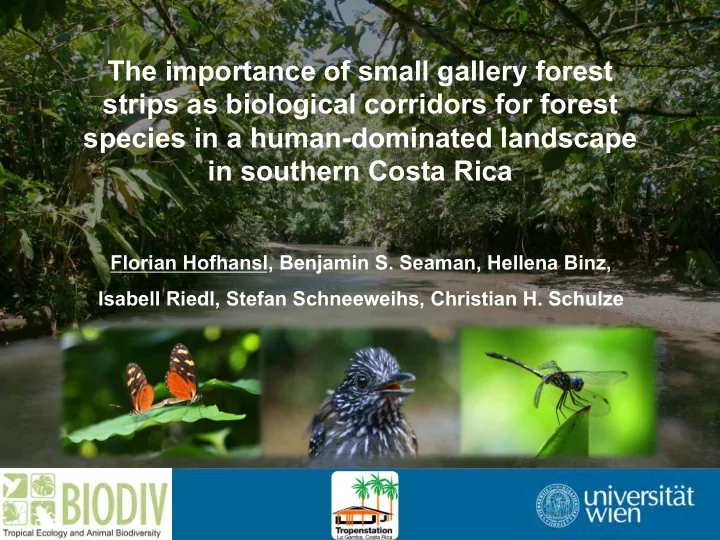
The importance of small gallery forest strips as biological corridors for forest species in a human-dominated landscape in southern Costa Rica Florian Hofhansl, Benjamin S. Seaman, Hellena Binz, Isabell Riedl, Stefan Schneeweihs, Christian H.


slide-1
SLIDE 1

The importance of small gallery forest strips as biological corridors for forest species in a human-dominated landscape in southern Costa Rica

Florian Hofhansl, Benjamin S. Seaman, Hellena Binz, Isabell Riedl, Stefan Schneeweihs, Christian H. Schulze

slide-2
SLIDE 2
  • Costa Rican forestry law protects forest strips of

30-100 m width along every stream and river.

  • Network of linear forest strips that cross the

agricultural matrix of open land.

  • Some strips are connected to closed forest,

while others are entirely isolated.

Gallery Forest

slide-3
SLIDE 3

Gallery Forest

slide-4
SLIDE 4

Gallery Forest

slide-5
SLIDE 5

Gallery Forest

slide-6
SLIDE 6
  • Forest (F): large patches of closed primary or

secondary forest.

  • Connected gallery forest (GC): directly

connected to closed forest.

  • Isolated gallery forest (GI): without canopy

connection to closed forest; 300–600 m distance from forest.

Habitats

slide-7
SLIDE 7
  • Difference in richness and composition of forest

species between habitat types?

à Conservation relevance of gallery forest?

  • Difference between connected and isolated

gallery forests?

à Importance of connectivity?

  • Correlation of species richness (α-diversity) and

species composition (β-diversity) of different species groups.

à Which measure is better suited for comparing species’ response to habitat change?

Questions

slide-8
SLIDE 8

Dragonflies Birds

  • Underst. Birds

Butterflies

Forest Connected GF Isolated GF

Study Sites

slide-9
SLIDE 9

Birds (103 forest species; 71.53 % of total):

  • 33 sites (11 F, 11 GC, 11 GI)
  • 10 min point counts, 25 m radius
  • visual and acoustic identification
  • 10-12 times per site

Dragonflies (18 forest species; 34.62 % of total):

  • 19 sites (5 F, 7 GC, 7 GI)
  • sweep-netting for 1 hour within 50

metres of shoreline

  • 3-4 times per site

Sampling Methods

slide-10
SLIDE 10

Butterflies (53 forest species; 70.67 % of total):

  • 30 sites (10 F, 10 GC, 10 GI)
  • sweep-netting and visual identification

along 50 m transects

  • 15 min per transect
  • 6 times per site

Understory Birds (73 forest species; 81.11 % of total):

  • 12 sites (4 F, 4 GC, 4 GI)
  • mist-netting with 4 mist-nets per site

(12 x 2.5 m, 16 mm mesh)

  • 3-4 days of mist-netting per site, ca

7 hours per day

Sampling Methods

slide-11
SLIDE 11

10 20 30 40 50 60 70 80 90 100

Birds Understorey Birds Butterflies Dragonflies

Birds & Understorey birds

5 10 15 20 25 30 35 40

Butterflies & Dragonflies

Chao 2 esti recorded F GC GI

Species Richness

F GC GI

Number of species

slide-12
SLIDE 12

Birds Understorey Birds Butterflies Dragonflies GC equivalent F equivalent F equivalent 100 % 100 % GC GI GI 100 %

Species Richness

Chao 2 estimates

slide-13
SLIDE 13

Birds Understorey Birds Butterflies Dragonflies Birds Understorey Birds R = -0.02, N = 12, p = 0.953 Butterflies R = -0.1, N = 30, p = 0.584 R = -0.04, N = 12, p = 0.909 Dragonflies R = 0.17, N = 17, p = 0.512 R = 0.28, N = 6, p = 0.536 R = 0.27, N = 17, p = 0.275

Spearman rank correlation (of recorded number of species per site):

Alpha Diversity

à N = refers to number of sites where both taxa were found à No significant effects - No correlation between taxa! à α-diversity no indicator of changes over habitat types across taxa!

slide-14
SLIDE 14

Birds Butterflies Dragonflies Understorey Birds Dimension 2 Dimension 1

Stress: 0.14 Stress: 0.19 Stress: 0.08 Stress: 0.22

F GC GI * F ≠ GC ≠ GI * F ≠ GI * F ≠ GC ≠ GI * F ≠ GC & GI

Species Composition

slide-15
SLIDE 15

Birds Understorey Birds Butterflies Dragonflies Birds Understorey Birds Rho = 0.726, N = 12, p = 0.001 Butterflies Rho = 0.661, N = 30, p = 0.001 Rho = 0.452, N = 12, p = 0.008 Dragonflies Rho = 0.062, N = 17, p = 0.302 Rho = 0.684, N = 6, p = 0.003 Rho = 0.083, N = 17, p = 0.245

Spearman matrix rank correlation (of Bray-Curtis matrices) :

Beta Diversity

à Based on randomization – significant pattern is NOT incidental! à Changes in composition are similar between taxa à β-diversity as indicator of changes over habitat types across taxa

slide-16
SLIDE 16
  • Species richness:

– Highest in forest but substantial number of forest species occur in gallery forests as well. – Conservation value of gallery forests: connected >>> isolated

  • Species composition:

– Forest interior set apart from gallery forests for birds and butterflies but not dragonflies – Distinct species assemblages of understorey birds at connected and isolated gallery forest sites.

Conclusions

slide-17
SLIDE 17
  • No congruency of species richness between taxa.
  • But: similar changes of species composition.

à β-diversity represents better measure for comparing changes over habitat types between species groups than α-diversity.

  • Conservation implication:

(1) gallery forests are important habitat patches for forest species in human-dominated landscapes (2) increase landscape permeability for forest species (3) act as biological corridors for additional forest species (?)

Conclusions

slide-18
SLIDE 18

Ministerio de Costa Rica: MINAE (Ministerio Nacional de Ambiente y Energia) Tropical Research Station La Gamba: Anton Weissenhofer, Werner Huber Victor Cruz-Garcia, Luis Sanchez-Jimenez, Eduardo Arauz-Suarez

Acknowledgements

www.univie.ac.at/bdef

slide-19
SLIDE 19

Tropical Research Station La Gamba

http://www.lagamba.at