The Labelling Nano products g p nanotechnology Environmental - - PDF document

the labelling nano products g p
SMART_READER_LITE
LIVE PREVIEW

The Labelling Nano products g p nanotechnology Environmental - - PDF document

01/03/2011 No current legislation and regulation of nanotechnologies in food and packaging applications , except cosmetics in EU Products, Privacy & People: Regulating at the Nanoscale USA UK/EC House of Lords, London, 28 Feb 2011 Regulatory


slide-1
SLIDE 1

01/03/2011 1

Products, Privacy & People: Regulating at the Nanoscale House of Lords, London, 28 Feb 2011

The Labelling ‘Nano‐products’

Geoffrey Hunt Centre for Bioethics & Emerging Technologies

www.smuc.ac.uk/cbet huntg@smuc.ac.uk

g p ‐ update February 2011

G Hunt 2011

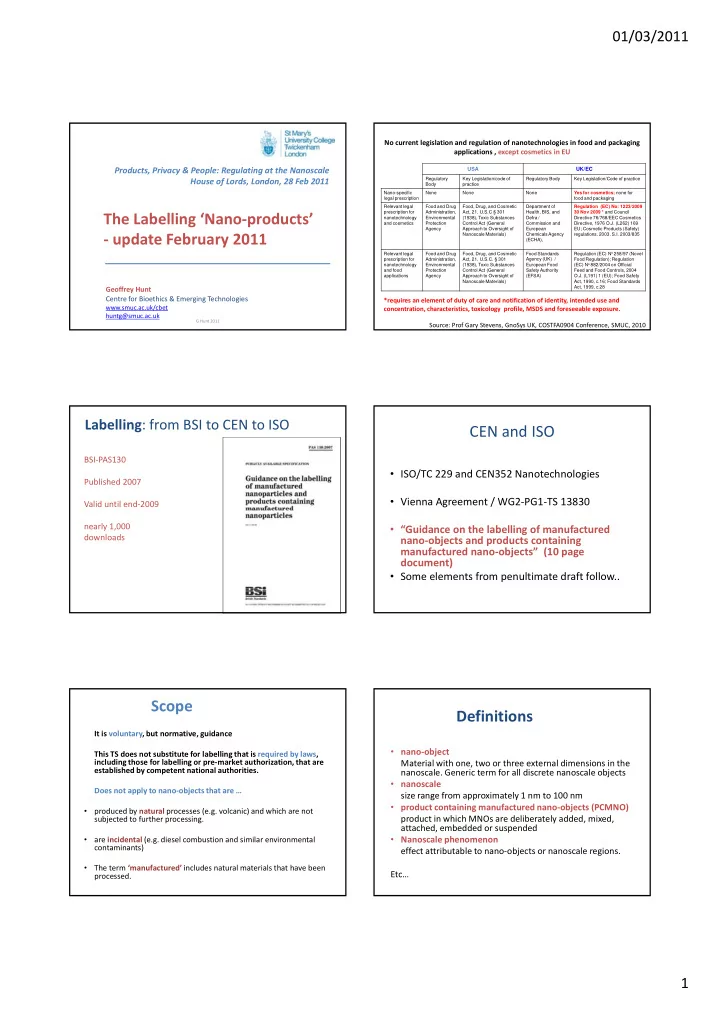
No current legislation and regulation of nanotechnologies in food and packaging applications , except cosmetics in EU

USA UK/EC

Regulatory Body Key Legislation/code of practice Regulatory Body Key Legislation/Code of practice Nano-specific legal prescription None None None Yes for cosmetics; none for food and packaging Relevant legal prescription for nanotechnology and cosmetics Food and Drug Administration, Environmental Protection Food, Drug, and Cosmetic Act, 21. U.S.C § 301 (1938), Toxic Substances Control Act (General Department of Health, BIS, and Defra / Commission and Regulation (EC) No: 1223/2009 30 Nov 2009 * and Council Directive 76/768/EEC Cosmetics Directive, 1976 O.J. (L262) 169 Agency Approach to Oversight of Nanoscale Materials) European Chemicals Agency (ECHA), EU; Cosmetic Products (Safety) regulations, 2003, S.I. 2003/835 Relevant legal prescription for nanotechnology and food applications Food and Drug Administration, Environmental Protection Agency Food, Drug, and Cosmetic Act, 21. U.S.C. § 301 (1938), Toxic Substances Control Act (General Approach to Oversight of Nanoscale Materials) Food Standards Agency (UK) / European Food Safety Authority (EFSA) Regulation (EC) No 258/97 (Novel Food Regulation); Regulation (EC) No 882/2004 on Official Feed and Food Controls, 2004 O.J. (L191( 1 (EU); Food Safety Act, 1990, c.16; Food Standards Act, 1999, c.28

*requires an element of duty of care and notification of identity, intended use and concentration, characteristics, toxicology profile, MSDS and foreseeable exposure. Source: Prof Gary Stevens, GnoSys UK, COSTFA0904 Conference, SMUC, 2010

BSI‐PAS130 Published 2007 Valid until end‐2009

Labelling: from BSI to CEN to ISO

nearly 1,000 downloads

  • ISO/TC 229 and CEN352 Nanotechnologies
  • Vienna Agreement / WG2‐PG1‐TS 13830

CEN and ISO

  • “Guidance on the labelling of manufactured

nano‐objects and products containing manufactured nano‐objects” (10 page document)

  • Some elements from penultimate draft follow..

Scope

It is voluntary, but normative, guidance This TS does not substitute for labelling that is required by laws, including those for labelling or pre‐market authorization, that are established by competent national authorities. Does not apply to nano‐objects that are … Does not apply to nano objects that are …

  • produced by natural processes (e.g. volcanic) and which are not

subjected to further processing.

  • are incidental (e.g. diesel combustion and similar environmental

contaminants)

  • The term ‘manufactured’ includes natural materials that have been

processed.

Definitions

  • nano‐object

Material with one, two or three external dimensions in the

  • nanoscale. Generic term for all discrete nanoscale objects
  • nanoscale

f l size range from approximately 1 nm to 100 nm

  • product containing manufactured nano‐objects (PCMNO)

product in which MNOs are deliberately added, mixed, attached, embedded or suspended

  • Nanoscale phenomenon

effect attributable to nano‐objects or nanoscale regions. Etc…

slide-2
SLIDE 2

01/03/2011 2 Labelling of what?

  • MNOs.
  • PCMNOs, except where the nano‐objects are

bound and could not be released ..

  • PCMNOs which are components of complex

p p systems (e.g. a vehicle, mobile phone or game console), which could be expected to release MNOs ..

  • MNOs and PCMNOs in which there is a significant

level of incidental NOs generated that might be released…

Use of the prefix “nano”

The prefix “nano” should only be used in product labelling if either or both… h d d i O i l di

  • the product does contain MNOs, including

their agglomerates or aggregates;

  • the product displays nanoscale phenomena

according to the definition

Label statements

Where a nanoscale form of a chemical substance is used the minimum statement should consist of the term ‘nanoscale’ or ‘nano’ before or after that substance. In addition the label statements may include:

  • CA number [chemical abstract ‐ ACS]
  • Size range
  • Specific surface area
  • Aspect ratio
  • Amount

Examples

  • X (nano) [Where ‘X’ is the chemical substance]
  • Contains a manufactured nanoscale form of X;
  • Contains 0.1 g of nanoscale X;
  • Contains a dispersion of manufactured nanoscale

Contains a dispersion of manufactured nanoscale form of X in Y [chemical substance];

  • Contains X, approximate size range P nm – Q nm,

specific surface area R m2 g‐1;

  • Contains carbon nanotubes, with an aspect ratio
  • f 1:20.

Other specific information

  • Consideration should be given, where relevant, to the inclusion of
  • ther specific information about the MNOs used such as:
  • Whether free or not, i.e. whether bound in a solid matrix;
  • Whether a mixture of MNOs (e.g. Contains nano‐objects of both

TiO2 and ZnO);

  • Any special disposal requirements (e.g. “Return to…”, “Do not

y p p q ( g , burn…”, “Do not flush into public waste water system”);

  • The specific source of the MNOs (e.g. derived from clay);
  • Description of the function(s) of MNOs (e.g. use of the material in

nano‐object form ensures more complete dissolution and hence faster assimilation);

  • Packaging information (e.g. for safe opening);
  • Date information regarding the MNOs (e.g. normal practice);
  • If unstable under specific conditions (e.g. UV, friction);

Annex: conceptual framework

Divergent regional needs and interests, hence

  • CSR and governance
  • supply chain communication
  • the precautionary principle
  • product stewardship
  • life‐cycle approach
slide-3
SLIDE 3

01/03/2011 3 The ISO Guidance: Conflict & Consensus

  • 2011: The final consensus‐based draft failed

in the international ballot

  • 48% in favour; CEN got 66% of the weighted

voting as opposed to the 71% necessary for voting, as opposed to the 71% necessary for

  • approval. What next?
  • Economic ideology

– Market or stakeholders?

  • Stakeholder ideology

– Producers or consumers?

REGULATION: THE FUTURE EU cosmetics regulation has established the principle of special regulation More is likely to follow, probably food and food packaging next, followed by amendments to REACH (chemicals) Life Cycle approach is now widely accepted and will probably be part

  • f any general regulatory framework

Regulation will probably be based on special characteristics in hazard assessment; including size, aspect ratio, surface area and chemistry Migration out of media, biological transport mechanism, and transformation are critical aspects in exposure assessment – pulmonary, dermal, GE Bioaccumulation and persistence will be key issues in the risk assessment Products, Privacy & People: Regulating at the Nanoscale House of Lords, London, 28 Feb 2011

Thank you!

Geoffrey Hunt Centre for Bioethics & Emerging Technologies

www.smuc.ac.uk/cbet huntg@smuc.ac.uk

Thank you!

G Hunt 2011

ADDITIONAL MATERIAL ADDITIONAL MATERIAL

Precautionary principle

  • The precautionary principle is the concept that lack of scientific

evidence of risk should not prevent appropriate precautionary actions being taken.

  • These should be proportionate, non‐discriminatory, and consistent

with previous action, considering both costs and benefits and be bj t t i [8] subject to review [8].

  • The exercise of “precaution” will necessarily vary depending on the

products or sectors regulated, differences in regulatory objectives, and perceived level of risk.

  • While the definition notes that costs and benefits should be

considered, it does not provide that measures should be cost effective.

  • It is recognized that the TS will be usable in countries that do not

subscribe to this concept.

Communication

  • Supply Chain communication

MNOs may enter at one or more points into a more or less complex supply chain from primary manufacturers through to wholesale and retail

  • distributors. In this situation, the upstream business should inform those

downstream when they are in possession of relevant information, and those downstream have a reciprocal duty to ask for any such information, in so far as it is significant for labelling.

  • Unexpected effects

Consumers using PCMNOs for the first time may not be prepared for any greater effectiveness, efficiency, capability or other difference compared to similar products that do not contain MNOs. Consumers should therefore be informed or reminded in the instructions for use of effects that may be different from those expected. This may be useful for making the user aware both of the benefits of appropriate use and the possible harms of inappropriate use.