
SLIDE 1
The R Statistical Computing Environment Basics and Beyond Mixed-Effects Models
John Fox
McMaster University
ICPSR/Berkeley 2016
John Fox (McMaster University) Mixed-Effects Models ICPSR/Berkeley 2016 1 / 13
The Linear Mixed-Effects Model
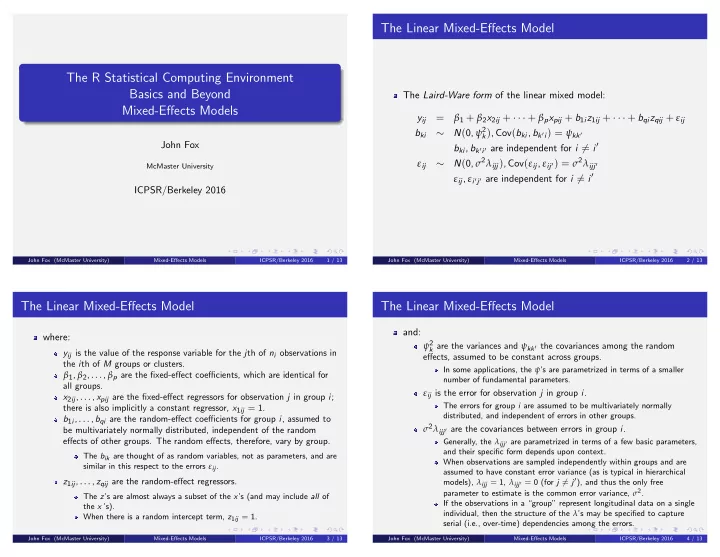
The Laird-Ware form of the linear mixed model: yij = β1 + β2x2ij + · · · + βpxpij + b1iz1ij + · · · + bqizqij + εij bki ∼ N(0, ψ2
k), Cov(bki, bk′i) = ψkk′
bki, bk′i′ are independent for i = i′ εij ∼ N(0, σ2λijj), Cov(εij, εij′) = σ2λijj′ εij, εi′j′ are independent for i = i′
John Fox (McMaster University) Mixed-Effects Models ICPSR/Berkeley 2016 2 / 13
The Linear Mixed-Effects Model
where:
yij is the value of the response variable for the jth of ni observations in the ith of M groups or clusters. β1, β2, . . . , βp are the fixed-effect coefficients, which are identical for all groups. x2ij, . . . , xpij are the fixed-effect regressors for observation j in group i; there is also implicitly a constant regressor, x1ij = 1. b1i, . . . , bqi are the random-effect coefficients for group i, assumed to be multivariately normally distributed, independent of the random effects of other groups. The random effects, therefore, vary by group.
The bik are thought of as random variables, not as parameters, and are similar in this respect to the errors εij.
z1ij, . . . , zqij are the random-effect regressors.
The z’s are almost always a subset of the x’s (and may include all of the x ’s). When there is a random intercept term, z1ij = 1.
John Fox (McMaster University) Mixed-Effects Models ICPSR/Berkeley 2016 3 / 13
The Linear Mixed-Effects Model
and:
ψ2
k are the variances and ψkk′ the covariances among the random
effects, assumed to be constant across groups.
In some applications, the ψ’s are parametrized in terms of a smaller number of fundamental parameters.
εij is the error for observation j in group i.
The errors for group i are assumed to be multivariately normally distributed, and independent of errors in other groups.
σ2λijj′ are the covariances between errors in group i.
Generally, the λijj′ are parametrized in terms of a few basic parameters, and their specific form depends upon context. When observations are sampled independently within groups and are assumed to have constant error variance (as is typical in hierarchical models), λijj = 1, λijj′ = 0 (for j = j′), and thus the only free parameter to estimate is the common error variance, σ2. If the observations in a “group” represent longitudinal data on a single individual, then the structure of the λ’s may be specified to capture serial (i.e., over-time) dependencies among the errors.
John Fox (McMaster University) Mixed-Effects Models ICPSR/Berkeley 2016 4 / 13