
SLIDE 1
The local velocity field according to 6dFGSv
Christina Magoulas (UCT) ! and the 6dFGSv team
LSS & Galaxy Flows: July 2016
Background Image: C. Fluke
The local velocity field according to 6dFGSv Christina Magoulas - - PowerPoint PPT Presentation
The local velocity field according to 6dFGSv Christina Magoulas (UCT) ! and the 6dFGSv team LSS & Galaxy Flows: July 2016 Background Image: C. Fluke 6dFGSv: outline 6dFGSv: distances and peculiar velocities defining the 6dFGSv sample
Christina Magoulas (UCT) ! and the 6dFGSv team
LSS & Galaxy Flows: July 2016
Background Image: C. Fluke
defining the 6dFGSv sample and the individual peculiar velocity distributions.
cosmological constraints from the velocity power spectrum (Johnson et al. 2014) and MV bulk flow (Scrimgeour et al. 2016).
3D map of the velocity field out to 160 Mpc/h, as traced by 6dFGSv
Bayesian analysis of the 6dFGSv dataset as a whole
Southern Sky on the UK Schmidt Telescope; large uniformly sampled volume
in log (distance ratio) units where errors are Gaussian, taking advantage of (forward) fitting in “data” space
Johnson et al. MNRAS (2014)
Gaussian distribution in log(distance) space where x = log10(Dz/DH) skewed in velocity, vp, distribution (errors are close to log-normal)
6dFGSv distance and velocity data
From Springob et al. MNRAS (2014)
Springob et al. MNRAS (2014)
(Δd), and probability distribution variables (ϵd, ⍺) available online: http://vizier.cfa.harvard.edu/viz-bin/ VizieR?-source=J/MNRAS/445/2677
The 6dF Galaxy Survey: peculiar velocity field and cosmography.
The 6dF Galaxy Survey: cosmological constraints from the velocity power spectrum.
The 6dF Galaxy Survey: bulk flows on 50-70 h-1 Mpc scales.
The 6dF Galaxy Survey: bulk flows and β from fitting the peculiar velocity field
Constraining the growth rate of structure using a velocity power spectrum analysis of 6dFGSv and SNe data
Johnson et al. MNRAS (2014)
ΛCDM prediction
300 Mpc/h 100 Mpc/h 50 Mpc/h
Johnson et al. MNRAS (2014) See also Howlett talk tomorrow
galaxy bias and accurate to ~15%
ΛCDM prediction (Planck)
fσ8(z = 0) = 0.418±0.065
using a minimum variance method to measure the 6dFGSv bulk flow in Gaussian spheres of RI=50 and 70 h-1 Mpc
|U| = 248±58 km s-1 (l,b) = (318°±20°, 40°±13°)
|U| = 243±58 km s-1 (l,b) = (318°±30°, 39°±13°)
z-direction when compared to MLE method (reflects difference in weighting schemes)
Turnbull et al. (2012), Feindt et al. (2013), Hong et al. (2014)
implying a high value of σ8, but consistent with Planck results within 2σ
Scrimgeour et al. MNRAS (2016)
ΛCDM prediction (all-sky Gaussian window)
[1] Forward-fitting (Magoulas et al. in prep.) Fitting model to the data and compare in “data space”. Do a Bayesian analysis of the observational data set as a whole (in r-s-i space), without computing individual peculiar velocities.
!
[2] Reverse-fitting (Springob et al. 2014) Fitting data to the model and compare in “model space”. Compute a Bayesian posterior probability distribution for the distance/ peculiar velocity of each galaxy, rather than a single velocity.
Springob et al. (2014)
3D Visualisation by S2PLOT
3D Visualisation by S2PLOT
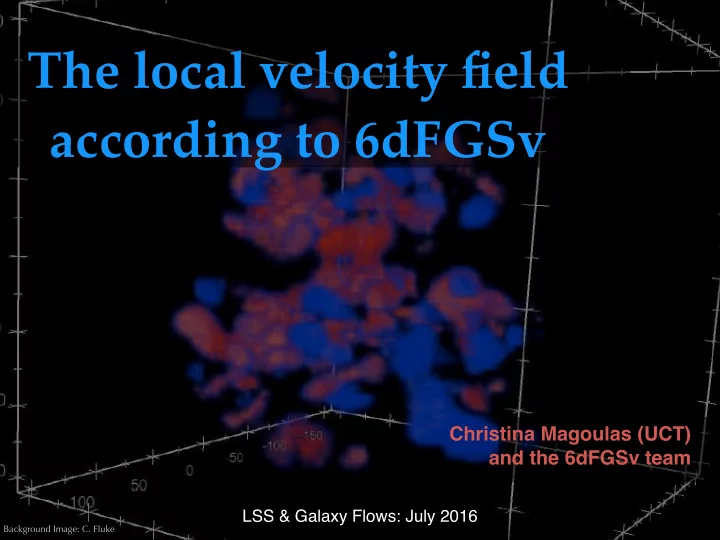
3D map of 6dFGSv velocity field (smoothed) showing only those regions with largest positive/negative velocities
Springob et al. (2014)
CF-2: Tully et al. (2014)
Cosmicflows-2 > 3: slice in the Supergalactic equatorial plane
CF-3: Tully et al. (submitted) Addition of 6dFGSv (orange) is significant fraction of the South
Springob et al. (2014)
compared with models of 2MRS and PSCz
positive peculiar velocities in vicinity
as Norma and Vela Supercluster)
negative than expected peculiar velocities in the direction of Pisces- Cetus Supercluster, (∼130° away)
PSCz 2MRS
CMB
90 60 30 330 300 270 240 210 180 150
15 30 45 60 75
6dFGSv (total) 6dFGSv (residual) Watkins et al. 2009 Turnbull et al. 2012 (total - ML) Turnbull et al. 2012 (residual) Turnbull et al. 2012 (total - MV) Colin et al. 2011 Dai et al. 2011 Nusser & Davis 2011
2000 4000 6000 8000 10000 12000 14000 16000
cz [km s−1]
6dFGSv
= (318°±20°, 40°±13°) using ML forward modeling approach
50 100 150
R [h−1 Mpc]
200 400 600 800
|vtot| [km s−1]
6dFGSv COMPOSITE A1 DKS11 CMSS11 CMB ND11
Scrimgeour et al. MNRAS (2016) Magoulas et al. (in prep)
different window functions; hard to compare with each
effective volume of the survey
6dFGSv
method of Carrick et al. 2015) within 200 h
2M++ redshift catalogue (mostly 6dF in the South)
2M++ velocity field Carrick et al. 2015, Magoulas et al. in prep. 2M++ density field Carrick et al. 2015
0.55/b).
2MRS (βfid=0.4) and PSCz (βfid=0.5), but low when compared to 2M++ (βfid=0.43)
distribution of the model reconstruction) but largest with comparison to 2M++ 420±65 km/s with a very low β=0.18±0.05;
as an independent check to 2M++ (doesn’t account for sample selection, distance weighting, zero-point calibration)
β = 0.13 is consistently close to the value fitted by the full ML forward modeling (cf. β = 0.14±0.06) and suggests usual fitting method is robust.
large discrepancy between the observed 6dFGSv and predicted 2M++ velocities.
velocities to date.
a Bayesian analysis of the dataset as whole. Using 6dFGSv, we map the velocity field in the nearby universe and compare to the density field derived from redshift surveys.
with some discrepancies: β=0.32±0.08 (2MRS), β=0.58±0.12 (PSCz) and β=0.13±0.06 (2M++)
km/s towards (l,b) = (318˚±20˚, 40˚±13˚) meaning the 6dFGSv volume has a substantial coherent motion towards Shapley.
3D Visualisation by S2PLOT
6dFGSv velocity field in 30 Mpc/h spheres around local overdensities
Springob et al. (2014)
morphological type separated by morphological subsamples (top; early types in red, intermediate types in green, late types in blue) and full sample (bottom).
error bars) indicate that a cut of T > 3 removes the most discrepant outliers,
50 100 150
R [h−1 Mpc]
200 400 600 800
|vtot| [km s−1]
6dFGSv COMPOSITE A1 DKS11 CMSS11 CMB ND11
6dFGSv
6dFGSv survey limit radius of sphere with same volume as 6dFGSv “hemisphere”
(Watkins 2009; Nusser & Davis 2011) and with standard model predictions (Colin 2011, Watkins 2009)
T O P H AT F I LT E R ( 9 0 % P R O B A B I L I T Y )
!
G A U S S I A N F I LT E R ( 9 0 % P R O B A B I L I T Y )