
SLIDE 1
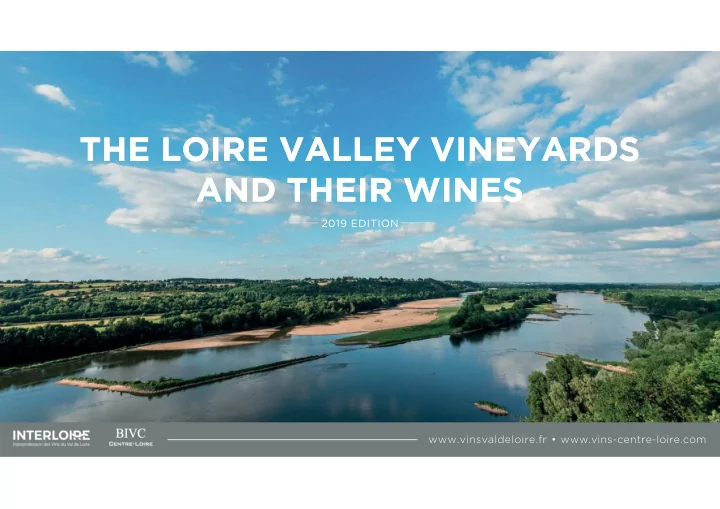
THE LOIRE VALLEY VINEYARDS AND THEIR WINES THE LOIRE VALLEY VINEYARDS AND THEIR WINES
2019 EDITION www.vinsvaldeloire.fr • www.vins-centre-loire.com
THE LOIRE VALLEY VINEYARDS THE LOIRE VALLEY VINEYARDS AND THEIR - - PowerPoint PPT Presentation
THE LOIRE VALLEY VINEYARDS THE LOIRE VALLEY VINEYARDS AND THEIR WINES AND THEIR WINES 2019 EDITION www.vinsvaldeloire.fr www.vins-centre-loire.com THE LOIRE VALLEY VINEYARDS AND THEIR WINES General Overview History of the Vineyards
2019 EDITION www.vinsvaldeloire.fr • www.vins-centre-loire.com
General Overview History of the Vineyards Soils, Climate and Grapes AOP/IGP Wines Key figures
www.vinsvaldeloire.fr • www.vins-centre-loire.com
The Vineyards of France The Vineyards of the Loire Valley
www.vinsvaldeloire.fr • www.vins-centre-loire.com
Page 4
The main winegrowing regions in France are:
The Loire Valley
The Loire Valley Vineyards and their Wines • General Overview
47° North
Page 5
The longest, most diverse vineyard area in France. Stretches horizontally across the country, giving it a unique profile. The Loire Valley vineyards are made up of several discrete vineyard areas.
Nantais Anjou-Saumur Touraine Centre-Loire Auvergne
The Loire Valley Vineyards and their Wines • General Overview
From the birth of the vineyards in the 5th century to the present day
www.vinsvaldeloire.fr • www.vins-centre-loire.com
4th century: The birth of the Loire vineyards From the Middle Ages to the 17th century: First the religious orders, then the Kings of France, played a major part in developing the Loire Valley vineyards. The Loire: The river Loire is an inextricable part of the vineyard landscape, casting its unique light over the surroundings and creating a breathtaking panorama. The Châteaux on the Loire: One of the most popular tourist destinations in France. Home of writers and other notable personalities: Including Joan of Arc, Leonardo da Vinci, Jules Verne, Balzac, Rabelais and George Sand. The Loire Valley is the largest French region to be recognised as a UNESCO World Heritage Site.
Jeanne d’Arc Léonard de Vinci François Rabelais Honoré de Balzac
Page 7 The Loire Valley Vineyards and their Wines • History
In the late 19th century, the French vineyards were all but annihilated by the tiny yellow phylloxera aphid from the United States. In 1885, overall harvest yield in France dropped from 80 million hectolitres to 25 million. Committees for the Eradication of Phylloxera were formed at this time to help battle the vineyard pests; these were the forerunners of today’s Winegrowers’ Syndicates. A solution was eventually found: to graft French varietals onto naturally resistant American rootstocks. It was an arduous, costly job to restore the French vineyards, and was not completed until after the 14-18 war.
Page 8 The Loire Valley Vineyards and their Wines • History
Page 9
When the phylloxera crisis was over, the vineyards were replanted using varietals better suited to the Loire Valley’s soils and climates:
In 1889, wine was defined by French law as ‘the product of complete or partial fermentation of fresh grapes or fresh grape juice’.
Melon de Bourgogne Cabernet Franc Chenin Sauvignon
This was the start of a boom in the cultivation of top-quality grapes, and the beginning of stricter quality controls for wines.
The Loire Valley Vineyards and their Wines • History
1936 saw the birth of the French AOC (Appellations d’Origine Contrôlées) system, driving a move towards higher quality wines. Quincy, Sancerre, Muscadet Sèvre et Maine, Muscadet Coteaux de la Loire, Cabernet d’Anjou, Rosé d’Anjou, Saumur and Vouvray were among the first vineyard areas to be awarded AOC status in 1936.
Page 10 The Loire Valley Vineyards and their Wines • History
The years following the Second World War brought the vineyards to crisis point, as young people left in their droves to work in factories. Winegrowers in the Loire Valley took a number of bold commercial decisions to help ensure their future, including:
Page 11 The Loire Valley Vineyards and their Wines • History
Technological advances (including improved vineyard management and root- stock selection) and increasing mechanisation led to continued improvements in wine quality. The introduction of pesticides helped ensure there was enough yield to support growth in new markets. Mixed farming gave way to specialist viticulture.
Page 12 The Loire Valley Vineyards and their Wines • History
Page 13
The 1980s brought an astounding array of technological advancements in the winery, including:
Vinification became increasingly precise, monitoring juice quality, tannin extraction etc. This period brought a marked improvement in the quality of the wines and more uniformity between vintages.
The Loire Valley Vineyards and their Wines • History
Page 14
In 1991, the Loire Valley experienced widespread frosts, to devastating effect. The quality of 1992’s harvests was average at best, and the Loire Valley lost a lot of ground in the marketplace. But the disaster marked the start of a resurgence in quality for Loire Valley
management plans, pruning, de-budding and green harvests. With improvements both in the vineyard and the winery, winegrowers were free to focus on the grape, a key component of wine quality.
The Loire Valley Vineyards and their Wines • History
Since the end of the 1990s, the Loire Valley winegrowing sector has been fully committed to taking a more environmentally responsible approach to its winegrowing activities, intervening only where strictly necessary. In 2019, almost 30% of Loire Valley vineyards are either sustainably or
Page 15
Today the Loire Valley are proud to acknowledge their close bonds with their terroir and the unrivalled quality of their wines.
The Loire Valley Vineyards and their Wines • History
The Loire River Basin and its Geology: A basis for diversity Climate: Tidal influences and the Loire Grapes: A wide range of different varieties
www.vinsvaldeloire.fr • www.vins-centre-loire.com
Page 17
The Loire is the longest river in France, its hydrographic network covering a full one-fifth of the
Loire Valley wines.
The Loire Valley Vineyards and their Wines • Soils, climate, grapes
Page 18
Massif Armoricain
(ancient bedrock)
Bassin Parisien
(sedimentary) Kimmeridgian
Massif Central
(ancient bedrock)
The Loire Valley Vineyards and their Wines • Soils, climate, grapes
Page 19
Nantais
Igneous rock from the Armorican Massif (gneiss, mica, greenstone rock and granite).
Anjou
Schist and sandstone (black soils)
Saumur
Tuffeau (chalk)
Touraine
Tuffeau to the west, with siliceous clay and siliceous sand to the east,and calcareous clay slopes and light gravel on the banks of the Loire.
Centre-Loire
Kimmeridgian limestone, flint and gravel
Auvergne
Mica schist, sandstone and granite
The Loire Valley Vineyards and their Wines • Soils, climate, grapes
Page 20
The Loire Valley microclimates change according to altitude and slope orientation. The prevailing westerly wind
400 km
C°
Oceanic climate Continental climate Semi oceanic / semi continental climate
The « buffer effect » can be a decisive factor in the production of sweet wines
The Loire Valley Vineyards and their Wines • Soils, climate, grapes
Page 21
Overall, the Loire Valley enjoys a temperate climate, but each of its sub-regions is subject to a different set of influences. The Nantais and Anjou enjoy an oceanic climate. From the Saumur region to Touraine, the climate becomes progressively more continental in character as the hills provide a barrier to the ocean’s influence. From Touraine to Centre-Loire, the climate is continental.
The Nantais climate is distinctive for its intense light and tidal influences. Chenin enjoys low rainfall, promoting late harvests. The cool, continental climate is ideal for Sauvignon and Pinot Noir.
01/04 - 30/10 Nantais Anjou-Saumur Touraine Centre-Loire Insolation (hours) 1570 1386 1349 1345 T sum (in °C) 3071 3294 3278 3276 Precipitation (mm) 406 352 376 406 Annual Temperature (°C) 11,9 11,9 11,1 11
The Loire Valley Vineyards and their Wines • Soils, climate, grapes
2 8 a g e P Page 22
Melon de Bourgogne
Folle Blanche Grolleau Côt
Cabernet Franc and Chenin Pinot Noir Sauvignon Blanc
Chardonnay Gamay
The Loire Valley Vineyards and their Wines • Soils, climate, grapes
Chardonnay
8%
Folle Blanche
3%
Divers
4%
Page 23
3 main varietals: Melon de Bourgogne, Chenin blanc et Sauvignon blanc. Other varietals include:Folle Blanche, Chardonnay, Chasselas, Romorantin Sauvignon Gris and Tressalier. These are made into dry, semi-sweet, sweet and sparkling wines, mostly single-varietal.
Sauvignon Blanc
28%
Melon de Bourgogne
30%
Chenin Blanc
27%
The Loire Valley Vineyards and their Wines • Soils, climate, grapes
Page 24
Melon de Bourgogne
Folle Blanche
Chenin Blanc
Sauvignon
Blends and single varietal
de l’Arnon, Puy-de-Dôme (Sauvignon, Chardonnay…) Chardonnay
Romorantin
Chasselas
Melon de Bourgogne : dans le Pays Nantais Chenin : Anjou Saumur et Touraine Sauvignon Blanc : Centre Loire et Touraine
The Loire Valley Vineyards and their Wines • Soils, climate, grapes
Page 25
Chenin Blanc
Malvoisie (Pinot Gris)
Chenin Blanc grapes with concentrated sugars, showing the start of botrytis cinerea.
The Loire Valley Vineyards and their Wines • Soils, climate, grapes
Page 26
Chenin Blanc
Chenin et Chardonnay : Anjou Saumur et Touraine
Blends
The Loire Valley Vineyards and their Wines • Soils, climate, grapes
Divers
6%
Grolleau
7%
Cabernet Sauvignon
5%
Page 27
The 3 main varietals are Cabernet Franc, Gamay and Pinot Noir Other varietals include: Grolleau, Cabernet Sauvignon, Pineau d’Aunis, Côt and Négrette. Used to make reds, rosés and sparkling wines, mostly as single varietals.
Cabernet Franc
56%
Gamay
18%
Pinot Noir
8%
The Loire Valley Vineyards and their Wines • Soils, climate, grapes
Page 28
Cabernet Franc
Gamay
Pinot Noir
Blends and single varietal
l’Arnon, Puy-de-Dôme (Gamay, Cabernet Franc, Pinot Noir…)
Cabernet Franc Gamay Pinot Noir
The Loire Valley Vineyards and their Wines • Soils, climate, grapes
Page 29
Blends and single varietal
Cher et de l’Arnon, Puy-de-Dôme (Gamay, Cabernet Franc, Pinot Noir…) Cabernet Franc
Cabernet Sauvignon
Pinot Noir
Pinot Gris
Pineau d’Aunis
Gamay
Cabernet Franc Gamay Pinot Noir
The only region in the world to ‘rosés tendre'.
The Loire Valley Vineyards and their Wines • Soils, climate, grapes
Page 30
VIGNOBLES D’AUVERGNE VIGNOBLES NANTAIS VIGNOBLES DE LA TOURAINE VIGNOBLES DU CENTRE-LOIRE VIGNOBLES D’ANJOU-SAUMUR
OCEANIC CLIMATE SEMI OCEANIQUE / SEMI CONTINENTAL CLIMATE CONTINENTAL CLIMATE
The Loire Valley comprises 51 AOPs and Loire Valley IGPs produced across 14 departments.
Regulation zone
Armorican Massif Paris Basin Massif Central
Kimmeridgien
Melon de Bourgogne Cabernet Franc et Chenin Blanc Sauvignon Blanc Pinot Noir
The Loire Valley Vineyards and their Wines • Soils, climate, grapes
The Nantais Region The Anjou-Saumur Region The Touraine Region The Centre-Loire Region The Auvergne Region
www.vinsvaldeloire.fr • www.vins-centre-loire.com
3 8 a g e P Page 32
51 AOP appellations and Loire Valley IGPs. 5 winegrowing regions across 14 departments.
VIGNOBLES D’AUVERGNE VIGNOBLES NANTAIS VIGNOBLES DE LA TOURAINE VIGNOBLES DU CENTRE-LOIRE VIGNOBLES D’ANJOU-SAUMUR
The Loire Valley Vineyards and their Wines • AOP/ IGP wines
AOP :
+ crus communaux : Gorges, Clisson, le Pallet, Château-Thébaud, Goulaine, Monnières-Saint- Fiacre, Mouzillon-Tillières
Brem, Chantonnay, Mareuil, Pissote, Vix
Loire Valley IGP 9 3 a g e P Page 33
Production :
485 000 hl soit 20 % of total Loire Valley production
Surface :
12 500 ha, soit 22 % of total Loire Valley vineyard area
68 %
Reds and rosés
5%
Whites
95% "Sur Lie” is a unique method of making wine. The Muscadets and Gros Plants du Pays Nantais “sur lies” spend the winter ageing on lees, and are bottled between 1st March and 31st December in the year following harvest.
The Loire Valley Vineyards and their Wines • AOP/ IGP wines
4 a g e P Page 34
LANDSCAPE
Coastal and woodland landscapes: the rivers Sèvre and Maine, the Lac de Grandlieu. The town of Nantes, the capital city of Nantais wines. The largest white single-varietal vineyard in France.
PAIRING NANTAIS WINES:
IGP Val de Loire: As an aperitif, with charcuterie, salads and summer barbecues. Muscadets and Gros Plants "sur lie": As an aperitif, with oysters and shellfish. Muscadet Communal Crus: With fish and other seafood.
FOOD HERITAGE: Seafood: Oysters and shellfish, Bouchot mussels Fish: Sardines, skate, seabass, sea bream, hake Seasonal Vegetables: Lamb’s lettuce, carrots, Noirmoutier potatoes Local products and specialities: Foods cooked with classic Nantais beurre blanc
The Loire Valley Vineyards and their Wines • AOP/ IGP wines
1 4 a g e P Page 35
AOP :
Coteaux du Layon « Villages » : Beaulieu sur Layon, Faye d’Anjou, Rablay sur Layon, Rochefort sur Loire, Saint Aubin de Luigné, Saint Lambert du Lattay
Production :
979 000 hl soit 38 % of total Loire Valley production.
Surface :
21 400 ha, soit 38 % of total Loie Valley vineyard area
89 %
IGP Val de Loire
Sparkling
19%
Red
20%
White
11%
Rosé
50%
The Loire Valley Vineyards and their Wines • AOP/ IGP wines
4 2 a g e P Page 36
LANDSCAPE
Undulating hillsides. South of the Loire: River Layon and River Aubance. The Layon Fault separates two distinct geological areas, the Armorican Massif (with Anjou Noir dark soils to the west) and the Paris Basin (with Anjou Blanc lighter soils to the east).
PAIRING ANJOU WINES:
Anjou rosé tendre: With summer salads, melon, world cuisine, red fruit tart. Anjou white/Savennières: With fish, seafood and white meat. Coteaux du Layon/Bonnezeaux: As an aperitif, with fruit-based desserts and blue cheeses (including Roquefort).
FOOD HERITAGE Fish: Pike-perch, eel, pike, Loire shad Seasonal Fruit and Vegetables: Apples, strawberries, melons, asparagus. Desserts: Crémet d’Anjou, Cointreau soufflé Local products and specialities: Rillauds, veal served Anjou-style
The Loire Valley Vineyards and their Wines • AOP/ IGP wines
4 3 a g e P Page 37
LANDSCAPE
The town of Saumur with its château overlooking the Loire. Built heritage: Tuffeau white stone. Troglodyte caves, perfect for sparkling wine.
PAIRING SAUMUR WINES
Saumur brut/Crémant de Loire: As an aperitif, with gougères or fruit-based desserts. Saumur reds: With charcuterie, meats and barbecues. Saumur white: With fish, seafood, poultry and white meat.
FOOD HERITAGE: Fish: pike-perch, eel, pike, Loire shad Seasonal fruit and vegetables: apples, strawberries, green beans, mushrooms Local products and specialities: fouées, stuffed mushrooms (galipettes), dried, apples (pommes tapées)
The Loire Valley Vineyards and their Wines • AOP/ IGP wines
4 4 a g e P Page 38
AOP :
Red wines
51%
Sparkling
17%
Touraine Amboise, Touraine Azay-le-Rideau, Touraine Chenonceaux, Touraine Mesland, Touraine Oisly
IGP Val de Loire
Production :
680 000 hl soit 28 % of Loire Valley total production
Surface :
16 300 ha, soit 29 % of Loire Valley total vineyard area
88 %
White wines
27%
Rosé wines
5%
The Loire Valley Vineyards and their Wines • AOP/ IGP wines
4 5 a g e P Page 39
PAIRING TOURAINE WINES:
Chinon/Saint-Nicolas-de-Bourgueil: With charcuterie, meat and barbecues. Vouvray/Jasnières: With fish, seafood, poultry, white meats, cheeses. Touraine whites: With seafood and goat’s cheese.
FOOD HERITAGE: Fish: fried Loire fish, pike-perch, pike, Loire shad Charcuterie: rillons and rillettes, andouillettes (sausage) made with Vouvray Seasonal fruit and vegetables: apples, pears, strawberries, asparagus, mushrooms Cheese: Sainte-Maure-de-Touraine, Valençay, Selles-sur-Cher Local products and specialities: fouées, saffron, truffles, poire tapée (speciality dried pears)...
Landscape
Vines and châteaux: Chinon, Azay-le-Rideau, Amboise, Chenonceau. River valley vineyards: Loire, Vienne, Cher, Indre, Loir, Cisse, Brenne. Home of writers and artists: Ronsard, Rabelais, Descartes, Balzac, Leonardo da Vinci.
The Loire Valley Vineyards and their Wines • AOP/ IGP wines
4 6 a g e P Page 40
AOP :
IGP
White wines
82% Production :
319 000 hl soit 13 % of total Loire Valley production
Surface :
5 900 ha, soit 10 % of total Loire Valley vineyard area
98 %
Red wines 12% Rosé wines 6%
The Loire Valley Vineyards and their Wines • AOP/ IGP wines
7 4 a g e P Page 41
CENTRE LOIRE WINE PAIRINGS
Whites: Shellfish, goat’s cheese, Japanese food. Reds: White meats, poultry. Rosés: As an aperitif, with summer salads and spicy foods.
FOOD HERITAGE: Fish: fried Loire fish, pike, eel…. Seasonal fruit and vegetables: apples, pears, Berry green lentils, walnuts Cheese: Crottin de Chavignol, Pouligny Saint-Pierre... Desserts: rousserolles doughnuts, tarte tatin, croquet biscuits, poirat pear tart... Local products and specialities: walnut oil, potato pancakes, pâté de Pâques (traditional Easter meat and egg pie)...
LANDSCAPE
A panoramic landscape featuring the hillsides of Sancerre, Pouilly and the Loire in all its untamed glory; the fields of Champagne Berrichone and the rural Pays Fort. History shaped by geology (Kimmeridgian limestone) and presence of the Loire. The town of Bourges with its cathedral.
The Loire Valley Vineyards and their Wines • AOP/ IGP wines
www.vinsvaldeloire.fr • www.vins-centre-loire.com
Page 43
Growers declaring harvests
€1.3 billion
Annual turnover, incl. 21% to export
Négociants
Cooperative wineries
A UNESCO WORLD HERITAGE SITE
The Loire Valley Vineyards and their Wines • Facts and Figures
5 1 a g e P 5 1 a g e P
appellations
IGP
hectares of vines
11.3% farmed organically (national average: 9%) and 25% with environmental accreditation
bottles of AOP/IGP wine sold
2.45 million hl produced in 2017, incl. 2.1 million hl of AOP (12% of national production).
Page 44 The Loire Valley Vineyards and their Wines • Facts and Figures
2 5 a g e P 2 5 a g e P Page 45
White wines
(dry, semi-sweet and sweet)
Rosé wines
(dry, semi-sweet)
Red wines Sparkling wines
(brut, semi-sweet)
The Loire Valley Vineyards and their Wines • Facts and Figures
3 5 a g e P 3 5 a g e P Page 46
(5th most widely available French wine region)
(3rd most widely available French wine region)
(3rd most widely available French wine region)
white wines
(2nd most widely available French wine region)
white wines
(2nd most widely available French wine region)
sparkling wines
(2nd most widely available French wine region)
rosé wines
(4th most widely available French wine region)
red wines
(4th most widely available French wine region)
white wines
(Leading French wine region for availability)
Wine shops France Large-scale retail France Foodservice* France
* Table service
The Loire Valley Vineyards and their Wines • Facts and Figures
5 4 a g e P Page 47
TURNOVER
2008: € 207 million 2013: € 213 million 2018: € 282 million
66% of this is generated by white wines, the Loire Valley’s most popular colour.
up by 36%
in 10 years LOIRE VALLEY WINES (BY VALUE)
USA
Up by
62%
115 900hl
UK
Up by
14%
92 930 hl
GERMANY
Up by
12%
71 282hl
NL Down by
31%
25 390 hl
CANADA Up by
29%
26 858 hl
BELGIUM Up by
14%
54 439 hl
JAPAN Down by
5%
13 298hl
AUSTRALIA Up by
29%
10 180hl
The Loire Valley Vineyards and their Wines • Facts and Figures
An extraordinary range of: 51 AOPs and Loire Valley IGPs produced across 14 departments. The 3rd largest French AOP vineyard. Famous for the diversity of its wines. Wines made for food, perfect as an aperitif or served with all types of cuisine.
20% sold to export
320 million bottles
Sold per year
€1.3 billion
in annual turnover
High quality products
85% of wines classified as AOP or IGP
"In the Loire Valley, the texture and richness of the wines, whatever the colour or style, never overpower their delicious fruity flavours, their ripeness, freshness, balance or ease of drinking”
Olivier Poussier, Best Sommelier in the World
Page 48 The Loire Valley Vineyards and their Wines • Facts and Figures