SLIDE 1
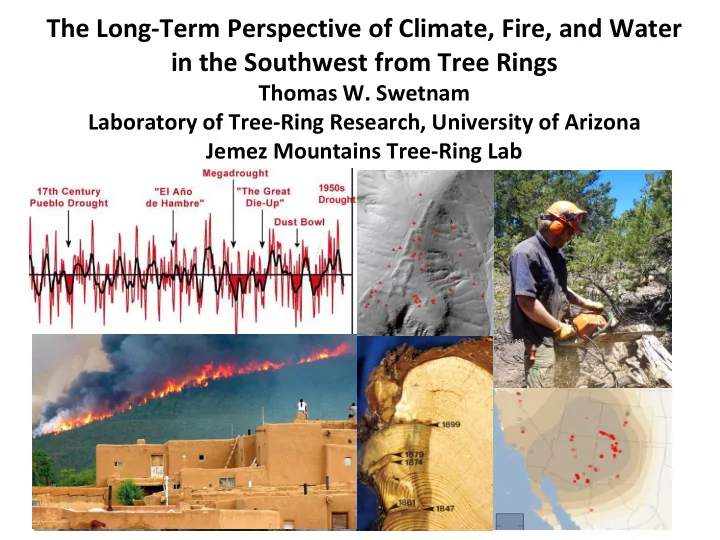
The Long-Term Perspective of Climate, Fire, and Water in the Southwest from Tree Rings
Thomas W. Swetnam Laboratory of Tree-Ring Research, University of Arizona Jemez Mountains Tree-Ring Lab
SLIDE 2
Dry ry year ears
Wet years
2018 1885
SLIDE 3
3 Andrew Ellicott Douglass 1867-1962 Founder of Modern Dendrochronology & Laboratory of Tree-Ring Research
SLIDE 4
What happened to the Cliff Dwellers? Why did they leave and where did they go?
Keet Seel, Navajo National Monument Pueblo Bonito, Chaco Culture National Historical Park Cliff Palace, Mesa Verde National Park
SLIDE 5
5 “Secrets of the Southwest Solved by Talkative Tree Rings”, by A. E. Douglass, National Geographic magazine, December 1929 “The great drouth of 1276 to 1299 was the most severe of all those represented in this 1,200 year record and undoubtedly was connected with extensive disturbances in the welfare of the Pueblo people.” AED
SLIDE 6
Courtesy of David Stahle
SLIDE 7
Drought sensitive tree-ring width chronologies are calibrated with instrumental-based records of Summer Palmer Drought Severity Index, and interpolated to an evenly spaced grid network.
Cook, E.R., C.A. Woodhouse, C.M. Eakin, D.M. Meko, D.W. Stahle. Science 306:1015-1018. Nov. 5 2004 7
SLIDE 8
Calibration/Verification Reconstruction Very Wet!
Data from Cook et al. Science 306:1015-1018. Nov. 5 2004, graphic courtesy of David Stahle
SLIDE 9
Woodhouse, C. A., & Pederson, G. T. (2018). Investigating runoff efficiency in upper Colorado river streamflow over past centuries. Water Resources Research, 54, 286–300. https://doi.org/10.1002/2017WR021663
SLIDE 10
Tree-Ring reconstruction of 1,200 years of Colorado River flow
Meko, Woodhouse and others, 2007 1130-1157 1950-1957
“The general picture of a collision between water demand and supply in the Upper Colorado River Basin in the not-too-distant future is all too apparent.” Stockton and Jacoby 1976
SLIDE 11 11
Fire-scarred trees record the history of forest fires within their tree rings. In the western US they typically show that frequent fires occurred before circa 1900, then abruptly ceased with the advent of livestock grazing and fire fighting by government agencies.
SLIDE 12
The Western North American fire scar network now includes more than 800 tree-ring based fire scar chronologies.
SLIDE 13
The combined record of fire occurrence from more than 800 sites shows relatively high fire frequency prior to circa 1900, and a high degree of synchrony in both large and small fire years. These regionally synchronous patterns are well-correlated with dry/wet conditions.
SLIDE 14
Drought Area Index Year
Drought Area Index over the Western US is significantly correlated (r=0.51, p<0.01) with Percentage of Sites Scarred Per Year over the region as well as modern Area Burned. Largest and Smallest fire years are also strongly linked to wet/dry patterns over this 3 million km2 region.
SLIDE 15
Encebado Fire, 2003
SLIDE 16
Las Conchas Fire, June 26, 2011 The Las Conchas Fire, near Los Alamos, New Mexico burned > 40,000 acres during the first 15 hours. For some hours in late afternoon it burned as a paired, counter-rotating, “horizontal roll vortex” fire.
SLIDE 17
SLIDE 18
Photo courtesy Craig Allen
SLIDE 19
Extreme water quality degradation following a catast rophic forest fire. Dahm et al. Freshwater Biology (2015) doi:10.1111/f wb.12548
SLIDE 20
Dissolved oxygen levels in the Rio Grande at the Hwy 550 bridge, Bernallilo, NM, following the Las Conchas Fire in 2011 (red line). Average conditions in previous years shown in black line. Dahm et al. 2015
SLIDE 21
University of Wisconsin “Wildland Urban Interface”
SLIDE 22
How did Puebloan people live within drought and fire- prone forests and woodlands of the Southwestern United States for multiple centuries?
“Kwastiyukwa” in Jemez Mountains, approx. 1,500 rooms, 3 to 4 stories, occupation ca 1300-1640 CE
SLIDE 23
The Southern Jemez Plateau in northern New Mexico sustained 8,000 to 5,000 people living within a 40,000 ha forested area from circa 1400 to 1620 AD. At least 10 villages had 500 to 1,500 rooms each, and 3 to 4 story stone masonry buildings. The surrounding landscape today is forested with ponderosa pine, pinyon pine and juniper trees.
SLIDE 24
Liebmann, M.J., J. Farella, C.I. Roos, A. Stack, S. Martini, and T.W. Swetnam. 2016. Native American depopulation, reforestation, and fire regimes in the Southwest United States, 1 492–1900 CE. Proceedings of the National Academy of Sciences 113 (6) E696-E704
SLIDE 25
By sampling and tree-ring dating trees that established on village ruins following de-population we estimated the timing of last major use of the village sites, i.e., terminus ante quem (a limit before which).
Liebmann et al. 2016.
SLIDE 26
1521 Smallpox in Mexico 1541 First Contact 1598 Oñate 1620’s Missions established at Giusewa and Walatowa Liebmann et al. 2016.
SLIDE 27
Franciscan friar Geronimo Zárate Salmerón stated that he baptized 6,566 “souls” at Giusewa in the 1620s.
SLIDE 28 The combined fire scar record over the entire Jemez Mountains shows a clear pattern of reduced widespread fires during the period prior to the 1680 Pueblo
- Revolt. Many fires occurred during the pre-1680 period, but they were relatively
small fires.
Swetnam, T.W., J. Farella, C.I. Roos, M.J. Liebmann, D.A. Falkand C.D. Allen.. 2016. Multi-Scale perspectives of fire, clim ate and humans in western North America and the Jemez Mountains, U.S.A. Philosophical Transactions of the Royal Soci ety B. 371: 20150168.
SLIDE 29 treering1748@gmail.com
- r http://treeringscar.org
If you would like to read more…
SLIDE 30
Before After Forest thinning with chain saws and other mechanical equipment can effectively “restore” the historical tree densities (numbers/area) of forests.
SLIDE 31
The most effective fuel treatments and long-term maintenance of healthy, resilient ponderosa pine forests includes the use prescribed fire.
SLIDE 32
1967 1975
SLIDE 33
“Fire adds richness to the land” — Paul Tosa, 6-3-2013
SLIDE 34
TREE-RING RESEARCH, Vol. 71(2), 2015, pp. 53–66 DOI: http://dx.doi.org/10.3959/1536-1098-71.2.53
SLIDE 35
Toby R. Ault, and Scott St. George. Unraveling the mysteries of megadrought Physics Today. Vol 71, 8, 44 (2018); doi: 10.1063/PT.3.3997
SLIDE 36 354 Tree-Ring Width Site Chronologies calibrated with warm season vapor pressure deficit and cool season precipitation to produce a “Forest Drought Stress Index”.
- A. Park Williams, et al. March 2013,
Vol 3(3).
SLIDE 37 Measurements of forest productivity and mortality
- verlaid on the Forest Drought Stress Index (red, right y
axis).
Vegetation Greenness (satellite observations) Percentage Standing Dead Trees by Species Area with >10 Trees/Acre Killed by Beetles Area of Forest & Woodland with Moderate & Severe Burn (satellite obs.)
SLIDE 38
Based on downscaled global circulation model outputs, by 2050 average Forest Drought Stress Indices in the Southwest will be as low or lower than during the worst droughts of the past millennia. Williams et al. Nature Climate Change 2013.